
An Incident Triage Skill File That Never Decides Notifiability, practitioner guidance from TheAICommand
← WHS & AI
Practical GuideWHS

An Incident Triage Skill File That Never Decides Notifiability

The first hour after a serious incident is chaos, and chaos is where structure helps most. This skill file structures the incident record and lays the facts under each notifiable incident question, while the statutory judgement, and the immediate phone call, stay with a person.

Practitioner content. Written for WHS and safety professionals under the model WHS laws (with Victoria, WA, and the Comcare scheme noted where they differ). General information only. Not legal or WHS advice. A competent person makes every risk and notification decision.

Quick answer

An incident notification triage skill file structures the first-hour record of a workplace incident and lays the facts under each notifiable incident question for the human decision-maker. It never concludes whether an incident is notifiable, and it never delays the immediate duty to notify the WHS regulator. Structure comes from the file; the statutory judgement stays human.

The safe way to use AI in the first hour after a workplace incident is a triage skill that structures the record and lays the facts under each notifiable incident question, while a person makes the notifiability call and makes it fast. The skill file below does exactly that, and its most important line is a refusal: it never outputs notifiable or not notifiable, because that judgement is statutory and human.

Part 9 of The Skill File Series: ten reusable AI skills for Australian professional teams, two for every domain we cover.* This is the advanced WHS instalment. It builds on the foundation piece, the safety comms skill file, and assumes the workspace setup taught in LM-S01: Set Up Your AI Command Centre.

Why the first hour needs structure, not a decision engine

The hour after a serious incident is chaos. People are being treated, a site needs securing, phones are ringing, and someone is trying to reconstruct what happened from fragments. Chaos is where structure helps most, and it is also where a badly designed AI workflow does the most damage, because the one thing that cannot wait is the phone call.

The legal frame is specific. Safe Work Australia states that persons conducting a business or undertaking "must notify their WHS regulator immediately after becoming aware" of workplace deaths, serious work-related injuries, illnesses and dangerous incidents (Safe Work Australia, Incident notification). Under section 35 of the model WHS Act, a notifiable incident arising from the conduct of the business or undertaking is the death of a person, a serious injury or illness (defined in section 36), a dangerous incident (section 37), or a violent incident (section 37A). The 2025 model law amendments widened the regime: violent incidents that expose a person to a serious risk of psychological harm, work-related suicides and attempted suicides (section 35B), and extended absences of 15 or more consecutive calendar days due to a work-related injury or illness (section 35A) are now notifiable, with the extended absence notified within 14 days rather than immediately. Section 38 carries the duty to notify, in the fastest way possible, which Safe Work Australia says could be telephone, email or an online form where available, with written notification within 48 hours if the regulator requires it, and a record kept for at least five years under section 38(7). Section 39 requires the person with management or control of the workplace to ensure the site of the occurrence is preserved until released by an inspector and, since the 2025 amendments, that evidence including electronic and digital records and witness details is preserved. Section 39A makes the PCBU and the person with management or control notify each other. One caveat sits over all of it: Safe Work Australia's handbook is explicit that these requirements apply only as adopted in your jurisdiction, so the current position gets confirmed with your WHS regulator, not assumed.

Notice what in that frame is judgement and what is structure. Whether a specific set of facts meets a limb of section 35 or section 36 is a statutory judgement, made by the accountable person, with the regulator's advice line available in doubt. Everything around that judgement, the record, the fact gathering, the checklists, the log of who has been told, is structure. Structure is what AI does well, and judgement is what this skill is designed never to touch.

The advanced pattern: flag and escalate, never conclude

The foundation articles in this series taught skills that produce a finished draft. This one teaches a different shape: the flag-and-escalate skill. Its output is not an answer but a decision surface, questions for the decision-maker with the relevant facts laid underneath each one. The design rule is blunt: wherever the underlying task contains a statutory or high-stakes judgement, the skill presents the question and the facts, then stops. It does not conclude, recommend, rate a likelihood, or nudge. That refusal is written into the file itself, in the Guardrails block, so it survives whoever is operating the tool under pressure at 2am.

A quick recap of the house anatomy for anyone joining at Part 9: every skill file in this series is a plain markdown file with six parts, Purpose, When to use, Inputs required, Method, Output format, and Guardrails. Write it once, test it, and reuse it on whichever platform your team runs. The foundation WHS article teaches the anatomy in full.
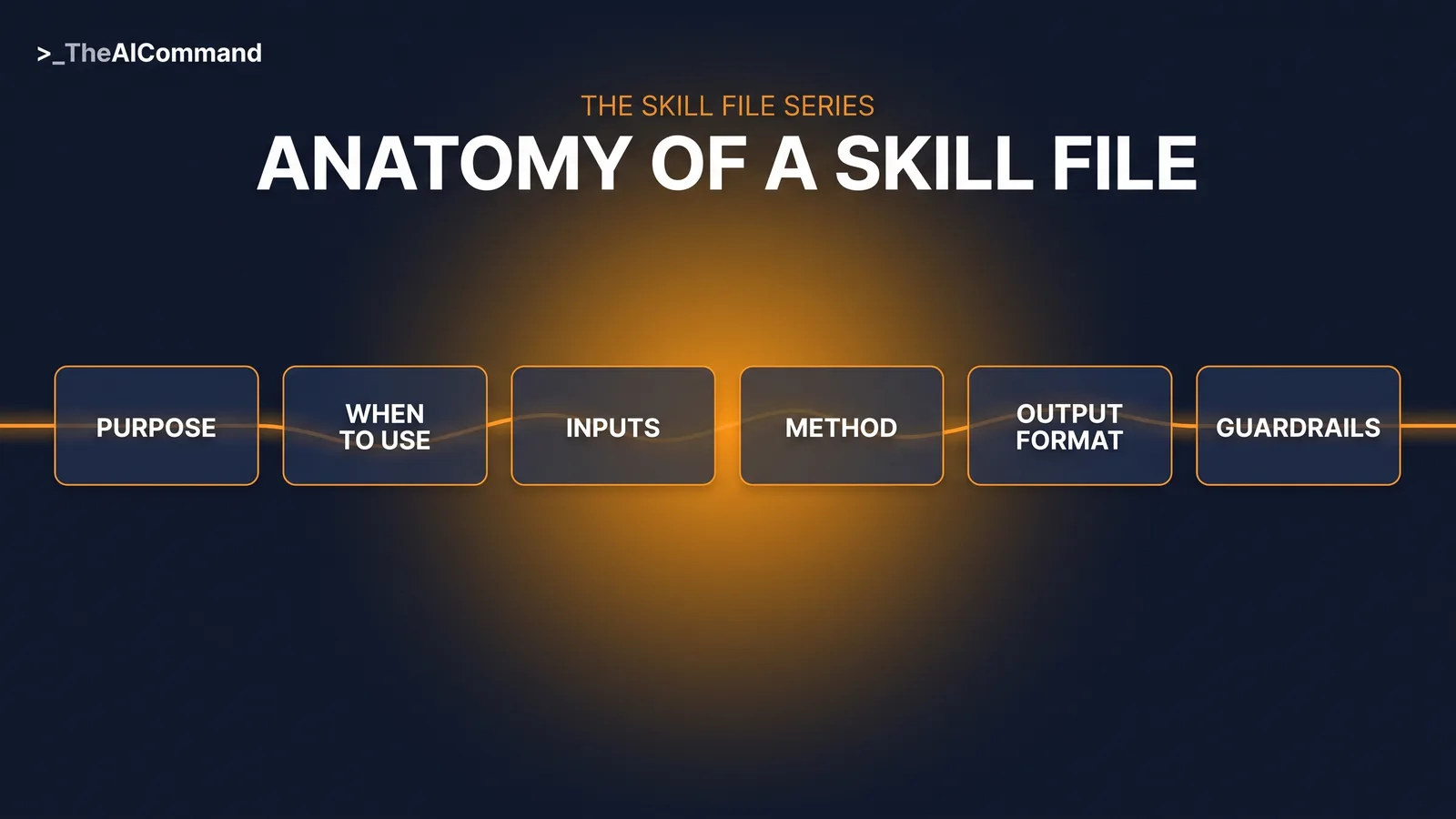
Stacked flow of six labelled blocks, Purpose, When to use, Inputs required, Method, Output format, Guardrails, descending on a deep navy background with a gold accent rule
Six parts, written once, reused every time: the house skill file anatomy.

The incident notification triage skill file

Here is the complete file. Paste it as written, then localise the escalation contacts and your jurisdictions.

Prompt
# Skill: Incident Notification Triage

## Purpose
Structures the first-hour record of a workplace incident and lays the facts
under each notifiable incident question so the accountable person can decide
fast. Produces a structured incident record, a decision-support checklist, a
site and evidence preservation checklist, and a who-has-been-told log. For WHS
practitioners, site managers and duty managers in Australian workplaces. This
skill never decides whether an incident is notifiable.

## When to use
Use immediately after people are safe and immediate risks are controlled, when
the facts need structuring for the notifiability decision and the internal
record. Do NOT use it before urgent calls: if the incident may be notifiable,
the duty to notify the WHS regulator applies immediately on becoming aware,
and no drafting step ever delays that call. Do not use this skill for
investigation findings, root cause analysis, or external communications.

## Inputs required
- Incident facts as known, de-identified (roles, not names): [INCIDENT_FACTS]
- Site or work area: [SITE]
- Date and time of the incident, and of becoming aware: [TIMES]
- Injuries, illnesses or exposures, by role: [INJURIES]
- Plant, substances or structures involved: [PLANT_SUBSTANCES]
- Immediate response actions already taken: [RESPONSE_TAKEN]
- Who has been told so far, and when: [NOTIFICATIONS_SO_FAR]
- Escalation contacts for this site: [ESCALATION_CONTACTS]

## Method
1. Print this line first, verbatim: "If this incident may be notifiable, the
   duty to notify the WHS regulator is immediate. Call first. This document
   waits." Then continue.
2. Structure the record: what happened, where, when, who by role, injuries or
   exposures, plant or substances involved, immediate response taken. Mark
   every unknown as UNKNOWN. Never guess or infer a missing fact.
3. Build the decision-support checklist. Present each notifiable incident
   limb as a question for the decision-maker: death of a person; serious
   injury or illness; dangerous incident; violent incident. Under each
   question, list only the supplied facts relevant to that limb. Answer none
   of the questions.
4. Add a follow-on flags list where the facts suggest them: possible
   extended absence notification, possible suicide notification duty, and
   the duty for the PCBU and the person with management or control of the
   workplace to notify each other.
5. Produce the preservation checklist: preserve the site until released by
   an inspector; preserve evidence including electronic and digital records
   and witness details; note the lawful exceptions (for example assisting an
   injured person, action essential to make the site safe, police direction).
6. Update the who-has-been-told log from the inputs, flagging gaps against
   the escalation contacts.

## Output format
1. URGENCY LINE (verbatim, first).
2. Structured incident record, unknowns marked UNKNOWN.
3. Decision-support checklist: each limb as a question, relevant facts
   beneath, no conclusions anywhere.
4. Follow-on flags.
5. Site and evidence preservation checklist.
6. Who has been told and when, with gaps flagged.

## Guardrails
- Never state, imply, score or estimate whether the incident is notifiable.
  If asked to, refuse and restate that the decision belongs to the
  accountable person, who can seek the regulator's advice when in doubt.
- The immediate notification duty outranks this workflow, always.
- If inputs appear to contain real names or identifying details, stop and
  ask for de-identified facts before producing anything.
- Flag missing facts; never fill gaps with assumptions.
- Every output is a draft for a competent person to verify. Notification
  requirements vary by jurisdiction and change as model law amendments are
  adopted; the accountable person confirms the current position with the
  local WHS regulator.

Worked example: the plant incident

Before the skill. A maintenance fitter is struck by an unsecured load shifting on a forklift tyne. The duty manager, shaken, opens a blank email to the regulator and spends 40 minutes drafting and redrafting while colleagues relay fragments. The record ends up half in the email, half in a group chat, and the question that actually matters, has the regulator been called, goes unasked until minute 41.

With the skill. The duty manager runs the triage skill with the de-identified facts: [WORKERROLE] maintenance fitter, struck by a shifting load, suspected fractured forearm, ambulance called, forklift isolated. The first line of the output is the urgency line, and the site lead phones the regulator inside ten minutes. The structured record marks the load restraint method as UNKNOWN instead of guessing. The checklist lays the suspected fracture and hospital transport under the serious injury or illness question, and the shifting load under the dangerous incident question, and answers neither. The preservation checklist stops a well-meaning supervisor from tidying the tynes before an inspector releases the site. Total elapsed time: minutes, with the call made first and a competent person verifying the record.
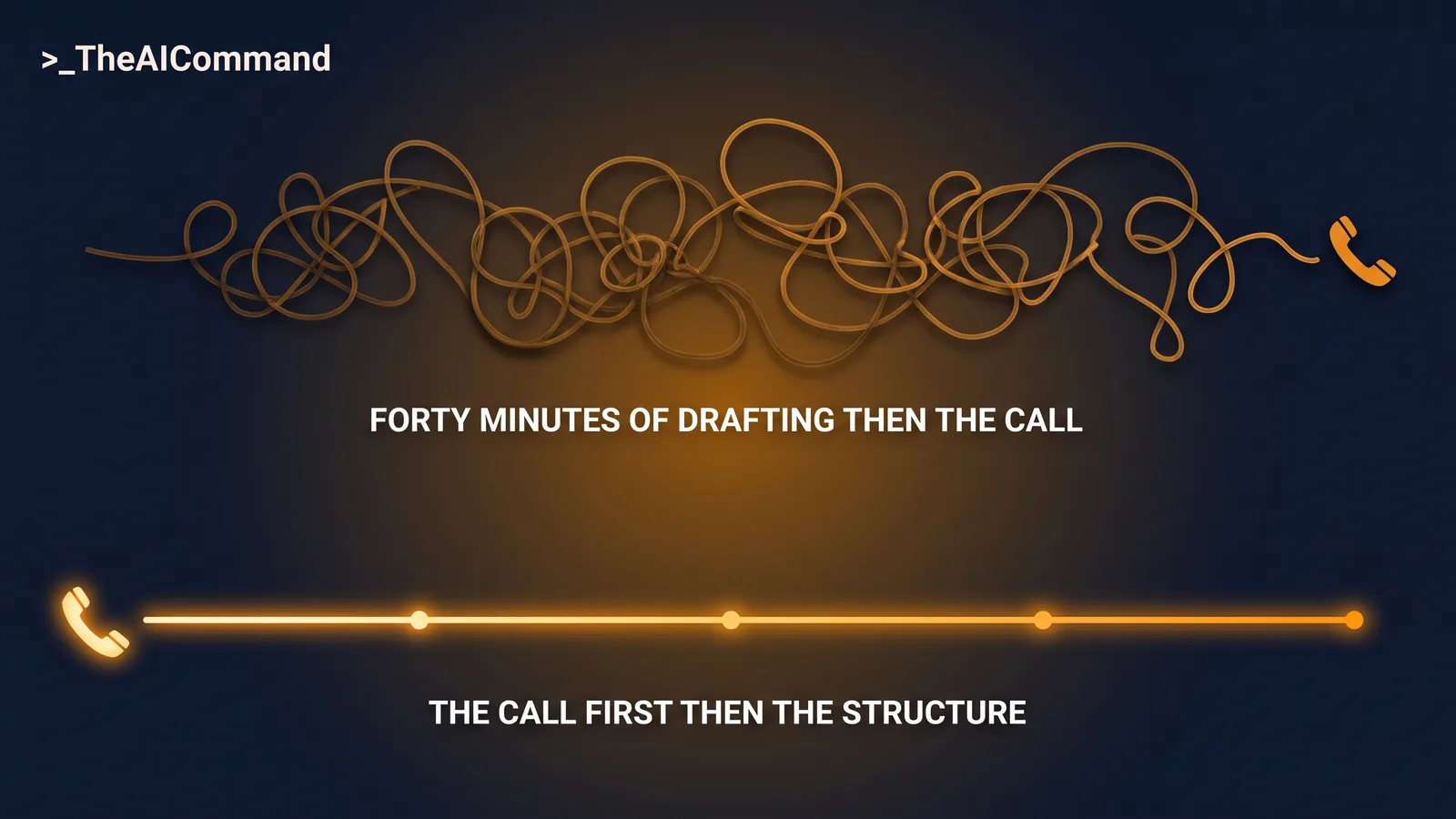
Split before and after timeline, the left path a long tangled forty minute thread ending at a late telephone icon, the right path a short straight sequence where the telephone icon comes first, gold on deep navy
Structure in minutes, decision by a person, and the phone call before the paperwork.

Chain it, and test it against the regulator's scenarios

Two more advanced patterns earn their place here.

Chaining. This skill's output is designed to feed the next one. Once the human decisions are made, the call placed, the site controlled, the structured record becomes clean input for the safety comms skill from Part 4, which drafts the worker-facing alert and toolbox talk intro. The order is not negotiable: triage, then human decisions, then comms. A chain that drafts communications before the notifiability call is a chain built backwards.

Testing. Never let a triage skill meet its first real incident untested. Safe Work Australia's handbook on notifiable incidents, extended absences and suicides is full of worked scenarios: mobile plant events, falls, exposure cases, absence counting examples across rosters. Turn a handful into fictional test inputs and run them through the skill in calm conditions. The test checks two things: that the structure holds, and that the refusal holds. If any test output drifts toward a conclusion on notifiability, the file gets fixed before it is ever used in anger.
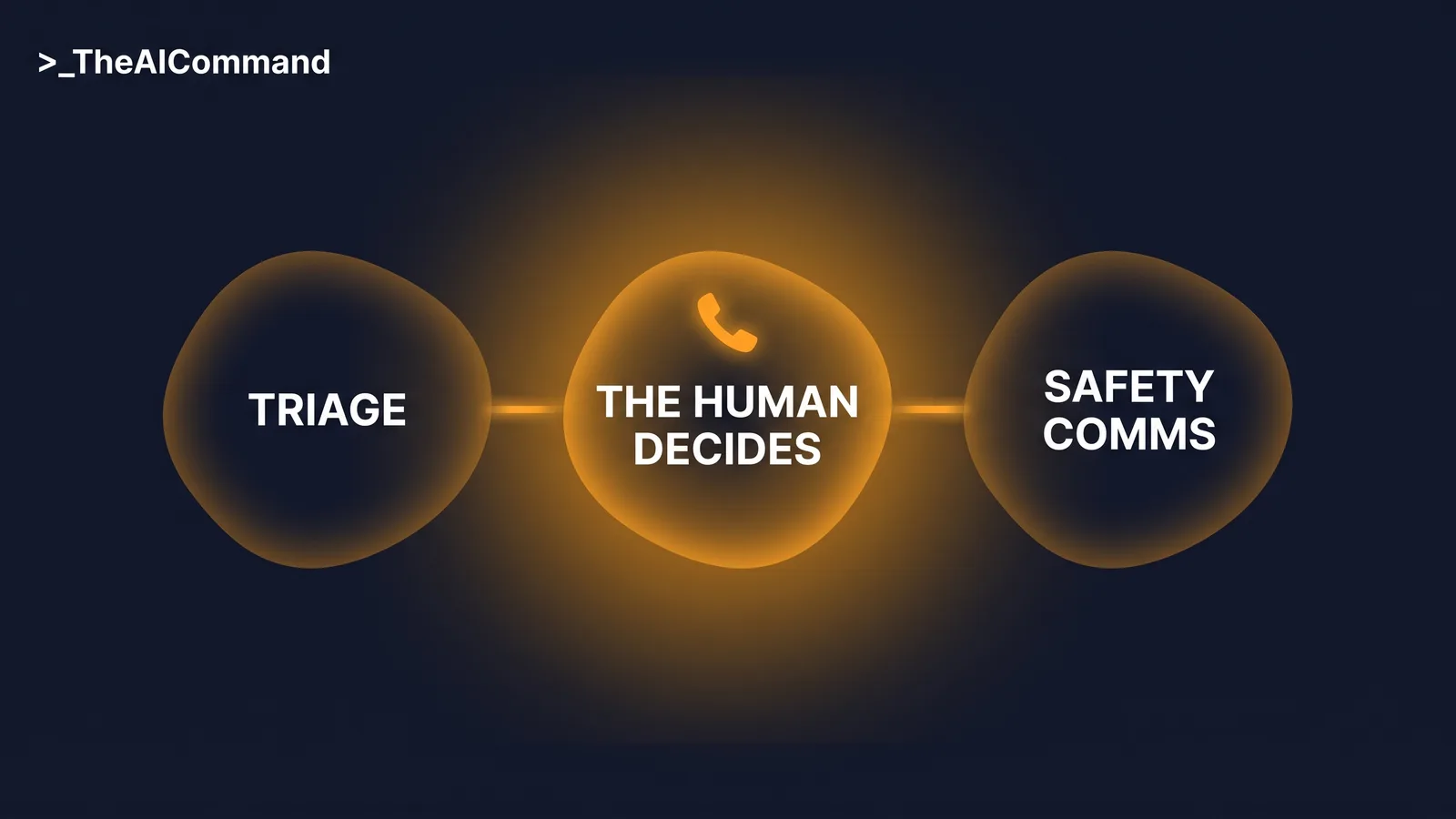
Three connected nodes on deep navy, a gold triage node passing a structured record to a human decision node marked with a telephone, which passes onward to a comms node, with a clear gap between each node
Triage feeds the human decision, and only the human decision feeds the comms skill. The chain never skips the person.

The five-prompt build chain

Build your team's own version with the same five prompts used across this series, written here for incident triage.

Prompt 1, the interview:

Prompt
Interview me to capture how our team handles the first hour after a workplace
incident. Ask one question at a time, maximum ten questions, covering: who is
usually first aware and who is accountable for the notifiability decision;
our escalation contacts; which WHS jurisdictions we operate in; what our
current incident record captures; where past first-hour responses went wrong;
and what must never appear in a tool (real names, identifying details).
Summarise my answers as a workflow map and list any gaps you see.

Prompt 2, the draft:

Prompt
Using the interview summary above and the six-part skill file anatomy
(Purpose, When to use, Inputs required, Method, Output format, Guardrails),
draft an Incident Notification Triage skill file for our team. Hard
requirements: it prints an urgency line first stating that notification
duties are immediate and the call comes before the document; it presents the
notifiable incident limbs as questions with facts beneath and never
concludes notifiability; it marks unknowns as UNKNOWN; it requires
de-identified inputs; and it includes a site and evidence preservation
checklist and a who-has-been-told log. Output the complete file in markdown.

Prompt 3, the test:

Prompt
Stress-test the skill file above. Run it against this fictional scenario and
show the full output: [PASTE A FICTIONAL SCENARIO BUILT FROM A REGULATOR
EXAMPLE]. Then audit your own output against the file's guardrails: did the
urgency line print first, did any sentence state or imply a notifiability
conclusion, were unknowns marked rather than guessed, and were any
identifying details reproduced? List every failure honestly, worst first.

Prompt 4, the refine:

Prompt
Rewrite the skill file to fix every failure found in the test, changing only
what the failures require. For each change, show the old line, the new line,
and one sentence on why. Then re-run the same fictional scenario and confirm
each failure is resolved. Do not weaken the never-decide guardrail or the
urgency line under any circumstances.

Prompt 5, the maintain:

Prompt
Review this skill file as at [DATE]. Check: are the escalation contacts
current; have any of our jurisdictions adopted or amended the model WHS Act
incident notification provisions since the last review (flag for human
verification against the regulator's website, do not assert); do recent
incidents suggest new test scenarios; and does the refusal guardrail still
hold against the latest test run? Output a short change list for the owner
to approve, or state that no changes are needed.

Install it in ChatGPT, Claude or Copilot

On ChatGPT, projects are available on every plan, including Free, and each project takes its own project instructions, which override account-level custom instructions inside that project. Paste the skill file into the project instructions, or upload it as a markdown file to project knowledge, noting ChatGPT treats project files as retrieval-based reference material rather than guaranteed full reads, so the never-decide guardrail belongs in the instructions field. Workspace plans go further: ChatGPT's Skills feature, generally available on Business, Enterprise, Healthcare and Edu, packages the same content as a folder with a SKILL.md manifest that loads only when relevant.

On Claude, this file is already the native shape: a Claude skill is a folder with a SKILL.md file, YAML frontmatter carrying a name and a description, instructions below, loaded by progressive disclosure. Write the description to say what the skill does and when to use it, because that is what Claude matches requests against. Enable Code execution and file creation under Settings, then Capabilities, and upload the folder as a ZIP via Customize, then Skills; skills are available across Claude plans, including Free per the Claude help centre, with code execution enabled, and on Team and Enterprise an organisation owner can provision the skill for everyone. The same format works across the Claude apps, Claude Cowork, Claude Code and the API, installed separately on each surface.

If your organisation runs Microsoft 365 Copilot instead, the same file adapts directly: paste its contents into an agent's Instructions field in Agent Builder, which caps at 8,000 characters, noting Copilot's uploaded knowledge accepts .txt and .docx but not .md.

Guardrails that keep this defensible

Three lines hold the whole design. First, consultation: introduce this skill to the people who will use it, including your health and safety representatives, before an incident, not during one. Second, competent-person sign-off: every output is a draft until a competent person verifies it against what actually happened, and the skill's own guardrails say so. Third, the human decision: notifiability is never delegated, never scored, never nudged. If a vendor, a colleague, or the model itself offers to close that loop, the answer is no, because the accountability cannot move even when the drafting does.

Bottom line

The first hour after a serious incident rewards structure and punishes delay. A triage skill file gives the duty manager a structured record, a fact-lined checklist and a preservation list in minutes, while the two things the law actually demands stay exactly where they belong: the immediate call to the regulator, and the human judgement on whether the incident is notifiable.

Do this Monday:

  • Draft the triage skill with the five-prompt chain above, starting with the interview prompt and your own first-hour workflow.
  • Localise the escalation contacts and name the jurisdictions the file was checked against.
  • Build two fictional test scenarios from Safe Work Australia's handbook examples and run the test prompt until the refusal holds.
  • Walk the duty managers and health and safety representatives through it before it is ever needed.
  • Set a quarterly maintain-prompt review, plus a trigger for any incident notification change adopted in your jurisdictions.

Take it with you

The blank six-part template, ready for any skill:

Prompt
# Skill: [Name]

## Purpose
[One paragraph: what this skill produces, and for whom.]

## When to use
[Trigger conditions. When NOT to use it.]

## Inputs required
[What the user must supply, as placeholder fields.]

## Method
[Numbered steps the AI follows, in order.]

## Output format
[The exact structure of the deliverable.]

## Guardrails
[What the skill must never do. Escalation rules. Verification requirements.]

And the five prompts by name: the interview (capture the team's real workflow first), the draft (turn the answers into the six-part file), the test (fictional scenario, audit the output against the guardrails), the refine (fix only what the test exposed), and the maintain (scheduled review with a change list for the owner).

The Skill File Series

Parts publish daily from 27 July to 7 August 2026; links go live as each part publishes.

  1. The decision memo skill file (Leadership)
  2. A policy-grounded HR query skill file (HR)
  3. A regulatory change impact assessment skill file (GRC)
  4. The safety comms skill file (WHS)
  5. A claim chronology skill file built for de-identification (Workers Compensation)
  6. Who owns your team's skill library? (Leadership)
  7. An investigation chronology skill file with fairness built in (HR)
  8. Skill files are controlled documents (GRC)
  9. An incident triage skill file that never decides notifiability (WHS, this article)
  10. A determination evidence-check skill file (Workers Compensation)

References

  1. Safe Work Australia. Incident notification (managing health and safety topic page). https://www.safeworkaustralia.gov.au/safety-topic/managing-health-and-safety/incident-notification
  2. Safe Work Australia. Handbook: Notifiable incidents, extended absences and suicides (December 2025 update). https://www.safeworkaustralia.gov.au/doc/notifiable-incidents-extended-absences-and-suicides-handbook
This article is general information for Australian workplaces, not legal or work health and safety advice. Incident notification requirements vary between jurisdictions and the 2025 model law amendments apply only as adopted locally, so confirm your duties with the WHS regulator in your jurisdiction and seek advice on your specific circumstances. Never paste real personal, health, or incident data into a model that is not an approved enterprise instance.*

TheAICommand. Intelligence, At Your Command.

Frequently asked questions

What is a notifiable incident under the model WHS Act?
Under section 35 of the model WHS Act, a notifiable incident arising from the conduct of a business or undertaking is the death of a person, a serious injury or illness, a dangerous incident, or a violent incident. The 2025 amendments also added notifiable extended absences of 15 or more consecutive calendar days due to a work-related injury or illness, and notifiable work-related suicides and attempted suicides. Adoption varies by jurisdiction, so check with your WHS regulator.
Can AI decide whether an incident is notifiable?
No. Notifiability is a statutory judgement the accountable person makes, with the regulator available for advice when in doubt. A well-designed skill structures the facts and presents the notifiable incident questions as a checklist for the human. It never outputs notifiable or not notifiable as a conclusion, a recommendation, or a probability.
Does using AI to draft the incident record delay notification?
It must never be allowed to. Under section 38 of the model WHS Act, notice of a notifiable incident goes to the regulator immediately after becoming aware, in the fastest way possible, which can be by telephone, email or an online form where available. The skill file in this article prints an urgency line at the top of every output: if this may be notifiable, call first, the document waits.
What changed in incident notification under the model WHS Act in 2025?
The 2025 amendments extend notification to violent incidents that expose a person to a serious risk of psychological harm, work-related suicides and attempted suicides, and extended worker absences of 15 or more consecutive calendar days due to a work-related injury or illness, and add an express duty to preserve evidence alongside the incident site. Safe Work Australia notes these requirements apply only as each jurisdiction adopts them, so check with your WHS regulator.
Why build this as a skill file instead of a saved prompt?
Because the first hour of an incident is the worst time to be writing instructions. A skill file captures the structure, the guardrails, and the never-decide rule once, is tested against fictional scenarios in calm conditions, and then runs the same way every time under pressure, on whichever platform your team uses.

For practitioners

Use the triage skill to structure the incident record and lay the facts under each notifiable incident question. Do not let it, or anyone, treat its output as the notifiability call. That judgement belongs to the accountable person, and if the incident may be notifiable the phone call to the regulator comes before any drafting. Structure from the file, decision from a person, call first.

For governance leads

Treat this skill file as a governed artefact: one owner, a version number, a test record against fictional scenarios, and a review trigger tied to WHS law changes in your jurisdictions. The 2025 model law amendments on violent incidents, suicides, extended absences and evidence preservation apply only as adopted locally, so the file must name the jurisdictions it was checked against and when. Keep notification records for at least five years, and keep the test outputs too.

Primary sources

WHS provisions referenced

Model WHS Act, section 35 (notifiable incident: the death of a person, a serious injury or illness, a dangerous incident, a violent incident)Model WHS Act, section 36 (what is a serious injury or illness) and section 37 (what is a dangerous incident)Model WHS Act, sections 35A, 35B and 37A (notifiable extended absence, notifiable suicide, violent incident, introduced by the 2025 model law amendments, applying as adopted in each jurisdiction)Model WHS Act, section 38 (duty to notify the regulator immediately after becoming aware; written notice within 48 hours if required; record kept for at least 5 years under section 38(7))Model WHS Act, section 39 (duty to preserve the incident site and evidence) and section 39A (duty holders to notify each other)
WHSSkill FilesIncident NotificationNotifiable IncidentsAI GovernanceSafety SystemsThe Skill File Series
← Back to WHS & AI

Content disclaimer: This article is for general educational purposes only and does not constitute legal advice, WHS advice, or a substitute for professional judgement. Work health and safety duties, including psychosocial duties and incident notification duties, vary by jurisdiction under the model WHS laws (with Victoria, Western Australia, and the Comcare scheme differing). Risk ratings, controls, and notifiability decisions must be made by a competent person. All AI outputs described in this article require human review before use.