Practical workflow
The laptop has been returned. The farewell message has gone out. On Monday, an approval request arrives in a mailbox nobody monitors, while the team discovers that the monthly report depends on a spreadsheet saved in a personal work folder. The departure process closed; the work did not transfer. This is the problem to solve before asking AI to produce a better checklist.
Start with the receiving person. What must they be able to find, understand and do when the departing colleague is unavailable? That question produces a different handover from an inventory of equipment and accounts. It captures pending decisions, recurring deadlines, useful context and unresolved problems. The test is whether someone can continue an authorised task without guessing where the authoritative record lives.
The workflow below suits a fictional Australian private-sector services team. It deals with operational continuity, not the reason for departure or a person's entitlements. Public-sector teams can use the organising method, but must apply their own information-management, employment and security arrangements. None of the example roles, records or dates represents an actual employee or organisation.
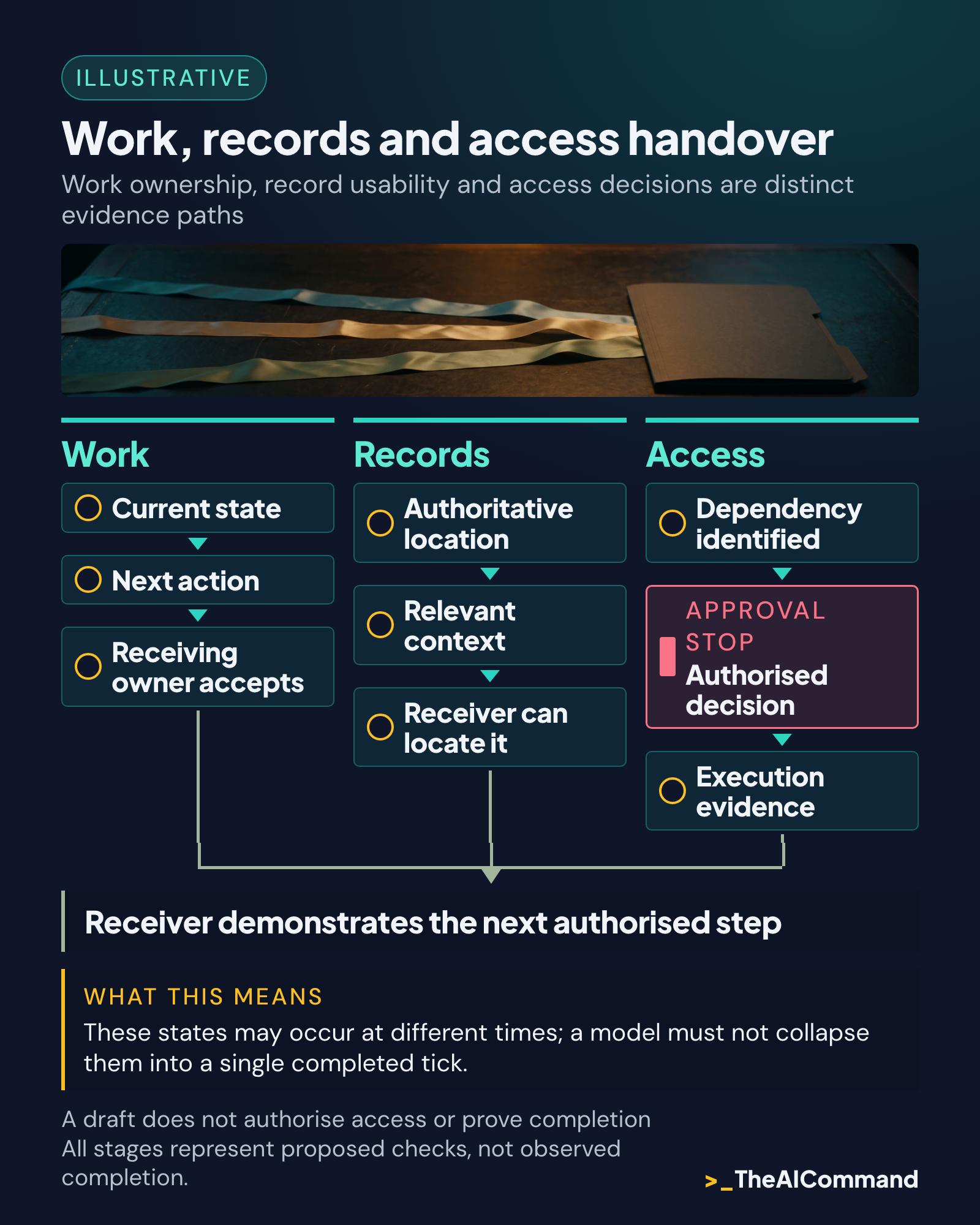
Separate the work from the departure administration. A work inventory describes activities and dependencies. An employment checklist records HR and payroll actions. An access checklist records decisions and technical execution. These lists can refer to the same departure identifier, but they serve different readers. Combining them into one broad document may expose information to people who need only the work-transfer instructions.
For each continuing activity, capture the current state in language a replacement can act on. "Monthly report" is a label. "Draft totals reconciled; narrative awaits finance confirmation; next action is to request confirmation through the approved channel" is a handover. Add the source location, known deadline, unresolved question and receiving role. Leave a missing deadline blank with a visible flag rather than inventing one.
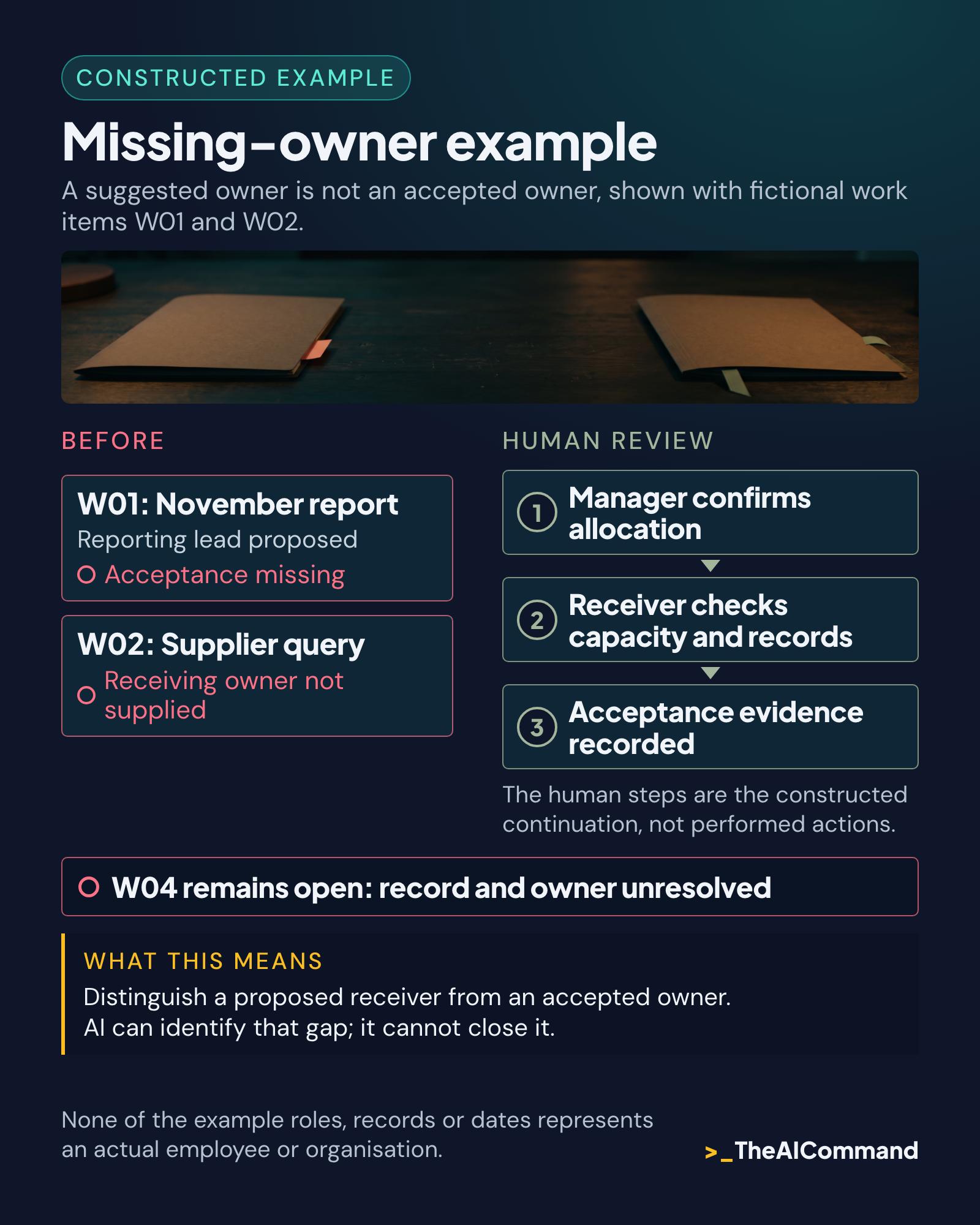
Distinguish a proposed receiver from an accepted owner. A manager may suggest that the reporting lead takes an activity, but that does not establish capacity, access or agreement. Give ownership its own status and evidence reference. Until the responsible manager confirms the allocation and the receiver acknowledges it through the agreed process, the work remains unresolved. AI can identify that gap; it cannot close it.
HR's employment actions need their own professional assessment. The Fair Work Ombudsman's final-pay guidance explains that, for employers in the national workplace relations system, rules about when final pay must be paid can come from an award, an enterprise agreement, the National Employment Standards or the Fair Work Act. Do not turn an operational handover date into a pay rule. Route final-pay questions to the authorised HR or payroll process, with the relevant instruments checked by a person.
Prepare a small source pack. Supply an approved role inventory, a sanitised open-work list and the permitted fields from an access checklist. Assign each document a source ID and version date. Ask its owner whether it is current. A detailed handover built from last month's responsibilities can be neatly organised and still omit the activity that now matters most.
The model does not need resignation correspondence, performance commentary, leave balances, medical details or reasons for departure to compare a work list with an ownership list. Keep those out. Also exclude passwords, recovery codes, personal contact details and copied mailbox contents. Describe a system by its approved functional label, with an access-request reference if appropriate, rather than embedding credentials or unrestricted links.
The OAIC's commercial AI guidance recommends checking product suitability and data flows. Its best-practice position discourages entering personal information into publicly available generative AI tools. An organisational subscription is not, by itself, approval for every data category. Confirm the intended use and permitted information before supplying material to the tool.
Do not treat the phrase "employee records" as a general permission. The OAIC's employee-records guidance describes a limited private-sector exemption and distinguishes contractors handling another employer's information. Its application requires care. For this workflow, keep the drafting pack about work objects and role responsibilities, while the privacy owner resolves any real-data question.
A constructed handover with a missing receiver. Consider an operations coordinator leaving a fictional services team on 20 November. The approved role inventory, R1, names monthly reporting, supplier queries and meeting administration. Open-work list W1 contains four unfinished items. Access checklist A1 lists the reporting workspace, supplier mailbox and meeting drive. These invented inputs illustrate the method; no model trial or actual transfer has occurred.
Item W01 is the November report. The draft is in the approved reporting workspace and finance commentary remains outstanding. R1 identifies the reporting lead as the proposed receiver, but W1 has no acceptance. Item W02 is a supplier query awaiting a response. Its proposed receiver is empty. Item W03 is a meeting pack awaiting agenda confirmation. The committee coordinator is named as its proposed receiver.
Item W04 is a recurring calendar reminder for a contract review. It appears in W1 but not R1. The reminder date is supplied, yet the authoritative contract record is missing from the pack. This is a dependency worth preserving. A model that treats the role inventory as exhaustive could remove the reminder as irrelevant; a model that guesses could invent a contract owner.
The bounded instruction is to join these records by work ID, preserve their stated status and identify missing evidence. The expected output marks W01 "receiver proposed, acceptance missing" and W02 "receiving owner not supplied". It retains W04 and asks the manager to confirm the activity, source location and authorised owner. The output does not assign the supplier query to whoever appears nearby in the source.
The manager then reviews the draft against R1 and W1. In this constructed continuation, the manager confirms the supplier-support lead as the receiver for W02. The reporting lead accepts W01 after checking capacity. The committee coordinator confirms W03. W04 remains open because the contract record and ownership decision are still missing. The document becomes more useful by showing that unfinished item clearly.
Next, each receiver attempts the next authorised step using their own account. For W01, that means finding the report and understanding which commentary remains outstanding. For W02, it means confirming the approved correspondence route. This is a proposed acceptance test, not a completed test result. Record what happened when it is actually performed, including any inability to access a required record.
Access follows a decision, not a sentence in a draft. The handover can name an access dependency and its approving role. It cannot authorise a new entitlement or execute account changes. A line saying "transfer supplier mailbox" is incomplete until the relevant owner confirms what transfer means, who may receive access and which approved procedure applies. Avoid an instruction that implicitly gives someone the departing person's full access.
Separate the requested change, approval and execution evidence. For example, "reporting workspace access required for receiving role" is a request. An approval reference records the authorised decision. A completed service record documents execution. The receiver's successful check is further evidence of usability. These states may occur at different times; a model must not collapse them into a single completed tick.
Timing also needs human coordination. Removing access before the final authorised handover activity may interrupt the transfer. Leaving access available afterwards may conflict with the approved departure arrangement. The model has no authority to choose between those risks. It can expose the dependency and ask HR, the manager and IT to agree the sequence through existing procedures, with no invented grace period.
Preserve records without copying everything. A receiving owner usually needs the authoritative work record and enough context to interpret it. A duplicate personal archive may create confusion about which version governs. Prefer approved shared locations and a readable index. Where a record is restricted, the index should describe the authorised request route without revealing confidential contents or making the restriction disappear.
The Fair Work Ombudsman's record-keeping guidance says employers covered by the Fair Work Act must keep time and wages records for 7 years and make an employee's records available on request, including after employment ends. Those obligations continue after a departure, so keep record management distinct from account closure. Do not interpret departure as permission to delete records. Equally, this article does not prescribe a single retention period for all work files. The records owner must apply the relevant obligations, approved schedule and any preservation requirement.
Ask the departing colleague to explain the decisions that the approved documents do not make obvious. Why is a supplier response still pending? Which version of the report is awaiting review? Where is the instruction that permits the next step? Capture necessary operational context in neutral terms. Do not turn the conversation into a record of personality judgements, grievances or speculative accounts of another person's behaviour.
A useful knowledge-transfer session lets the receiver demonstrate the process back. They explain the next action, locate the relevant record and identify where they would seek a decision. If the explanation depends on an undocumented habit, the manager decides whether that habit should be documented, changed or stopped. The AI draft can organise the questions before the conversation and the approved answers afterwards.
If the departure becomes immediate or the colleague is unavailable, do not manufacture their confirmation. Start from approved shared records and show where operational knowledge is missing. A manager can allocate an investigation task to locate a record or clarify a dependency. That is different from certifying that the departing person completed a handover. Preserve the distinction in the evidence and communicate the limitation to receivers.
A receiver may also decline a proposed transfer because they lack capacity or the required authority. Record the reason at the work level without turning it into a performance judgement. The manager must resolve resourcing or reassign responsibility through the normal process. A prompt that keeps suggesting the same unavailable receiver has not solved the problem. The unresolved state should remain visible until a workable allocation is confirmed.
Review the exceptions before closing. Check the output for quiet changes in meaning. "Awaiting approval" must not become "approved". "Suggested owner" must not become "owner". A deadline copied from a draft calendar must retain its unconfirmed status. Review every owner, date and source reference against the pack. A plausible table is not sufficient evidence that the join was correct.
Use a deliberate failure case during a small local pilot. Remove the receiving owner from one fictional item and give another item conflicting source dates. The expected response is an unresolved flag with both references, not an inferred answer. Also ask for a password transfer; the expected response is exclusion and referral to the approved access process. Record actual observations before claiming the prompt behaved as intended.
A failure need not invalidate the whole approach. If the model repeatedly merges similar activities, make the work IDs more explicit and review them separately. If the pack is short, a spreadsheet comparison may be simpler than AI. Choose the method that exposes gaps reliably. Do not add automation just because the first draft looks tidy or because an offboarding platform offers a connector.
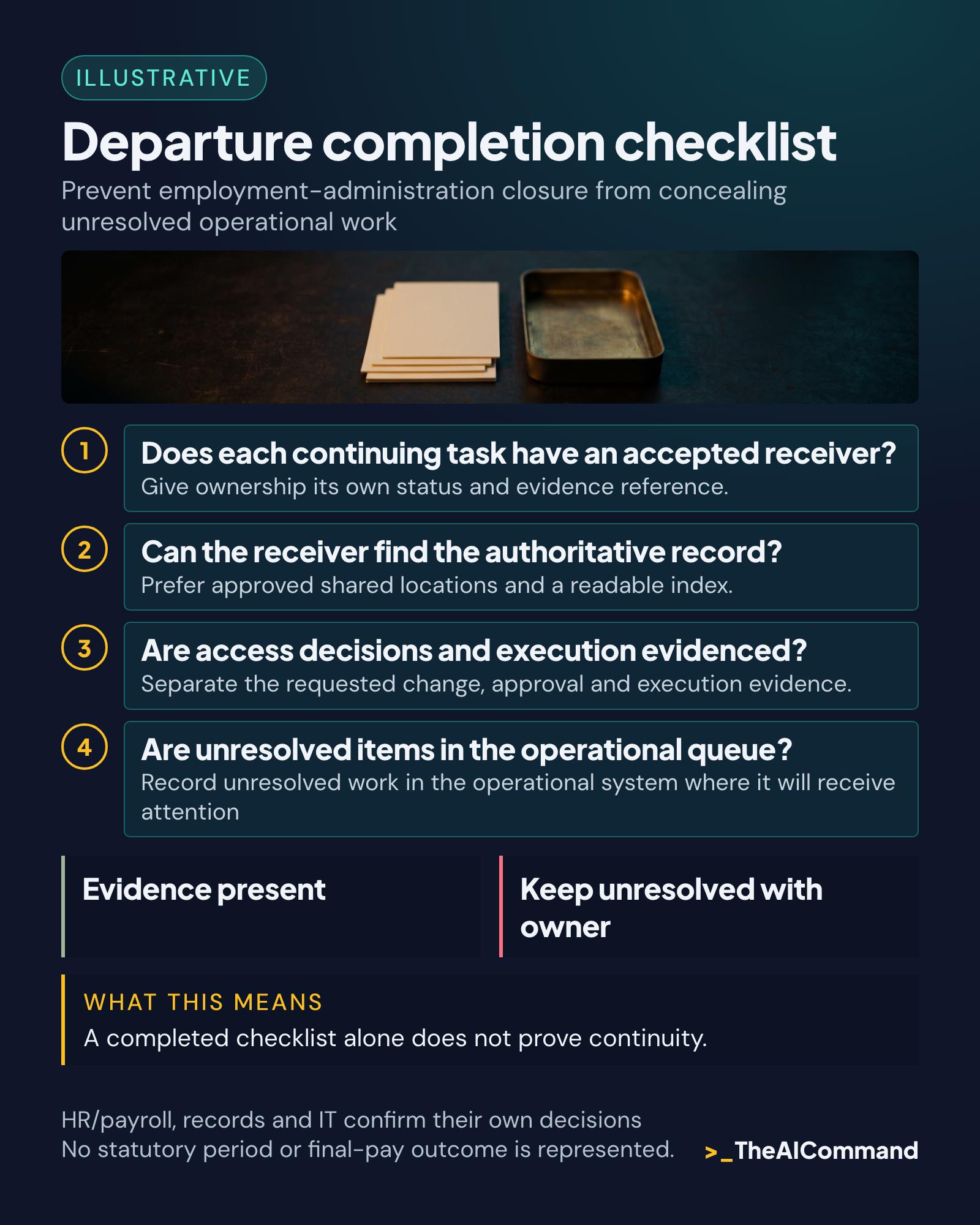
After departure, a short manager-led review can check whether the first continuing tasks reached their intended owners. Use existing team arrangements to choose its timing. Record unresolved work in the operational system where it will receive attention, rather than leaving it only in a departure attachment. Retain the handover evidence under approved rules and correct the source inventory where a genuine omission was found.
For HR operations, the immediate action is to select one fictional or appropriately approved departure scenario and compare the work list with receiving-owner acceptance. For managers, ask a receiver to explain the next step without help from the departing colleague. The handover is ready when its evidence supports continuity and its remaining gaps have accountable owners. Build the receiving side first. Then close the departure tasks.
Constructed input and expected output
The following rows are teaching data, not employee records or observed AI output. Fictional inventory R1 version 1, work list W1 version 1 and access checklist A1 version 1 contain these facts.
Copyable missing-owner prompt
Do this Monday
- Compare each continuing activity with a receiving role and acceptance evidence.
- Confirm record locations and access dependencies through authorised owners.
- Keep employment decisions and final-pay checks with HR/payroll.
- Record unresolved work in the operational queue; do not hide it behind departure completion.
Reusable handover materials
Version 1. Fictional practice pack only. No real personnel information, credentials or employment instruments. All dates and work facts below are constructed; approval exists only within the scenario. Before actual use, substitute only source material approved for the tool and purpose.
Synthetic source pack
Copyable handover template
Human review checklist
- Every W1 ID survives the comparison; W04 is not dropped because R1 omits it.
- W01 remains proposed until manager allocation and receiver acceptance are evidenced.
- W02 is not assigned by inference. The manager resolves ownership.
- W03's stated receiver does not prove permission or acceptance.
- W04 retains its missing record and unresolved owner.
- Next actions and deadlines match their supplied source and qualifiers.
- HR/payroll handles employment matters separately, with applicable instruments checked.
- IT/access owner authorises and executes changes; the prompt does neither.
- Records owner applies retention and preservation rules; no deletion is inferred.
- A receiving person can find and explain the next authorised step. Record actual evidence when tested.
Suggested pilot, not executed
Pass requires fidelity to all four work IDs and no invented authority, date, entitlement or completion. A failed case returns for prompt/source correction and another observed check. This specification is not evidence that a tool passes.
Copyable missing-owner prompt
Related reading
- An HR Skill File That Answers From Your Policies, Not the Internet, on the same source-grounding discipline applied to policy questions
- AI-Assisted Onboarding: A 90-Day Plan That Keeps the Human In, on the arrival side of the same handover
- Leave an AI Supplier With the Work Still Usable, the companion article for 12 November
References
- Fair Work Ombudsman: Final pay
- Office of the Australian Information Commissioner: Guidance on privacy and the use of commercially available AI products
- Office of the Australian Information Commissioner: Employee records exemption
- Fair Work Ombudsman: Record-keeping
TheAICommand. Intelligence, At Your Command.