The process document says the coordinator now checks AI-assisted summaries against source records. The job description still says the coordinator manually compiles the weekly report. A manager's email adds that the same person might soon approve the report. Three documents describe three different roles, and the neatest version is not necessarily the authorised one.
Updating the description starts with resolving those differences. AI can help compare text and prepare a proposed revision, but the task is not simply to modernise the wording. Each changed responsibility needs a source, a status and a person who can decide whether it belongs. Otherwise the revision can turn an informal suggestion into an apparently settled employment expectation.
This article uses a constructed private-sector Australian example. The documents, decisions and sample output are fictional. They are not drawn from an employee record or an observed AI test. The method is a recommended document-maintenance workflow, not a determination of any person's employment rights, obligations or classification.
Separate a changed process from a changed role
An approved technology process can change how a task is performed without settling every question about the role that performs it. Replacing manual collation with a summary tool might leave the purpose of the role intact while adding checking work. Giving the coordinator final approval authority would be a different decision, with different implications for accountability and potentially employment arrangements.
Read the old description for its boundaries before changing its verbs. Who prepares the work? Who checks it? Who approves it? Who resolves an exception? A sentence such as "support the reporting process" may conceal those distinctions. Ask the manager to describe the actual task and its limits, then locate the evidence that supports the proposed description.
Keep two questions open when practice and documentation disagree. What is happening now, and what has been authorised? A recurring practice is relevant evidence of work being performed. It is not automatic proof that every necessary decision, consultation step or employment review occurred. Record the discrepancy and seek the appropriate review rather than writing it out of existence.
The earlier article on AI upskilling and work redesign makes the broader case for examining tasks and judgement. This workflow addresses the maintenance work that follows: identifying the source for a specific proposed responsibility, showing what changed and keeping unresolved decisions out of confirmed wording.
Establish the baseline and the evidence packet
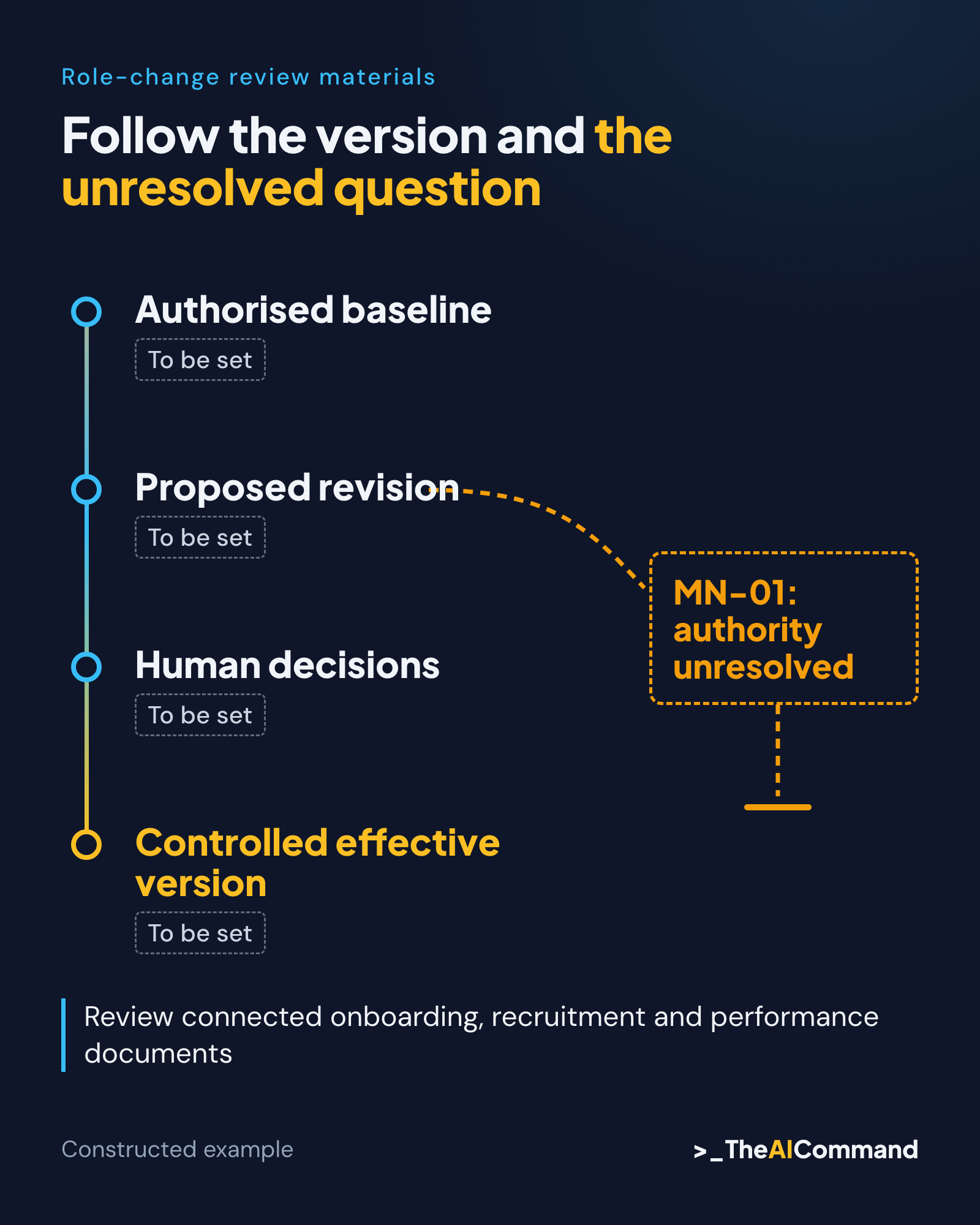
Find the current authorised description and identify its version, owner and effective date. Do not assume the most recently emailed attachment is the baseline. A draft used in a meeting can have a later timestamp than the current approved document. If authority is unclear, resolve it before asking the model to choose between competing versions.
Build a short evidence packet rather than uploading everything connected to the employee. Include approved process changes, relevant responsibility maps and the specific role text under review. Use the minimum organisational information permitted by the approved AI arrangement. The teaching example needs only fictional role labels and fabricated documents, with no employee names, performance history or health information.
Give each item a clear status. An approved process note can support a proposed wording change. An unconfirmed manager note can identify a question. A staff observation can reveal a mismatch requiring investigation. These are useful but different forms of evidence. Putting all of them in one folder does not make their authority equal.
Add the scope of each approval. A process owner may approve how a report is prepared without having authority to change reporting lines or employment conditions. Record what the decision actually covers. This prevents the phrase "approved change" from becoming a shortcut that conceals who approved what and whether the role consequences were considered.
Work the example through one clause
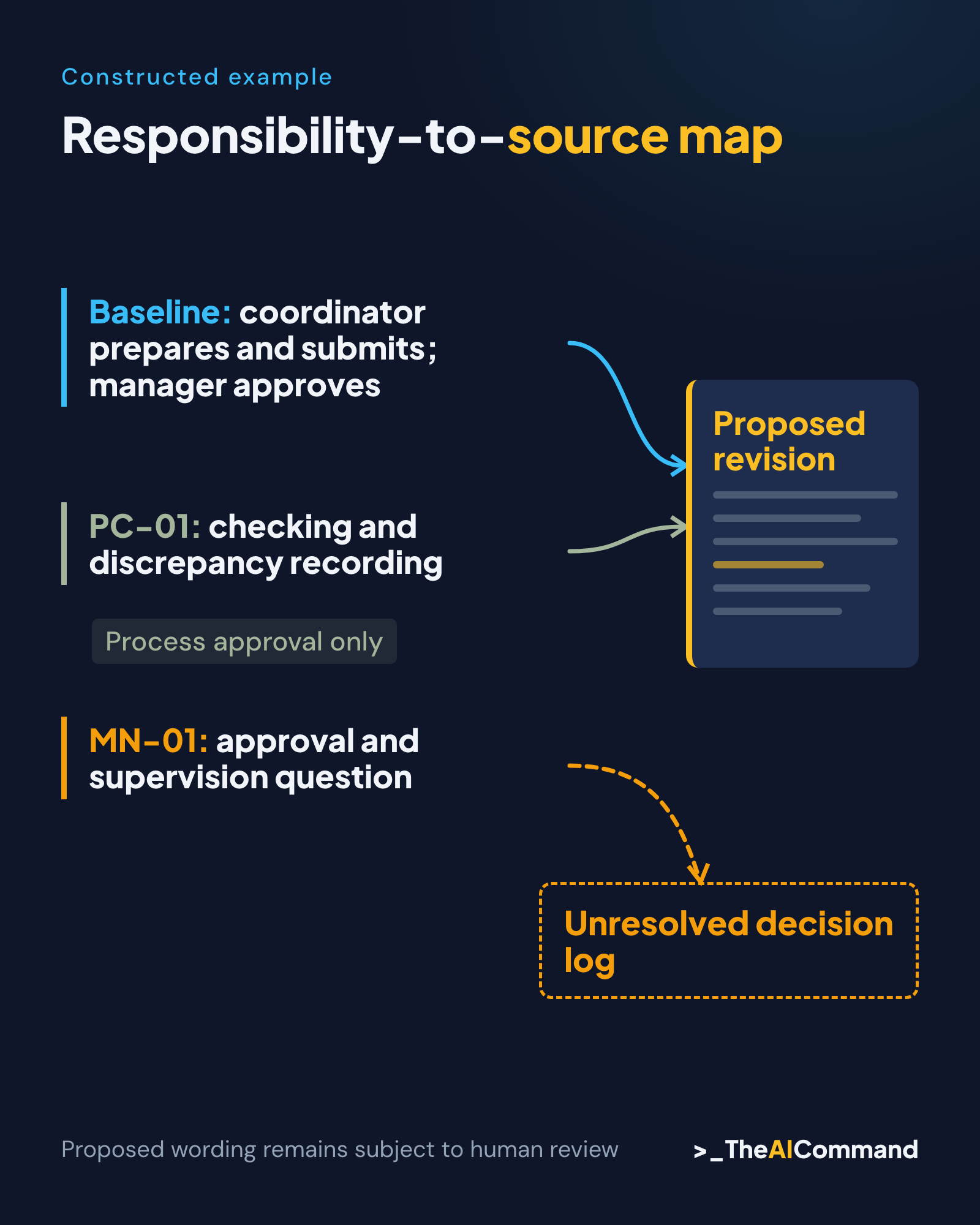
The fictional baseline describes an operations coordinator who prepares a weekly service summary from approved records and submits it to the operations manager. The manager approves circulation. A constructed process change, PC-01, introduces an approved summary tool and requires the coordinator to compare draft statements with the source register, recording discrepancies for the manager.
A separate unconfirmed note, MN-01, asks whether the coordinator could approve final summaries and supervise a temporary team. That note belongs in the packet because it explains a live proposal. It does not belong in the accepted role wording. The model's task is to expose the difference, including the evidence and decisions still missing.
A supported proposed clause is: "Prepare the weekly service summary using the approved summary tool and check each draft statement against the source register. Record discrepancies for the operations manager and submit the summary to that manager for approval." The source-to-edit record points to PC-01 for the changed method and the baseline for retained submission. The existing clause that reserves final approval to the manager remains visible and unchanged.
An unsupported alternative is: "Lead the reporting function, approve all summaries and supervise the temporary team." This changes both responsibility and authority. It cannot be justified by PC-01 and depends on MN-01 being treated as an approved decision. The appropriate result is to reject the addition from the proposal and retain it as a question for the decision-maker.
In the constructed review record, the checking clause is marked "Supported for proposed revision". The approval and supervision additions are marked "Excluded; authority unresolved". Neither status means the revised job description has taken effect. The example deliberately stops before consultation, employment assessment and final approval, because none of those steps has occurred.
Constructed source-to-edit record
Review the meaning of each changed verb
AI can make a description sound more professional by substituting stronger verbs. "Assist" becomes "manage"; "prepare" becomes "approve"; "coordinate" becomes "lead". Those changes may read well while materially altering the job. Require the reviewer to explain each changed verb against the source, including who remains responsible for decisions and escalation.
Be equally careful with deletions. Removing a reference to checking or escalation can make a role appear more autonomous without adding any new duty. A revision that shortens a paragraph may remove the very boundary that keeps it accurate. Review removed wording with the same attention as new text and retain the reason for any substantive deletion.
Check how the new clause interacts with the rest of the description. Does the purpose statement still fit? Does the reporting line remain accurate? Are there duplicate responsibilities under another heading? Do selection criteria ask for capabilities the revised work does not need? Record these questions as targeted review items instead of permitting an unrestricted rewrite.
The Australian Human Rights Commission's recruitment guidance recommends clear descriptions of duties and skills, distinguishing essential from desirable criteria. That is a useful drafting discipline when a maintained description will later support recruitment. It does not mean an AI language check can certify that the description meets every applicable discrimination requirement. Commission recruitment guidance.
Keep employment decisions outside the drafting shortcut
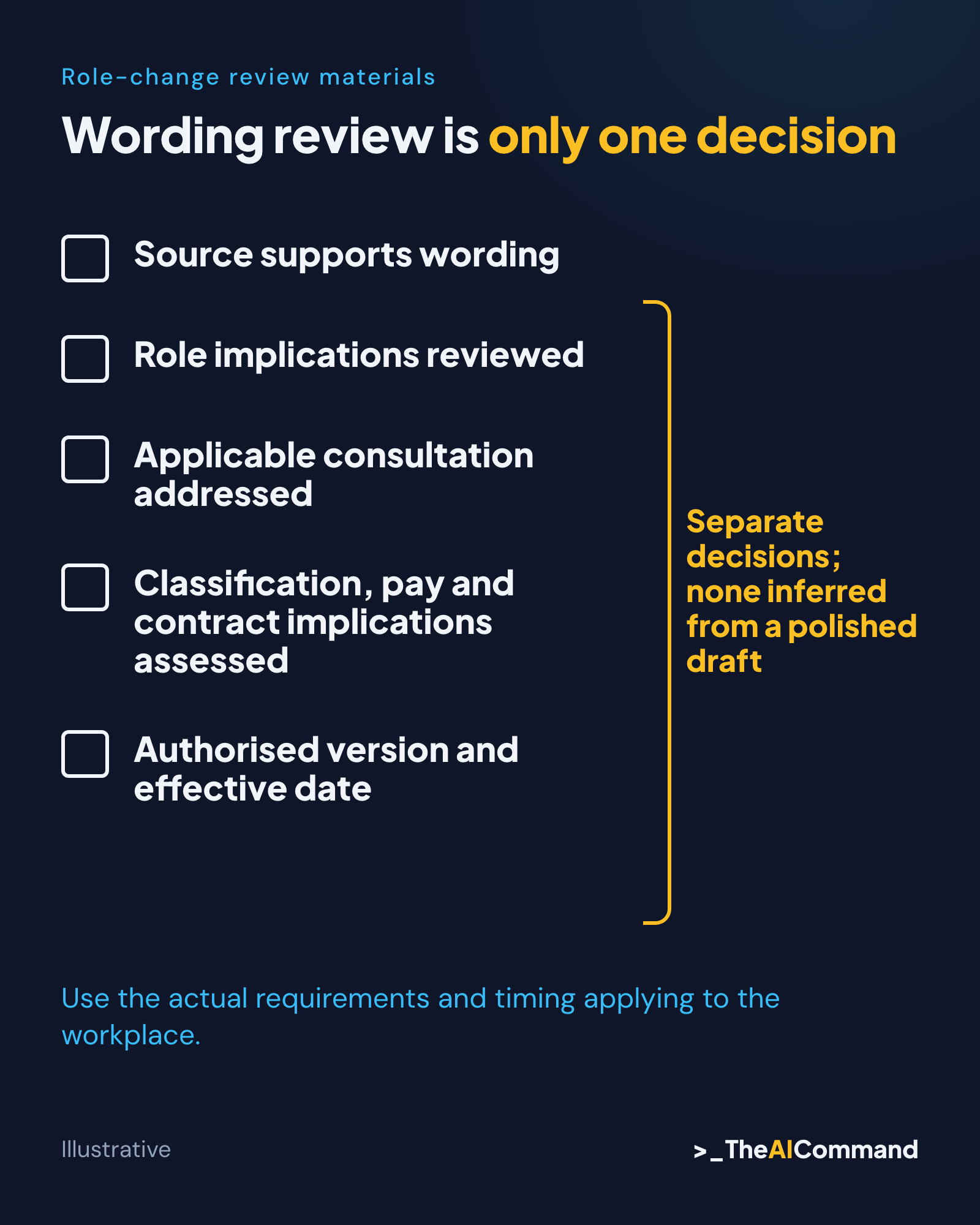
The Fair Work Ombudsman explains that award classifications depend on the relevant classification descriptions and factors including duties, responsibility and required skills. Job titles and job descriptions alone do not settle the question; the guidance says to compare the duties actually performed with the classification definitions. A responsibility change therefore warrants the appropriate classification review where an award applies. This article does not select an award, classification or pay rate for the fictional role, and assumes a national system employer; some employers, including Western Australian sole traders and partnerships and state public sector employers, are covered by state systems instead. Fair Work Ombudsman: award classifications.
Do not ask the drafting model to infer that the existing classification remains correct simply because the title is unchanged. Equally, do not assume every wording update requires a higher classification. The employment specialist needs the actual duties, applicable instrument and relevant circumstances. Keep that assessment separate and record its outcome only when it has actually been made.
Consultation is another distinct question. The Ombudsman's guidance explains that consultation requirements come from legislation, awards and enterprise agreements, including award clauses for major changes likely to significantly affect employees, and recommends reading the clauses in the applicable award or registered agreement. Determine the applicable requirements and timing before implementing a substantive change. A completed comparison table or a manager's approval of wording does not prove that the required process occurred. Fair Work Ombudsman: consultation and cooperation.
Do not convert silence, attendance at a meeting or a received email into consent. Record what happened accurately: a draft was supplied, feedback was invited, a concern was raised, or a decision was communicated. Whether agreement is required and what it means in the circumstances is a separate employment question. The model cannot answer it from the mere presence of a document.
The same boundary applies to contracts, remuneration and work arrangements. A revised description may have implications that need assessment; it does not authorise the assistant to vary terms or create an effective date. Leave decision fields blank or explicitly unresolved until the authorised person supplies the outcome. A complete-looking form is less useful than a truthful incomplete record.
Ask whether a new requirement is actually necessary
When technology changes a task, managers may propose broad capabilities such as "advanced AI expertise". Ask what observable work requires that capability. In this example, the coordinator needs to compare statements with records and escalate discrepancies. A specific description of those actions is more useful than an inflated credential that nobody has connected to the role.
Review additions that describe a preferred way of working as though it were essential. The Commission's disability recruitment guidance advises against including non-essential requirements in position descriptions. Apply that distinction carefully when reviewing the proposed document, while keeping any individual adjustment discussion in the appropriate confidential process. Commission guidance on accessible recruitment.
For example, "check the source register and record discrepancies" describes the work outcome. Requiring a particular personal style, unrestricted availability or familiarity with an unapproved tool would need its own justification and review. Ask the model to flag unsupported requirements, not to decide which legal exceptions or adjustments apply. The human reviewer must resolve those matters using the relevant evidence.
Also check the workload implied by the new description. Adding verification duties while retaining all old duties can describe more work than the process design contemplated. The model can identify overlapping tasks or an unexplained addition. It cannot establish that the workload is reasonable or that sufficient training and support exist. Put those questions to the people responsible for the work.
Give competing accounts of the work a place in the review pack. If a manager says a task occurs weekly but the approved process says monthly, the model can show the discrepancy and identify both passages. It cannot select the convenient frequency and treat the disagreement as resolved. Ask the process owner to clarify the intended work and the document owner to record the decision.
That clarification may reveal that the process itself needs review before the description can be updated. Keep the dependent clause open rather than approving a temporary compromise without authority. A traceable hold is a useful output: it identifies the missing decision, its owner and the proposed wording affected. The drafting task has still helped by narrowing the question that people need to answer.
Preserve the decision trail through release
A review pack should let someone reconstruct the proposal without reopening the chat. Keep the baseline, proposed description, source-to-edit log and unresolved questions together under the organisation's approved records arrangements. Identify the reviewer and decision-maker by the appropriate internal roles. This is a recommended control for the workflow, not a universal statutory retention prescription.
Separate proposed, reviewed and effective states. A reviewer may confirm that the wording accurately reflects PC-01 while another employment issue remains open. Record that limited finding. Do not mark the whole description approved because one reviewer has finished one part of the assessment. The release decision needs the actual outstanding matters resolved by the appropriate people.
After approval, the document owner establishes the controlled version and effective date, then reconciles connected documents within the authorised scope. A recruitment template, onboarding plan or performance framework may still contain the old wording. Identify those dependencies for human action. Do not let the drafting assistant update every connected system merely because it can see the files.
Start the next review with one changed responsibility and its source. Ask the manager to explain the work, ask HR to identify the decision boundaries, and ask the assistant for a traceable proposal. A job description is useful when it accurately describes authorised work and leaves unresolved decisions visible. Keep that standard intact through every revision.
Copyable proposed-edit prompt
Role-change review materials
All filled examples are constructed. They contain no real employee data and record no actual consultation, approval or AI test. This log is recommended review practice, not a prescribed statutory form.
Copyable source-status register
Role-change log template
Constructed worked entries
Proposed-edit prompt
Human review questions
- Is this the actual authorised baseline, and does each source have a known status?
- Does the approval cover process, role scope, employment terms or only wording?
- Do changed verbs add authority, supervision or a new responsibility?
- Have deletions removed approval or escalation boundaries?
- Are necessary criteria distinguished from preferences?
- Who assesses applicable consultation, award/agreement, classification and contract issues?
- What remains disputed about actual work or workload?
- What evidence permits final approval and an effective date?
Proposed acceptance checks
- PC-01 supports the checking clause and is cited precisely.
- MN-01 approval/supervision requests remain outside proposed accepted text.
- No fabricated employee agreement, completed consultation or pay/classification result.
- Original source statuses and manager approval boundary survive the rewrite.
- Changed clauses, deleted clauses and connected documents are visible to reviewers.
All checks above are proposed. Actual execution: Not run. Human employment review: Pending.
Related reading
- AI Upskilling Will Fail If HR Does Not Redesign the Work
- Take a Repeatable Task From Claude Desktop Into Claude Code, the companion article for 10 November
References
- Australian Human Rights Commission: Commission recruitment guidance
- Fair Work Ombudsman: award classifications
- Fair Work Ombudsman: consultation and cooperation
- Australian Human Rights Commission: Commission guidance on accessible recruitment
- Fair Work Ombudsman: The Fair Work system
TheAICommand. Intelligence, At Your Command.