
A download is only the beginning
The subscription is ending next month. A manager asks the team to save its AI work, and someone downloads a folder of conversations. The folder opens. That appears reassuring until another colleague tries to repeat the monthly briefing and cannot identify the current prompt, source pack or version that received approval.
The team has recovered text but not a working method. A planned supplier exit needs both. Decide which tasks must continue, which records must remain readable and which capabilities may be retired. This gives the exit a practical scope instead of making every historical chat equally important or treating all of it as disposable.
The method in this article is a proposed operational approach for business owners and managers. It is not a contractual interpretation or a guarantee of portability. The supplier's current documentation, the organisation's agreement and the actual account configuration determine what can be exported, transferred, retained and used elsewhere.
Begin while the old service remains available and the people who understand it can explain the work. The objective is to identify dependencies before the final access change. Do not cancel first and assume a support request will recover whatever the team later discovers it needed.
Inventory the work, then the files
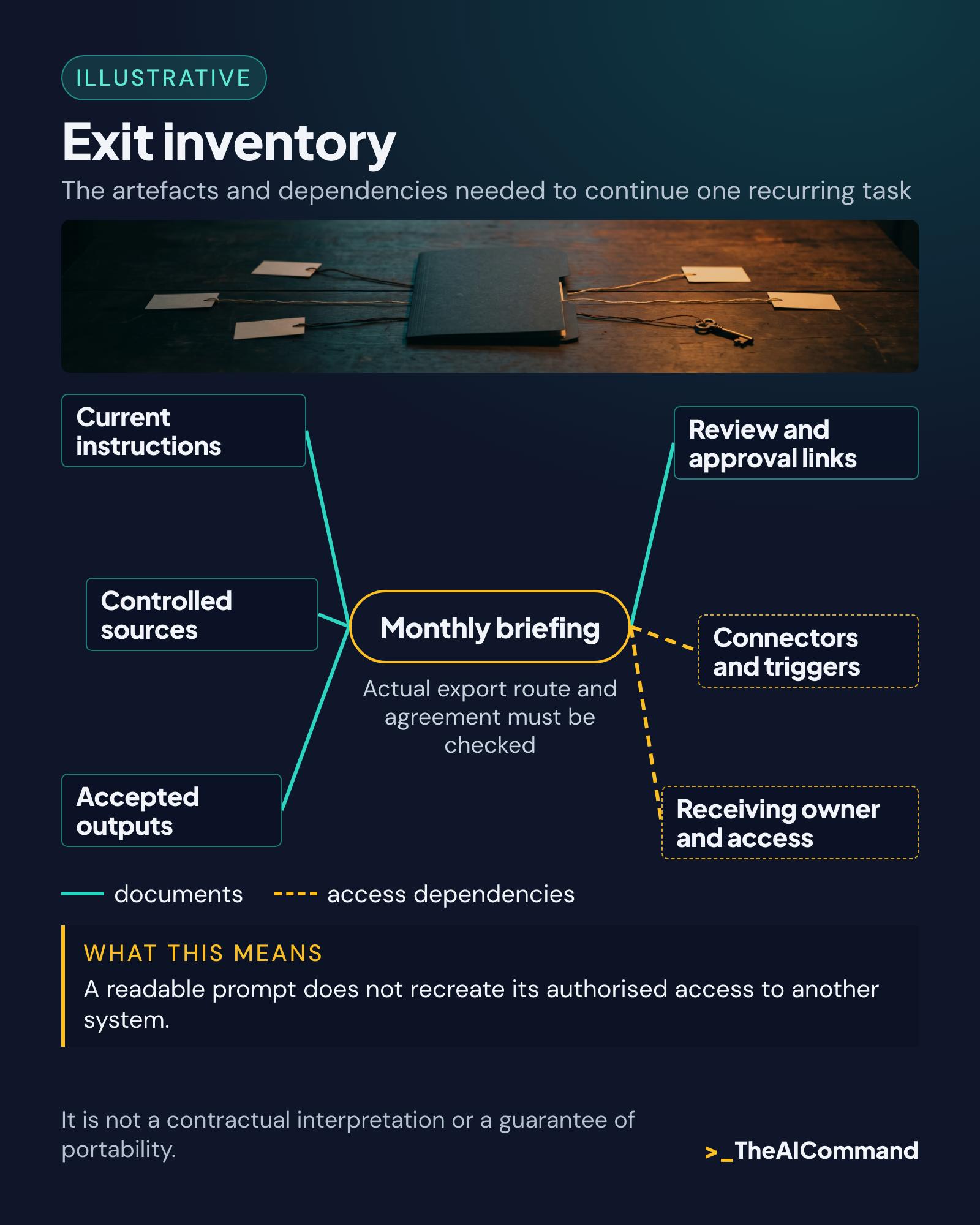
Choose a recurring business task as the first unit of analysis. For a monthly service briefing, the necessary materials might include its approved source list, briefing instructions, calculation method, latest accepted output and review record. A collection of all files with briefing in the title does not reveal those relationships.
Separate reusable instructions from conversational history. A useful instruction set explains the allowed sources, required output and boundaries that prevent the model from inventing missing information. Historical discussion may explain why those rules exist. Preserve the decisions that matter, while applying the organisation's records and privacy requirements to the rest.
Record the authoritative source for each artefact. An uploaded copy may have become stale after the source document changed elsewhere. Before migration, identify which version the workflow should use and where it is controlled. Moving every duplicate to a new tool can preserve the original confusion more efficiently.
Include human decisions in the inventory. A model output that was accepted for one audience may be unsuitable for another. A review record should identify the artefact version and permitted use. If the export contains the output but loses that link, the receiving team cannot safely infer approval from a polished document.
List dependencies that are not documents. These include connectors, scheduled triggers, source folders, destination permissions, identity arrangements and the people who maintain them. Record references to secure credential management rather than copying credentials into an exit pack. A readable prompt does not recreate its authorised access to another system.
Verify the actual export route
Do not assume that another person's export instructions apply to your account. OpenAI's current data-export guidance distinguishes eligible personal plans and eligible ChatGPT Edu workspaces, where self-service export is offered, from other managed workspaces. It directs Business, Enterprise and Healthcare users to their workspace owner for organisation-managed access, rather than offering self-service export there.
That example illustrates why the inventory needs product, workspace type and responsible administrator. The article is not comparing every supplier or asserting what your contract provides. Ask the administrator to verify the supported route against current documentation. Record which kinds of material it covers and which require a different authorised process.
Check timing before the exit date. A request being accepted is not evidence that the data has arrived or that its contents are complete. Give the team time to inspect the returned files, resolve omissions and repeat the handover exercise. Record the required lead time from current supplier information and the organisation's own test.
Keep the evidence for each export. Record the request date, retrieval date, scope, source account category and the location of the protected archive. Use an integrity check where appropriate to show that the retained file has not changed. An integrity check proves consistency of bytes, not completeness or business usefulness.
Read the exported material in the environment where the receiving team will work. A file can exist and still depend on broken links, unsupported formatting or access to the old workspace. Treat these as portability findings. Do not label the export successful solely because the original owner can open it on their own computer.
Ask the contractual questions separately
The existence of a download button does not settle ownership, licence or retention questions. Ask the appropriate commercial or legal reviewer which agreement applies and what it says about input materials, generated outputs and third-party content. Record the provision and their interpretation instead of asking a model to declare that everything is transferable.
Some dependencies may belong to another supplier. A generated briefing could include a licensed image, a purchased report extract or a connected database result. The exit inventory should identify those components and their source rights. A general claim about ownership of AI output does not answer every component's permitted reuse.
Treat retention and deletion as separate workstreams. The organisation may need to preserve particular records while removing unnecessary copies. Confirm the applicable retention schedule, contractual arrangements and any relevant holds before deciding what happens to either the old service or the migration archive. Do not invent a universal retention period.
Privacy review also continues during the move. The Office of the Australian Information Commissioner's commercial AI guidance calls for due diligence and attention to access and personal information across the lifecycle. A new destination requires assessment for the intended use. An export is not permission to upload its entire contents elsewhere.
A constructed export that loses its meaning
Consider a fictional Australian consultancy preparing a monthly service-capacity briefing. It uses a neutral, invented assistant service called Workspace A. This is not a disguised vendor test. All inventory entries, files and outcomes described here are constructed to demonstrate the checks, and no real supplier export was performed.
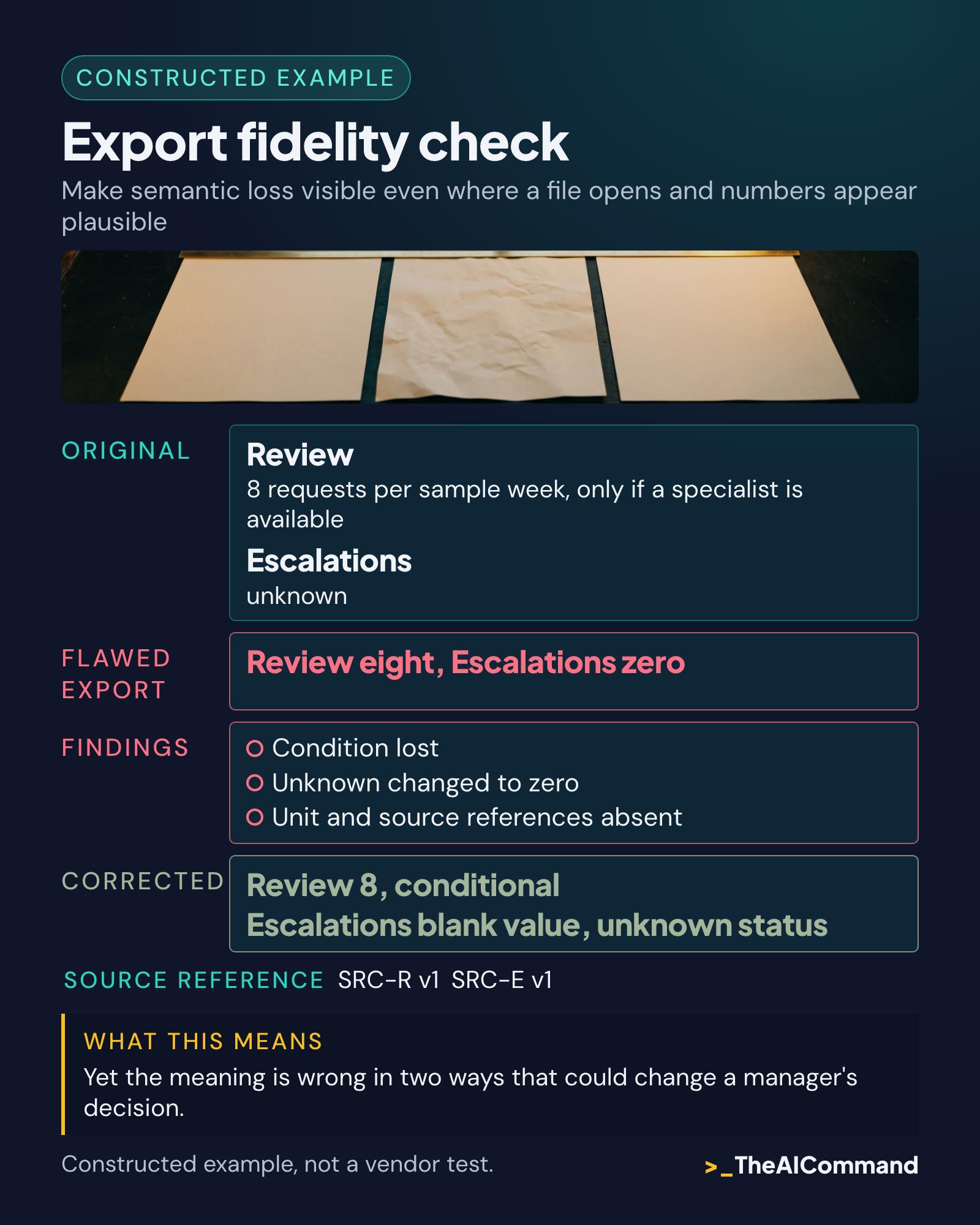
The original source table contains three service rows. Intake has capacity for twelve routine requests during the sample week. Review has capacity for eight, subject to a specialist being available. Escalations has no confirmed capacity. Each row has a source reference and an owner role. These figures are teaching data, not service promises.
The sample export contains a readable paragraph: Intake twelve, Review eight, Escalations zero. It omits the specialist condition and converts the unknown escalation capacity into zero. The file opens, and the first two numbers match the table. Yet the meaning is wrong in two ways that could change a manager's decision.
The portability check compares fields rather than appearances. The reviewer checks each service label, capacity value, unit, condition and source reference. Review fails because its condition is missing. Escalations fails because unknown has become a numeric value. Source references are also absent, so the receiving team cannot trace either claim from the paragraph alone.
The remedy is not to ask another model to guess the lost structure. The team returns to the controlled original and creates a portable table with explicit fields. Review retains the specialist condition. Escalations retains unknown as a status, with no invented number. The source references and owner roles travel with the data.
The workflow instructions also need attention. Workspace A's conversation contained a later correction requiring unknown capacity to remain unknown. That correction was never added to the reusable prompt. The exit pack incorporates the rule into a versioned instruction document, with a test example that would fail if the rule were lost again.
A second colleague then rehearses the task using the controlled sample pack, without relying on the original conversation. The intended acceptance condition is that they can reconstruct the briefing and identify both limitations. This rehearsal is a proposed next step, not an observed success. The constructed correction demonstrates the method without claiming a measured migration result.
Test fidelity at the level that matters
Define pass conditions before running the portability exercise. For a briefing table, those conditions may require all rows, units, source references and qualifications to survive. For a reusable prompt, they may require its allowed sources and decision boundaries. A visual match is useful only when the task also depends on visual presentation.
Distinguish content fidelity from functional continuity. A document can preserve every word while its workflow no longer runs because a connector is missing. Conversely, a replacement workflow can run and still produce a subtly different decision summary. Test both where relevant, and record separate findings rather than averaging them into one pass mark.
Use representative edge cases. Include an unknown value, a conditional figure, a linked source and an item that requires human approval. These examples reveal losses that a simple success case will miss. Select them from an invented or otherwise authorised test pack, not by copying identifiable customer records into a migration experiment.
A model can help compare supplied fields and draft an exception list. Keep its task narrow: identify differences, quote the relevant local passage and mark missing evidence. The reviewer should inspect the original and exported versions directly for consequential fields. Asking a model whether an export looks complete does not define completeness.
Keep a discrepancy register with the impact and remedy. A missing decorative border may be acceptable. A missing qualification about capacity is not. The business owner decides whether a change is acceptable for the intended use, while the relevant specialists resolve legal, security or records issues. Preserve that reasoning beside the result.
Transfer ownership before removing access
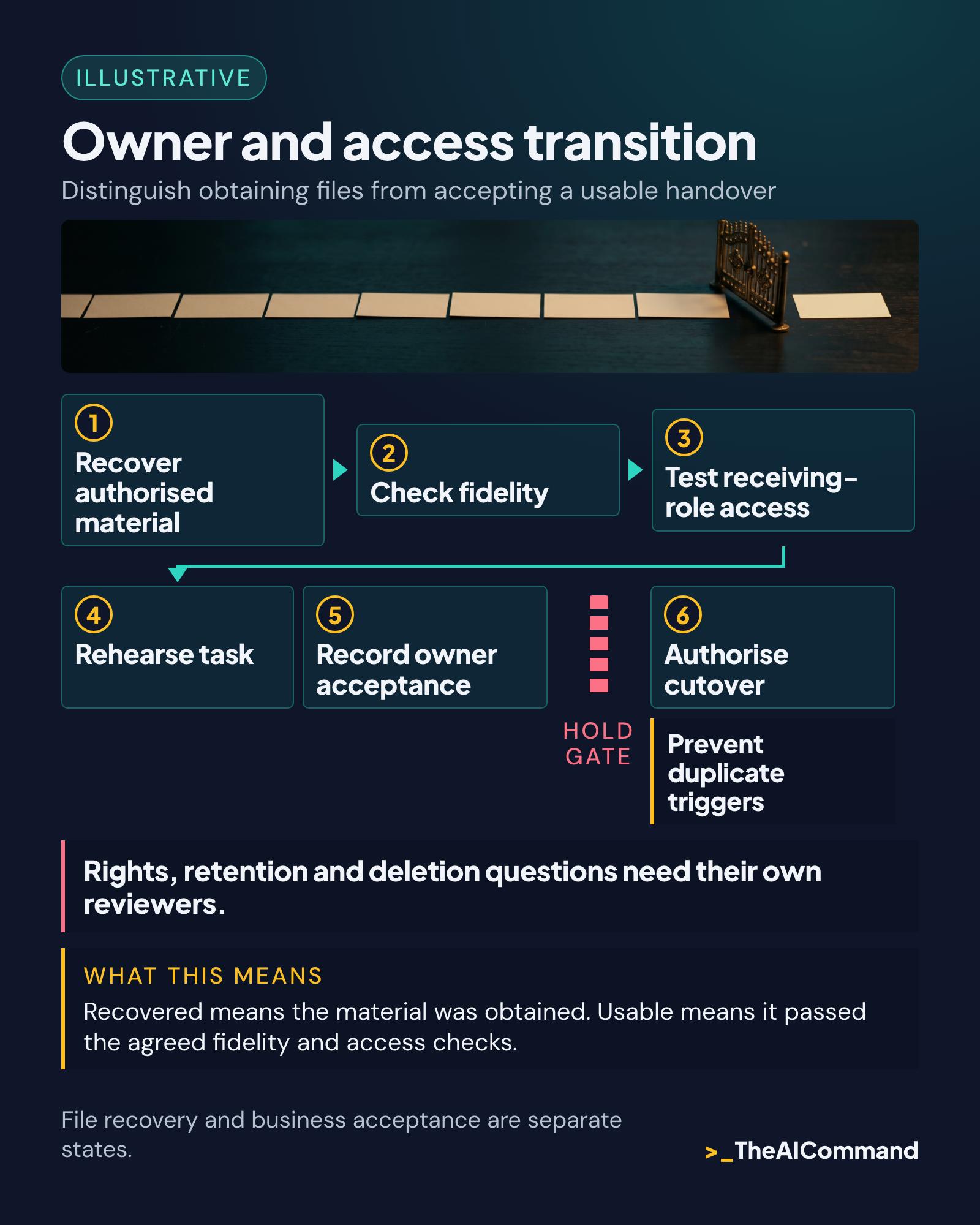
The receiving owner needs more than the archive location. Provide the task's trigger, source-selection rules, permitted outputs and review route. Explain which steps remain manual and which depend on another system. A handover that cannot be followed without the departing owner is still relying on the old arrangement.
Test access using the receiving role's authorised account. The original owner may see files through permissions that will disappear at cancellation. Record whether the new owner can read the sources, run the bounded process and store its output. Do not solve an access failure by sharing passwords or broadening permissions without the proper authority.
Plan the cutover so the same business action is not performed twice. A draft-only task may tolerate parallel comparison. A workflow that sends notices or changes records needs a controlled point where the old trigger stops and the new route becomes authorised. Keep testing separate from external action and confirm the actual trigger state.
Retain a defined fallback until the receiving process has met its acceptance conditions. The fallback might be a manual briefing built from the controlled source pack. It should identify its owner and limitations. Do not describe an untested second model as a ready replacement simply because it accepts similar prompts.
Close the exit with evidence
A useful exit record distinguishes recovered, usable, accepted and retired items. Recovered means the material was obtained. Usable means it passed the agreed fidelity and access checks. Accepted means the receiving owner agreed it supports the required work. Retired means an authorised decision removed the need to continue it.
Keep unresolved items explicit. An export route awaiting supplier confirmation, a licence question awaiting review and a missing connector have different owners. The cancellation decision should take those gaps into account. A manager may choose a constrained exit, but the record must explain the resulting limitation rather than quietly declaring full readiness.
After cutover, verify the first required business output through the new process. Record any correction to the pack and who approved it. Then complete the authorised access and records actions against their own requirements. A successful new draft does not itself prove that old access was removed or that deletion obligations were met.
For a business owner, the practical result is a colleague who can continue the work with the necessary evidence and authority. Start with one valuable recurring task and prove its handover before scaling the exit. Preserve the method, test the meaning and transfer the responsibility. The supplier can change while the work remains understandable.
Do this Monday
- Choose one recurring task and inventory its sources, instructions, outputs and approvals.
- Confirm the export route for the actual workspace and agreement.
- Compare a sample export against explicit fidelity conditions.
- Give a receiving colleague the pack and record what still prevents a handover.
Copyable exit pack
The supplier-exit checklist and portability prompt that accompany this article include the complete synthetic table, deliberately flawed export and corrected representation.
Supplier-exit reusable materials
This pack contains a supplier-exit template and a constructed fidelity example. Workspace A is invented. No actual supplier export or replacement-model trial occurred.
Supplier-exit inventory template
Credentials never belong in this template. Reference the approved secure store without including secrets or account identifiers in portable examples.
Exact constructed source table
Sample week: fictional week W1. Unit: requests per sample week. References are synthetic source labels, not live files.
Instruction correction IC1: Preserve unknown capacity as unknown. Do not replace it with zero. Keep all conditions and source references attached to the corresponding row.
Deliberately flawed export
Expected comparison output
Corrected portable representation
The correction is authored from the source table. It is not a vendor export or an observed model output. The receiving-owner rehearsal remains not tested.
Portability-test prompt
Exit and handover checklist
- [ ] Scope continuing tasks and authorised retirements.
- [ ] Confirm current export route for actual account and administrator role.
- [ ] Confirm agreements, third-party rights, retention and deletion questions with the responsible reviewers.
- [ ] Save authorised exports securely and inspect their actual contents.
- [ ] Compare semantic fields, source links and approval relationships.
- [ ] Test receiving-role access and task execution with an approved sample.
- [ ] Reconcile connectors and triggers without duplicate external actions.
- [ ] Record acceptance, unresolved exceptions and bounded fallback.
- [ ] Perform authorised cutover and confirm the first required output.
- [ ] Complete access and records actions with their own evidence.
This blank checklist is a reusable aid, not a completed exit record.
Related reading
- Your AI Fallback Is Not a Recovery Plan., on recovery testing for regulated entities, a different task from a planned exit
- What Needs to Be Handed Over Before Someone Leaves?, the companion article for 12 November
References
- OpenAI: Exporting your ChatGPT history and data
- Office of the Australian Information Commissioner: Guidance on privacy and the use of commercially available AI products
TheAICommand. Intelligence, At Your Command.