
The assistant still answers short questions, but it refuses another attachment. Yesterday it stopped a different task until a reset time. The invoice says the subscription is active. Those events can all be consistent: paying for access does not mean every feature draws from one simple message counter.
The practical problem is deciding what to do next without buying the wrong thing or losing work. A message about conversation length calls for a different response from a weekly usage warning. A storage problem needs another diagnosis. Treat the wording on screen as evidence to interpret, then match it to the provider's current documentation for the product you are actually using.
This guide uses official ChatGPT and Claude documentation retrieved on 24 October 2026. It describes documented behaviour, not a hands-on benchmark. Product examples need a fresh check before use because plans and limits change. The fictional deadline exercise below illustrates a decision process; it does not report an observed quota, measured consumption or actual account warning.
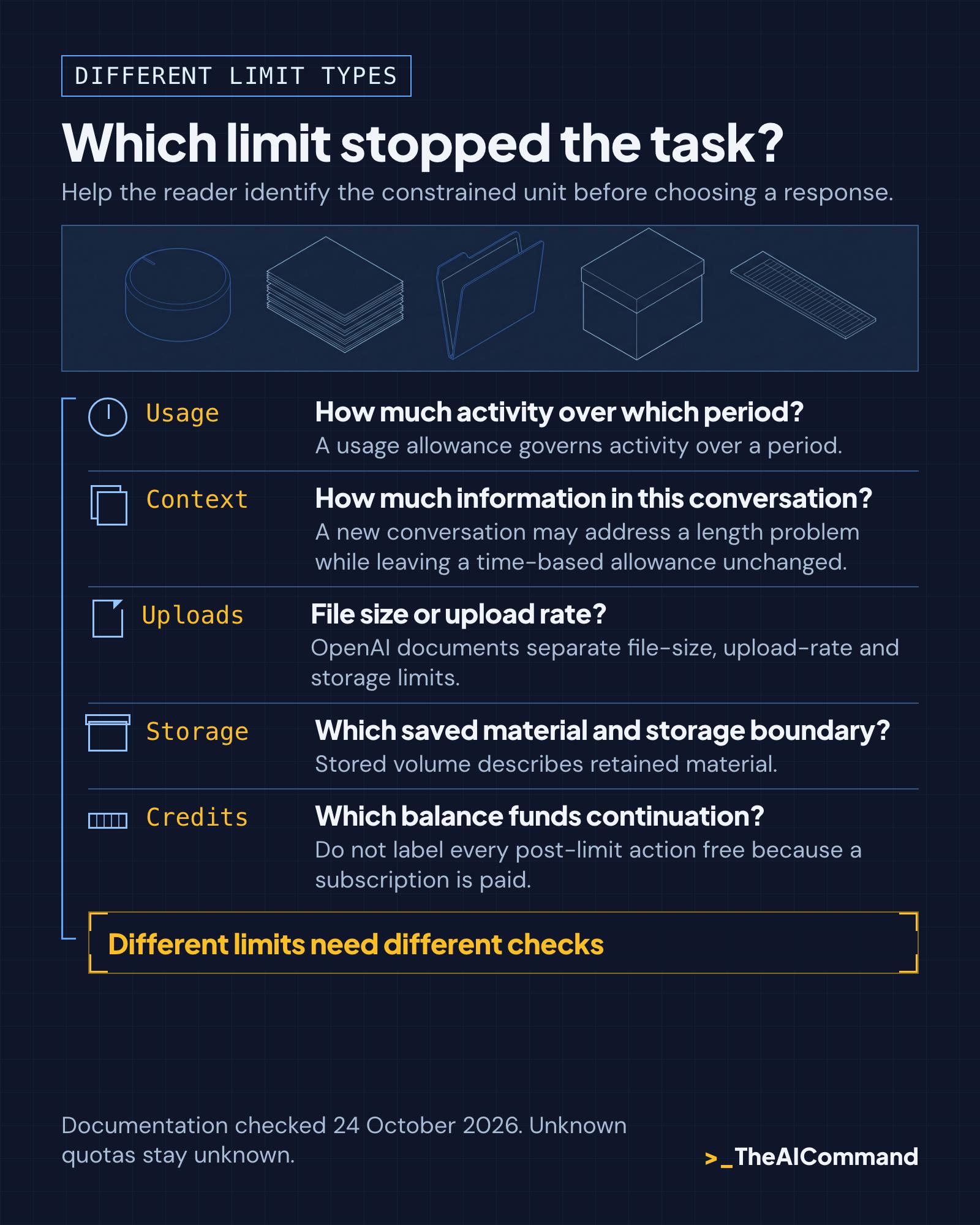
Give each limit a name and a unit
A usage allowance governs activity over a period. Its unit may be messages, tasks or a provider's capacity measure rather than a visible token total. The question is how much eligible work remains before the relevant reset. Do not assume that a monthly subscription invoice establishes a monthly reset for every feature.
A context or length limit concerns how much information the model can work with in a particular conversation. That is a different question: how much material fits together for this task. Anthropic explicitly separates these concepts in its usage guidance. [1] A new conversation may address a length problem while leaving a time-based allowance unchanged.
File limits introduce other units. Megabytes describe file size, file counts describe an upload or project restriction, and stored volume describes retained material. OpenAI documents separate file-size, upload-rate and storage limits. [2] When an upload fails, establish which restriction applies before assuming that the model's conversation allowance has run out.
Tokens are units used to represent information for model processing. Knowing an input's token count can help with a documented context boundary. It does not, by itself, reveal how many subscription messages remain. Do not divide a subscription price by an API token rate to invent a private allowance. Those numbers describe different offers unless the provider expressly connects them.
Read Claude's limits as several constraints
Anthropic's current guidance describes session and weekly usage limits, with consumption affected by conversation length, complexity, features, model and effort. It also states that its listed product surfaces share the usage limit. [1] A day spent in a coding surface may therefore matter when planning later work in the same subscription's chat experience.
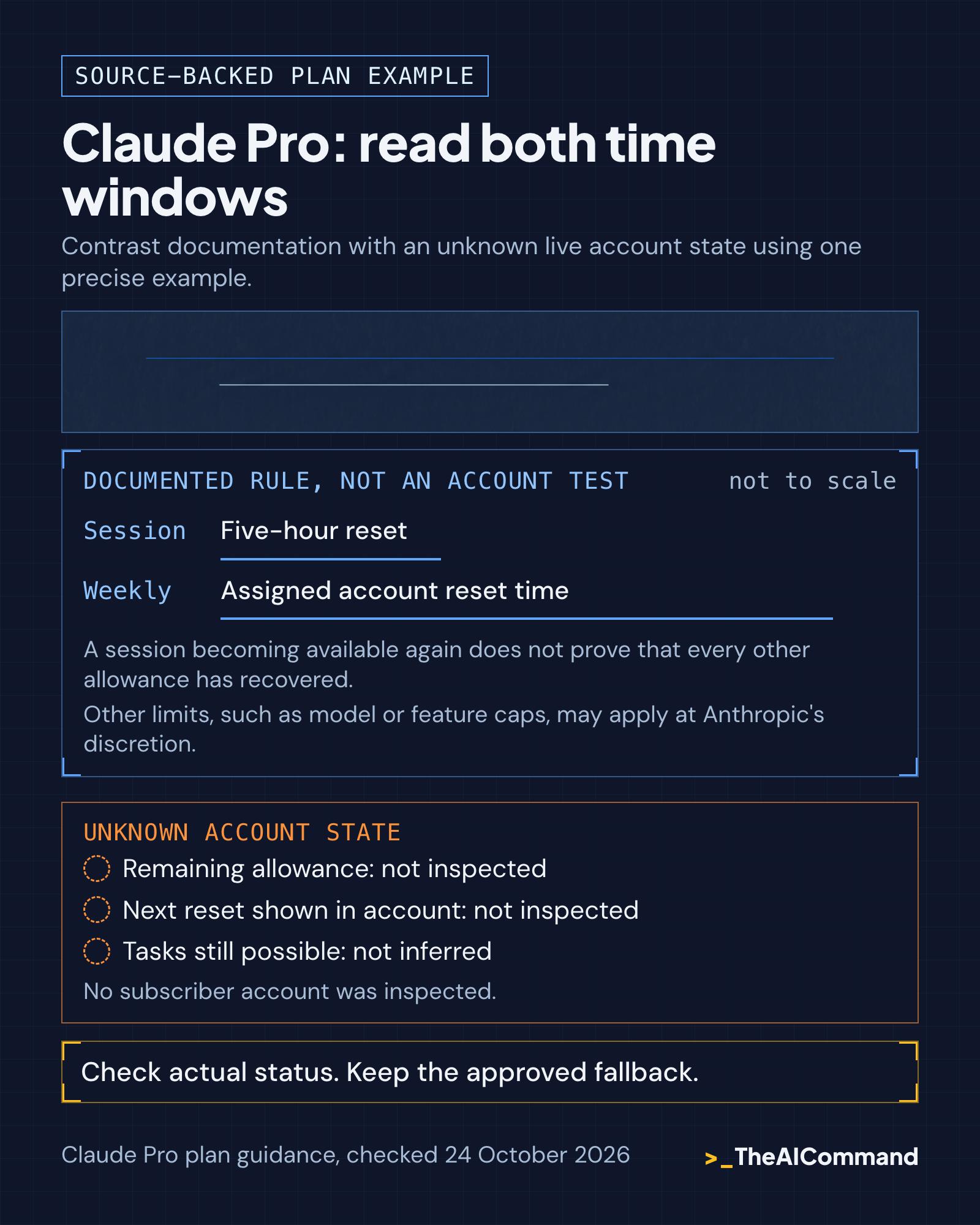
Claude Pro's plan page specifies a five-hour session reset and an account-assigned weekly reset time. It directs subscribers to Settings > Usage for the next reset, and says other limits, such as model or feature caps, may apply at Anthropic's discretion. [3] These are documentation statements. They do not establish how many copies of your particular document-comparison task will fit, and this article has not inspected a subscriber's account.
The useful planning consequence is to record both time windows. A session becoming available again does not prove that every other allowance has recovered. Conversely, a warning about length does not show that waiting for a weekly reset will help. Identify the constrained mechanism first and retain the actual warning wording in the task record.
Avoid comparing colleagues' message totals as if all messages carried the same weight. For planning, record what the task involved and whether it completed. The number of attachments, model choice and need for repeated corrections help explain an interruption without pretending to reverse-engineer Anthropic's allocation. Where the provider does not publish a fixed task count, write 'not published'.
Read ChatGPT's product and tool boundaries
OpenAI's current model guide says limits depend on plan, model and workspace settings. It describes possible model fallback when a Thinking limit is reached and displayed reset information when available. [4] A continuing conversation is therefore not sufficient evidence that the same model remains available for the work you intended to do.
Read the displayed model and any fallback notice before continuing a demanding comparison. If the task was evaluated using one configuration, a changed configuration deserves a fresh quality check. This is an editorial workflow recommendation, not a claim that another model must perform worse. The point is to preserve a known acceptance test rather than silently changing the conditions.
The upload guidance makes a different limitation visible. OpenAI says the remaining rolling upload-rate quota is not currently displayed, and failed attempts can sometimes count towards it. [2] Repeatedly retrying an attachment may therefore be unhelpful. Record the error and inspect the documented restriction instead of treating a missing counter as evidence that capacity remains.
Keep separate product surfaces separate in the record. OpenAI's model guide distinguishes ChatGPT Work and Codex allowances from Chat in the relevant Pro-model discussion. [4] Do not extend a rule found for one surface to every app carrying the same account name. The source must match the plan, feature and place where the interruption happened.
Credits do not all buy the same thing
Claude's guidance for Pro and Max plans describes optional usage credits for continuing beyond included limits, with additional charges and spending controls. [5] This creates a financial decision as well as an access decision. Before a deadline, establish who may enable extra use and the permitted spend. A user needing to finish a draft does not automatically have purchasing authority.
Anthropic also documents monthly API credits for eligible Max and Team plans. Those credits are separate from the app's usage limits and do not fund app extra usage. [6] This distinction matters when reading a balance: a credit attached to one service is not proof that the interrupted service can continue. Eligibility and claiming conditions still require checking.
For ChatGPT Business, OpenAI describes workspace credits for eligible activity after included usage, subject to settings and spend controls. [7] Do not label every post-limit action free because a subscription is paid. Ask which balance would fund the next action, what control applies and who authorised it. Keep that answer alongside the task's continuity plan.
This article does not calculate API costs or recommend a top-up. An application programming interface is a separate delivery route that needs its own configuration and evidence. Moving unfinished work there changes more than the counter. It can change the tool, approval boundary and review process, so it is not an automatic escape route from an interruption.
A fictional deadline exercise
An operations analyst has an internal briefing due at 3 pm Sydney time. They are comparing two public guidance documents and must provide source locations for each difference. Both documents are approved for the exercise. The analyst has no personal records, confidential attachments or authority to purchase extra usage. These facts are constructed inputs, not a client case.
The preparation record names the product and plan, the selected model if shown and the permitted manual fallback. It also reserves time for checking the comparison against the originals. The expected AI contribution is a draft differences table. The analyst, not the model, decides whether a difference changes the briefing and approves the final wording.
In the Claude Pro branch, where the organisation has approved that plan for this public-document task, the analyst consults the official session and weekly rules. The record leaves the account's remaining allowance and reset time unknown because no live account has been inspected. The output of this preparation is therefore a decision rule: if interrupted, use the actual displayed reset information and the approved fallback. It is not a forecast of how many prompts remain.
Suppose, as an expressly fictional training event, a usage notice appears while the analyst is drafting. The analyst saves the already reviewed comparison notes in the approved work location. They record the notice's exact scope and time without assuming it applies to all features. If the relevant reset falls after the briefing deadline, the remaining comparison proceeds manually.
In the ChatGPT branch, suppose the fictional interruption is an upload error while ordinary chat still works. The analyst checks the file guidance and distinguishes size, rate and storage possibilities. They do not paste the whole document into chat merely to bypass the error. The information boundary and source-traceability requirement still apply, and the diagnosis remains unknown until evidence resolves it.
The expected decision note is short: 'The required attachment workflow is interrupted. The exact upload restriction needs confirmation. Continue the approved manual comparison and retain the source documents.' This is a constructed output illustrating disciplined uncertainty. It does not claim that ChatGPT failed a test or that the error definitely arose from a particular quota.
In either branch, the manager receives the impact on the work, the fallback used and any unresolved issue. The manager does not receive an invented remaining-token estimate. If extra capacity might help future briefings, the team schedules an authorised assessment using representative work. It separates that purchasing question from the immediate obligation to deliver a checked document.
Plan interruptions without weakening the work
Prepare a small continuation note as the task develops. Record the source versions, completed sections, verified findings and unresolved questions. Keep it in the organisation's approved location. If you need to continue elsewhere, this note makes the state legible without depending on the model to remember what has already been checked.
Do not treat a conversation summary as a replacement for the evidence. A summary may omit a caveat that controls the conclusion. When restarting a task, provide the relevant approved source material and the review criteria again. Ask the assistant to distinguish supplied facts from assumptions, then inspect that distinction before accepting further drafting.
Narrowing the task can help the workflow even when it does not guarantee a particular allowance saving. Ask for a defined comparison or a specific section rather than a complete report with every possible appendix. Preserve the material required to answer accurately. Removing essential context just to fit a limit can leave a polished output that answers a different question.
Choose the fallback before the interruption. For some work, it is a manual draft. For other work, it is an approved alternative service whose data rules and output checks are already established. Avoid transferring material to an unapproved personal account or sharing a colleague's credentials. Operational pressure does not change who can authorise the input or the purchase.
Keep a source-backed limit record
Use a small record that another person can audit. It needs the exact plan and product surface, the feature in question, the official page and the date read. Add the limit's unit, period and any variable conditions. Where the page gives no fixed quota or no reset rule, leave the field unknown and state what evidence is missing.
Distinguish the source record from observations. A provider says how a feature is designed to work. A screenshot or task log can show what a particular authorised user encountered at a particular time. Neither substitutes for the other. A single successful morning does not prove unlimited use, and one interruption does not establish the plan's performance for every task.
If you ask AI to prepare the record, constrain it to the supplied official passages and redacted observations. Require a source ID beside each factual entry. The model must not fill blank cells from its recollection of an older plan. Reject a complete-looking table if its precision exceeds the evidence, especially a conversion from subscriptions into API tokens.
What to do before the next deadline
Pick the workflow most affected by interruptions and identify the exact limit categories relevant to it. Check the current official pages, then inspect your authorised account without changing spending settings. Record the gaps as gaps. This small preparation gives the team a shared vocabulary for diagnosing a warning when time is short.
Agree who decides whether to wait, change the approved workflow or approve additional spending. Keep the manual route and the human review intact. A subscription limit is a condition to manage, not a reason to lower the standard of the final work. Finish with an evidence-backed decision about the task, rather than an unsupported estimate of what the provider owes you.
Limit interpretation table
Copyable source-check prompt
Reusable materials
These are reusable planning materials, not a completed workplace assessment. Examples are constructed. Use only approved public material, independently invented examples and policy excerpts approved for the chosen environment. Do not supply real staff, claimant or client data, credentials, account details, confidential contracts or payment information. Human approval is required before any access, purchase or workflow change.
Blank limit interpretation record
Category guide
This is an editorial diagnostic guide. Product examples must use the dated official sources listed with this article. Do not treat these labels as exact UI messages.
Constructed interruption decision note
- Task: briefing from two approved public documents, due 3 pm Australia/Sydney.
- Expected output: source-located differences, checked against originals.
- Scenario: fictional upload interruption while ordinary chat remains available.
- Known: the exercise stipulates an interruption; no live account has been observed.
- Unknown: the exact upload restriction and relevant remaining allowance.
- Decision: preserve reviewed notes; perform the approved manual comparison; investigate the restriction separately.
- Escalation: authorised manager decides any future additional spending.
Source-check checklist
- Match provider, plan, seat and product surface.
- Open the exact official page; preserve its date and qualifications.
- Name the unit, period, scope and reset rule separately.
- Retain absent quantities as unknown or not published.
- Separate documented behaviour from actual authorised observations.
- Check the purpose of every credit balance; never convert subscriptions to API tokens without explicit evidence.
- Save approved work and retain human review when choosing a fallback.
- Recheck the source before relying on a time-sensitive limit.
Ready-to-use prompt
Expected output and unknown handling
Return a reviewable table with a source or an explicit UNKNOWN for each factual field. Keep a separate list of decisions needing a human. The example output may use only the constructed scenarios above. Do not turn a proposed action into an account change. Copy the prompt and template into an approved working document; a separate download is not required.
Related reading
- Choosing Claude, ChatGPT, Gemini or Copilot for Your Job
- Token Budgets for a Team: Set a Cap That Actually Stops
- AI Tool Comparison, each app's plans with their published usage limits, in Australian dollars
- Who Needs Which AI Access to Do the Work?, the companion article for 17 November
References
- Anthropic: Claude usage and length limits
- OpenAI: ChatGPT file and audio uploads
- Anthropic: Claude Pro plan
- OpenAI: ChatGPT model availability and limits
- Anthropic: Claude paid-plan usage credits
- Anthropic: Claude monthly API credits
- OpenAI: ChatGPT Business credits and spend controls
General information only. Not legal, compliance, financial, or professional advice.
TheAICommand. Intelligence, At Your Command.