The cheapest advertised seat looks sufficient until somebody asks who owns the workspace when the subscriber leaves. The more expensive option looks comprehensive until the buyer discovers that the required setting is not included. A buying checklist helps expose those gaps before a subscription becomes part of the team's daily work.
The useful comparison is between requirements and evidence. A good purchase decision names the task, explains why the selected plan supports it and records any condition that remains unresolved. It also says what the organisation will stop doing if access changes. A long feature list is useful only when its entries correspond to work somebody is actually authorised to perform.
This article compares selected documented features of ChatGPT and Claude, checked on 24 October 2026. It does not declare a model winner or report hands-on tests. The purchasing scenarios are fictional. Monetary prices are deliberately not quoted: obtain the current regional checkout or written quote before approval, including currency and tax treatment. No Australian dollar conversion is implied.
Write the requirement in a form somebody can test
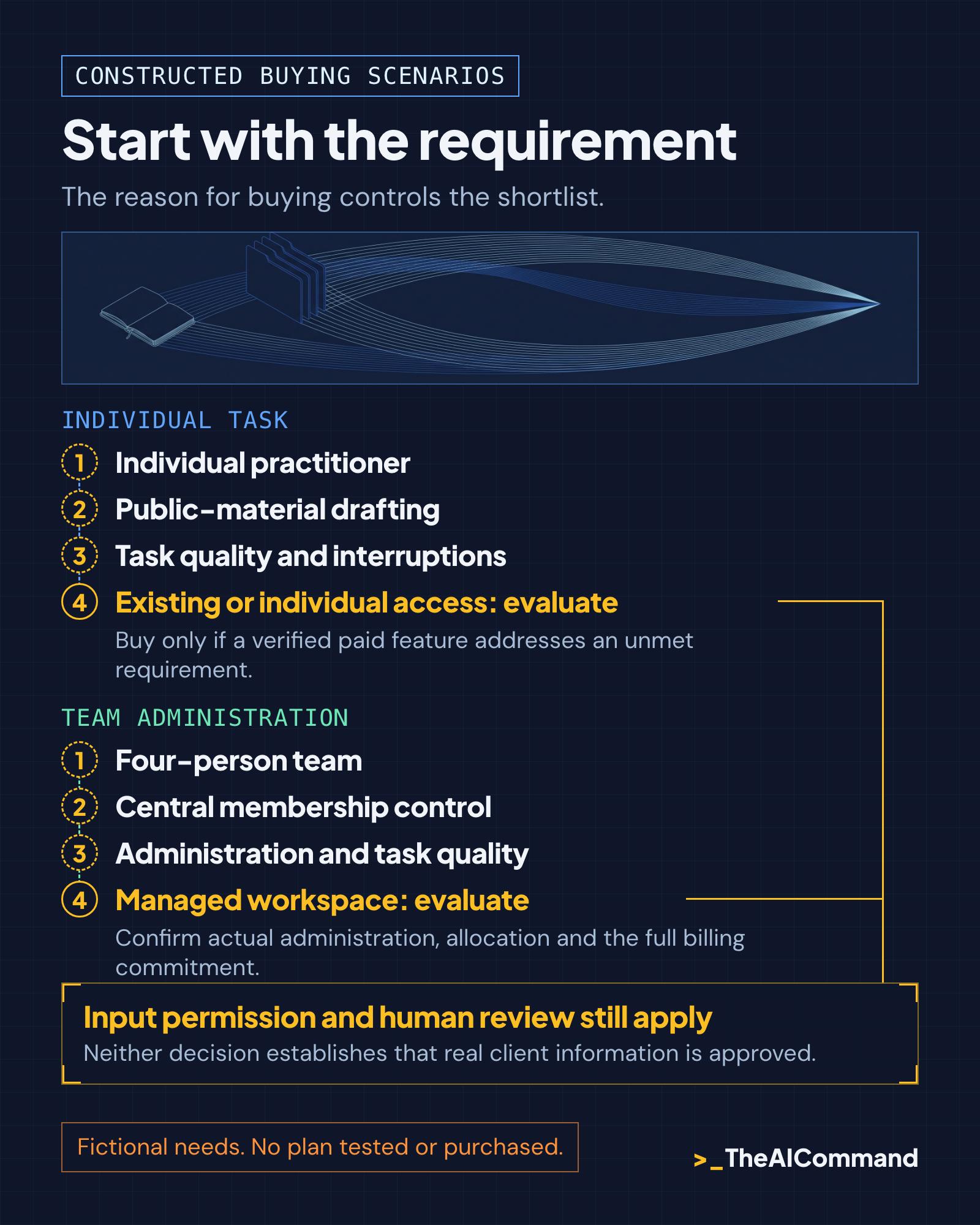
Start with a real task category, described without personal or confidential information. An individual practitioner might need a draft outline from public guidance. A small team might need a shared working environment for approved documents with centrally managed membership. Those requirements can lead to different purchases even if both buyers prefer the same model's writing style.
Describe the output and its review. For a document comparison, require accurate source locations and a clear distinction between changed wording and changed meaning. For a client-facing draft, require review by the authorised professional before release. This defines what a trial must demonstrate. It also prevents the buyer from treating access to a named model as proof of suitability.
Make essential requirements explicit. If the organisation needs to remove a departing user's access centrally, that is a purchasing condition. If a particular connector would merely save a few uploads, it might remain optional. Keep untested features out of the benefits calculation. Otherwise a speculative convenience can appear to justify a contract before anyone has checked whether it works.
Include the work pattern. Occasional preparation with a flexible deadline differs from continuous production that cannot wait for a reset. Describe expected peaks as assumptions until measured. A salesperson's higher-capacity language does not show how many of your specific tasks will complete. The buyer needs an interruption plan as well as a feature comparison.
Establish who is buying and who controls access
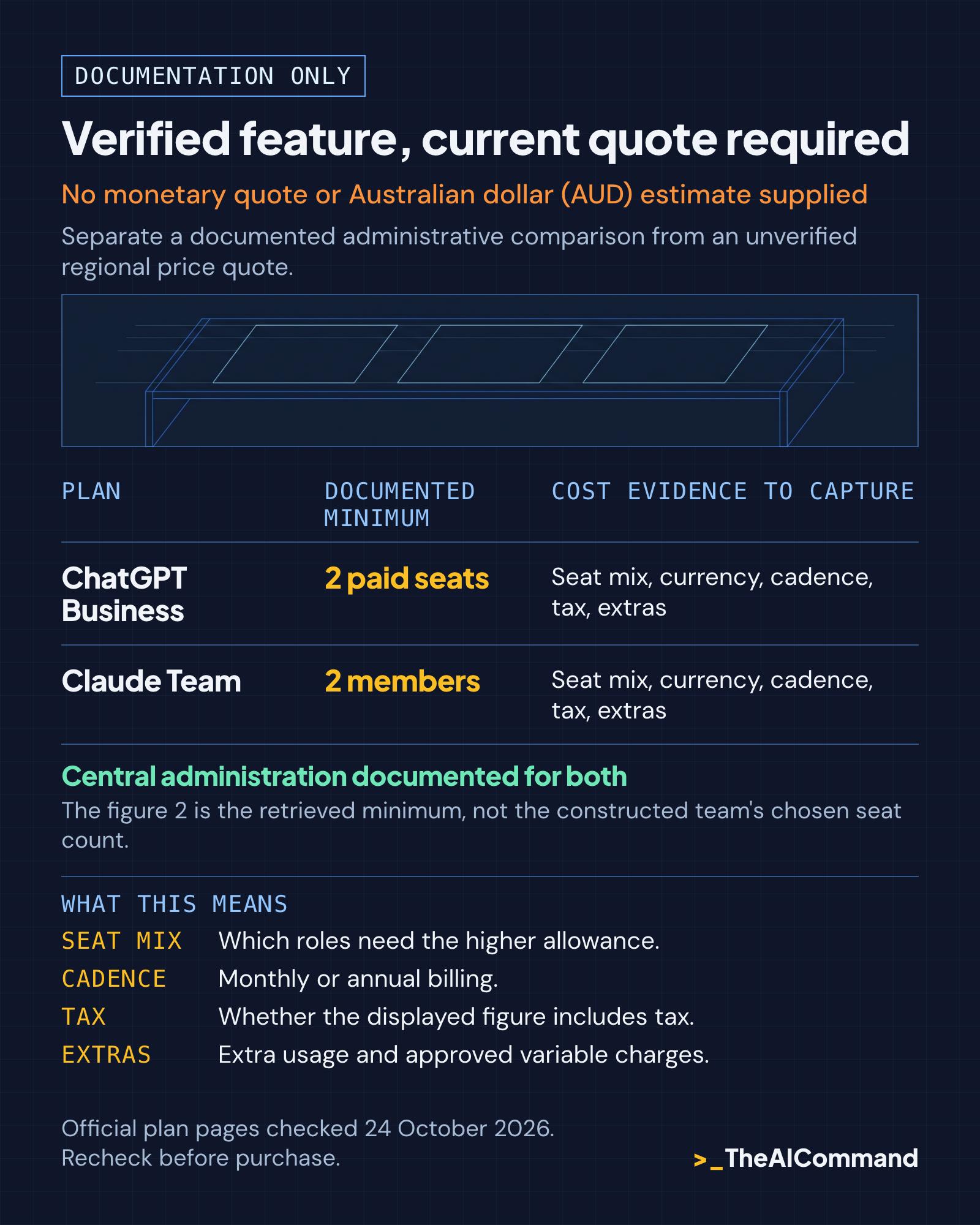
A personal subscription and a managed workspace answer different administrative questions. OpenAI documents central administration for ChatGPT Business, a minimum of two paid seats and monthly or annual billing options. Anthropic documents a two-member minimum and monthly or annual options for Claude Team. [1][2] These minimums matter even when only one person expects heavy usage.
Do not interpret a team label as requiring identical allocations. Both providers document more than one seat capacity within their team offering. [1][2] That creates a question for the buyer: which roles need the higher allowance, and what evidence supports it? The answer can remain provisional while the organisation tests its recurring work.
Ask who will hold the primary administrative role and who can recover control if that person is absent. Establish how membership changes are approved, how records are retained and how purchasing authority is delegated. These are organisational design choices. Buying a plan with administrative features does not assign those responsibilities automatically or establish that the configured permissions match your policy.
Explain the account boundary to staff before moving work. Anthropic's commercial guidance says the organisation's Primary Owner manages the work account and may request data exports containing conversations, files and usage information. [4] Staff should understand the relevant organisational arrangement. Do not mix private activity into a workspace on an assumption that every conversation has the same access conditions as a personal account.
Read the data promise at its actual scope
Check the terms and controls that apply to the exact product being considered. A statement about training is useful evidence, but it answers a training question. It does not establish a particular retention period, processing location, access arrangement or legal privilege. Record those requirements separately and obtain the applicable evidence instead of inferring a complete protection package from one sentence.
For example, Anthropic describes no training on commercial inputs and outputs by default, while identifying feedback and other permission as exceptions. [5] That page covers commercial products, not consumer plans such as Pro, so record both the exception and that scope. A blanket 'never used for training' summary would overstate that source. Likewise, a product security badge does not determine whether the intended input or use is acceptable in your organisation.
The Office of the Australian Information Commissioner advises assessing commercially available AI against the intended use and associated privacy risks. [3] For this buying exercise, that means involving the responsible information owner before a workflow uses personal information. The legal application depends on the organisation and circumstances; this article does not decide it from business size or subscription name.
Use public material or wholly fictional examples for the initial evaluation. Removing a name from an existing case does not, by itself, resolve identification risk. A synthetic example copied from a real person's distinctive history can preserve the problem. Build the practice material independently and keep actual employee, claimant and client records outside this exercise.
Compare the commitment, not only the displayed rate
Record the billing currency, the period being purchased and whether the displayed figure includes tax. Distinguish a monthly equivalent on an annual offer from the amount payable when the commitment begins. Keep the regional checkout evidence with the decision. If the supplier quotes in another currency, record any Australian dollar estimate separately with its dated rate source and assumptions.
Calculate the full proposed allocation. Multiply the verified rate by the relevant paid seat count and billing period, then add separately identified taxes and approved variable charges. This is a budgeting method, not a price quotation. Do not silently treat an unassigned seat as free or assume that a later reduction produces an immediate refund. Verify the supplier's change rules.
Set a decision about additional usage before relying on it. Who can authorise continuation after an included limit, and what spend control is required? Leave optional top-ups disabled unless the authorised buyer decides otherwise. A predictable seat invoice and permission for variable spending are separate decisions, even when they appear in the same account interface.
Keep API arrangements explicit. OpenAI's Plus documentation excludes separately billed API use, and Anthropic's Pro guidance similarly separates Console API access. [7][8] However, Anthropic now documents monthly API credits for eligible Max and Team plans. [6] The correct checklist asks what the exact offer includes; it does not repeat a universal rule that subscriptions never include API benefits.
Two buyers with different reasons to choose
The first constructed scenario is an individual practitioner preparing occasional learning materials from public guidance. There are no staff accounts to administer and no confidential uploads in the proposed workflow. The person needs useful drafting, attachment suitability and manageable interruptions. Their initial requirement is an individual evaluation, not a centrally managed team environment.
ChatGPT Plus and Claude Pro can enter that evaluation because their official descriptions document enhanced individual access. [7][8] This is a shortlist, not a recommendation that either passes the task. The practitioner tests the same approved material against the same acceptance criteria. They record source accuracy, required corrections and whether the workflow can be completed within their working pattern.
If existing approved access already handles the task, the practitioner has no demonstrated need to buy more. If a paid option is proposed, the decision note identifies the unmet requirement it addresses. The note does not assign a monetary saving to time that has never been measured. It leaves the purchase conditional on the regional offer and a satisfactory trial.
The second constructed scenario is a four-person Australian private-sector advisory business. Its proposed pilot uses published guidance and independently invented examples only. The owner needs central membership administration and a consistent process when somebody leaves. One person expects intensive drafting, while the others expect occasional use. Those are planning assumptions, not observed consumption or grounds for uploading client files.
ChatGPT Business and Claude Team enter this shortlist because their documented administrative features match a stated organisational need. The team prepares an allocation with named users and considers different capacities where supported. [1][2] It checks the controls in the actual workspace before approving production use. A page saying the feature exists is not a completed configuration check.
The intensive drafter receives a pilot question rather than an automatic premium allocation: does permitted work repeatedly stop, and would the proposed change address the interruption? Meanwhile, the owner checks membership control and the records required when access ends. The team's preference may turn on that administration evidence rather than on which model writes the most polished sample paragraph.
The two decision notes can therefore reach different outcomes without disagreeing. The individual may retain existing access or choose a suitable personal plan. The team may prefer a managed workspace because it needs organisational controls. Neither decision establishes that real client information is approved. That separate assessment remains open until the responsible people resolve it.
Use AI to expose gaps in the buying evidence
Give the assistant a requirements table and short dated passages from official documents. Include only information approved for that environment. Exclude credentials, payment details, private contract terms and identifiable staff or customer records. The bounded task is to organise evidence, not to purchase, negotiate or declare that the organisation complies with its obligations.
Require the output to distinguish a documented feature, an untested capability and an unresolved requirement. An acceptable row might read: 'Central membership administration is documented; the required removal process has not been tested; the owner must validate it.' An unacceptable row says: 'Team plan is compliant.' That conclusion exceeds both the source and the assistant's role.
Have the model identify contradictions rather than resolve them by guessing. A general marketing page and a detailed help article may describe different rollouts or account types. Keep their dates and scope together. Ask the supplier or check the actual eligible workspace where necessary. A purchasing decision should not rest on whichever passage gives the most convenient answer.
Test the exit while the evaluation is small
Include the end of the arrangement in the evaluation. Identify which work products must be retained, how an authorised person can retrieve them and what happens to shared material when access changes. Test with fictional material where permitted. Do not assume that cancelling a subscription, removing a member and deleting retained information are the same operation.
Keep the authoritative finished work in the organisation's approved record location. A conversation can help prepare a document without becoming the only copy of the result. Record the source evidence and human approval outside a dependency on one user's account. This recommendation makes a later change of plan easier to assess because the working record remains understandable.
Name the fallback for work that cannot wait. If a service becomes unavailable, can the team complete the essential task manually with the retained sources? If an alternative service is proposed, establish its information permissions and review method first. A second subscription is useful only if the fallback can actually be used within those boundaries.
Approve a purchase with conditions that can be checked
The approval note needs a selected plan, paid seat allocation, exact billing evidence and any outstanding conditions. Attach the trial results separately from the vendor description. State who owns configuration, access reviews and additional spending. Avoid approving an undefined 'AI budget' that leaves the product, information boundary and decision rights to emerge later.
Set a review trigger that corresponds to the reason for buying. Revisit capacity after representative use, administration after a staffing change and data handling before introducing a new information class. Recheck material terms at renewal. These are targeted checks, not a requirement to repeat the entire selection process whenever a vendor changes a promotional headline.
For the next purchasing conversation, take one task and one unresolved requirement to the table. Obtain the evidence that settles it before discussing an upgrade. The right plan is the one whose documented and tested conditions support the approved work at an accepted commitment. Make that decision visible, then keep it current as the work changes.
Requirements-to-evidence buying checklist
Verified feature and cost questions
Documentation only, checked 24 October 2026. No quoted monetary amounts or AUD estimates.
Copyable buying-evidence prompt
Reusable materials: AI plan buying checklist
These are reusable templates, not a completed workplace assessment. Examples are constructed. Use only approved public material, independently invented examples and policy excerpts approved for the chosen environment. Do not supply real staff, claimant or client data, credentials, account details, confidential contracts or payment information. Human approval is required before any access, purchase or workflow change.
Blank requirements-to-evidence table
Buying checklist
- Define the task, expected output and review acceptance condition.
- Identify approved inputs and explicit exclusions before a trial.
- Separate documented features from local configuration and tested capability.
- Record named users and who administers access, billing and records.
- Capture plan, seat type, paid count and minimum-seat requirement.
- Capture regional billing currency, total payable, cadence and commitment.
- Record tax inclusion/exclusion, applicable extras and change/cancellation rules.
- If converting to AUD, identify a dated exchange-rate source and distinguish estimate from charged amount. No rate or conversion is supplied here.
- Distinguish app subscriptions, extra usage and any eligible API credit benefit.
- Verify eligibility, expiry and billing route for any credit relied upon.
- Test required retrieval and access-change steps with fictional material where permitted.
- Name the manual route and approval conditions before purchase.
Cost capture template
Constructed decision outputs
Individual: 'Evaluate existing approved access against public-material drafting. Buy only if a verified paid feature addresses an unmet requirement. Regional cost and task trial pending.'
Four-person team: 'Evaluate a managed workspace for central membership control. Confirm actual administration, allocation and the full billing commitment. Real client records remain excluded. Capacity assumptions require a representative pilot.'
These are example decisions, not product recommendations or observed outcomes.
Human review
The buyer validates the complete commitment. The information owner decides permitted inputs. The workspace owner validates administration and exit. The professional reviewer approves outputs. AI may identify evidence gaps but cannot approve the purchase or infer contractual protection.
Ready-to-use prompt
Expected output and unknown handling
Return a reviewable table with a source or an explicit UNKNOWN for each factual field. Keep a separate list of decisions needing a human. The example output may use only the constructed scenarios above. Do not turn a proposed action into an account change. Copy the prompt and template into an approved working document; a separate download is not required.
Related reading
- Choosing Claude, ChatGPT, Gemini or Copilot for Your Job
- AI Tool Comparison, individual and team plans for seven AI apps, with Australian dollar prices and published limits
- What Service Standard Applies to AI-Assisted Work?, the companion article for 20 November
References
- OpenAI: ChatGPT Business FAQ
- Anthropic: Claude Team plan
- OAIC commercially available AI guidance
- Anthropic: Claude work-account data management
- Anthropic commercial data training policy
- Anthropic: Claude monthly API credits
- OpenAI: ChatGPT Plus
- Anthropic: Claude Pro
General information only. Not legal, compliance, financial, or professional advice.
TheAICommand. Intelligence, At Your Command.