
An internal customer asks for a reporting pack by lunchtime because the assistant can write the narrative quickly. The analyst still needs to reconcile the source table, resolve a missing category and obtain approval. Neither person is being unreasonable. They are using different definitions of the service, and no written commitment explains which definition governs delivery.
A useful service standard closes that gap. It says what the team provides, what the requester must supply and what happens when the normal route cannot finish. This article offers a recommended template for internal reporting. Its times and examples are illustrative planning assumptions. They are not measured performance, contractual advice or a claim that any AI product meets a particular service level.
Describe the outcome before setting the time
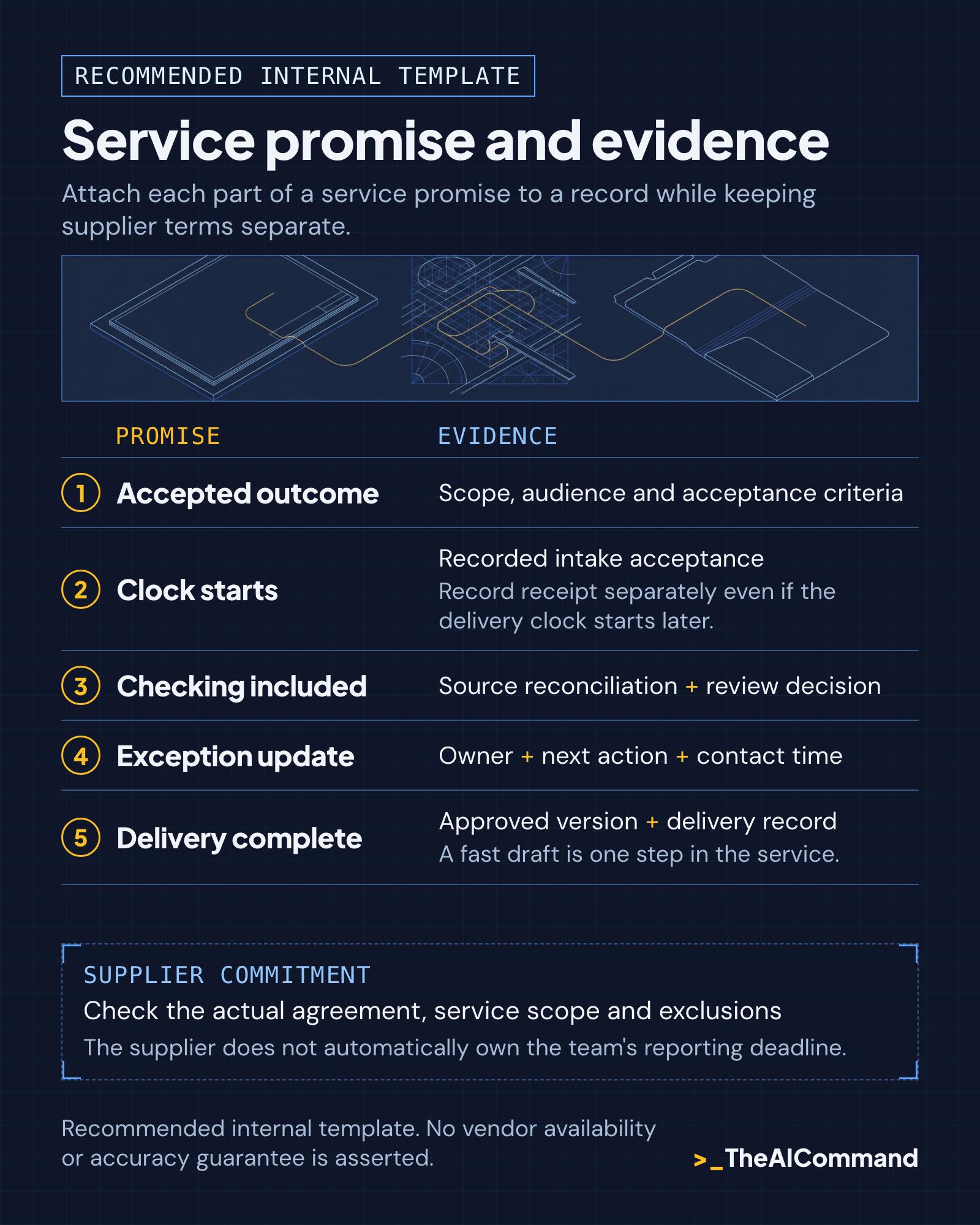
Start with a sentence a requester can recognise: "The service provides a checked internal report for the agreed reporting period, with source references and unresolved issues disclosed." That describes an outcome. "The service uses AI to prepare a report" describes a method and leaves the acceptance boundary unclear.
Define the standard report's scope. Specify the permitted source pack, reporting period, audience and output format. Explain whether the service includes reconciliation, commentary and an approval step. State exclusions such as external publication, legal interpretation or decisions about individual employees. A request that crosses those boundaries needs a separate scope decision rather than a hurried exception hidden in the prompt.
Define what the requester receives at intermediate points. An acknowledgement confirms receipt. A draft is available for checking. A checked report has passed the specified review. An accepted report has the authorised decision attached. If a requester chooses to view a draft early, its status must remain visible so availability is not mistaken for permission to rely on it.
The same distinction applies in public-sector teams, although their approval, records and disclosure requirements may differ. Do not copy a private business's turnaround promise into a government function without checking its actual authority and obligations. The template provides questions for local agreement, not a universal service standard across Australian organisations.
Make the clock's boundary explicit
A turnaround promise needs a start event. Does time begin when an email arrives, when the request is acknowledged or when required inputs pass intake? Each can be used, but the standard must state which one applies. Record receipt separately even if the delivery clock starts later, otherwise intake delays can disappear from the service record.
Define service hours, time zone and how non-service days are treated. Explain what happens to a request received outside those hours. A target expressed in "hours" is ambiguous if one person means elapsed hours and another means staffed hours. Avoid relying on an assistant's interpretation of calendars or public holidays when the approved service calendar is the authority.
If missing information pauses a delivery clock, show the pause start, reason and request to the source owner. Resume it when the agreed condition is met, retaining the history. Also report total elapsed time. A service that meets its target only by repeatedly stopping the clock may still leave its users unable to plan.
Set a separate expectation for updates. The team may be unable to complete a report while a source is disputed, yet still be able to acknowledge the problem and give a next contact time. A promise to communicate progress is useful when a completion estimate remains uncertain. Do not turn that update into an invented commitment to finish.
Worked example: a fictional weekly reporting service
Consider a constructed private-sector facilities business that requests a weekly internal maintenance summary. Every record, duration and response below is invented for this exercise. No model was timed, no production service was observed and no accuracy rate was measured. The example shows how to write a service commitment that can later be tested.
The agreed input pack contains job-status extract R-8, category definitions D-2 and a reporting brief naming the week and audience. R-8 contains twenty synthetic jobs: thirteen closed, four open and three awaiting an access window. The definitions distinguish status from timeliness. No service deadlines or individual worker details are included in the pack.
The service offers a checked summary of recorded status, a brief explanation of unresolved items and an appendix linking figures to the source. It excludes statements about whether the work met contractual obligations, whether individual staff performed well or whether the open items create a safety risk. Those questions require other evidence and the appropriate human authority.
The bounded AI task is to draft narrative from the reconciled figures and list missing facts. A useful constructed output says, "The extract records thirteen closed jobs, four open jobs and three awaiting access. The pack does not establish whether the open items are overdue." The reviewer checks that all twenty records are represented and that the uncertainty survives editing.
An unsuitable output would say, "The team completed all urgent work on time." Neither urgency nor timeliness is present in the source pack. The review process rejects that sentence rather than trying to make it sound more cautious. A source cannot support a conclusion about a field it does not contain.
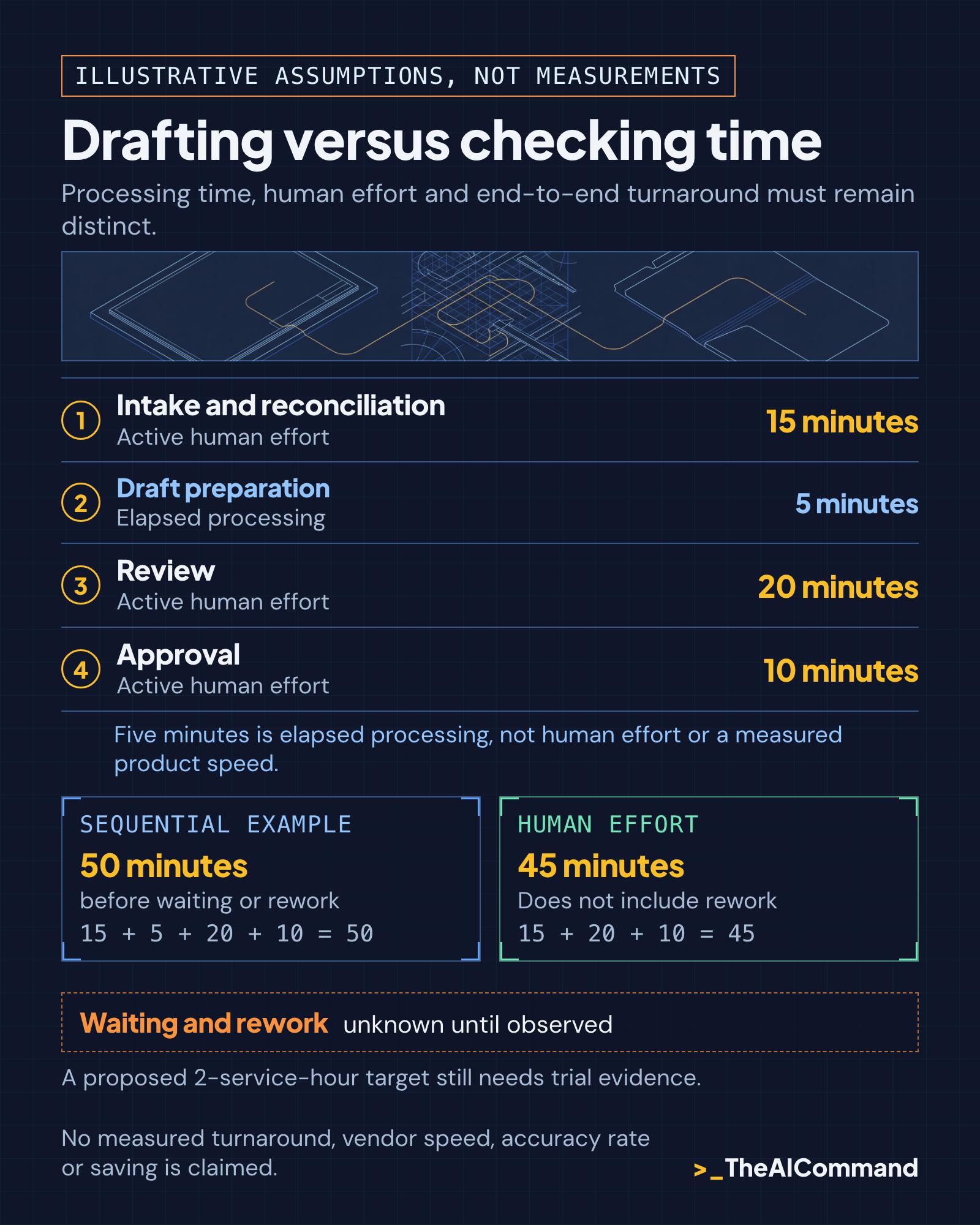
For planning only, suppose intake and reconciliation need fifteen minutes of active human work, draft preparation uses five minutes of elapsed processing, review needs twenty minutes and approval needs ten minutes of active human work. These figures are illustrative assumptions, not measurements. They identify fifty minutes of sequential work in this simplified example, before any waiting or rework is added.
The human effort in that assumption is forty-five minutes. The five-minute drafting interval is not interchangeable with human effort, and none of the figures establishes actual turnaround. If the reviewer is unavailable for an hour, elapsed delivery time grows even though the active review estimate is unchanged. Record effort and waiting separately when the service is tested.
Assume the team proposes a two-service-hour target from accepted intake to an approved report, during locally defined service hours. That is a proposed internal commitment for discussion, not a recommended industry benchmark. Before adopting it, the owner needs evidence from representative work and confirmation that a reviewer and approver can actually be available within the proposed window.
Now introduce an exception. R-8 arrives without a reporting cut-off, and the requester says it is "the latest extract". The service records receipt but cannot accept the pack against the weekly scope. The owner asks for the cut-off and identifies the report as awaiting source clarification. The model must not infer the period from the filename or today's date.
A useful exception message says, "The reporting cut-off is missing, so the pack has not passed intake. The source owner is confirming the period. The service owner will provide an update at the agreed contact time; a completion time is not yet confirmed." It describes the block without blaming the requester or suggesting that drafting can solve it.
When the source owner confirms the period, intake can proceed and the start event is recorded. If the answer instead reveals that the extract covers a different week, the pack remains unsuitable. The operator can agree a revised scope or wait for the correct source. That is a human service decision, not a reason for the assistant to quietly relabel the data.
Put checking inside the commitment
A useful standard states what the reviewer checks before delivery. In the example, the reviewer reconciles the population, confirms the period, traces material claims and checks that the report does not imply unsupported timeliness or safety conclusions. The approver then confirms suitability for the intended internal audience. Both roles need a defined substitute or a stated exception route.
Describe evidence of review rather than requiring a decorative signature. Record the output version, reviewer, checks performed, unresolved issues and decision. A reviewer may return the report for correction or accept it with an explicit limitation if authorised to do so. The model can prepare the record's structure, but the person supplies the actual review result.
Internal audit provides a useful professional comparison with a defined scope. The IIA's Standard 15.1 addresses approval of final engagement communications, and Standard 15.2 addresses follow-up of recommendations or action plans. These are internal audit requirements. They do not make this reporting template compulsory or establish an AI service turnaround target. [2]
Do not promise perfect accuracy. Define acceptance criteria that a person can check, such as reconciling reported totals to the approved extract and preserving identified limitations. Those checks can catch specific problems. They do not guarantee that the original source is complete or that every possible interpretation has been considered. Explain what assurance the service actually provides.
Separate the team promise from the vendor contract
The team controls its intake rules, review allocation and communication arrangements. It may depend on an AI supplier for processing availability, but the supplier does not automatically own the team's reporting deadline. A vendor response arriving quickly cannot complete reconciliation or business approval that the team has left unassigned.
OpenAI's Services Agreement is a concrete example of a contractual boundary: section 4.3 assigns the business customer responsibility for evaluating output accuracy and appropriateness. Its stated scope covers specified business and developer services, not all consumer use. Check the agreement applicable to the actual purchase rather than transferring this provision to every product. [1]
Any supplier availability commitment must be checked in the applicable agreement, order and service-specific terms. Record what service is covered, how availability is defined and which exclusions or remedies apply. This article makes no assertion that a particular plan includes an availability guarantee. A pricing-page feature label is not enough to establish the team's contractual position.
Write the internal fallback in business terms. If the approved drafting service is unavailable, the owner may use a permitted manual process, agree a narrower report or revise the delivery expectation. Do not quietly switch to a personal account or unapproved supplier. A service interruption does not create permission to move the source pack elsewhere.
Make exceptions visible without normalising them
Agree which events require the service owner to intervene. Missing inputs, conflicting definitions, failed processing and unavailable reviewers need different responses. A general "delayed" status conceals that distinction. Use a concise reason, accountable role, next action and update point. Record whether the delivery target remains achievable, uncertain or formally revised.
Where the report has already been delivered with an error, the service includes a correction route. Preserve the affected version, identify the recipients and assess downstream use. The authorised owner decides what correction is required and communicates it through the established channel. A regenerated report is not a completed correction until the relevant people know what changed.
Review repeated exceptions as service-design evidence. If the same input is missing each week, improve the intake agreement. If approval repeatedly waits on one person, examine coverage and authority. Do not use an AI-generated explanation to conclude that a worker is underperforming. The service record identifies operational questions; people assess their causes in the proper process.
Test the promise before making it routine
Trial the proposed standard on representative work with approved data handling. Record actual intake delays, processing intervals, review effort, rework and acceptance times. Retain failures and requests that never reached acceptance. Excluding difficult cases would make the headline look better while hiding the conditions that determine whether requesters can rely on the service.
Compare results with the proposed target without confusing measures. Report the number of accepted requests, the number completed within the target and the number still open. Explain the reporting period and any exclusions. A fast average can coexist with unresolved work that matters to a requester, so also examine the oldest outstanding item and its next action.
Only then decide whether to adopt, narrow or revise the commitment. Keep the version and effective date with the standard so earlier requests can be assessed against the expectations that applied when accepted. Revisit it after material changes to the source pack, workflow, supplier or review capacity. A promise needs maintenance as the service changes.
Agree one standard with one requester
Choose a recurring report and draft the service definition with its main requester. Set the acceptance boundary, clock, review evidence and exception message before debating a faster target. Use the constructed example to expose assumptions, then replace its invented times with observations from the actual approved workflow.
The immediate goal is a commitment both sides can understand. The requester knows what arrives and when an uncertainty will be explained. The team knows which checks belong inside delivery. Keep the promise attached to the accepted outcome, and make any limit visible before someone has to rely on the report.
Copyable resource
Use the service-standard template, worked assumptions and exception-handling prompt below. All timings are illustrative until replaced with approved local evidence.
Service-standard materials
Recommended internal workflow for human adaptation. All example durations are illustrative planning assumptions, not measurements or vendor commitments.
Service-standard template
This template does not establish a legally binding service-level agreement. An authorised owner decides the nature and applicability of any commitment.
Constructed inputs and outputs
R-8: twenty synthetic maintenance jobs, thirteen closed, four open and three awaiting access. D-2: status categories describe recorded progress, not timeliness. Reporting brief: weekly internal status summary, period must be confirmed before intake acceptance. No deadlines, urgency flags, individual performance or safety assessment supplied.
Expected draft: "The extract records thirteen closed jobs, four open jobs and three awaiting access. The pack does not establish whether the open items are overdue."
Reject: "The team completed all urgent work on time." The supplied pack contains neither urgency nor timeliness evidence.
Illustrative time assumptions
Calculation: 15 + 5 + 20 + 10 = 50 minutes in the deliberately sequential example. Human effort: 15 + 20 + 10 = 45 minutes. Waiting, interruptions and rework are excluded from these invented figures and must be observed in a real trial. Do not represent 50 minutes as human effort or claim a saving against an absent baseline.
Exception-handling prompt
Constructed exception notice
"The reporting cut-off is missing, so the pack has not passed intake. The source owner is confirming the period. The service owner will provide an update at [AGREED_UPDATE_TIME]; a completion time is not yet confirmed."
The placeholder remains until a human supplies an actual agreed update time. No fabricated communication or delivery is recorded.
Human acceptance and trial checklist
- [ ] Reporting period, population and definitions confirmed.
- [ ] Totals reconcile; unsupported claims removed; limitations visible.
- [ ] Reviewer and approver identify the exact output version.
- [ ] Receipt, intake, pauses, review and delivery events recorded distinctly.
- [ ] Failed, abandoned, rejected and still-open requests retained in trial data.
- [ ] Actual observations separated from assumptions and from supplier terms.
- [ ] Fallback approved without moving data to an unapproved service.
- [ ] Correction recipients and downstream uses considered when relevant.
- [ ] Commitment adopted or revised by the authorised human after evidence review.
Related reading
- The Review Tax: AI Adoption Is Done, Now Design the Checking
- A Buying Checklist for Individual and Team AI Plans, the companion article for 20 November
References
- OpenAI: Services Agreement, updated 1 December 2025, effective 1 January 2026, scope and section 4.3
- The Institute of Internal Auditors: Global Internal Audit Standards, condensed edition, published 9 January 2024, Standards 15.1 and 15.2
TheAICommand. Intelligence, At Your Command.