
The manager has a paid AI account because it was easy to approve. The coordinator who prepares three document packs each week keeps asking for help. Another colleague has access but cannot use it for their actual work under the organisation's data rules. Counting licences makes the rollout look complete. Following the work reveals the gaps.
An access proposal needs to explain who can perform which task, with what information and under whose review. Seniority can determine approval authority. It provides little evidence about how much model capacity a person needs. A useful proposal makes those two decisions separately and leaves room to revise the allocation when actual use becomes visible.
This article uses ChatGPT and Claude as documented examples, checked on 24 October 2026. It does not rank their output quality. No accounts were tested for this comparison, and none of the fictional workload descriptions is a measured usage result. The method below is an editorial recommendation for preparing an access decision, subject to the organisation's existing rules.
Describe a piece of work before naming a plan
Start with a sentence that a colleague could recognise: prepare a draft comparison of two public policies for review. That sentence identifies the input, the contribution and the output. Asking for access to an advanced model leaves all three unspecified. It also makes it difficult to distinguish a genuine requirement from a feature somebody would like to try.
Next, identify what successful assistance would look like. In the policy example, the draft must preserve document versions and distinguish a changed requirement from different wording. The reviewer needs source locations beside each proposed change. A fluent summary without those locations fails the task, regardless of which plan produced it. Write the acceptance condition before considering additional capacity.
Separate capability from volume. Reading attachments is a capability requirement. Repeating that work across a concentrated deadline period is a capacity question. Accessing an approved shared workspace is another requirement. Recording all three prevents a common purchasing mistake: paying for more usage while the person still lacks permission to access the required source or feature.
Ask what happens if the tool is unavailable. A draft for next month's internal workshop can wait. An essential service deadline needs a workable manual route. Describe that fallback in the same task record. Do not use a more expensive subscription as a substitute for a continuity arrangement that has never been practised.
Establish the information boundary first
The proposed input matters as much as the desired output. A public policy, an unpublished commercial proposal and an employee record create different approval questions. Avoid the shorthand that a document is safe because names have been removed. Ask the information owner what remains identifying or restricted and whether the intended service is approved for that material.
The Office of the Australian Information Commissioner recommends due diligence when selecting commercially available AI and, as best practice, avoiding personal and especially sensitive information in publicly available generative AI tools. Its guidance addresses both inputs and outputs. Apply its scope carefully; it is not an assurance that a particular subscription satisfies an organisation's obligations. [1]
For the access proposal, record the approved input class in ordinary language. An occasional drafting role might use public guidance and wholly fictional examples. A confidential workflow may remain outside the pilot until the responsible teams assess it. Both decisions are useful. Buying access does not remove an unresolved permission question, and a pilot does not need real personal records to begin.
Keep the account boundary equally clear. Each user needs their own authorised access. Shared credentials would make it harder to attribute activity and remove access when responsibilities change. Anthropic's Team guidance expressly makes seats individual and says members cannot transfer their usage allowances between themselves. [2] Do not propose a common login as a way to stretch capacity.
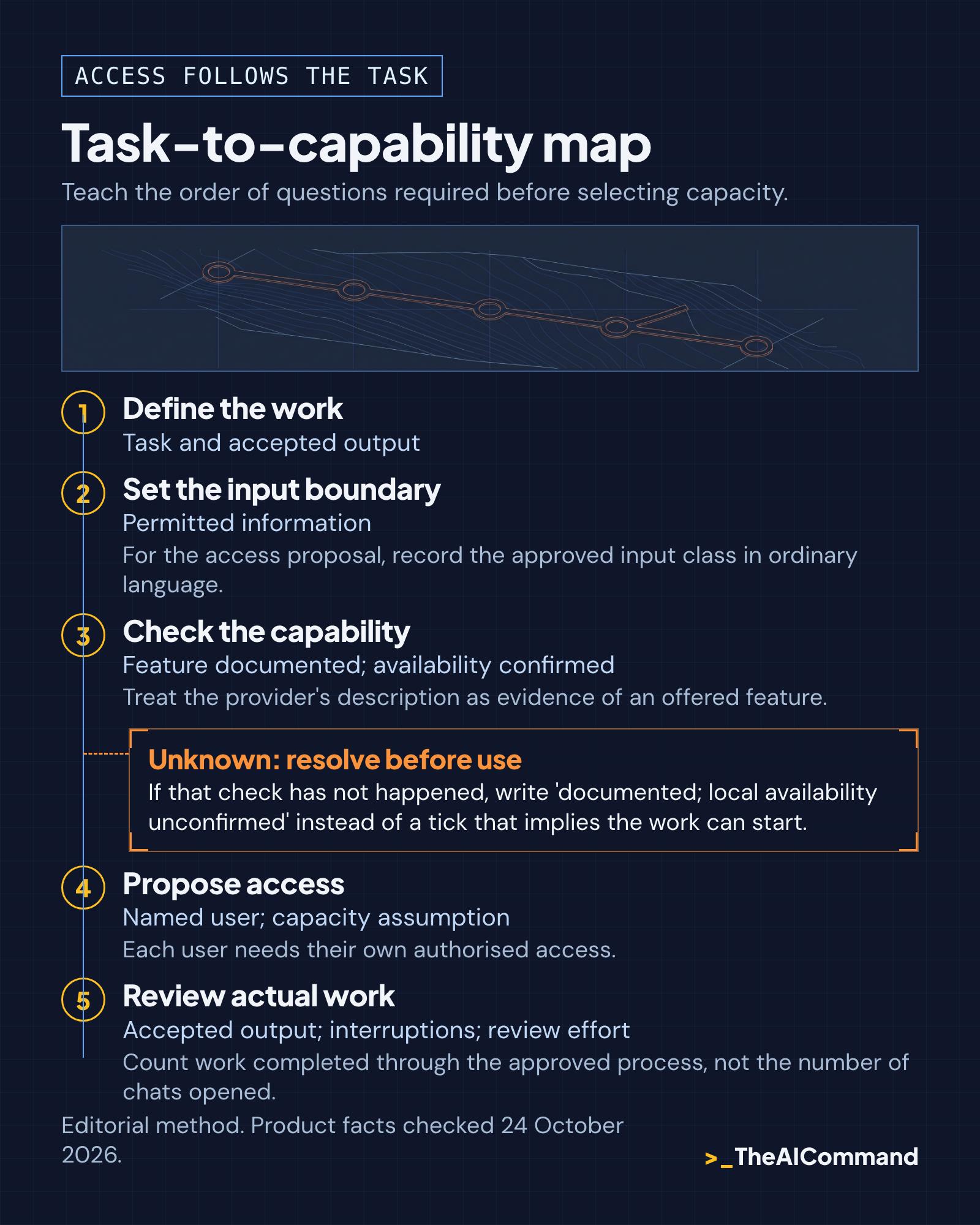
Read the workspace features separately from the usage offer
OpenAI describes ChatGPT Business as a workspace with central billing and administration, supporting Standard and Premium seats. Anthropic documents central access and billing management for Claude Team and allows mixed seat types. [3][2] These are useful facts for an allocation proposal, because a common workspace does not require every role to have identical usage capacity.
Treat the provider's description as evidence of an offered feature. It does not show that the feature is enabled in your workspace or that the workflow produces acceptable results. Ask the workspace owner to confirm the actual configuration. If that check has not happened, write 'documented; local availability unconfirmed' instead of a tick that implies the work can start.
Data-handling statements also need their own reading. Anthropic says commercial inputs and outputs are excluded from training by default, with exceptions for feedback or other permission. [4] This is a scoped vendor commitment. It does not answer every retention, location, access or contractual question. Preserve those questions for the organisation's assessment rather than collapsing them into a single 'private' label.
Administration involves people as well as features. Name the person who may authorise a new seat, the person who reviews additional spending and the person who removes access. Keep these responsibilities distinct from reviewing model output. The best drafter in the team need not control billing, and the bill payer need not approve professional conclusions.
Five fictional profiles, five different access decisions
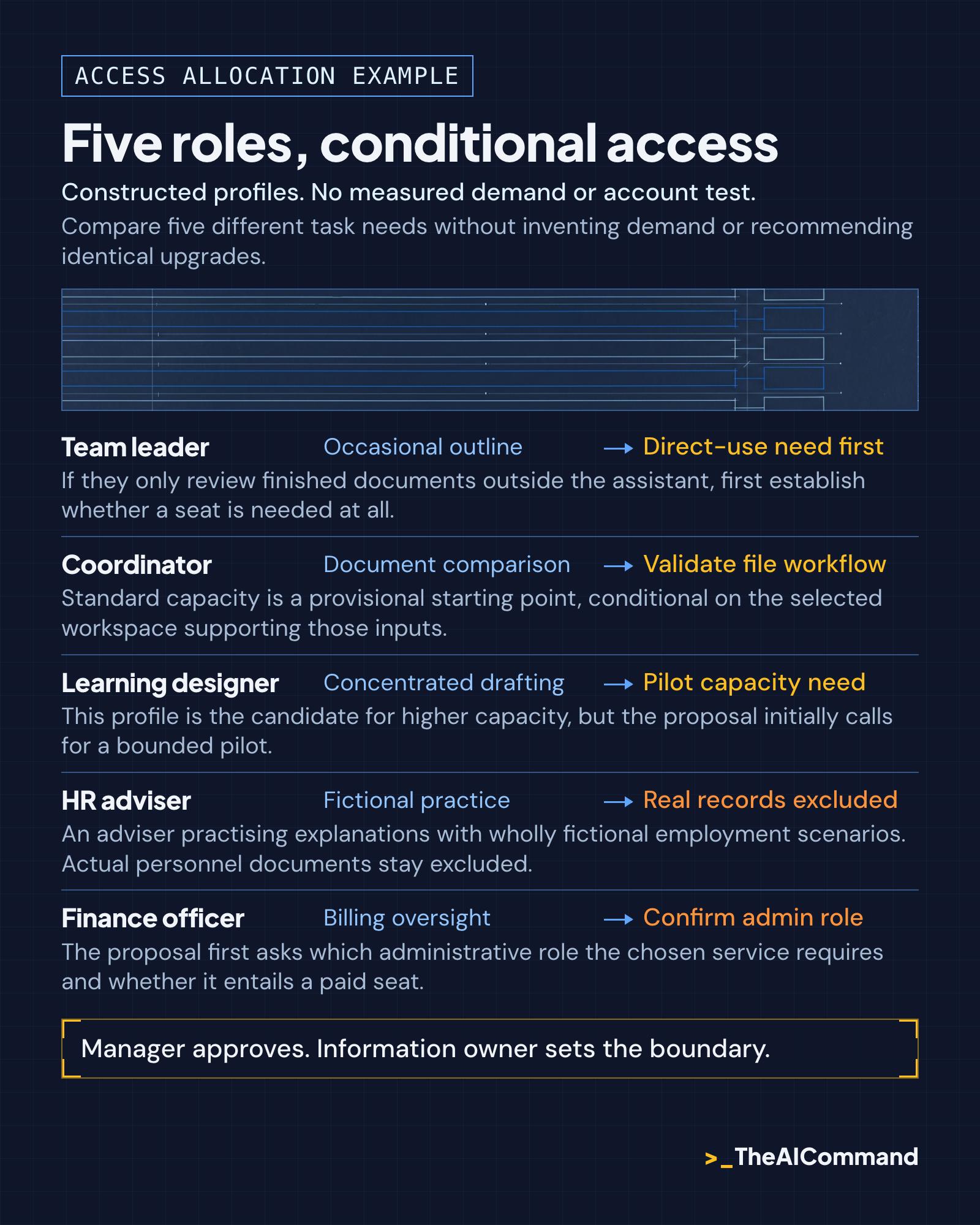
Consider a fictional Australian private-sector operations team. Its pilot permits only public documents and original fictional examples. The five profiles below are constructed planning inputs. Descriptions such as 'weekly' and 'intensive' express the team's proposed work pattern, not observed demand. Either ChatGPT Business or Claude Team remains a candidate pending the organisation's own assessment.
The team leader prepares an occasional workshop outline from published material. Their task needs ordinary drafting and source checking, with no urgent turnaround. The initial proposal is a named standard-capacity seat in the approved workspace if direct use is necessary. Leadership rank adds no reason for a higher allowance. If they only review finished documents outside the assistant, first establish whether a seat is needed at all.
The operations coordinator prepares a weekly comparison pack from several public documents. Their proposal requires attachment handling and a repeatable source-location format. Standard capacity is a provisional starting point, conditional on the selected workspace supporting those inputs. The coordinator records interruptions during a representative pilot. The manager does not turn the number of source documents into an invented message allowance.
The learning designer expects concentrated drafting during workshop preparation. This profile is the candidate for higher capacity, but the proposal initially calls for a bounded pilot. The question is whether approved work repeatedly stops at an included limit and whether the extra capacity materially helps. A large number of prompts alone would be insufficient evidence if repeated corrections consume the allowance.
The HR adviser wants to practise writing explanations using wholly fictional employment scenarios. That practice can be assessed within the pilot's input boundary. Actual personnel documents remain excluded. An individual consumer subscription is not a workaround for that exclusion. The adviser can learn the method while a separate organisational decision addresses any proposed use of workplace records.
In this fictional team, the finance officer reviews invoices and authorises spending within the agreed plan. They do not need a higher-capacity drafting seat simply because they manage the budget. The proposal first asks which administrative role the chosen service requires and whether it entails a paid seat. That detail is left unconfirmed until checked. Administrative responsibility and content-production demand remain separate entries.
The resulting recommendation is deliberately conditional: establish named access for the roles that need direct use, confirm the coordinator's file workflow and measure the designer's interruptions. Keep the HR input restriction. Resolve the finance role before purchase. There is no unsupported declaration that one vendor is best for finance or that a particular plan will handle a week's work.
Let AI organise the proposal without deciding access
The planning prompt can use these fictional profiles, approved policy excerpts and dated vendor passages. Its bounded job is to map requirements to evidence and identify gaps. Do not upload a real staff directory, credentials, confidential commercial terms or raw activity logs. Role labels are enough to prepare the first version of the proposal.
An acceptable draft row would say that the coordinator needs document comparison, that file-workflow suitability remains untested and that a named manager must approve the pilot. An unacceptable row would invent a weekly token requirement or label HR data safe because the workspace has a business name. The reviewer removes such claims instead of treating them as useful estimates.
Require a reason for every proposed upgrade and an explicit unknown where evidence is missing. Ask the model to retain the distinction between vendor documentation and a local observation. If a feature is mentioned on a general product page but its plan entitlement is unclear, the output must keep that uncertainty. The final allocation belongs to the authorised manager.
Measure work completed, including the checks
Before the pilot starts, agree a small observation record. Capture the task type, approved input class, whether the output passed review and whether access interrupted completion. Record the model and product surface used when relevant. Keep this at task level; collecting private conversation contents is unnecessary for deciding whether a role's capacity is adequate.
Include reviewer effort. A draft that arrives quickly but requires extensive repair is different from one that is ready for a short check. Record the repair reason rather than assuming the subscription is too small. Missing evidence, unclear instructions and unsupported conclusions call for changes to the workflow. More allowance may simply make the same problem easier to repeat.
Count work completed through the approved process, not the number of chats opened. A person who submits few requests may finish valuable work with careful preparation. Another may send many requests because the source material is unsuitable. Usage information becomes decision evidence only when read beside the task and its result. It is not a league table of employee capability.
Set the review date around a representative working period. Include a deadline cycle if deadline concentration is the reason for the request. A quiet week cannot settle a claim about intensive monthly preparation. Conversely, an unusual launch week should not establish a permanent allocation without considering whether the same demand will recur.
Change access when the evidence changes
An upgrade is easier to defend when the record names a repeated interruption of permitted work and an affordable response. Compare the proposed capacity change with rescheduling, narrower inputs or the existing manual route. Do not promise a precise productivity saving from vendor allowance language. Any saving needs evidence from the team's own reviewed work.
A lower allocation can also be justified, but speak with the user before acting. Infrequent use may reflect a missing permission, inaccessible training or work that occurs only periodically. Removing access without understanding the cause can preserve the original problem. Where the role no longer needs direct use, follow the workspace's authorised access-removal process and preserve required business records.
Reopen the assessment when the task starts using different information, a connector is proposed or the provider changes an entitlement. These are more meaningful triggers than an automatic upgrade at promotion. A seat can stay unchanged while the permitted input boundary tightens. Equally, a junior role can need higher capacity without receiving authority to approve consequential decisions.
Put one decision in front of the approver
Give the approver a short proposal they can act on: the task, named user role, approved inputs, candidate access, unresolved conditions and review date. Attach the supporting vendor passages and the pilot acceptance criteria. Separate permission to run the pilot from permission to buy additional usage. That makes both the financial decision and the professional boundary visible.
Start with the coordinator's next public-document pack. Confirm the information boundary, test the required output format and record the result. Then use that evidence to decide whether access needs to change. The useful outcome is a person who can complete approved work with an accountable review path, rather than an impressive list of subscriptions.
Task-to-access matrix
Constructed example. All allocations are proposals, not entitlements or purchases.
Copyable access-planning prompt
Reusable materials
These are reusable planning materials, not a completed workplace assessment. Examples are constructed. Use only approved public material, independently invented examples and policy excerpts approved for the chosen environment. Do not supply real staff, claimant or client data, credentials, account details, confidential contracts or payment information. Human approval is required before any access, purchase or workflow change.
Blank task-to-access record
Constructed five-profile access matrix
All rows are fictional proposals. They assign no measured demand or entitlement.
Observation record
Do not include conversation contents or rank staff by message volume. Record task-level evidence sufficient for the access decision. Never use a low activity count by itself as a reason to remove access.
Human review checklist
- Confirm input permission independently of the candidate plan.
- Verify each vendor feature against the exact source and current plan.
- Keep proposed patterns separate from observed use.
- Require individual identities; never use shared credentials.
- Preserve output review and the manual route during a capacity pilot.
- Obtain named-role approval before buying, upgrading or removing access.
Ready-to-use prompt
Expected output and unknown handling
Return a reviewable table with a source or an explicit UNKNOWN for each factual field. Keep a separate list of decisions needing a human. The example output may use only the constructed scenarios above. Do not turn a proposed action into an account change. Copy the prompt and template into an approved working document; a separate download is not required.
Related reading
- Choosing Claude, ChatGPT, Gemini or Copilot for Your Job
- What Counts Towards Your AI Subscription's Usage Limit?, the companion article for 17 November
References
- OAIC guidance on commercially available AI
- Anthropic: Claude Team plan
- OpenAI: ChatGPT Business FAQ
- Anthropic commercial data and model training
TheAICommand. Intelligence, At Your Command.