
Start with the work left at the end of the evening
The committee meeting has ended, but someone still needs to turn the agreed actions into a weekly update. A volunteer has notes in a document, the next event date sits in a spreadsheet and a draft notice has last month's opening hours. That is a useful place to examine an AI writing aid: a bounded piece of administration with identifiable source material.
A volunteer-led charity does not need an ambitious automation programme to try this carefully. It needs a clear task, a realistic checking commitment and an ordinary way to continue when the tool is unavailable. A process that depends on one volunteer's private account or unexplained instructions may add a new dependency to an already stretched team.
The setting here is a fictional Australian registered charity. That matters because the Australian Charities and Not-for-profits Commission (ACNC) guidance is directed to charities. A neighbourhood group, informal association or other volunteer organisation must identify its own structure and obligations. The practical worksheet can be adapted, but registration-specific responsibilities cannot be assumed to apply to every group.
This article develops an original operating example, rather than reporting a charity's actual results. All dates, activity counts and records in the example are constructed. No beneficiary, donor or volunteer information has been used to create them, and no fundraising or public communication is sent by the workflow.
Select a task the team can inspect
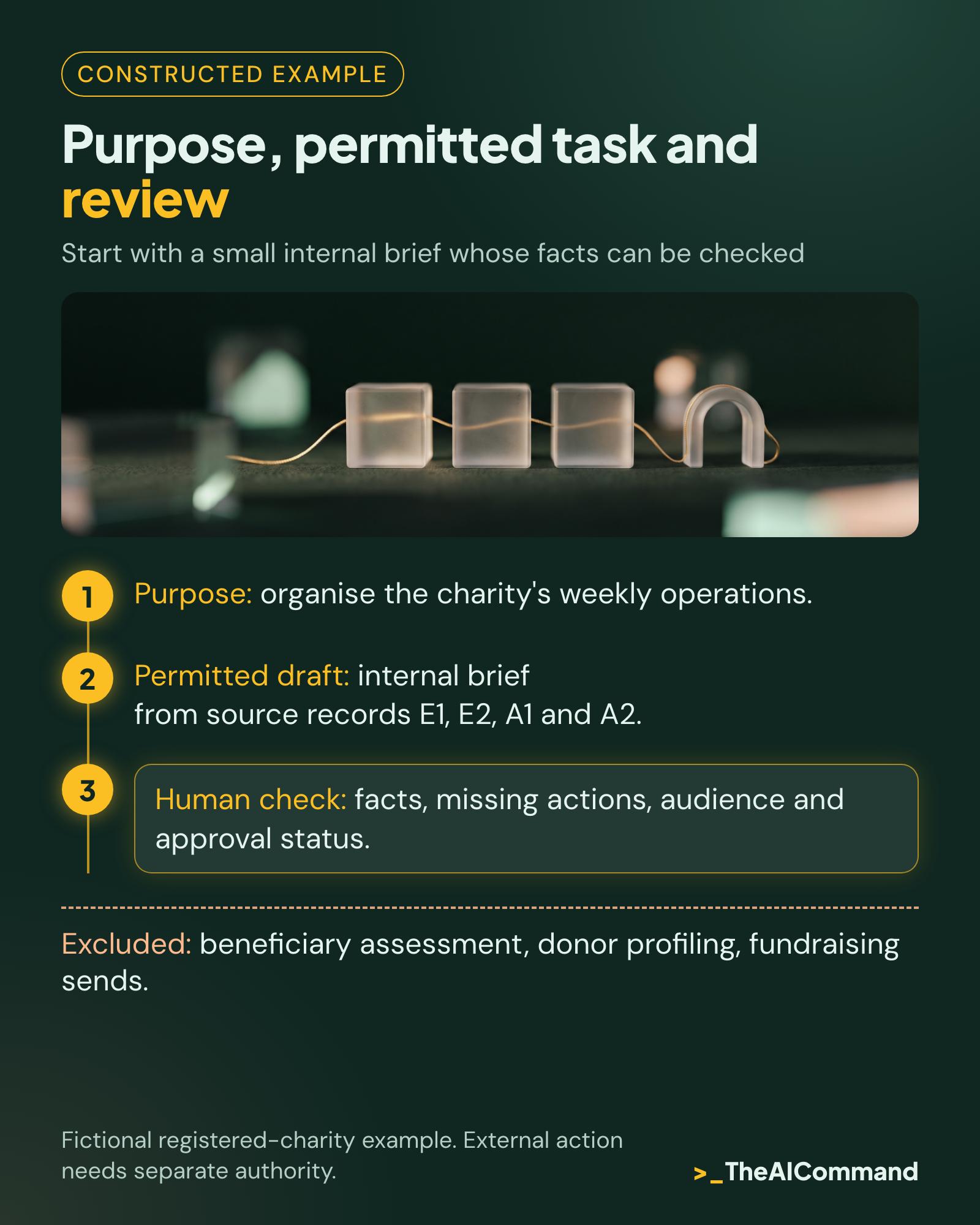
Start by describing the purpose of the work in ordinary language. "Prepare the internal weekly operations brief from approved updates" gives a reviewer something concrete to inspect. "Use AI to improve engagement" does not say which inputs are allowed, what output is expected or who decides whether it is accurate enough to use.
The ACNC's guidance on charities and artificial intelligence treats adoption as a strategic choice requiring risk management and suitable oversight. It asks charities to consider whether AI is an appropriate solution and how it serves their purposes. That provides a reason to begin with a defined organisational need rather than a tool demonstration.
For a first exercise, prefer a task with short inputs and errors that a nominated reviewer can detect. A draft notice based on an approved event sheet can be checked against that sheet. An answer about a person's eligibility for help may require sensitive facts, professional judgement and a much more demanding review process. Keep that second task outside this example.
Also consider whether a template would solve the problem on its own. If the weekly brief always consists of four fields copied from one table, ordinary document tools may be sufficient. AI is worth testing when the drafting or organisation work is material and the team can still explain how the result was checked. Convenience is a hypothesis to examine, not a guaranteed saving.
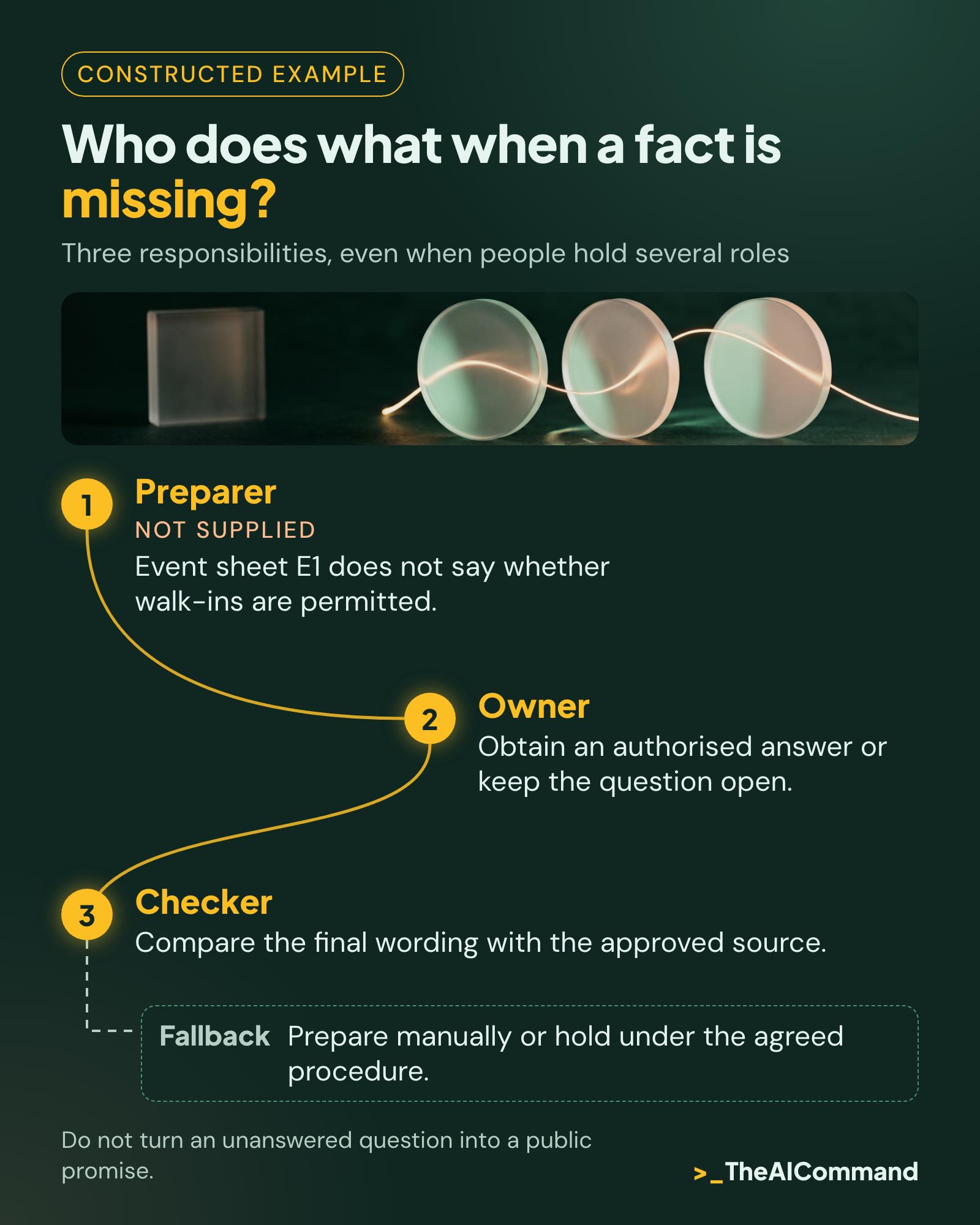
Three responsibilities, even when people hold several roles
Give the task an owner who decides its boundaries. In the constructed charity, that is the committee's operations lead. The owner approves the source categories, agrees the intended recipients and decides when the trial pauses. This responsibility is wider than writing the prompt. It includes whether the process remains useful after the first enthusiastic volunteer steps away.
The preparer assembles the approved source packet and creates the draft. The checker compares the draft with that packet, records corrections and authorises the version used internally. These are responsibilities, not a claim that every small charity needs three additional people. One person may hold more than one role, but the resulting review limitations must remain visible.
For the initial example, the charity uses two volunteers: one prepares and one checks, with the operations lead owning the procedure. If the checker is away, the brief is prepared manually through the existing process or held until the agreed review occurs. The workflow does not quietly convert absence into permission to send an unchecked draft.
Keep a short handover note beside the template. It identifies the approved input folder, the output location, the prompt version and the person to contact about a disputed fact. Do not include passwords or personal account details. The point is that an authorised replacement can understand the task without reconstructing it from someone else's chat history.
Build a packet that excludes the sensitive work
The fictional charity runs public repair workshops and maintains a community equipment library. Its trial packet contains an approved event sheet, a list of equipment awaiting a routine administrative action and committee actions cleared for the internal brief. It excludes member contact details, donor histories, beneficiary circumstances, complaints and any safeguarding matter.
That exclusion is a deliberate design choice for this example. It does not claim that removing a name makes a real record anonymous. Combinations of circumstances can still identify someone. Before operational use, the charity needs to examine the actual material, access arrangements and product terms rather than applying the word "de-identified" as a general assurance.
The Office of the Australian Information Commissioner's guidance on commercial AI products recommends, as best practice, avoiding personal and especially sensitive information in public generative AI tools. It also addresses product due diligence and human oversight. Whether a particular charity is covered by the Privacy Act requires its own assessment; this article does not decide that question.
Use the charity's approved workspace and permitted product settings. Do not solve an access problem by moving the packet into a personal account. If no suitable tool has been approved, rehearse the method with wholly invented records and keep real operations manual. A fictional practice exercise can teach the review method without implying that organisational permission already exists.
Work through one weekly brief
The example packet has four source records. E1 says the public repair workshop is planned for Saturday 5 December, from 10 am to noon, at the community hall. E2 says volunteer setup begins at 9.30 am. A1 assigns the equipment coordinator to confirm the projector booking by Wednesday. A2 says the updated tool-return notice is awaiting committee approval.
All four records are invented teaching material. The date is set in 2026 for illustration only, and no real booking or venue availability is being asserted. The packet deliberately includes one uncertainty: the event sheet does not confirm whether walk-ins are permitted. That omission is useful because it tests whether the draft leaves a gap visible or supplies a friendly but unsupported invitation.
The preparer asks the model for an internal brief with an event section, outstanding actions and questions requiring confirmation. Each statement must carry its source ID. The model may shorten wording, group related items and suggest a draft public notice based only on the approved event information. It cannot approve the tool-return notice or answer the walk-in question from general knowledge.
A suitable constructed output says the workshop is planned for 10 am to noon, citing E1, and that setup starts at 9.30 am, citing E2. It lists the projector confirmation as an action assigned to the equipment coordinator, citing A1. It keeps the tool-return notice under "awaiting approval", citing A2. The unanswered walk-in question appears in the questions section.
The draft public notice can state the supplied event details and stop there. It must not add "all ages welcome", "free repairs guaranteed" or an invented booking link. Those phrases may sound helpful, but none is supported by the packet. A reviewer would return the draft for correction if they appeared. This is an expected-output illustration, not a recorded product test.
Review meaning, not just spelling
The checker begins with the facts whose alteration would change what someone does: the date, time, place, required action and approval status. They open the source records and compare each sentence. A polished paragraph can still turn a planned activity into a confirmed one or make a pending decision sound settled.
Next, the checker examines omissions. An AI draft might preserve every event detail but drop the projector action because it seems administrative. That action may be precisely what the internal brief needs. A short checklist should therefore test both what the output says and what the packet requires it to carry forward.
Then check tone and audience. An internal operations brief can name an accountable role and a deadline. A public notice may need different context and approval. Keep the two outputs separately labelled. Copying a paragraph between them is a publication decision, not an automatic consequence of the internal draft being factually accurate.
Finally, record the result in a small run log: the packet version, draft version, checker role, corrections made and approved destination. Save only what the organisation's rules permit. The log is a way to reconstruct the work, not a reason to keep sensitive material forever or create an uncontrolled collection of volunteer information.
Set a trial the volunteers can sustain
The fictional charity chooses four weekly briefs as its initial trial. Four is a constructed local choice, not a recommended minimum or proof threshold. The owner can stop earlier if the tool repeatedly invents details, the checker cannot keep up or the packet becomes harder to prepare than the original brief.
Measure the whole effort. Record preparation, drafting and checking time separately, including the time needed to correct the output. Also record material errors and omissions. A faster first draft is not a useful result if another volunteer spends longer reconstructing the facts or if checking repeatedly falls to a person who did not agree to do it.
Compare the trial with a straightforward manual brief using the same required content. Avoid claims that the tool caused a change when the template, workload or people also changed. A small charity can make a practical decision to keep or stop a method without presenting its local trial as research about the whole sector.
Use the existing AI operating rhythm for managers as background on regular review. For this example, the review can fit into an existing operations discussion. It needs to answer whether the brief is useful, what checking it requires and whether the people responsible can maintain it. Another standing meeting is not automatically necessary.
Keep an ordinary way to stop
Write the fallback before the trial begins. The preparer can complete the same brief template manually from the approved packet. The checker uses the same factual checks. If the AI product is unavailable, changes its features or becomes unsuitable for the task, the charity still has a working administrative process.
Treat any proposed expansion as a new decision. Moving from an internal brief to personalised donor messages changes the audience and the information involved. Connecting a tool to email changes what it can do. Neither follows automatically from success with a short document. Keep those proposals separate and obtain the required organisational review before changing the boundary.
A volunteer may also notice an error after a brief has been circulated. The owner needs a practical correction route through the charity's existing communication process. Record the affected version and correct the information with the appropriate people. Do not quietly replace the saved draft and leave recipients relying on an earlier version.
For the next weekly cycle, choose one small administrative task and assemble four or five approved source records. Name the preparer and checker, document what the model must leave unknown and keep every external action with the authorised person. The result to seek is a maintainable routine that helps the charity's work, with enough evidence to stop when it does not.
Reusable operating pack
The source packet, role checklist, trial log and task-selection prompt for this example are set out below.
Reusable volunteer-charity AI operating pack
Setting: a fictional Australian registered charity. Inputs and outputs are wholly constructed; this is not an operational test record.
Approved task boundary for the example
Purpose: prepare an internal weekly operations brief and a separately labelled public-notice draft from an approved non-sensitive packet. No sending, publishing, beneficiary assessment, donor profiling or fundraising action.
The example uses separate preparer and checker volunteers. A role allocation is not a substitute for the charity's own governance arrangements.
Constructed source packet
The year fixes the illustrative calendar only. The venue, date and activity are invented. No record is copied from a real charity.
Constructed expected brief
Workshop: planned for 10 am to noon on Saturday 5 December 2026 at the community hall [E1]. Setup starts at 9.30 am [E2].
Open actions: equipment coordinator to confirm the projector booking by Wednesday [A1]. The tool-return notice remains awaiting committee approval [A2].
Questions: Are walk-ins permitted? No answer is supplied in E1. Who will confirm the projector booking outcome? A1 assigns the action but contains no completion evidence.
Public-notice draft: "A repair workshop is planned for Saturday 5 December 2026, 10 am to noon, at the community hall." Draft only, requiring the charity's approval and any missing public information before issue.
Do not add a booking URL, eligibility promise, guarantee, price or impact statistic.
Copyable task-selection and drafting prompt
Trial and continuity checklist
- [ ] Suitable tool and workspace approved for the actual intended inputs.
- [ ] Preparer, checker and owner available; replacement documented.
- [ ] Input packet contains only permitted material.
- [ ] Factual changes and missing actions recorded.
- [ ] Internal and external drafts labelled separately.
- [ ] No external action performed by the workflow.
- [ ] Manual fallback tested as a document process.
- [ ] Four-run example trial reviewed without treating four as a universal minimum.
Blank trial log
Leave observations blank until measured. This log does not assert any time saving, successful trial or approval.
Related reading
- Managers Need an AI Operating Rhythm, Not More Pilots
- A Clear Record of Gifts, Benefits and the Decision Taken, the companion article for 22 November
References
- ACNC: Charities and artificial intelligence
- OAIC: Guidance on privacy and the use of commercially available AI products
- OAIC: Privacy for not-for-profits, including charities
- ACNC: Governance Standards
TheAICommand. Intelligence, At Your Command.