
A register entry needs more than a value
A register says "conference invitation, value unknown, approved". It does not identify the offeror's relationship with the organisation, the employee's role or who approved attendance. Someone reviewing it months later can see a conclusion, but cannot reconstruct how the conclusion was reached. Filling the value cell would not resolve all those gaps.
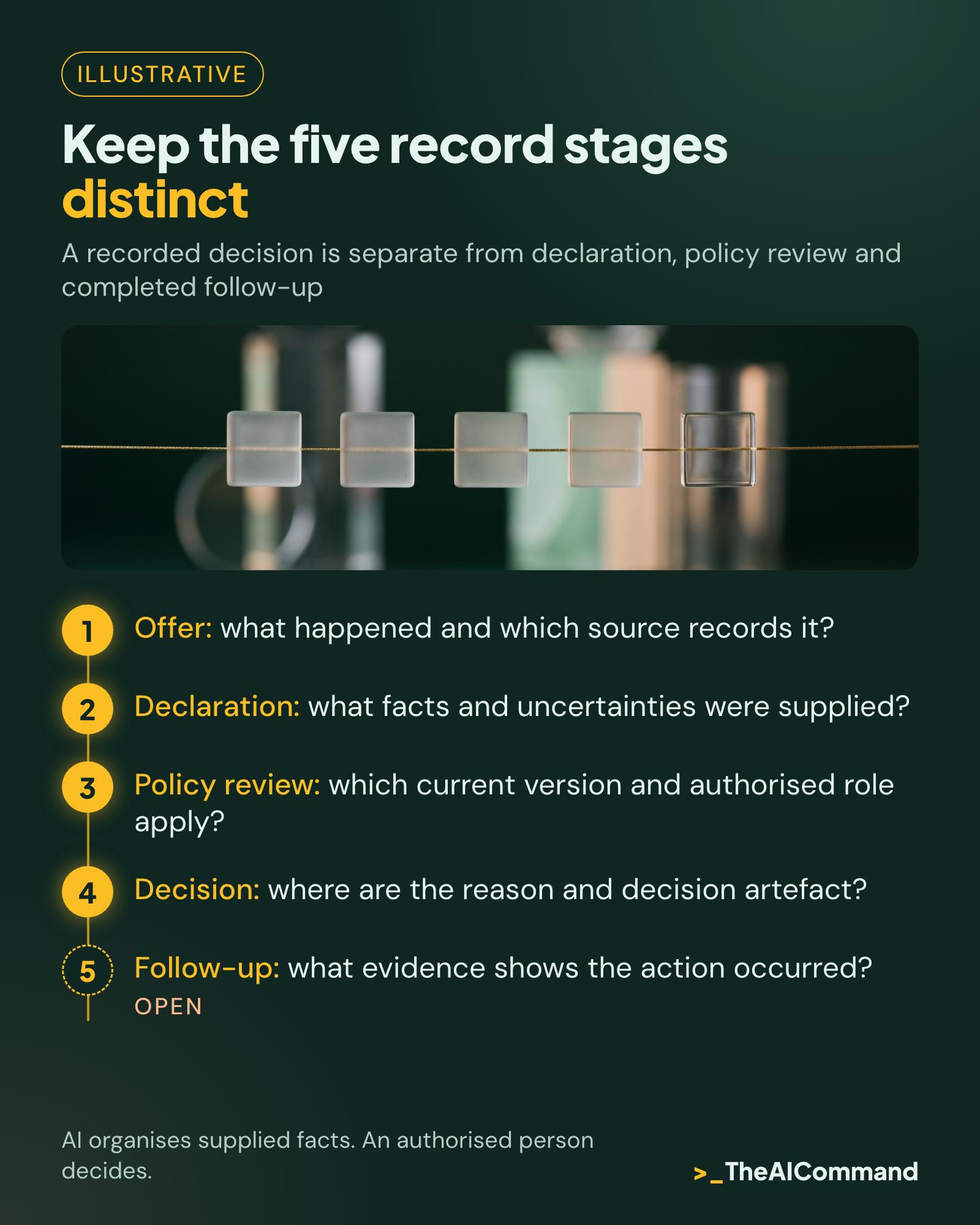
Gifts and benefits administration needs a record of context and action. What was offered, when was it offered and what official relationship existed? Was it accepted, declined or still awaiting consideration? Which policy applied, and what did the authorised person decide? Those questions should remain distinguishable even when the register presents them on a single row.
An AI assistant can help convert inconsistent declarations into a common draft structure. It can preserve a description, extract a supplied date and flag that a decision-maker is missing. It cannot establish the truth of the declaration, infer intent or make an acceptance decision. A complete-looking row is not an integrity clearance.
The primary public-sector context here is the Australian Public Service (APS). Other public bodies and private organisations must identify their own applicable rules. The worked example uses a fictional administrative procedure to demonstrate record handling. It is not the Australian Public Service Commission's model policy or a statement that an example outcome is legally correct.
Start with the policy that applies now
The Australian Public Service Commission's gifts and benefits page provides current guidance and supporting tools for APS agencies, employees and senior officials. Its resources include a model policy, a model public reporting register template, a decision-making flowchart, a declare and report checklist, and a discussion toolkit with case studies. Use the current official materials alongside the agency's applicable arrangements rather than relying on a saved generic form.
There is a specific transition to check. APSC Circular 2026/03, published on 17 August 2026, says the new guidance supersedes the previous agency-head guidance. It requires agencies to align internal policies, systems and processes with the minimum requirements by 31 January 2027. The circular does not make a saved generic form current. Check the declaration threshold and register template in the agency's current policy.
For each review, record the actual agency policy title, version and effective date. Identify who confirmed that it applies to the person and the circumstances. If the agency is updating its procedure, the reviewer needs to resolve the applicable arrangements. The model must leave that issue open rather than choosing whichever document appears newest in its supplied folder.
For a private-sector comparison, replace the APS material with the organisation's approved policy and any applicable legal advice. Do not copy APS reporting rules into a company register and call them law. A consistent record structure can travel between settings more readily than the rules that determine what must be declared or may be accepted.
Preserve the source before normalising it
Keep the original declaration or authorised source record available to the reviewer. Assign it a reference and store the normalised draft separately. An ambiguous phrase such as "cleared with manager" should remain visible in the source. The draft can identify a missing approval record, but it cannot convert that phrase into a named decision-maker and an approval date.
Use distinct fields for the date offered, the date declared and the date of the decision. A model may otherwise select one date and place it everywhere. Distinguish estimated value from an invoice amount or a documented valuation. If the currency, valuation basis or value is absent, preserve the uncertainty rather than assigning a plausible retail price.
The offeror's relationship also needs a source. "Supplier" may describe an existing contractor, a bidder, a potential bidder or someone whose relationship is unknown. Those differences can matter to the human review. Ask for clarification when the declaration is insufficient. Do not let a language model search broadly and connect unrelated entities or people to the offer.
Use an approved environment with access limited to the authorised task. Remove unnecessary personal details from the working extract and follow the organisation's record-handling arrangements. The example below contains invented roles and offerors only. It does not demonstrate that a real declaration becomes safe to upload merely because an employee's name has been replaced.
Six fictional offers, one reviewable packet
The constructed example uses six fictional source records, G1 to G6, and a fictional procedure called Example Procedure EP-1. For this exercise, EP-1 asks the preparer to log every supplied offer, preserve uncertain details and refer any missing decision evidence to an authorised reviewer. That is a teaching rule for the packet, not a claim about a universal legal declaration requirement.
G1 describes a conference ticket offered by [SUPPLIER_A] to [CONTRACT_ROLE]. The source says a procurement involving that supplier is active, but gives no value or decision. The draft retains the offer and procurement connection, marks value and decision as unknown and routes it for policy review. It does not calculate a conflict score or recommend acceptance.
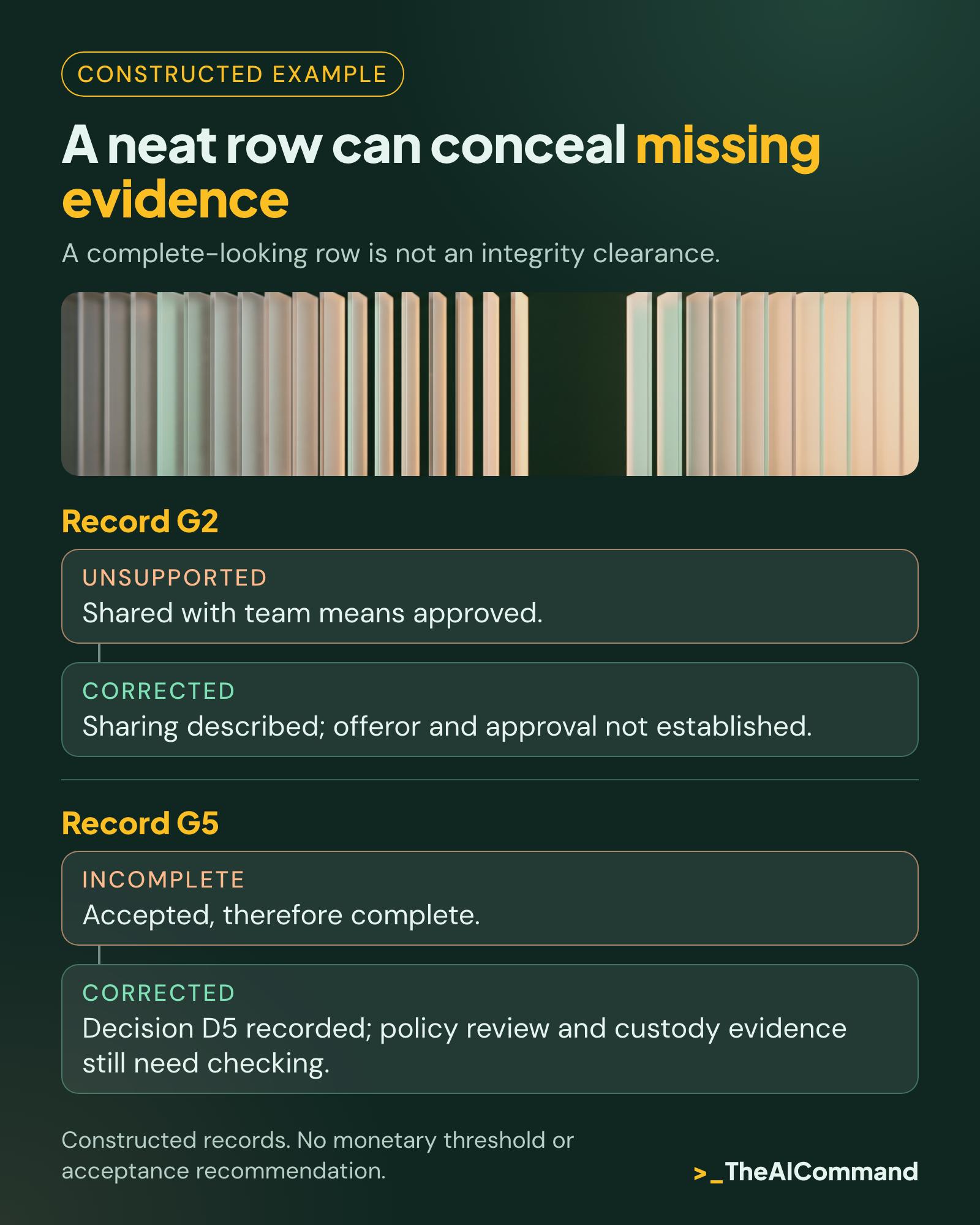
G2 describes a hamper delivered to a team reception point. The note says "from partner, shared with team" but does not identify the partner or confirm who authorised distribution. The draft preserves that wording through its source reference. It asks for the offeror's identity, relationship and disposition details. "Shared" is not silently turned into "approved for team use".
G3 records a working-lunch invitation from [SUPPLIER_B]. The declaration states that the employee declined it on the day offered. The draft records the declined status and the supplied date, while leaving the applicable recording and reporting treatment to the reviewer. Declining an offer does not make the original source disappear from this constructed packet.
G4 describes a discount code seen on a public website. The source says it may be available to anyone, but does not retain the eligibility wording. The draft records that uncertainty and requests the terms. It cannot classify the offer as generally available simply because a public webpage was involved, or assume that the person's official role was irrelevant.
G5 describes a ceremonial book offered after an official visit. The packet includes a fictional signed decision note saying the book is accepted into the office collection, with a reason, decision date and approving role. The draft records that decision as supplied. It does not endorse its correctness; the human reviewer still checks the decision note against the applicable policy and delegation.
G6 describes two event tickets offered to an employee through a family connection. The note also says the offeror has recently sought a meeting about an agency matter. The draft preserves both facts and leaves the relationship question unresolved. It does not decide that a family connection makes the offer purely personal, or that the meeting request proves improper intent.
These records deliberately vary in completeness. G1 and G6 contain context requiring careful human consideration. G2 and G4 need factual clarification. G3 contains a stated decline, while G5 includes a decision artefact. The task is to organise that different evidence honestly, not to force all six records into a single automatic acceptance or rejection rule.
Give the assistant a narrow transformation job
Ask for a table containing source ID, offer description, dates, offeror relationship, supplied value and basis, current status, missing information and decision evidence. Require each populated field to be supported by the identified source. Keep an additional column for the review question. The model can organise a question without answering it.
Specify how uncertainty must appear. Use "not supplied" for absent facts, "unclear in source" for ambiguous statements and "conflicting sources" when two records disagree. These labels have different meanings. A blank cell could conceal any of them, and a general "low confidence" score does not tell the reviewer what information is needed next.
The expected constructed output for G2 is a hamper record with an unidentified offeror, an unconfirmed relationship and no verified approval. It includes a question asking who supplied the hamper and what happened to it. It contains no invented price, employee identity or retrospective approval. That output is a teaching example, not the result of a measured live deployment.
Use the same prompt on the packet only after the authorised preparer has checked the inputs. Instructions such as "normalise everything" are insufficient because they can encourage tidy guesses. Require the model to retain contradictory wording, preserve source references and stop short of an acceptance recommendation. The workflow should make difficult records easier to find.
Read the draft against the original records
A reviewer should begin with a source-to-row reconciliation. Confirm that all six records are represented once and that no record has been merged with another merely because the offeror or event sounds similar. A later offer from the same organisation may be a distinct event. A repeated submission of the same declaration may instead be a duplicate requiring investigation.
Compare the normalised wording with the original description. "Offered accommodation" and "reimbursed travel" are not interchangeable. "Awaiting manager response" and "manager approved" are different states. Preserve any material distinction even if it makes the table longer. The purpose is a reliable administrative record, not a summary that reads smoothly at the expense of meaning.
Then check the apparent decision trail. A decision entry should point to the supplied artefact, identify the authorised role and retain the recorded reason. Where those elements are absent, the reviewer obtains them through the organisation's process. The AI assistant cannot repair an incomplete historical decision by writing the reason that a reasonable person might have given.
Have the appropriate person resolve policy questions separately from data cleaning. That includes applicability, delegations, acceptance, reporting and follow-up. If the reviewer corrects the AI draft, retain the original draft and the correction record according to the applicable retention arrangements. The resulting trail distinguishes the source, the machine transformation and the human decision.
Follow the action after the decision
A decision can require an action that has not yet occurred. A gift may need to be returned, an item transferred to organisational custody or an additional record completed. The workflow should preserve the difference between a decision to do something and evidence that it was done. Otherwise the register can appear finished while practical steps remain open.
In the constructed G5 record, the signed decision concerns acceptance into the office collection. Add a separate follow-up field asking for the custody record. Until that evidence is supplied, the decision can be recorded while the custody action remains open. Do not rewrite the decision as pending merely because its implementation is incomplete; keep both states visible.
A later correction should also be traceable. If the estimated value changes or the offeror relationship is clarified, record the new evidence and refer the decision for review where appropriate. Do not overwrite the earlier basis so completely that a reviewer cannot understand why the original action was taken. Whether reconsideration is required is for the authorised person to determine.
Internal records and public reporting serve different purposes. Before producing any public register, apply the actual reporting requirements and review what information may be disclosed. This drafting workflow does not publish declarations or decide which personal details belong on a website. A clean internal table is not publication authority.
Make the next review easier
Retain a simple account of the source set, transformation prompt and reviewed output. The existing run-lineage article explains the broader problem of reconstructing AI-assisted work. Here, the practical aim is narrower: another authorised reviewer should be able to connect a register entry to the offer, the applicable policy and the decision record.
Start with a small, approved sample of declarations and the current policy confirmed by the responsible officer. Ask the assistant to normalise facts, identify omissions and preserve uncertainty. Check every row against its source, then have the authorised person resolve the decision and any follow-up. A useful gifts record makes accountability visible without pretending that the software exercised it.
Reusable materials
The six fictional source records, EP-1 teaching procedure, completeness checklist and normalisation prompt are set out below.
Reusable gifts and benefits record pack
All offers, roles and decision records below are invented. They are not legal advice, a model acceptance policy or findings about actual people.
Example Procedure EP-1
This fictional procedure exists only to test record handling. Log every supplied record in the exercise; preserve its source; mark missing or conflicting information; send policy and decision questions to an authorised reviewer. The model cannot approve acceptance, change a recorded decision or determine public reporting obligations. No monetary threshold is specified.
Actual use requires the current applicable agency or organisational policy, delegation and reporting requirements. EP-1 is not the APSC Model Policy and does not assert compliance with it.
Six source records
Draft normalisation table
Copyable register-normalisation prompt
Completeness and decision-history checklist
- [ ] Source retained and source ID accurate.
- [ ] Offer, declaration and decision dates separated.
- [ ] Offeror relationship supported or explicitly unknown.
- [ ] Value, currency and valuation basis supplied or explicitly missing.
- [ ] Policy title, version, effective date and applicability confirmed by reviewer.
- [ ] Original status preserved; no inferred approval.
- [ ] Decision artefact, authorised role and reason linked.
- [ ] Follow-up completion distinguished from the decision itself.
- [ ] Changes preserve earlier evidence and review history.
- [ ] Public reporting assessed separately by an authorised person.
Related reading
- Defensible AI Lineage Starts Before the Prompt.
- Practical AI for a Volunteer-Led Charity, the companion article for 22 November
References
- Australian Public Service Commission: Gifts and benefits guidance
- Australian Public Service Commission: Circular 2026/03, APS gifts and benefits guidance review
TheAICommand. Intelligence, At Your Command.