
Your team adopted AI. Now it spends its time checking. The leadership move this quarter is to design how AI output gets reviewed, deliberately, so the time it saves does not leak straight back out as re-checking.
For two years the leadership conversation about AI was about getting people to use it. That problem is largely solved. The new one is quieter and more expensive: the time AI saves is leaking straight back out as reviewing, correcting and re-directing the output. If you lead a team, the highest-leverage thing you can do this quarter is not push adoption harder. It is to design how AI output gets checked, deliberately, so the gain stays in the building.
This is not a productivity-hack point. It is an operating-model point, and the evidence behind it is fresh.
What has changed now that AI adoption is solved?
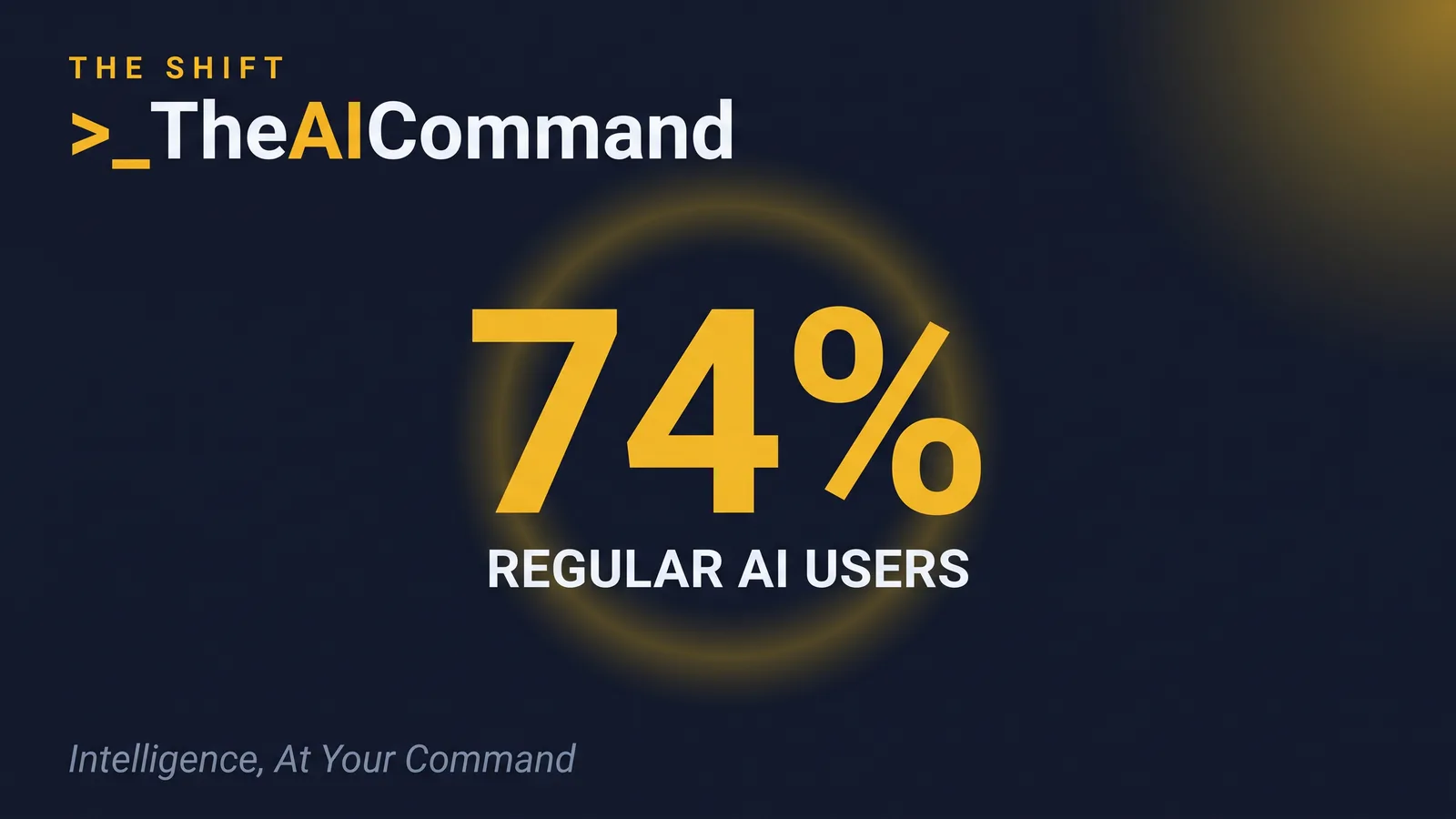
BCG's June 2026 "AI at Work" report, its fourth annual edition and a survey of close to twelve thousand employees, managers and leaders across more than a dozen markets, marks a turning point. Adoption has arrived: "A breakthrough 74% of frontline employees are now regular AI users," up twenty-three percentage points in a year. Notably, BCG names India, the Middle East and Australia as the markets leading on regular frontline use, so Australian teams are at the front of this, not catching up.
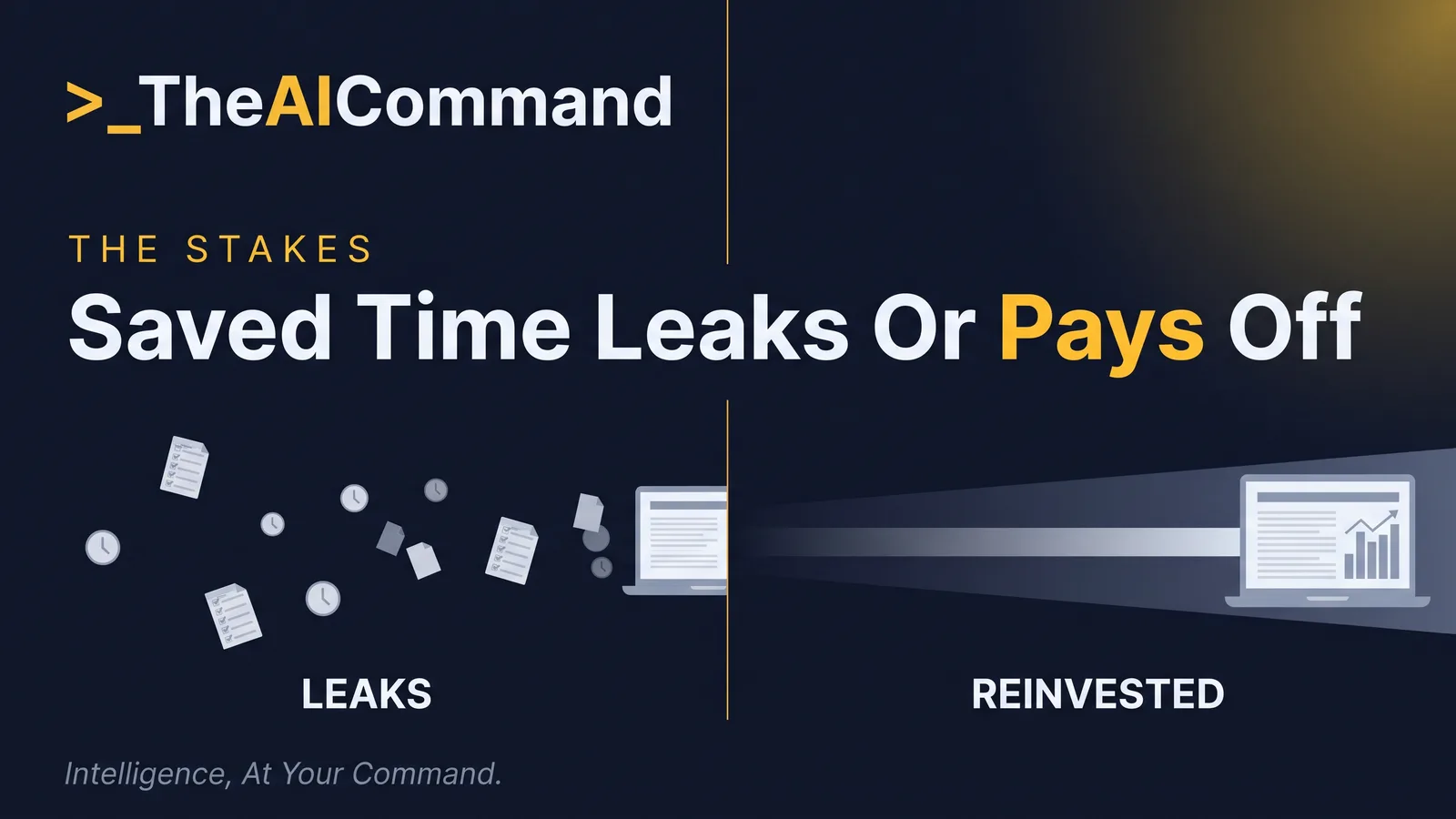
The interesting part is what comes next. The same report finds the work has not got lighter, it has changed shape. "Close to half or more report spending more time reviewing and correcting AI output or managing and directing AI," and forty-one per cent say AI has increased the time they spend making decisions. The standard expected of the work has risen too: "Almost as many (60%) say the bar for work that counts as 'good enough' is higher." And the time that should be freeing up is not landing anywhere useful. "66% still receive limited or no guidance on what to do with the time they save, and more than half say they are not reinvesting time saved into more strategic work."
Put those together and you get the review tax. AI produces a first draft fast, but someone has to check it, the bar for what passes is higher than it was, and nobody has told them what to do with the hour they got back, so it dissipates into more checking. The productivity gain is real at the point of drafting and then quietly leaks away at the point of review.
There is a governance edge to this that leaders should not miss. BCG also found that "Half of all respondents say their companies lack clear governance for managing teams with people and AI, and almost as many say AI-related accountability is one of their three top concerns." Microsoft's 2026 Work Trend Index lands in the same place from a different angle, noting that as AI does more of the work, "humans stay involved by setting direction and taking responsibility for how outputs are used," yet "only 1 in 4 AI users surveyed (26%) say their leadership is clearly and consistently aligned on AI." The checking is happening everywhere and the design of it is happening almost nowhere. That gap is a leadership vacancy, and it is yours to fill, in the same way that decision rights have become the leadership job AI made urgent.
How do you assign a review tier to every workflow?
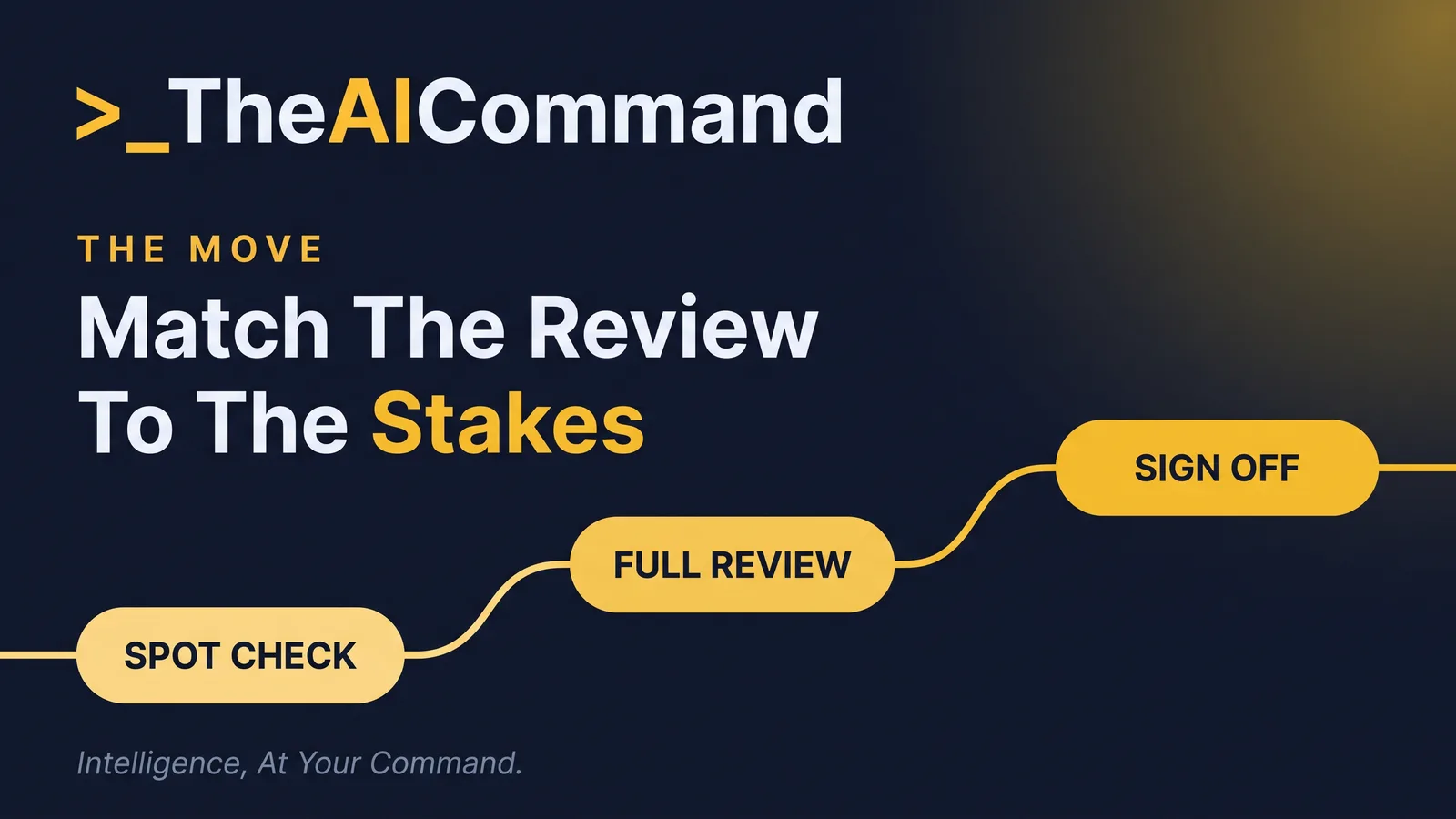
The fix is not more rules. It is one clear decision, made once per recurring task and written down: how much review does the output of this workflow need before it leaves the team? Three tiers cover almost everything.
Spot-check. Low-stakes, internal, easily corrected work. A meeting summary for your own use, a first-pass brainstorm, an internal draft that several people will see and improve anyway. The reviewer samples it, does not read every line, and moves on. Over-reviewing this tier is where a lot of the review tax hides.
Full human review before it leaves the team. Anything client-facing, anything with numbers, anything where the rising "good enough" bar actually bites. One named person reads the whole thing and owns it going out. Not a glance, a read.
Two-person or named sign-off. Regulated, legal, financial, safety-critical, or anything irreversible. The output gets a second set of eyes and an explicit owner, and the standard is that a human can explain and defend every part of it.
Write the tier next to each recurring workflow your team runs through AI. The act of assigning is most of the value, because it stops the default, which is that everything silently gets full anxious review regardless of stakes, or worse, that nothing does and the regulated work gets the same casual glance as the brainstorm.
Assigning the tier is quick if you use a simple test: how bad is it if this goes out wrong, and can you take it back? Low harm and easily reversed is tier one. Real harm or hard to reverse is tier two. Severe, regulated or irreversible is tier three. You are not engineering a policy; you are answering two questions per workflow and writing the answer down. Revisit the list when the work changes, and when the models improve enough that a tier-two task genuinely becomes a tier-one one, but make that a deliberate decision, not a drift.
Then add the second half, the half BCG shows almost everyone skips: name where the saved time goes. If AI takes a two-hour task to thirty minutes, say out loud what the recovered ninety minutes is for, deeper client work, a stalled priority, actual thinking time, and protect it. Saved time that is not claimed for something gets reabsorbed into busywork and double-checking. Claimed time is the only kind that shows up as a result, which is why the measure that matters is the work that actually improved, not the prompts counted.
A worked example
Take a team lead running a recurring deliverable, say [TEAM] produces client-facing [DELIVERABLE] each fortnight, and the team has started drafting them with ChatGPT or Claude.
Before, the whole thing took a day and the quality was even. Now the draft lands in twenty minutes, but two things have happened. The bar has risen, because everyone knows a polished draft is cheap now, so "good enough" quietly means "better than it used to be." And every team member double-checks every AI draft to the same anxious standard, because no one has said what level of checking this work actually needs. The day you thought you saved is half-spent on uneven, undirected review.
Apply the move. The client-facing [DELIVERABLE] is tier two: full human review by a named owner before it goes out, because the stakes and the raised bar warrant it. The internal notes the team also generates with AI drop to tier one: spot-check only. The recovered time per cycle, name it, is reinvested in the part of [DELIVERABLE] that AI cannot do well, the judgement about what this particular client actually needs. Three decisions, written once, and the leak closes.
Notice what changed and what did not. The team still uses AI as heavily as before, and the draft still lands in twenty minutes. What changed is that the checking is now matched to the work instead of applied in a uniform fog of anxiety, and the saved time has somewhere to go. The output that leaves the team is, if anything, better, because the review effort is concentrated where the stakes actually sit.
This costs nothing and needs no tooling. It is a page, a conversation in your next team meeting, and the discipline to hold it.
The failure mode to watch for is leaving review as a private habit rather than a team standard your people can copy. When checking is something each person does to their own taste, you get the worst of both: the careful people over-review everything and burn the savings, the rushed people under-review the things that matter, and no one can tell you which work got real scrutiny. Making the tier explicit converts a thousand individual judgements into one shared standard. It also makes the review defensible, because you can say, for this kind of work, this is the level of checking we apply and this is who owns it, rather than hoping everyone happened to be careful on the right things.
There is a second, easily missed payoff. Review is where your team learns the shape of the tool. The person who reads AI drafts closely is the one who notices that the model is strong on structure and weak on your specific numbers, confident on general guidance and unreliable on the local detail that matters to you. That pattern knowledge is how a team gets genuinely good at using AI, knowing where to trust it and where to lean in, which is why verification is a management skill in its own right. Treat the time spent reviewing not only as quality control but as the team building its own map of where AI helps and where it quietly misleads, and the review tax starts to look less like a cost and more like an investment, provided you are deliberate about both.
Can AI handle its own review?
The line for a leader here is sharp, and it is worth stating plainly because it is what stops "let AI handle review too" from creeping in.
AI cannot decide its own review tier. The stakes of a piece of work, what happens if it is wrong, who is affected, whether it can be undone, are a judgement about the business and its obligations, not a property the model can read off the text. That decision is the leader's.
AI cannot certify that its own output clears the bar. The whole point of the rising "good enough" standard is that it is a human standard, set by what your clients, your regulator and your own credibility require. A model marking its own homework is not review.
And AI cannot carry the accountability for what ships. When something goes out under your team's name, the responsibility sits with a person, and the review architecture exists precisely to make sure a person has actually looked. BCG's finding that half of organisations lack clear governance for mixed human-and-AI work is not a technology gap. It is an accountability gap, and accountability is the one thing that has never been delegable to a tool.
Why this is the leadership job now
It is tempting to read the adoption numbers as a finish line. Seventy-four per cent of people are using AI, the rollout worked, on to the next thing. The data says the opposite. Adoption being solved is exactly what surfaces the next problem, and that problem is not technical. It is about how work is organised, an operating-model problem rather than a technology one: who checks what, to what standard, and what happens to the time that opens up.
That is leadership work in the most ordinary sense. You are not deciding which model to buy or writing a prompt. You are deciding what level of scrutiny each kind of work deserves, making sure a human owns the high-stakes output, and refusing to let the productivity gain dribble away into undirected review. The teams that pull ahead in the next year will not be the ones that adopted AI fastest. Almost everyone has now done that. They will be the ones whose leaders designed the checking, so the time AI saves turns into something the team actually did with it.
Bottom line
Adoption is no longer the problem; the review tax is. The highest-leverage move a leader can make now is to assign each recurring AI workflow a review tier and name where the saved time goes, so the productivity gain stays in the building instead of leaking into undirected checking.
Do this Monday:
- List the recurring workflows your team runs through AI.
- Assign each one a tier: spot-check, full human review, or two-person or named sign-off, using the test of how bad it is if it goes out wrong and whether you can take it back.
- Name a human owner for every full-review and sign-off workflow.
- Say out loud what the recovered time is for, and protect it.
- Make the tiers a shared team standard on one page, not a private habit.
TheAICommand. Intelligence, At Your Command.