
Your team copies how you use AI, not what you say about it.
If you tell your people that AI is a priority and then never visibly touch it, they hear the second message, not the first. They watch what you do in the meeting, how you talk about your own work, and whether using AI gets someone praised or quietly judged. That is where the norm gets set. Not in the all-hands slide about digital transformation, but in the small signals you send every day about whether this is real, safe and expected.
The good news for any leader who finds AI strategy overwhelming is that the highest-leverage move is also one of the simplest. It is not a budget line or a new tool. It is your own behaviour, made visible. This piece sets out the evidence, then gives you a copy-paste way to do it, including a project space you can set up in ten minutes and three prompts you can run before your next team meeting.
The shift the evidence now shows
For two years the debate about AI at work has focused on the individual: train people, give them prompts, raise their AI literacy. The latest data says the individual is not where the leverage is. Microsoft's 2026 Work Trend Index, built on trillions of Microsoft 365 productivity signals and surveys of 20,000 workers across ten countries, puts it bluntly: "Organizational factors like culture, manager support, and talent practices account for more than 2x the reported AI impact of individual factors like mindset and behavior (67% vs. 32%)."
Read that again, because it inverts the usual approach. Two-thirds of AI's real impact comes from the environment a leader creates, and only a third from the mindset of the individual using it. You can send every person on a prompting course and still get nothing, if the culture around them treats AI use as risky, unserious or vaguely like cheating. The training was never the constraint. The conditions around the training were, and those conditions are set by leaders, not by the course.
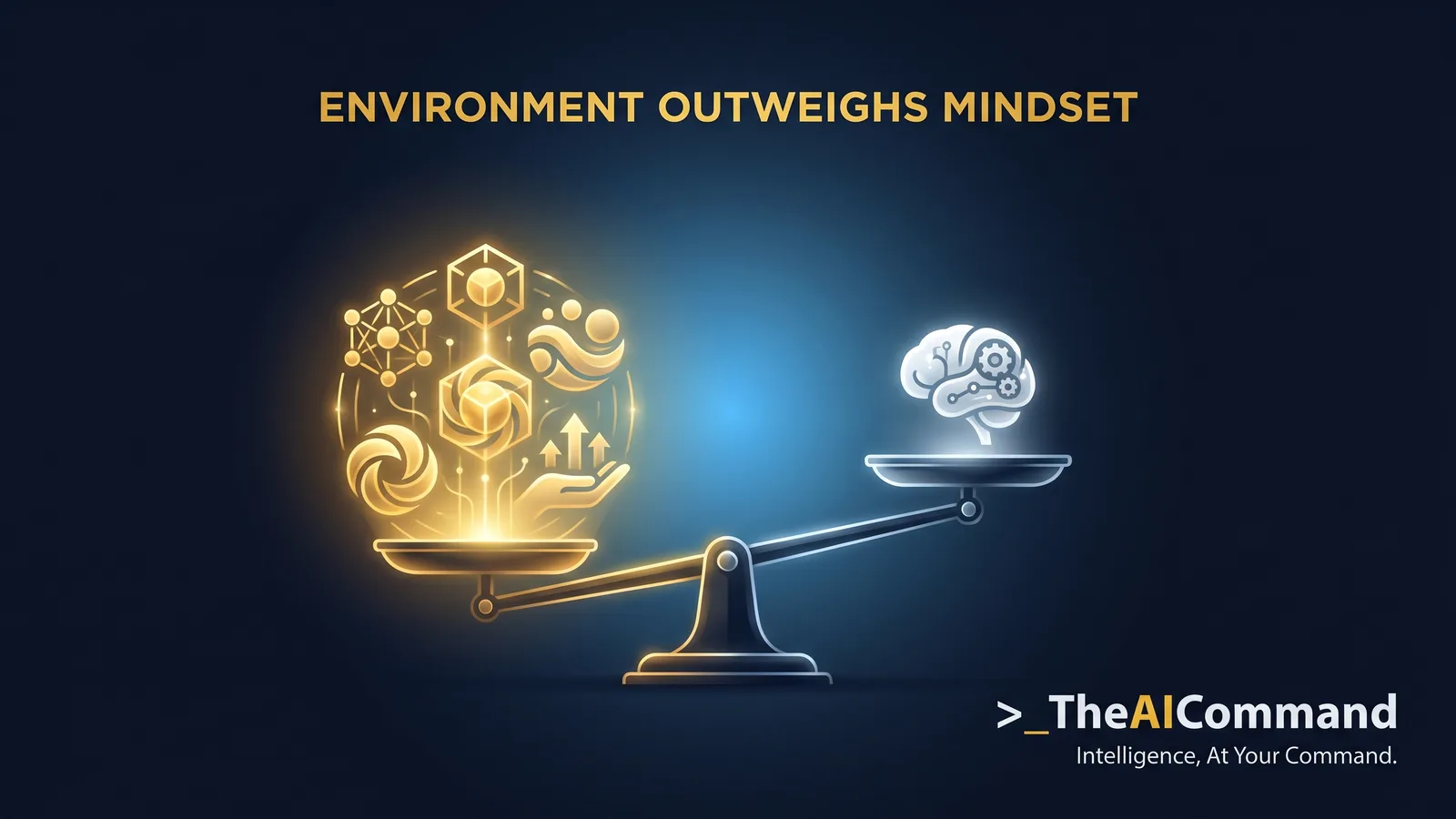
The same research found that only 19% of surveyed AI users sit in what Microsoft calls the Frontier zone, where organisational capability and individual readiness are both high and reinforce each other. The other four-fifths are held back not by a lack of tools, but by a lack of the conditions that let tools matter. And the single condition that shows up most clearly is the manager.
Why is the manager the biggest multiplier for AI adoption?
The data on manager behaviour is the part every leader should sit with. In a separate Microsoft-led study of 1,800 workers, when managers actively modelled AI use, their people reported a 17-point lift in the value they got from AI, a 22-point lift in critical thinking about how they used it, and a 30-point lift in trust in agentic AI. The manager did not run a training session. They just used the tools where their team could see, and the effect on the team was measurable.
It shows up again in how Frontier Professionals describe their managers compared with everyone else. They are far more likely to say their manager openly uses AI (85% versus 64%), sets quality standards for AI work (83% versus 57%), and creates space for experimentation (84% versus 61%). Three behaviours, all the manager's, all visible, all the difference between a team that absorbs AI and one that nods along and carries on as before.
None of this should be surprising. It is how norms have always formed. People take their cues about what is acceptable and expected from the person they report to, far more than from a policy. AI is no different. If you want your team to use AI thoughtfully, the most powerful thing you can do is use it thoughtfully in front of them.
What is the difference between AI adoption and absorption?
Microsoft's report draws a useful line between two things that are easy to confuse. AI adoption is people using the tools. AI absorption is the organisation actually redesigning how it works to capture the value. A team can have high adoption, everyone logging into the assistant, and low absorption, none of that use changing how the work gets done or what it produces. Adoption is a licence-utilisation number. Absorption is a result, the kind you only see when you measure the work that actually improved rather than the logins.
The reason this matters to a leader is that you cannot buy your way from adoption to absorption. You can buy licences and you can mandate logins, and you will get adoption you can put on a dashboard. Absorption only comes when people change how they actually work, and people change how they work when their manager makes it safe, expected and normal to do so. That is precisely the gap the manager's visible behaviour closes. The tools get you adoption. The norm you set gets you absorption. One is a purchase, the other is a choice you model.
How do I set my team's AI norm this week?
You do not need a transformation programme to act on this. You need to make four behaviours visible, starting at your next team meeting.
Model it in the open. In your next meeting, narrate a piece of your own AI use out loud. Not a polished success story, the actual working version: "I asked Claude to draft this, here is what it gave me, here is the bit it got wrong, and here is how I fixed it." Showing the edit and the error matters more than showing the win, because it tells your team that AI is a first draft to improve, not a magic answer to trust, and that getting a wrong answer and correcting it is exactly the skill you want.
Set the norm explicitly. Do not leave your people to guess. Say what is encouraged, what is off-limits, and what good looks like. "Use AI to draft, research and check your thinking. Do not paste anything confidential into a public tool. And whatever AI helps you produce, you own, so it has to meet our standard." Three sentences remove the fear and the guesswork at once.
Make space to experiment. The quiet killer of AI adoption is the fear of looking incompetent or of being caught taking a shortcut, the same anxiety that grows when leaders avoid an honest conversation about AI and jobs. People will not experiment with something they think they could be judged for. So give explicit permission and a little time: a standing invitation to try AI on a real task and bring back what worked and what did not, with no penalty for the experiments that flop. You are trying to make trying normal.
Hold the quality bar. Setting the norm is not lowering the standard. Be clear that AI does not change what good looks like; it changes how fast you get there, and the person remains accountable for the result. A leader who models use but tolerates sloppy AI-generated work teaches the wrong lesson, which is why holding the bar means designing the checking that AI speed does not remove. The standard is the same. The route to it is faster.
A manager's prompt pack
Here is the practical part. The three behaviours that need words, set the norm, design the experiment, run the demo, can each be drafted by AI in a couple of minutes, and the act of drafting them with AI is itself the modelling. Set up a small project space once, then run the prompts as you need them.
A standing note before any of this. Never paste real personal, claim, health or incident data into a model that is not an approved enterprise instance. The prompts below use placeholder tokens such as [TEAM], [ROLE], [SITE] and [DATE]. Keep them as placeholders, or fill them with non-sensitive descriptors only. If you are in financial services, your organisation almost certainly has an approved enterprise tool; use that, not a personal account, for anything touching the business.
Set up the project space
Both ChatGPT Projects and Claude Projects let you save a reusable description and instructions so every chat inside the project starts with the same context. Create one called "Team AI Norm" and paste this into the custom-instructions or project-description field.
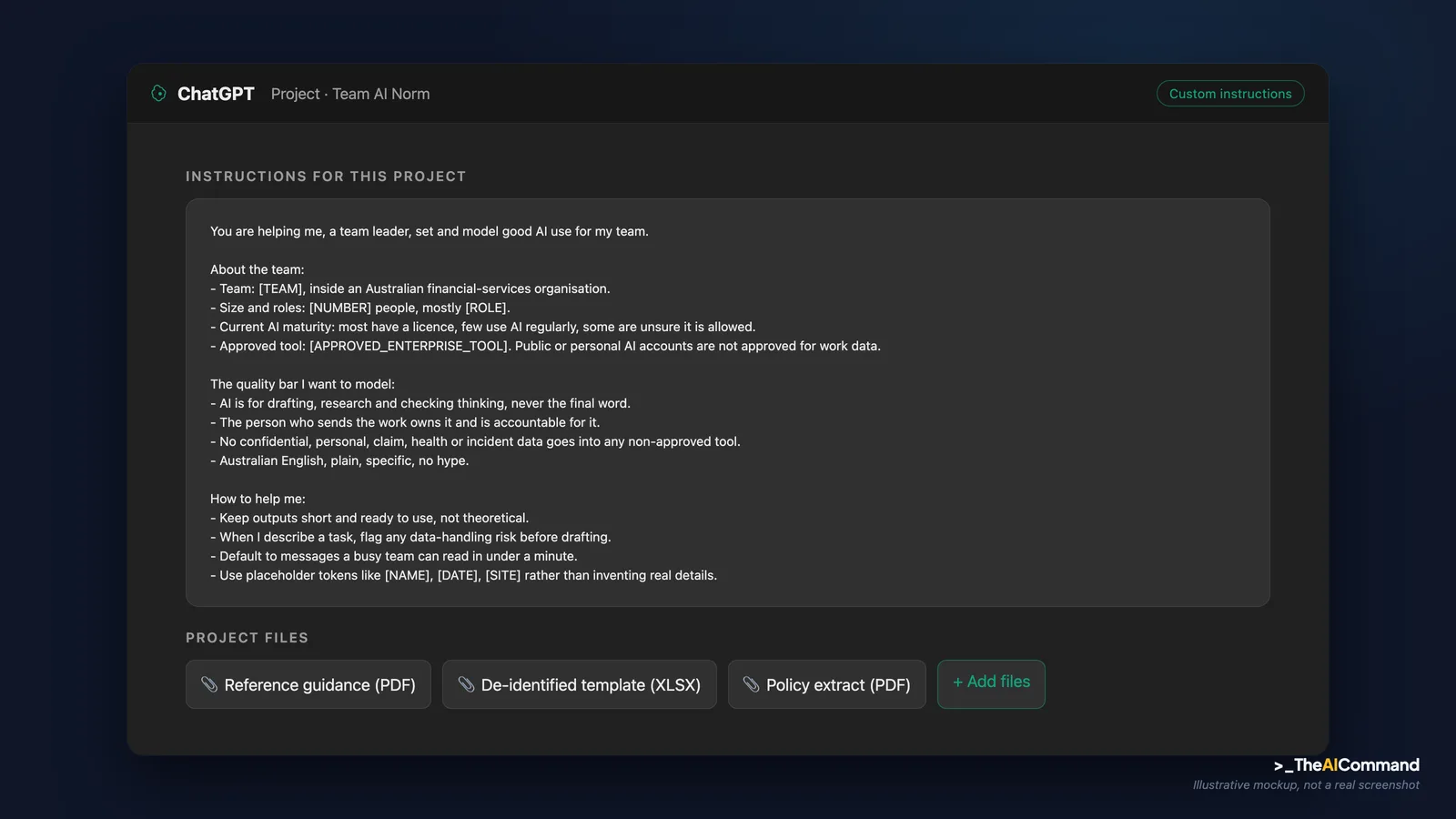
Files to upload to the project (optional, but they sharpen every output):
- Your organisation's AI acceptable-use policy or guidance, so the model stays inside the rules.
- A short note on your team's current state: how many use AI, what is blocking them, what you have already tried.
- One example of a recent piece of team work at the standard you want, with any names or numbers removed.
Prompt 1: draft the set-the-norm message
Run this when you want a short message that tells the team, in plain terms, what is encouraged, what is off-limits, and what good looks like.
Prompt 2: design a safe-to-experiment task for this week
Run this to turn one real, low-stakes piece of your team's work into a deliberately safe experiment people can try without fear.
Prompt 3: build a use-it-in-the-open demo I can run live
Run this to script a two-minute, live walkthrough you can do at the top of a meeting, including the deliberate moment where you show AI getting something wrong and you fix it.
The judgement boundary
Modelling AI use does not mean modelling reckless AI use, and this is where a leader has to stay sharp. When you narrate your own use, narrate the guardrails too: that you used an approved tool, that you did not put confidential information into it, that you checked the output before you trusted it. Your team copies the whole behaviour, including the caution, so make the caution visible on purpose.
The deeper boundary is accountability. AI can draft your decision, but it cannot own it, and part of a leader's job now is being explicit about who holds the decision rights when AI is in the loop. The judgement about whether to act, who is affected, and whether it is right stays with you, and your team needs to see you treat it that way. The leaders who get this wrong are not the ones who use AI too much. They are the ones who let AI's confidence stand in for their own thinking, and whose teams learn to do the same. Model use, and model ownership, in the same breath.
Three ways leaders get this wrong
Three patterns quietly undo all of this, and they are common.
The first is the absent sponsor. The leader who announces that AI matters, then never engages with it again, leaves a vacuum the team fills with their own assumptions, usually the cautious ones. Enthusiasm without visible practice reads as a slogan, and slogans do not change behaviour.
The second is the secret user. Some leaders use AI heavily but privately, perhaps because they feel they should already have it mastered, or because they are not sure it is allowed. The cost is that all the modelling value is lost. If your team cannot see you use it, your use does you no good as a leader, however good it does you as an individual. Bring it into the open even when, especially when, you are still learning.
The third is the enforcer. The leader who mandates AI use, sets targets for it and treats reluctance as a performance problem produces compliance and resentment, not absorption. Pressure makes people perform usage for the dashboard while changing nothing real. The lever is permission and example, not a quota. You are trying to make AI feel safe and worthwhile, and you cannot order either into existence.
A worked example, end to end
Take [MANAGER_NAME], a team lead in the lending operations function of an Australian bank. They run a team of [NUMBER] people, mostly [ROLE], and have spent a quarter trying to lift AI adoption with no luck, despite buying licences and running a lunch-and-learn. The dashboard shows logins. The work has not changed.
Setup. They create a Claude Project called "Team AI Norm" and paste in the custom instructions above, with [APPROVED_ENTERPRISE_TOOL] set to the bank's approved enterprise assistant. They upload the bank's AI acceptable-use policy and a two-line note on the team's current state. No customer data, no account numbers, nothing personal goes anywhere near it.
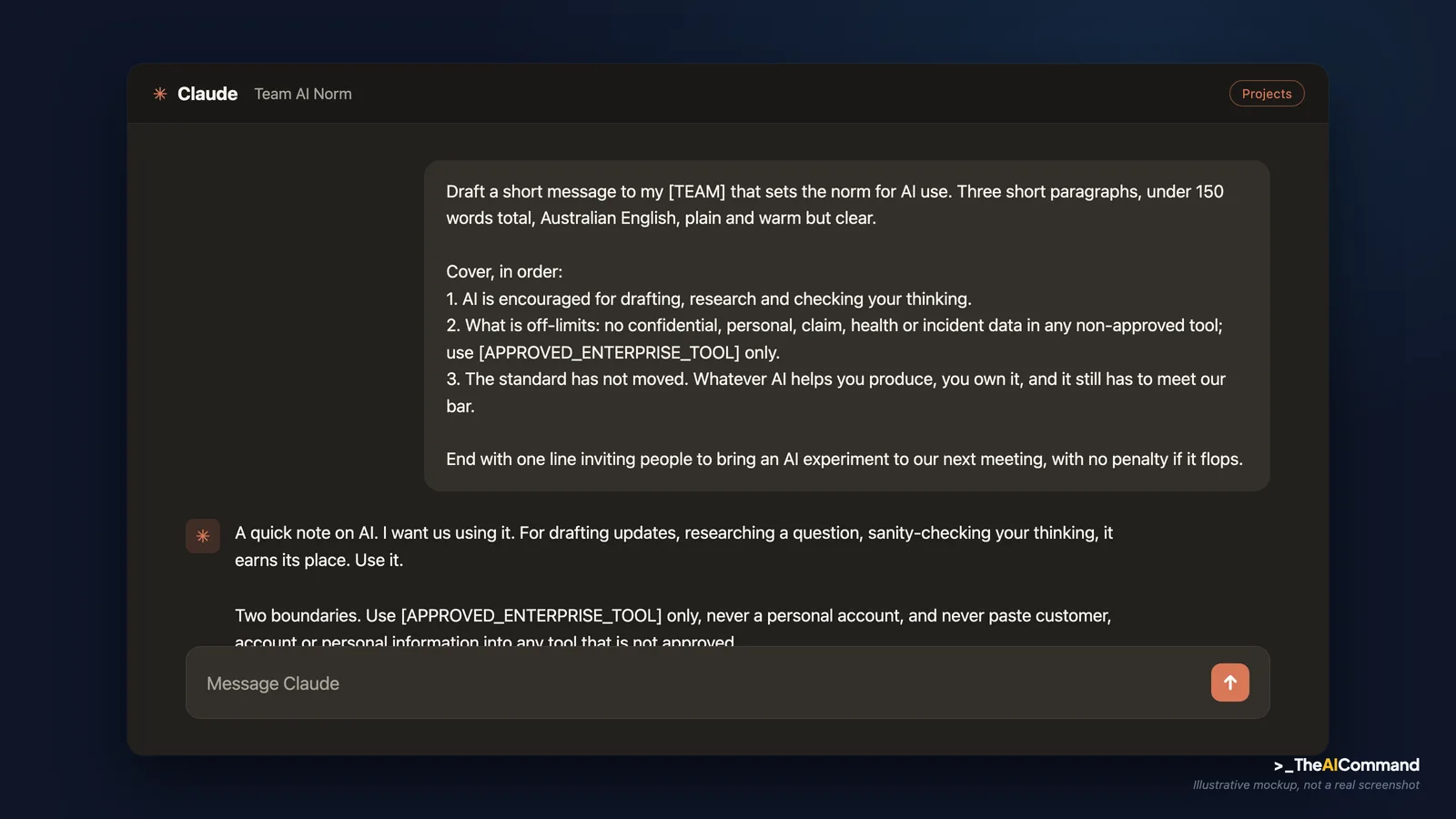
Prompt. They run Prompt 1 to draft the set-the-norm message. The model returns three short paragraphs. An illustrative version of the output reads:
Human review and decision gate. This is the step that matters, and the manager makes it explicit. They do not send the draft as-is. They read it against three checks: Is it true to how I actually want this team to work? Does the data boundary match our real policy, not a generic one? Does it sound like me, not like a model? They change two things: they swap the generic "ask me first" for the bank's actual approval channel, and they cut a sentence that read as corporate. Then they decide to send it. The decision to send, and the accountability for what it says, stay with the manager. The AI drafted; the human owns.
The demo. At Thursday's meeting they run Prompt 3's output live: a real, non-sensitive task, the prompt typed on screen, the draft it produces, and the one thing it got generically wrong, which they correct out loud. They close with the two sentences: AI is a fast first draft, and I own the final version.
Within a few weeks the team starts doing the same, unprompted. One person shares a prompt that saved them an afternoon. Another flags where AI gave them a confidently wrong answer, and the team treats that as useful, not embarrassing. The licences were always there. What changed was the norm, and the norm changed because the leader stopped describing it and started demonstrating it, with the data boundary and the human decision gate visible the whole way through.
That is the whole move. Not a strategy, a budget or a tool, but a leader deciding that the fastest way to set the standard is to be seen meeting it. Your team is already watching how you work. Show them the version you want them to copy.
If you take one thing from the evidence, take this: two-thirds of whether AI works for your team is the environment you set, and the cheapest, fastest lever on that environment is your own visible behaviour. You do not have to be the most fluent AI user in the building. You have to be a visible one, an honest one about what it gets wrong, and a clear one about the standard. Do that at your next meeting, and again at the one after, and you will have done more for your team's AI capability than another round of licences or training ever could. The norm is set by whoever the team is watching. That is you.
Bottom line
Two-thirds of whether AI lands in your team comes from the environment you set, not the mindset of the person using it, and the cheapest lever on that environment is your own visible behaviour. You cannot buy your way from adoption to absorption; people change how they work when their manager makes it safe, expected and normal. Model use and model ownership in the same breath, with the data boundary always in view.
Do this Monday:
- Narrate one piece of your own AI use in your next meeting, including the bit it got wrong and how you fixed it.
- Set the norm in three sentences: what is encouraged, what is off-limits, and what good looks like.
- Invite one no-penalty AI experiment on a real task, to be shared back at the next meeting.
- Hold the quality bar, so faster never becomes an excuse for a lower standard.
- Never paste confidential, personal, claim, health or incident data into a non-approved tool; use your approved enterprise instance.
TheAICommand. Intelligence, At Your Command.