
If AI is visibly changing work in your team, raise it with them first, honestly and early, before the silence hands the story to rumour. Your team is already worried about AI and their jobs. The only question is whether they hear from you or from the rumour mill.
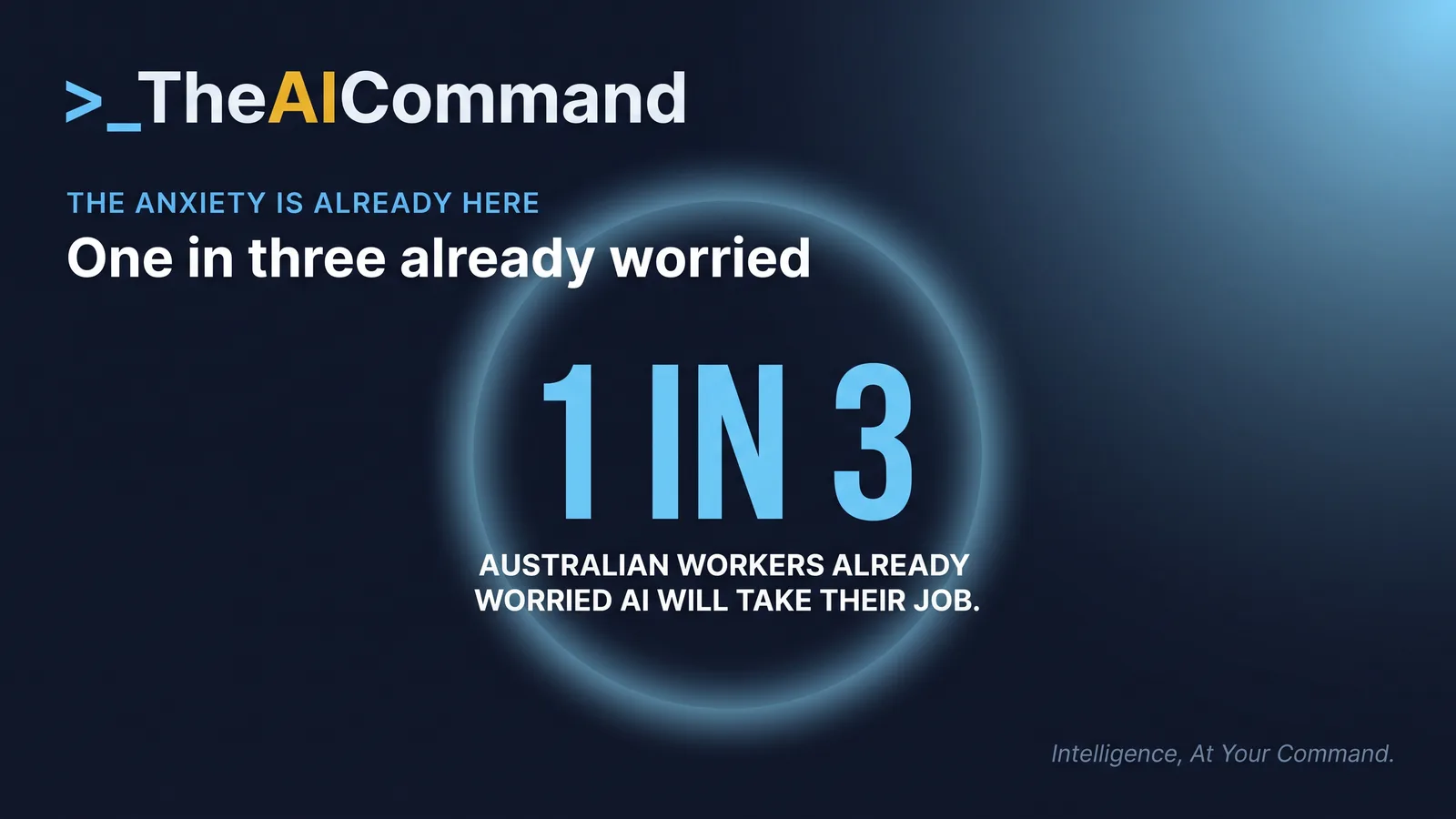
The data is not subtle. In a Finder survey of 669 employed Australians published on 1 April 2026, 9 per cent said their job will "definitely" be replaced by AI and a further 21 per cent were worried but not sure, so nearly one in three carries some fear about it. Among younger workers it is higher: 38 per cent of Gen Z and 34 per cent of Millennials think they will be replaced. Globally the picture rhymes. ADP Research's Today at Work 2026 report, a survey of more than 39,000 workers across 36 markets, found only 22 per cent of workers worldwide strongly agreed their job was safe from elimination, as Fortune reported in March 2026. This anxiety is sitting in your team right now, whether or not anyone has said it out loud.
Most leaders respond to that with silence, usually for understandable reasons. They do not have all the answers. They do not want to start a panic. They are waiting until there is something concrete to say. But silence is not neutral. In an information vacuum about something as personal as job security, people do not assume the best. They assume the worst, they compare notes, and they fill the gap with rumour and with whatever the loudest voice on the internet is saying that week. The leadership move is to get there first, and to be honest when you do.
The shift: uncertainty is now the thing to manage
For most of the last few years, leading through AI was a tooling question: which tools, what training, what use cases. That part is largely solved. The unsolved part is human. AI is now visibly changing what work looks like, and workers can see it happening, which means the uncertainty itself has become the thing a leader manages.
Uncertainty is corrosive in a specific way. Decades of work on psychological safety, most associated with Amy Edmondson at Harvard, show that teams do their best work and speak up most honestly when it is safe to raise concerns. A quiet, unaddressed fear about redundancy is the opposite of that. It does not make people work harder; it makes them cautious, distracted and quietly disengaged, and it makes them stop telling you things. So the cost of not having the conversation is not just morale. It is the honesty and the discretionary effort you rely on to do the actual work.
There is a second shift. The people most anxious are often not the ones being loud about it. The younger members of your team, the ones with the highest reported anxiety in the Finder data, may be the least likely to raise it with a manager. So waiting for someone to bring it up is not a plan. The concern is there; the silence is just hiding it.
There is also a cost to getting the timing wrong, and it compounds. Once a rumour takes hold, a leader is no longer shaping a conversation; they are correcting a story that already carries emotional weight, and corrections rarely catch up to the original fear. Worse, the people who most need to hear from you have often already made quiet decisions by the time you get to it: to start looking elsewhere, to stop offering ideas, to keep their heads down. The window where honesty does the most good is early, before the anxiety has hardened into a settled belief.
What must the conversation actually do?
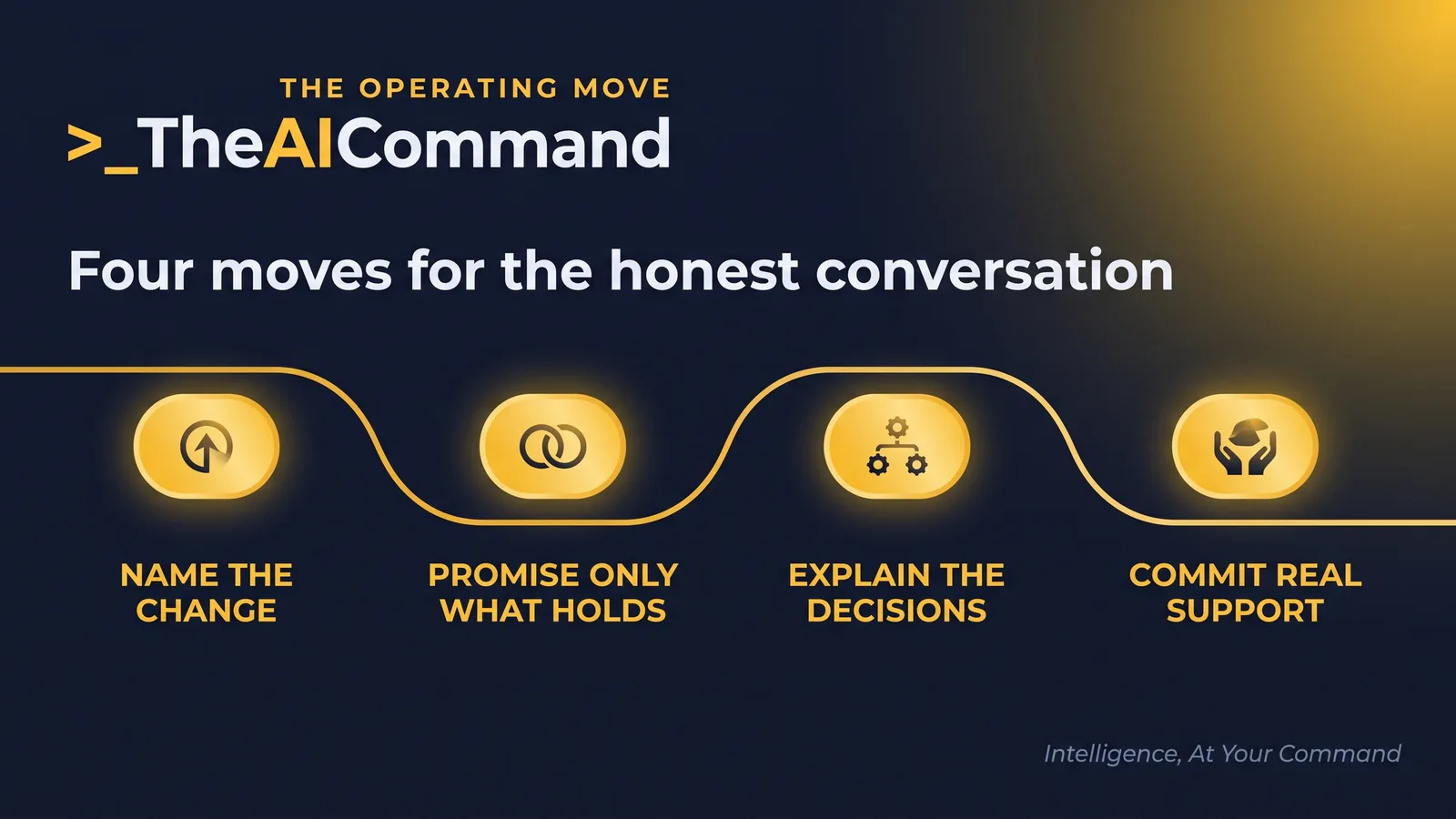
This is not a town hall with a polished deck. It is a deliberate, honest conversation, run early, with your actual team. Four things make it work.
First, name what is changing and what is not. Be concrete. Point at the specific tasks AI is starting to do in your team, drafting a first pass, summarising, handling routine queries, and then name what still needs a person: the judgement, the relationships, the accountability, the work that only makes sense with context AI does not have. Specificity calms people. The vague, grand register, the "AI transformation journey", does the opposite, because people cannot tell whether a buzzword means their role is safe or gone. Avoid the doom register too. Your job is to be the calm, straight signal in a noisy channel.
Second, be honest about what you can and cannot promise. This is where most leaders either overpromise or go silent, and both are wrong. If you cannot honestly say no one will lose their job, do not say it. Credibility is the entire asset in this conversation, and the first time reality contradicts a reassurance you gave, you lose it, permanently. What you can do is separate the certain from the uncertain: here is what I know, here is what I do not yet know, here is what I will tell you the moment I do. People can handle uncertainty from a leader they trust. They cannot handle being managed.
Third, explain how decisions will actually be made. Much of the fear is not really about AI. It is about arbitrary, opaque decisions made about people without them. So say how it will work: that any change to roles will involve genuine consultation before anything is decided, not after; that people will get notice, not a surprise; that decisions will be made on a fair and explainable basis. In Australia this is not just good practice, it intersects with real obligations to consult on major workplace change, but the leadership point stands regardless of the legal one. A fair process, named in advance, removes most of the terror.
Fourth, commit to concrete support, and only what you will actually deliver. This is the constructive half of the conversation. Reskilling time. Access to the tools and the training so people are building AI into their work rather than being blindsided by it. A standing invitation to raise concerns without it counting against them. The point is not to hand out comfort; it is to give people a way to act on the anxiety instead of sitting in it. Do not promise support you cannot fund. A broken commitment here is worse than none.
Should you do this as a group or one-to-one?
Run this in two settings, because they do different jobs. The group conversation, your team together, sets the shared, honest baseline. It puts the same facts in front of everyone at once, so no one is left reconstructing what was said second-hand, and it signals that this is a topic you will discuss in the open rather than manage in corners.
The one-to-one is where the real work happens. Anxiety about job security is personal, and people will not voice their sharpest fears in a group. So follow the group conversation with individual check-ins, especially for the quieter members and the younger ones the data says are most worried, and ask directly: how are you feeling about all this, and what would help. The group sets the frame; the individual conversations are where you actually hear people, and where trust is built or lost. Do only the group version and you have informed your team without reaching the ones who most needed reaching.
What part of this can AI not own?
It is worth being precise about why this is a leadership job and not something you can delegate to a policy, a memo, or an AI assistant.
AI can change what work gets done, but it cannot decide who is affected, and it cannot carry the consequences of that decision. The duty of care to the actual people on your team is yours. So is the accountability: if roles change, a person has to own that call and be able to face the team on it, and no model can stand in that place. And trust, the thing this entire conversation is really about, can only be extended or repaired by a person. A perfectly worded AI-drafted message about job security, sent because the leader could not face the conversation, is worse than clumsy honesty delivered in person, because the team can tell the difference and the whole point was the human commitment behind the words.
That is the boundary. Use AI to help you prepare, to pressure-test your talking points, to anticipate hard questions. Do not use it to avoid the conversation, and never let it be the one that appears to be doing the reassuring.
Do this Monday
Here is the whole play as one week of work, not a theory.
- Block 45 minutes on Monday morning and write three lists in plain words: what AI is actually changing in your team's work right now, what you can honestly commit to, and what you genuinely cannot promise. If a line would not survive being said to someone's face, cut it.
- Open ChatGPT, Claude or equivalent and paste the preparation prompt below, with your three lists as the inputs. Keep the talking points you believe. Delete anything that reads like a press release.
- Run the red-team prompt below over the surviving talking points. Fix every flagged overpromise and buzzword before a human hears any of it.
- Check every commitment with your own manager before you make it. Reskilling time and tool access only count if they are actually funded.
- Book a 30 minute team conversation for this week, no deck, and one-to-ones with every team member over the following fortnight, starting with the quietest.
- Run the team conversation on the four moves: name the change, promise only what holds, explain how decisions get made, and commit the support. Close by saying you will follow up with each person individually.
- In each one-to-one, ask directly: how are you feeling about AI and your role, and what would help. Write down anything you commit to, and deliver it within the week.
- Put a repeat check-in in the diary a fortnight later. Trust on this subject is built by showing up more than once, not by one good speech.
Two prompts: one to draft, one to attack
Use these in ChatGPT, Claude or equivalent to rehearse the exchange before you have it. They help you prepare; they do not have the conversation for you.
Then make the same tool attack your work. The second prompt exists because you are the worst available judge of your own reassurances.
The pre-conversation checklist
Walk into the room only when every line below is true.
- The three lists are written: what is changing, what you can commit to, what you cannot promise.
- Every talking point survived the red-team pass, with no buzzwords and no reassurance you cannot personally back.
- Your examples are specific to your team's actual work, not generic AI talking points.
- The decision process is ready to explain: consultation before decisions, notice before changes, a fair and explainable basis.
- Every support commitment is confirmed and funded: reskilling time, tool access, training.
- You have an honest answer prepared for "is my job safe", and it is not a hollow yes.
- One-to-ones are booked for the fortnight after, quietest team members first.
- A repeat conversation is already in the diary, because one pass is not trust.
A worked example
Take [TEAM_MEMBER], a capable analyst on [TEAM] who has gone quiet over the last two months. Their output is fine, but they have stopped volunteering ideas in meetings, and the change roughly coincides with AI drafting starting to appear in the team's workflow. A weaker response is to note the disengagement and wait. A stronger one is to recognise the pattern and run the play.
The leader starts with the preparation prompt. The inputs: AI is now drafting first-pass reports and summarising routine queries on [TEAM]; the commitments the leader believes they can fund are two hours a week of paid learning time, tool access for everyone, and consultation before any role change; the thing they cannot promise is that every role will look the same in twelve months. The talking points that come back are useful and slightly too smooth. The red-team pass catches it: "we are investing in you for the long term" is flagged as a promise the leader does not own, and the hardest question on the list is one they had not prepared for, "would you tell us if redundancies were being discussed".
So the leader edits. The long-term line goes. The redundancy question gets an honest answer written in advance: consultation would come before any decision, and I will not pretend to certainty I do not have. They confirm the two hours a week with their own manager before promising it. Then they run the group conversation, and in the one-to-one with [TEAM_MEMBER] they name it plainly: "There is a lot of noise about AI and jobs at the moment, and I have not said much about it, which is on me. I want to be straight with you about how I am thinking about it for this team."
What the leader does not do matters as much as what they do. They do not tell [TEAM_MEMBER] their job is safe, because they cannot honestly guarantee it, and a hollow reassurance would cost more than it bought the first time it was contradicted. They do not send the AI-drafted message as an email, because the entire value is a person visibly standing behind the words. And they do not treat one conversation as the end of it; a fortnight later they ask again. The anxiety is not solved in one pass. But a private, worst-case story has been replaced with an honest, shared one, and raising it is now safe. That is the whole job.
The teams that come through this period best will not be the ones whose leaders had the most reassuring script. They will be the ones whose leaders had the conversation early, told the truth, and treated the fear as real. Your team is already worried. The rumour mill is already talking. The only decision left to you is whether they also hear the honest version, from the person actually accountable for their future.
Bottom line
The anxiety about AI and jobs is already sitting in your team, and silence hands the story to rumour that later corrections rarely catch up to. A leader who raises it early and honestly, names what changes and what does not, promises only what they can keep, and treats the fear as real, replaces a private worst-case story with a shared, truthful one.
Do this Monday:
- Write three plain lists: what AI is changing, what you can honestly commit to, and what you cannot promise.
- Use ChatGPT, Claude or equivalent to turn them into talking points, then red-team every overpromise and buzzword.
- Confirm every commitment with your own manager before you make it, because only funded support counts.
- Book a short group conversation this week and one-to-ones over the fortnight, quietest members first.
- Put a repeat check-in in the diary, because trust is built by showing up more than once.
TheAICommand. Intelligence, At Your Command.