
Use AI freely for a leader's informational messages, but write the recognition, feedback and apologies yourself: when employees sense AI wrote those, perceived sincerity collapses. Your team can tell when AI wrote it.
That is the uncomfortable finding from the first solid research on leaders using AI to write to their people. When employees sense that a manager leaned heavily on AI to write a message of praise, recognition or personal feedback, their rating of that manager's sincerity falls off a cliff. The leadership skill AI changes is not how fast you can write. It is knowing which messages you must still write yourself.
Most of the AI-and-leadership conversation is about speed and leverage. Draft the update faster, summarise the report, clear the inbox. That is real, and for a lot of your communication it is fine. But a leader's words are not all the same kind of thing. Some carry information. Some carry the relationship. AI is good at the first and quietly corrosive on the second, and the cost is invisible until the trust has already leaked.
The evidence for that cost is below. So is the fix: a three-lane triage you can set up in under an hour on Monday, prompts that keep AI in its lane, and a single test for the messages that must stay yours.
What did the research actually find?
In 2025, Anthony Coman at the University of Florida and Peter Cardon at the University of Southern California ran a study of 1,100 full-time professionals, published in the International Journal of Business Communication. They showed people the same supervisor messages written with low and high levels of AI assistance and asked how sincere the supervisor seemed.
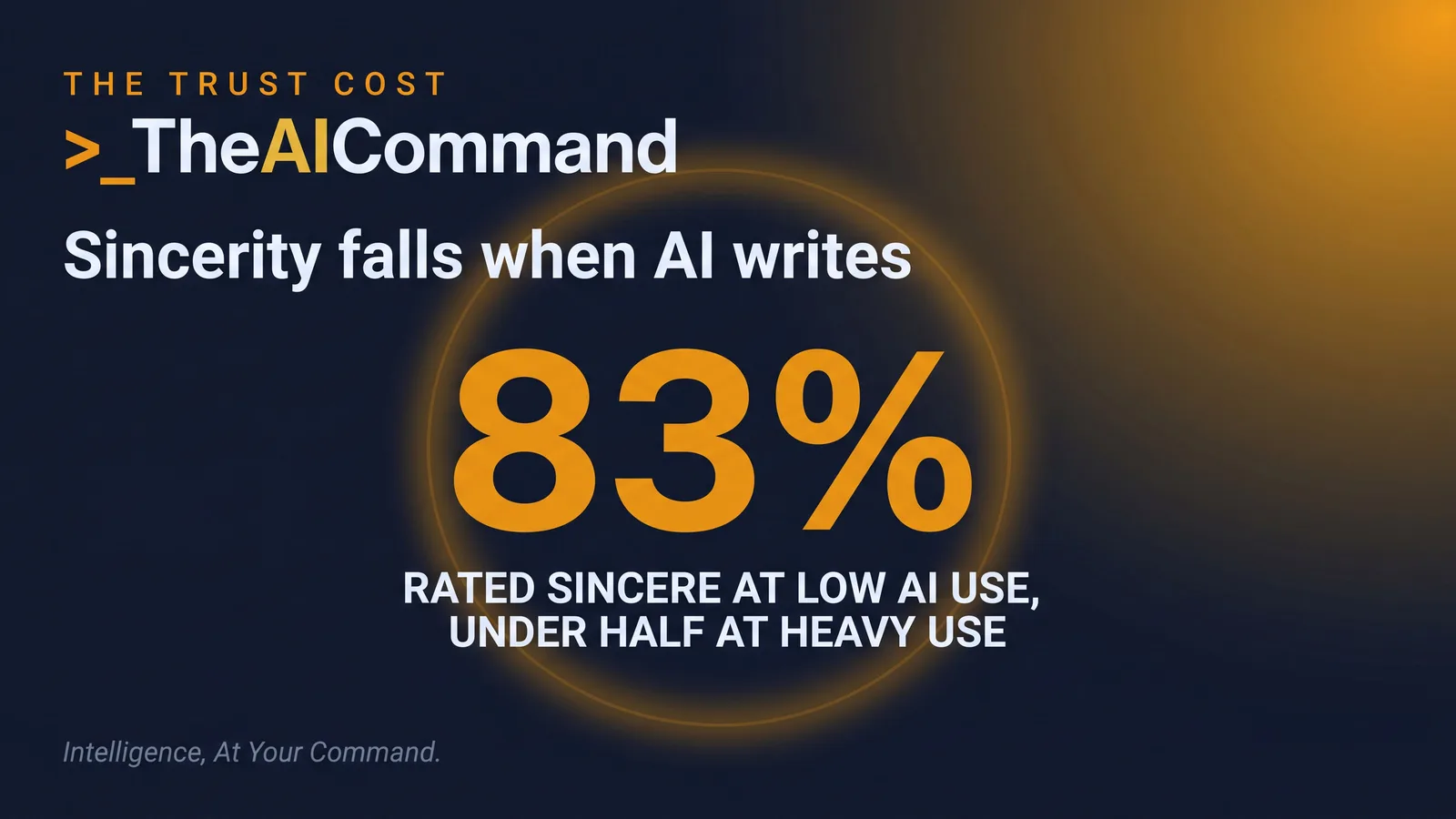
The gap was stark. When a message used little AI, 83 per cent of employees rated the supervisor as sincere. When the same kind of message was heavily AI-assisted, that fell to between 40 and 52 per cent. Perceived professionalism dropped too, from 95 per cent down to the low seventies. The researchers were blunt about where the damage lands. As HR Dive's report of the study put it, praise, congratulations, motivation and personal feedback are better handled with minimal technological intervention, because those are the messages people read for sincerity rather than information.
There is a twist that should stop any leader who tells themselves "everyone uses AI now, so it is fine". Employees apply a double standard. They are relaxed about their own AI use and sceptical about their boss's. The same tool, used by the person in authority on a message that is supposed to be personal, reads as not bothering.
This is not one study. A December 2025 survey of 1,000 UK employees, run by Raconteur in partnership with Attest, found that only 28 per cent would fully trust a manager if AI had contributed to their feedback. Thirty per cent said it would actively damage trust, and 49 per cent said AI-assisted recognition simply lacks authenticity. Two independent samples, in two countries, pointing the same way. Neither is an Australian dataset, but there is no reason to think the mechanism stops at the border.
The mechanism is not mysterious. People treat fluency as a proxy for effort, and effort as a proxy for care. A message that is suspiciously smooth, arriving instantly, in a register that is not quite yours, reads as low-effort precisely because it was easy. The polish AI adds to an informational update is an asset. The same polish on a personal message is the thing that gives it away.
The objection that does not hold
Every leader reading this has the same reflex. "My team knows I am busy. They would rather get a quick AI-written note than nothing." It sounds reasonable. The research says it is wrong in the one lane that matters. When a message is meant to carry care, a fast outsourced version does not land as better than nothing. It lands as worse, because it signals that the relationship was worth automating. The employees in the study were not annoyed that their manager used a tool. They were reading the message for evidence that the manager meant it, and a heavily AI-written message gives them evidence of the opposite.
The deeper issue is authority. When you are the one in charge, your communication is one of the few direct signals your team has about how you actually regard them. A peer's AI-written message is a convenience. A leader's AI-written message on something personal is a verdict. That is why the same level of AI assistance reads so differently depending on who sent it, and why "everyone uses AI now" is not the defence it feels like.
Why is this a leadership problem, not a writing problem?
It is tempting to file this under writing tips and move on. That misses what is actually at stake. Leadership communication is not the transfer of information. As Kathy Caprino put it in Forbes, it is "expressing judgment, intent, perspective, and direction". Clarity of perspective is a leadership responsibility. AI can support it. It cannot originate it.
When you hand a recognition message to a model, you are not just outsourcing the wording. You are outsourcing the signal that you noticed, that you cared enough to find the words, that the praise came from you. The words can be more polished and mean less. Deloitte's 2026 work on decision-making with AI makes the same point at the level of judgement. Technology can accelerate analysis but cannot "replace human purpose, values, and judgment", and over-delegation produces diluted accountability and reduced ownership. A leader who delegates the relationship-bearing message has diluted exactly the thing the message was supposed to carry.
So the real decision is not whether to use AI to write. It is which of your messages a machine can help with, and which must stay yours. That is a sortable, answerable question, and it deserves a deliberate answer rather than a habit.
How does the communication triage work?
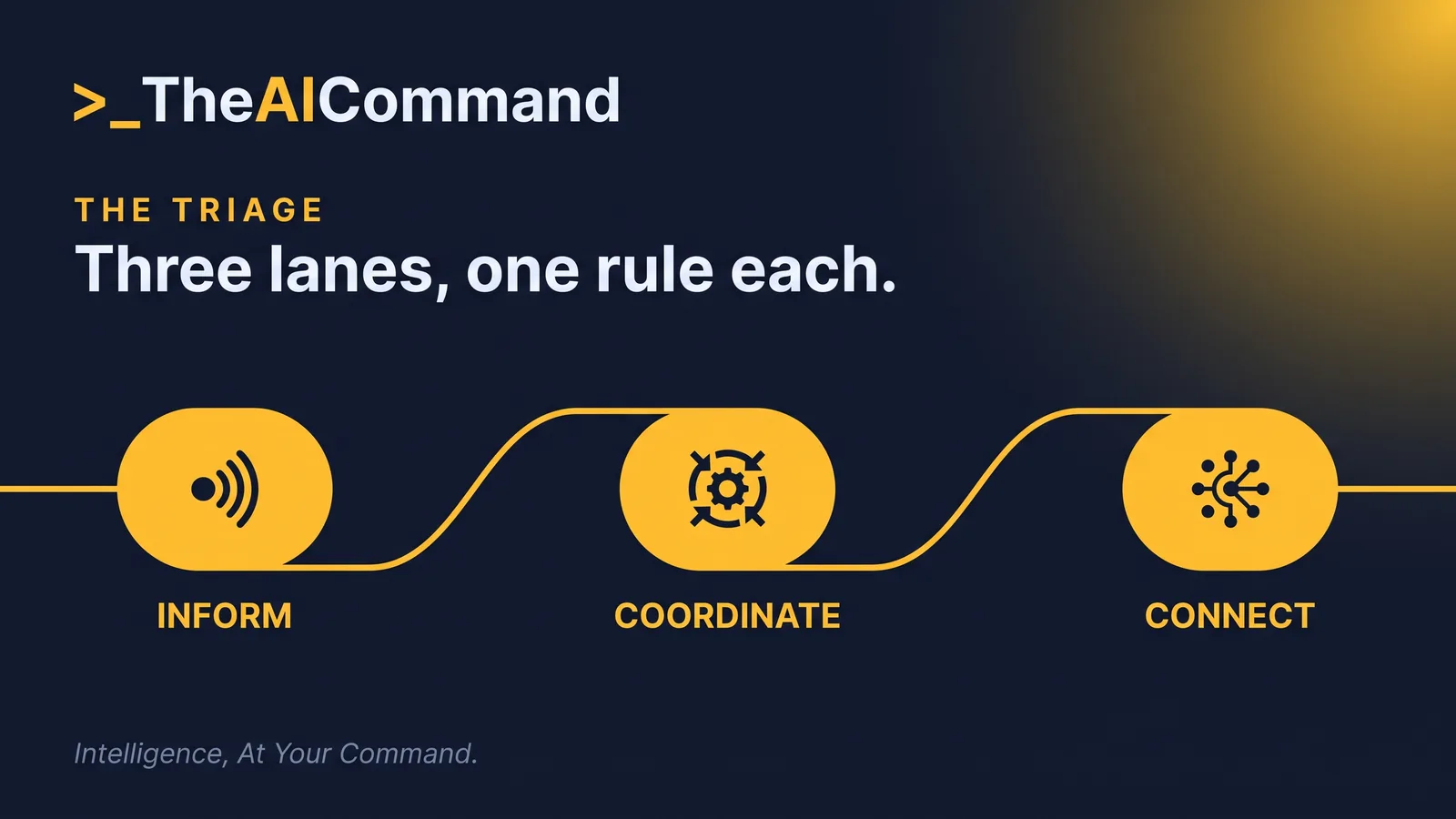
Here is a practical way to make that decision once and then run it on autopilot. Treat it as triage. Sort every recurring message you send into three lanes, and set a different AI rule for each.
Lane one: Inform. Facts and logistics. Meeting times, project status, policy reminders, where the document lives. These messages exist to be clear and correct. AI is genuinely useful here as a clarity and structure tool. Let it draft, tighten and check. Nobody reads a room-change notice for your soul.
Lane two: Coordinate. Decisions, asks, plans, the reasoning behind a call. These carry more weight, because people read them for your thinking. AI can help you structure the argument and pressure-test it before anyone sees it. You stay the author of the judgement. AI sharpens how clearly it lands. The pressure-test is worth systematising, so save this prompt and run it in ChatGPT, Claude or equivalent whenever a Coordinate message carries real weight:
Lane three: Connect. Recognition, personal feedback, an apology, the message that lands the morning after a hard restructure. Anything that carries the relationship. This is the lane the research is warning you about. You write these yourself. AI's only allowed role here is to check, not to write. Catch a typo, flag a sentence that might read the wrong way. It does not supply the words.
Making the sort once is the whole trick. The Monday setup below takes under an hour, and after that the rules run themselves.
The name test
The check is a single question. Before you send a Connect message, ask whether you would be comfortable if this person knew these were your words and not a model's.
If a piece of praise would feel hollow the moment the recipient learned AI wrote it, that is your answer. Rewrite it yourself. It does not need to be polished. A slightly clumsy sentence that is plainly yours beats a fluent one that reads as outsourced. Sloppy writing carries its own cost, so the point is not carelessness. The point is to be present.
For Connect messages, the safety net is a checker that is explicitly forbidden from writing. This prompt holds that line:
There is a quiet bonus here. If you tell your team openly where you draw the line, that you use AI for updates and logistics and never for recognition or feedback, the line itself signals that you take the relationship seriously. The boundary becomes part of how you lead, not a secret you are keeping.
Set it up on Monday
The triage only works if it exists before you are tired and tempted. Here is the setup, start to finish.
- Block 45 minutes. Open your sent messages from the last fortnight, email and chat both, and list every recurring team-facing message type you find: status updates, meeting logistics, decision announcements, plan changes, feedback notes, recognition.
- Sort the list into Inform, Coordinate and Connect. If a message type sits between two lanes, place it in the more personal lane.
- If you want a starting point, paste your list into the sorting prompt below and correct what comes back. Sorting a list is Inform-lane work, so the tool is allowed here. You make the final call on every row.
- Write your one-page lane rules using the template below and keep them where you draft, pinned in your notes app or stuck to the monitor.
- Save the pressure-test prompt and the checker prompt somewhere one paste away, in the same note.
- Before you send your next Connect message, run the name test. If it fails, rewrite the message in your own words, even if the sentences come out plainer.
- Tell your team where the line is, once, at your next team meeting. One sentence is enough: AI helps with updates and logistics, and never writes recognition or feedback.
Your one-page lane rules should read like this:
- Inform: AI may draft. I check names, dates and facts before sending.
- Coordinate: I write the judgement. AI structures and pressure-tests. The final wording is mine.
- Connect: I write every word. AI may flag typos and unclear sentences only. It never supplies the words.
- Connect triggers: recognition, personal feedback, an apology, thanks for extra effort, bad news that lands on one person, any message sent the week after a hard change.
- The name test: would I be comfortable if this person knew exactly which words were mine and which were the model's?
- The default: when in doubt, treat it as Connect.
A worked example
[TEAM_LEAD] runs a team of twelve. A project they care about has just slipped, and two people pulled long hours to recover it. [TEAM_LEAD] needs to send three messages this week: a status update to stakeholders, a note to the team explaining the revised plan, and a personal thank-you to the two who carried the recovery.
The status update is Inform. [TEAM_LEAD] gives the model the facts, lets it draft, checks the milestone dates against the plan, and sends.
The revised-plan note is Coordinate, and this is where the pressure-test earns its keep. [TEAM_LEAD] writes a first draft, pastes it into the pressure-test prompt with the context filled in, where [DECISION_OR_CHANGE] is a four-week delay with a descope and [ROLE_1] is the developer whose feature was cut. Three findings come back worth having: the second paragraph reads as though testing caused the slip, which the tired testers will notice; the note never says whether the delivery date moved for the client or only internally; and the reasoning for the descope is asserted in one line but never explained. [TEAM_LEAD] rereads the flagged paragraph cold and agrees the first finding is fair, rewrites the framing, answers the client-date question explicitly, and adds two sentences of reasoning. The judgement is unchanged. The message is clearer, and nobody gets ambushed.
The thank-you is Connect. [TEAM_LEAD] writes it by hand: "[EMPLOYEE_NAME], the recovery worked because you rebuilt the test schedule over two nights and caught the integration gap nobody else saw. That is the difference between a slip and a failure. Thank you." No model touches it. Fifty imperfect words, sent the same day, and the person who carried the project knows their leader saw exactly what they did.
Same week, same leader, three different rules. The thank-you is the one that builds the trust, and it is the one the machine never touches.
Where the boundary holds
The judgement AI cannot own is authorship of the relationship. A model can refine clarity. It can hold up your message against how different people will hear it. It can save you real time on the two lanes that are mostly mechanical. What it cannot do is supply your sincerity, your intent, or your accountability for words sent under your name. Judging whether an AI draft reads as authored or outsourced is itself a skill, and as Harvard Business Review has noted, judging the quality of AI output is expertise-dependent. You have to know what good looks like to catch when the machine has produced something fluent and empty.
This is not a counsel of fear about AI. It is a counsel of allocation. Used in the Inform and Coordinate lanes, AI gives you back the time and attention you should be spending on the Connect lane. The leaders who get this right are not the ones who refuse the tool. They are the ones who spend the time AI frees up on the messages that only they can write.
If you have already been leaning on it
Most leaders reading this have already sent AI-written praise at some point. You do not need to confess it. You need to change the pattern going forward, and the simplest correction is also the most visible. The next time someone on your team does something that genuinely deserves recognition, write it yourself, name the specific thing they did, and send it the same day. Specificity is the tell that a human was paying attention, and it is the one thing a model cannot fake, because it was not in the room. One concrete, hand-written acknowledgement does more to rebuild the signal than a month of polished generic praise.
The point is not that AI has no place in how you communicate as a leader. It is that the most important messages you send are the ones it should never write. Decide which those are before you are tired, busy and tempted, and the decision will hold when it matters.
Bottom line
AI is genuinely useful for the informational and coordinating messages a leader sends, and quietly corrosive on the ones that carry the relationship. The research is consistent across two countries: when employees sense AI wrote praise or feedback, perceived sincerity collapses, from 83 per cent down to as low as 40. Decide which messages must stay yours before you are tired and tempted, and the boundary will hold when it matters.
Do this Monday:
- Block 45 minutes and list every recurring team-facing message you send.
- Sort each one into Inform, Coordinate or Connect, placing anything borderline in the more personal lane.
- Save the pressure-test prompt and the checker prompt one paste away.
- Run the name test before every Connect message, and rewrite it by hand if it fails.
- Tell your team once where the line sits: AI for updates and logistics, never for recognition or feedback.
TheAICommand. Intelligence, At Your Command.