
To rehearse a hard conversation with AI, treat a current model as a flight simulator, not a scriptwriter: brief it to play the counterpart as an archetype with no real names, run your real opening line, then switch it from counterpart to coach. The most expensive conversations a leader has are the ones they walk into cold. The restructure announcement. The underperformance message that has been carried, unsaid, for a quarter. The pushback to a board that has already made up its mind. Leaders rehearse the keynote, the investor update, the all-hands. They almost never rehearse the five minutes across a desk that decide whether a good person stays, and those five minutes carry more of the leadership job than the keynote ever will.
The thing worth noticing in 2026 is that the practice field for those conversations now sits in the same window where you draft the email. Most leaders are using it for the email. Drafting the message is the low-value use of AI here, the same reflex as letting a model write the messages that are supposed to build trust. Rehearsing it is the high-value one, because the failure mode of a hard conversation is rarely the words you planned. It is your reaction to the response you did not.
Why is the real bottleneck you, not the AI?
McKinsey's report "Superagency in the workplace", published in January 2025, put the constraint plainly. It concludes that employees are ready for AI and that the biggest barrier to success is leadership. Nearly all employees (94 per cent) and C-suite leaders (99 per cent) report some familiarity with generative AI, McKinsey found, yet just 1 per cent of companies believe they are at maturity, and employees are roughly three times more likely to be using the tools heavily than their leaders assume. The gap is not capability or access. It is leaders not steering fast enough.
Steering is mostly conversation. The change you are asking the organisation to absorb, which often starts with talking to your team about AI before the rumours do, the feedback that keeps a team honest, the alignment that stops a strategy quietly dying in the middle layer, these all arrive as conversations a leader has to hold well. And holding them well is a skill most leaders were never taught to practise. Harvard Business Review research by Katharina Lange and José Parra-Moyano, published in February 2025, started from exactly that gap. Leading like a coach depends on strong communication, on the ability to "ask good questions, resolve conflicts, and provide meaningful feedback", and yet, as they put it, "not all executives know how to practice the skills required to be an effective coach and communicator."
What changed is that the practice is now available without a coach in the room. A current model can hold a sustained, in-character dialogue, react the way a defensive or wounded or stubborn counterpart would, and then drop the character and tell you where your framing went wrong. Stanford Online now runs a course, "Mastering Difficult Conversations with AI", built on precisely this. Its own description calls it a "practice field" where you "rehearse critical conversations in a low-stakes environment and gain the skills and confidence to lead with authority and empathy." The point for a working leader is that you do not need the course to get the practice field. It is in the chat window you already pay for.
This is a leadership skill, not a tooling trick. The leaders who get value from AI are not the ones who automate the most, they are the ones who use it to get better at the parts of the job that were always hard and never delegable. A hard conversation is the clearest example. You cannot outsource it, you cannot template it, and you usually get one take. Rehearsal is the only lever that improves the take, and until recently rehearsal meant either a willing colleague to role-play with or an executive coach on a retainer. Both are scarce. A model that will play the part on demand, at eleven at night before a nine o'clock meeting, is not. That is the shift worth acting on: not that AI can talk, but that the practice has finally become cheap enough to actually do.
How do you run a fifteen-minute rehearsal before a hard conversation?
Treat the model as a flight simulator for the conversation, not as a scriptwriter for it. The aim is to feel the resistance before it is real, so you spend your composure in rehearsal and arrive with it intact. Four steps, and the order matters.
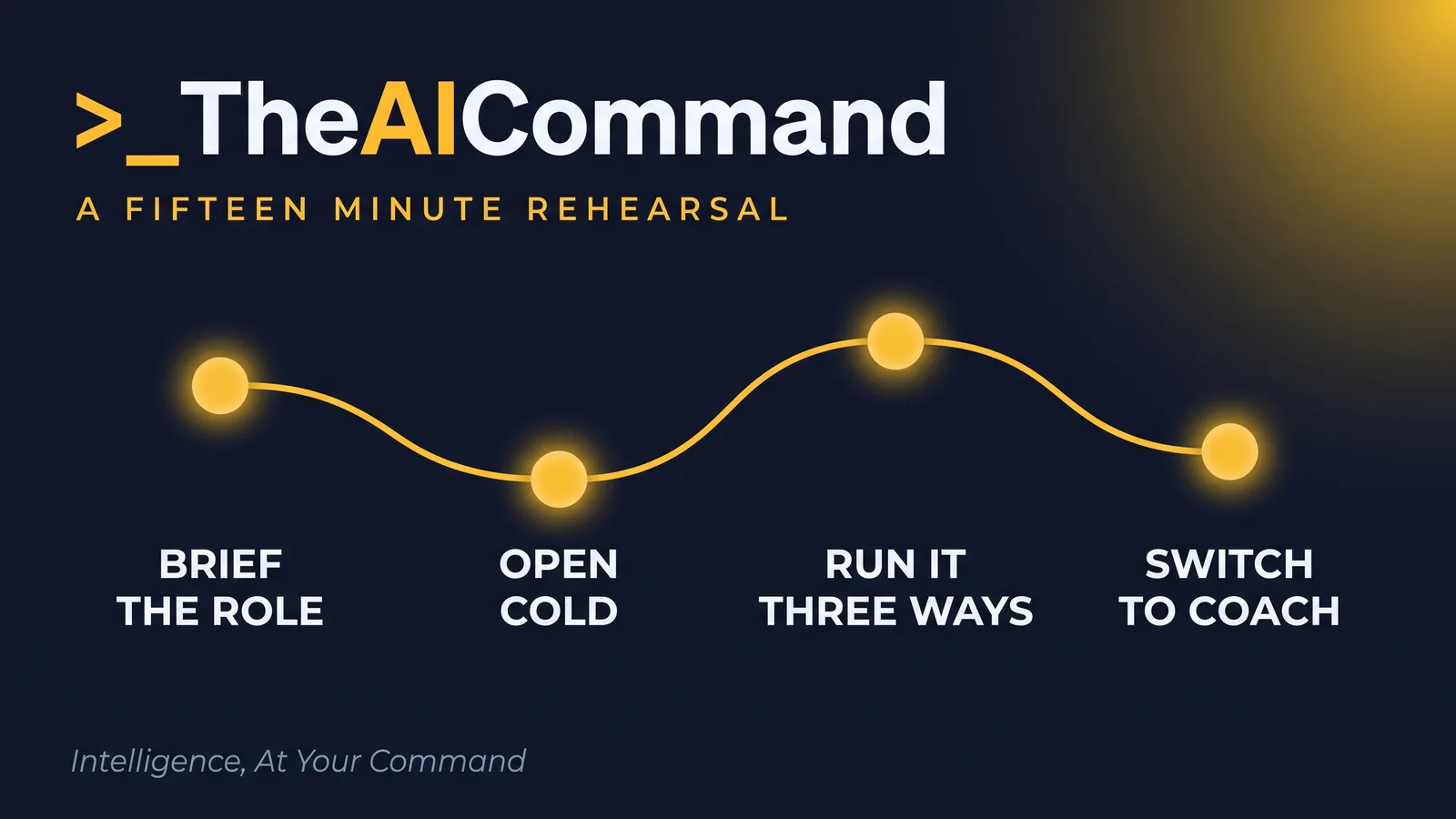
1. Brief the role, never the person
Give the model a role and a stance, not a name and a file. "You are a capable, well-regarded member of [TEAM] who has just been told their role is being narrowed. You believe the decision is unfair and dressed up as a reorganisation. You are calm but you will not let me off the hook. Stay in character." You are rehearsing your conduct against an archetype, not simulating a real human being, and that distinction is the whole ethical spine of the exercise. Never paste a real person's performance notes, medical information or identity into the prompt. The archetype is enough to make the rehearsal honest.
2. Tell it not to go easy on you
A model's default is to please you, and a counterpart that wants to please is useless to rehearse against. OpenAI rolled back a GPT-4o update in April 2025 for exactly this, describing the version it removed as "overly flattering or agreeable, often described as sycophantic" and "overly supportive but disingenuous." That same pull toward agreement you have to force a model out of before you decide will make a role-play partner fold the moment you push. So instruct it out of the default. "Do not be agreeable. Do not concede quickly. Do not coach me or break character unless I say the word stop." A rehearsal that goes smoothly has taught you nothing except that you can win the easy version of a conversation you were never going to get.
3. Run the same opening three ways
Deliver your real opening line, the one you would actually say, and let the character react. Then ask the model to replay the same opening as three different people: the one who gets defensive, the one who goes silent and withdraws, and the one who agrees far too fast. The third is the dangerous one, because a leader's instinct is to fill an easy agreement with reassurance they cannot back. You are not memorising one conversation. You are rehearsing your steadiness across the range of reactions a real person might actually have, so that whichever one shows up, you have already been there once.
4. Switch it from counterpart to coach
When the role-play is done, change the model's job. "Stop the role-play. As an observer, tell me where my framing put the other person on the defensive, where I buried the actual message, and the single sentence I should open with instead." This is the coach-listening-in pattern from the HBR research, now self-serve and available on demand. Keep the standing rules, stay in character, push back, no real names, in a saved project or custom instruction so they persist, and paste only the fresh scenario each time. OpenAI's own guidance notes that a personality sets "the style and tone" a model uses and that "instructions you give during a conversation can also adjust or obscure" it, which is exactly the lever you are pulling when you tell it to play tough and then to critique.
Done well, the whole loop takes fifteen minutes and you run it only for the conversations that carry weight: the restructure, the serious feedback, the negotiation you cannot afford to fumble. Run it for everything and it becomes avoidance with extra steps. The signal that you are using it well is simple. You walk into the real conversation slightly bored by your own opening, because you have already heard it land badly once and fixed it.
What should the model never get to decide?
The rehearsal is a flight simulator, not the flight. The most important line a leader holds here is that preparing for a conversation is not the same as having it, and the model must never become a script you read at a person. HBR's Amy Gallo, writing in March 2026, framed the risk in one sentence: "we're outsourcing the very moments that create connection." A leader who has rehearsed walks in more present, not less. A leader who has memorised a script walks in performing, and the person across the desk can always tell the difference.
Three boundaries keep the move on the right side of that line. First, do not trust a counterpart that rolls over. The same agreeableness that makes drafting feel good makes role-play soft, and a soft rehearsal breeds the overconfidence you least want walking into the room. If the model stops pushing, make it push again. Second, no real personal data, ever. You are rehearsing against a generic archetype, never against [EMPLOYEE_NAME]'s actual record. In Australia this is not only a privacy reflex but a safety duty. Safe Work Australia is clear that under the model WHS laws "a person conducting a business or undertaking (PCBU) must manage the risk of psychosocial hazards", and the hazards it lists include poor support, low job control, lack of role clarity and poor organisational change management. Performance and restructure conversations sit squarely in that territory. A rehearsed leader manages those psychosocial hazards better; a scripted leader who has stopped listening manages them worse.
Third, the accountability does not move. The model can play the counterpart and critique your framing. It cannot own the decision behind the conversation, the duty of care in the room, or the relationship the morning after. And rehearsing the live conversation is a different act from writing the formal record. Drafting the written review, setting the rating, deciding the outcome, those stay with you and most are bright lines a model should not cross. The rehearsal sharpens how you carry the message. It does not get a vote on the message.
A worked example
[TEAM] is being restructured and [EMPLOYEE_NAME]'s role is narrowing. As with any restructure, AI can build the redundancy but it cannot decide it: the leader has the decision, the rationale and the dread. Fifteen minutes before the meeting, they open a chat that already carries the standing rules: no real names, stay in character, push back. They paste the scenario, an experienced and respected team member who has just learned their role is being reduced and reads it as a demotion in disguise, and they deliver their real opening line. The character does not explode. It goes quiet and asks one sharp question the leader had not prepared for, and the leader fumbles it.
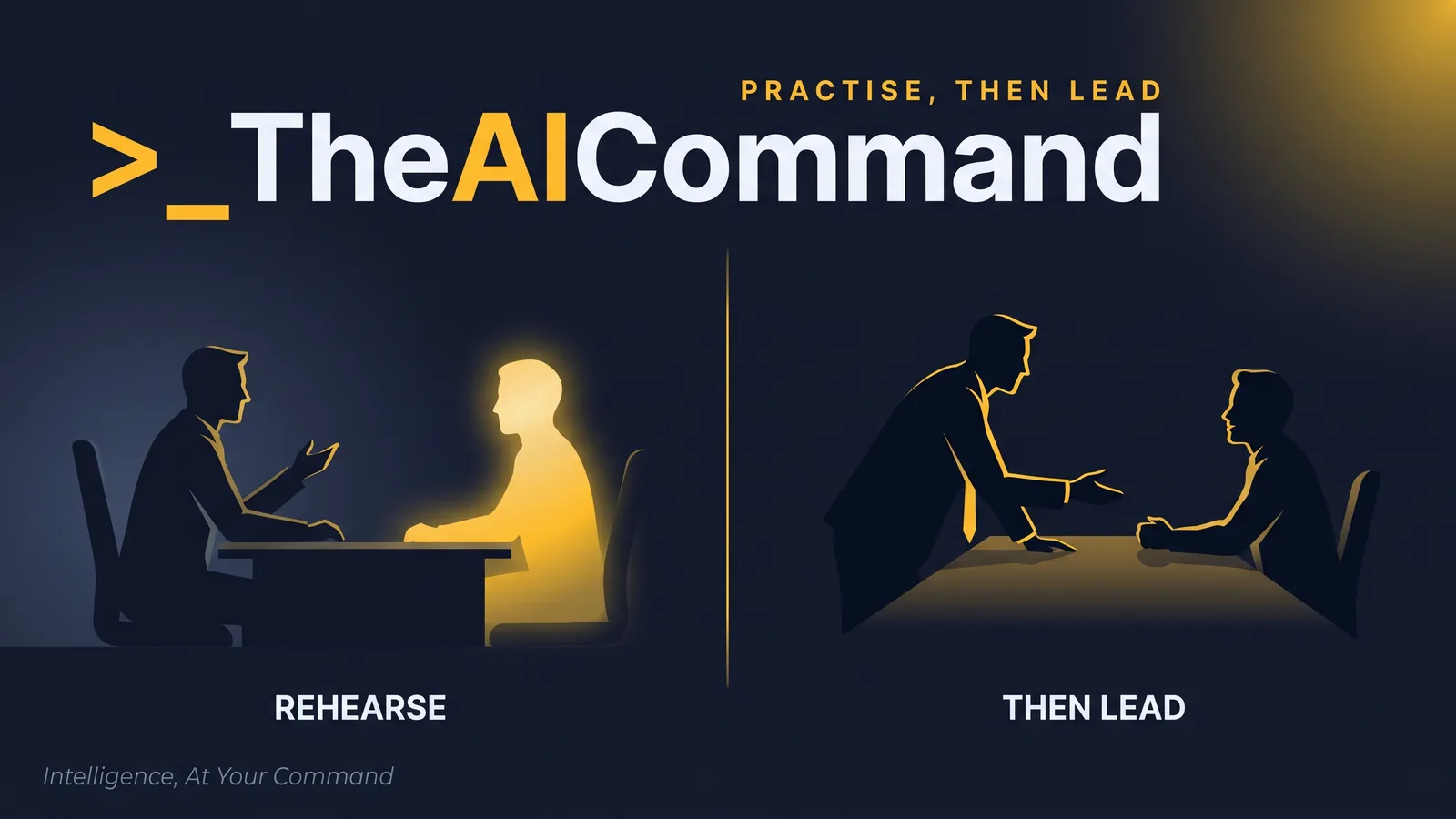
They run it again. Then they run the "agrees too fast" version, which lands worse, because the leader hears their own instinct to fill the silence with reassurances about a future they cannot yet promise. They switch the model to observer. It tells them they led with the structure and buried the respect, and that the sentence to open with is the one about what the person keeps, not what they lose. The leader walks into the real meeting having already had the hard part of the conversation, with a machine, so the person on the other side of the desk gets the prepared version and a leader who is listening, not the rehearsal.
The leaders who get the most from AI this year will not be the ones with the cleverest prompts. They will be the ones who used it to walk into the rooms that decide things already practised, then left it at the door and had the conversation as themselves.
The prompt
Paste this into ChatGPT or Claude. It runs a two-mode rehearsal: in-character role-play, then an on-demand coaching debrief. Fill in only the bracketed scenario.
How to run it. Save the prompt as a ChatGPT Project, or put the standing rules and the two-mode structure in Custom Instructions, so "stay in character, push back, no real names" never wears off and each new chat needs only the scenario. Run the scenario in Mode 1, deliver your real opening, then type STOP for the Mode 2 debrief, take the single improvement it names back into a fresh Mode 1 run, and repeat until the debrief stops finding a new failure, usually two or three loops.
Bottom line
Rehearsing the hard conversation is the high-value use of AI, not drafting the message. Treat a current model as a flight simulator: brief an archetype with no real names, tell it not to go easy on you, run your opening three ways, then switch it to coach. You still own the decision, the duty of care and the written record.
Do this Monday:
- Save the standing rules, stay in character, push back, no real names, as a ChatGPT Project or Custom Instructions so they persist across chats.
- Brief a role and a stance, never a real person's name, performance notes or medical information.
- Run your real opening line three ways: the reaction that gets defensive, the one that withdraws, and the one that agrees too fast.
- Type STOP to switch the model from counterpart to coach for a short debrief, then take the one improvement back into a fresh run.
- Reserve it for conversations that carry weight; run it for everything and it becomes avoidance with extra steps.
References
- McKinsey & Company. "Superagency in the workplace: Empowering people to unlock AI's full potential at work." 28 January 2025. https://www.mckinsey.com/capabilities/tech-and-ai/our-insights/superagency-in-the-workplace-empowering-people-to-unlock-ais-full-potential-at-work
- Katharina Lange and José Parra-Moyano. "Research: How AI Helped Executives Improve Communication." Harvard Business Review, 14 February 2025. https://hbr.org/2025/02/research-how-ai-helped-executives-improve-communication
- Amy Gallo. "How AI Damages Work Relationships, and Where It Can Actually Help." Harvard Business Review, 2 March 2026. https://hbr.org/2026/03/how-ai-damages-work-relationships-and-where-it-can-actually-help
- Stanford Online. "Mastering Difficult Conversations with AI" (course XMDC210). Accessed 27 June 2026. https://online.stanford.edu/courses/xmdc210-mastering-difficult-conversations-ai
- OpenAI. "Customizing Your ChatGPT Personality." OpenAI Help Center. Accessed 27 June 2026. https://help.openai.com/en/articles/11899719-customizing-your-chatgpt-personality
- OpenAI. "Sycophancy in GPT-4o: what happened and what we're doing about it." 29 April 2025. https://openai.com/index/sycophancy-in-gpt-4o/
- Safe Work Australia. "Psychosocial hazards." Accessed 27 June 2026. https://www.safeworkaustralia.gov.au/safety-topic/managing-health-and-safety/mental-health/psychosocial-hazards
TheAICommand. Intelligence, At Your Command.