Start with the week that is already in your calendar
The subscription renewal arrives on the same morning as a policy comparison, an overdue spreadsheet and a briefing note. Each task needs something different. A larger model allowance might help with one and make no practical difference to the others. The buying question begins with that uneven week, rather than a list of product badges.
Write down the work before opening a pricing page. Describe the source material, the result someone needs and how that person will check it. "Help with documents" is too broad. "Compare two approved procedure versions, identify changed obligations and link every proposed amendment to a paragraph" gives you something a plan can either support or fail to support.
This article uses a constructed week for an operations coordinator in a small Australian private business. The tasks, restrictions and decisions are fictional teaching examples. No subscription was purchased and no vendor was tested for this article. The comparison below separates official product documentation from proposed tests and judgement calls. It is a shortlist for investigation, not a performance ranking.
Give each task a requirement that can be checked
Monday's work is a comparison of two fictional procedure documents. Tuesday needs a summary of public regulator guidance. Wednesday involves cleaning a synthetic supplier table. Thursday requires a draft briefing from approved notes. Friday is reserved for reviewing the work and updating reusable instructions. None of these activities authorises an external message, a purchase or an employment decision.
For Monday, success means the changed passage, its source location and a proposed explanation appear together. For Tuesday, the reader must be able to open the primary source and distinguish its requirements from commentary. Wednesday's table needs preserved row identifiers, an exception list and an explanation of transformations. Thursday's briefing must retain disagreements in the supplied notes instead of resolving them silently.
These definitions expose different subscription questions. Can the account accept the required files? Is the relevant research or analysis tool available? Can the output be exported into the team's ordinary review process? How often does the work need to run? A feature name is only the beginning of that enquiry. The next step is a bounded test using the actual file type and a safe sample.
Remove tasks that the account is not allowed to handle
Keep a separate exclusion column. In this example, real employee files, customer records, commercially restricted documents and credentials are excluded from consumer-account trials. The coordinator uses public documents and newly constructed samples. A redacted file is not automatically suitable: context, uncommon events and retained identifiers may still reveal information the organisation did not approve for this destination.
Ask the organisation which account and services it permits before testing work material. An individual subscription purchased personally does not establish organisational approval. Equally, an employer's existing subscription may make a new purchase unnecessary. Record what is already available, who owns it and whether the proposed task is authorised there. Do not connect workplace storage merely to make a comparison easier.
An Australian public-sector reader can use the inventory method, but must substitute the agency's own approval and information-handling requirements. This private-business example does not establish a procurement pathway for government. Where required controls cannot be confirmed, leave the task outside the trial. Buying more usage does not resolve an unanswered question about where information may go.
What the three shortlists actually tell you
Start with ChatGPT Free and Plus, Claude Free and Pro, and Gemini's free access and Google AI Pro. These are selected examples, not the whole market or a claim that the named paid tier is the cheapest sufficient option. Lower-priced or specialist tiers may deserve a separate check when your inventory shows a narrow need.
OpenAI documents free access to file uploads, data analysis and web search, with separate tool limits. Its Plus help page describes broader access and variable usage limits. That supports checking whether a particular restriction is interrupting the week; it does not prove that every document will fit or every analysis will be accurate. ChatGPT Free Tier FAQ and Plus details.
Anthropic's Pro documentation lists more usage than Free and Claude Code access. Its pricing page also lists Projects among the Pro features, although its comparison table allows up to five Projects on Free. Treat these as documented inclusions to check against a specific workflow. They are not evidence that Claude produced a better policy comparison in this example. Claude Pro details and plan comparison.
Google's Australian subscriptions page lists free Gemini access, while Google AI Pro includes greater access and Gemini in Google apps. That makes the location of work a useful question for a Google-based business. It does not establish access to a particular managed workplace account or permission to use its documents. Australian Gemini subscriptions.
Check whether this week represents the work
A quiet week can hide the task that makes a subscription necessary. In the constructed business, the coordinator also prepares a quarterly report with several source documents. That report is not due during the diary week. Add it as an exception case, recording its frequency and input requirements, without pretending that it ran during the trial. A useful diary describes both ordinary demand and known peaks.
The opposite mistake is buying for a demonstration task that never recurs. An attractive presentation or image may take up most of a trial even though the reader's routine work involves checking tables. Separate experiments from recurring responsibilities. Keep an experiment on the list only when someone can explain the future use, permitted inputs and review requirements. Otherwise it should not determine a continuing subscription.
Ask a colleague to review the inventory before evaluating plans. They may identify a necessary accessibility feature, a handover requirement or an existing approved tool that the original author missed. Record the change and its reason. The inventory is a practical description of work, not a fixed questionnaire whose completeness can be assumed from the number of rows.
Read the price as a payment commitment
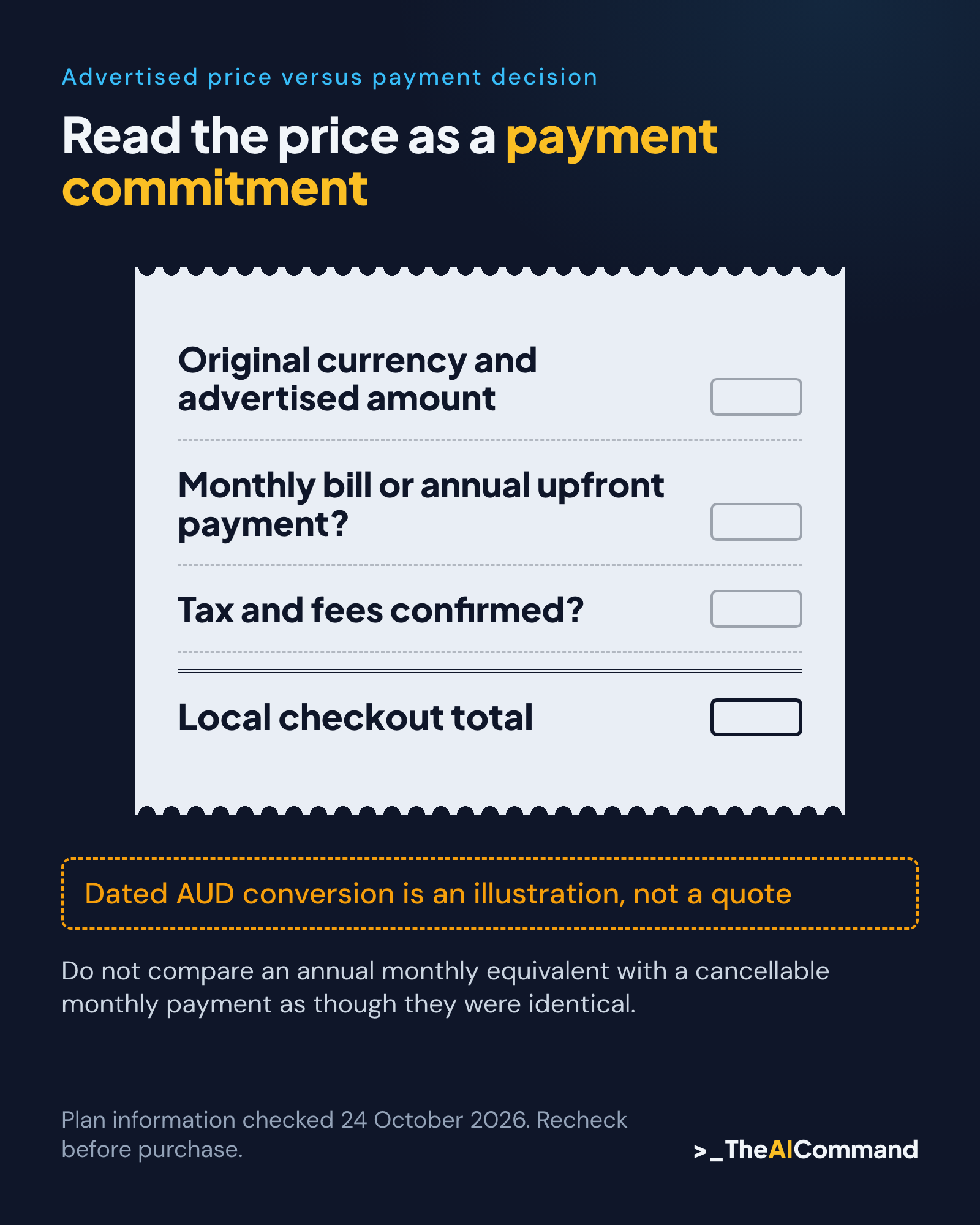
The dated price table below records the offer, currency and billing basis separately. OpenAI lists Plus at USD 20 monthly in its official help material and does not offer annual Plus billing there. Its pricing page, viewed from an Australian location on 24 October 2026, showed Plus at A$30 a month without stating whether GST was included. Anthropic lists Pro at USD 20 monthly in its US help information, with a USD 200 annual option in the US view of its pricing page. Viewed from an Australian location on 24 October 2026, the same page showed Pro at $34 monthly or $340 billed up front for a year, with a note that prices include 10% GST, although the page also keeps a generic line saying prices shown do not include applicable tax. Confirm the total at checkout. Google's Australian page displays Google AI Pro at AUD 32.99 monthly. Recheck each page before purchasing.
Do not compare an annual monthly equivalent with a cancellable monthly payment as though they were identical. In the US view, Claude's displayed rounded annual equivalent is USD 17, but USD 200 divided by twelve is about USD 16.67, and the payment remains USD 200 upfront. The Australian view showed $28 a month against $340 billed up front, which is about $28.33 a month. A reader who needs the product for one uncertain month has a different decision from a reader with an established year of permitted work.
OpenAI's billing guidance for subscriptions bought on chatgpt.com lists AUD support and says existing subscriptions remain in their current currency; app store subscriptions are billed by Apple or Google. Anthropic says regional prices and tax presentation vary. The table's USD conversions are therefore illustrations, not Australian checkout quotations. Google's Australian pages do not state whether their prices include GST. Confirm the actual total, billing channel and renewal terms without assuming that an advertised amount already answers those questions. OpenAI currency guidance.
For a transparent illustration, the Reserve Bank of Australia's published rate for 21 October 2026 was USD 0.7010 per Australian dollar. Dividing USD 20 by 0.7010 gives AUD 28.53. Dividing USD 200 gives AUD 285.31. These exclude any additional tax, card fees or vendor localisation and are not bank settlement rates. The Australian prices shown on 24 October, A$30 for ChatGPT Plus and $34 for Claude Pro monthly including GST, sit above these conversions. Record the rate date alongside the arithmetic. RBA exchange rates.
Turn the constructed diary into a shortlist
Return to the coordinator's week. Monday needs a source comparison, Tuesday needs public research, Wednesday needs table handling and Thursday needs a controlled draft. The provisional decision is to try permitted free access first, because the diary contains no observed limit failure yet. That is a constructed decision from incomplete evidence, not a finding that free tools will complete the week.
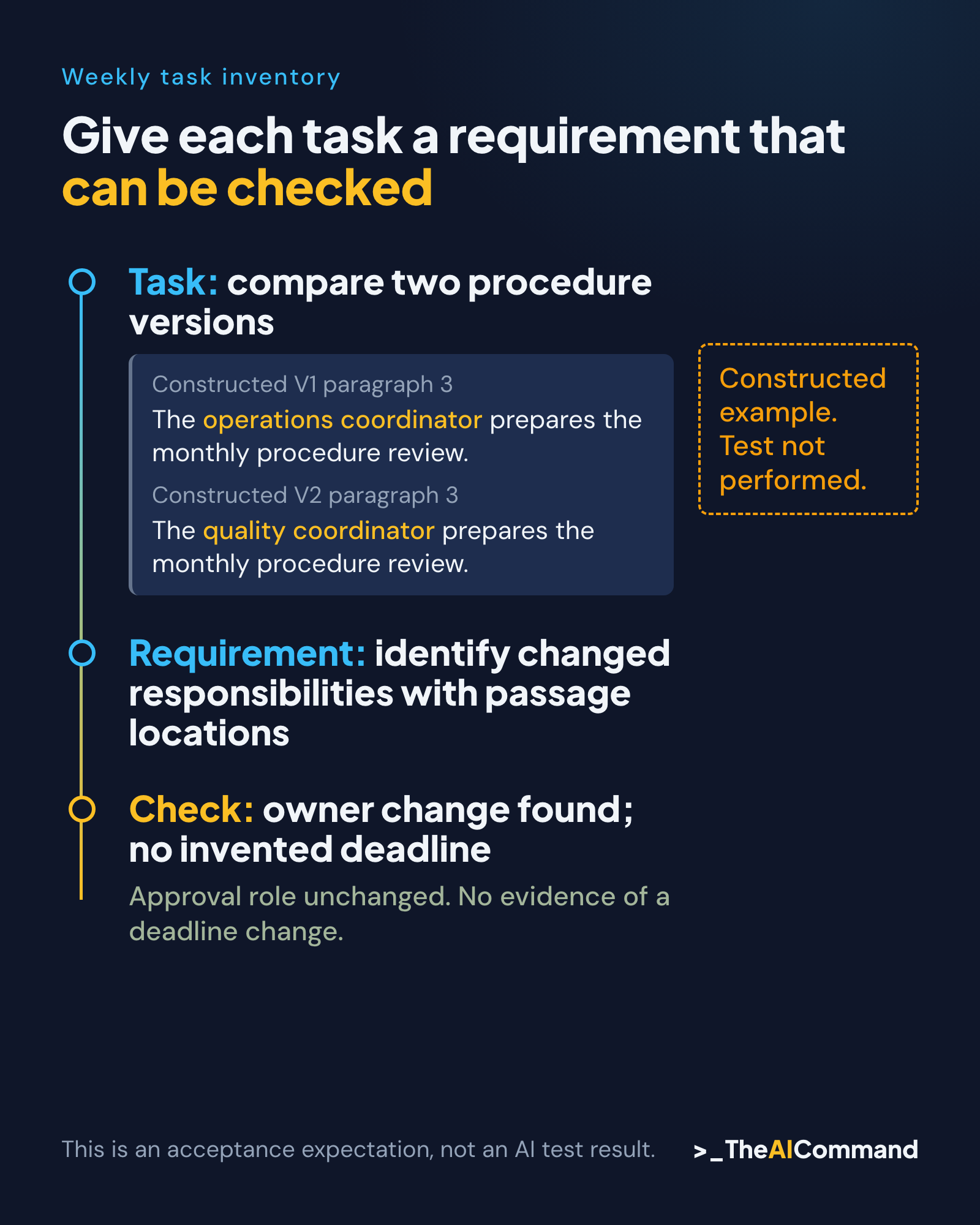
The coordinator gives each candidate the same short fictional procedure pair. One clause changes the review owner; another merely changes formatting. The required output must identify the substantive change and leave the cosmetic change separate. The prompt also asks for the location of every cited passage. A plausible illustrative response identifies the owner change and records "no evidence of a deadline change" rather than inventing one.
On the supplier-table task, two rows contain the same trading name but different reference identifiers. The expected behaviour is to flag a possible duplicate for review, not merge the rows automatically. A tool that produces a neat table after deleting a valid row has failed this case. Extra usage cannot make that deletion acceptable. The human reviewer checks the original rows before deciding whether the task merits another attempt.
The actual trial record remains blank until someone performs these checks. If file limits prevent the comparison, record the exact limit message and account context. If the task runs but the output misstates the clause, record an accuracy failure. If the reviewer cannot trace the answer, record an evidence failure. These different outcomes point to different remedies, only one of which may be a paid upgrade.
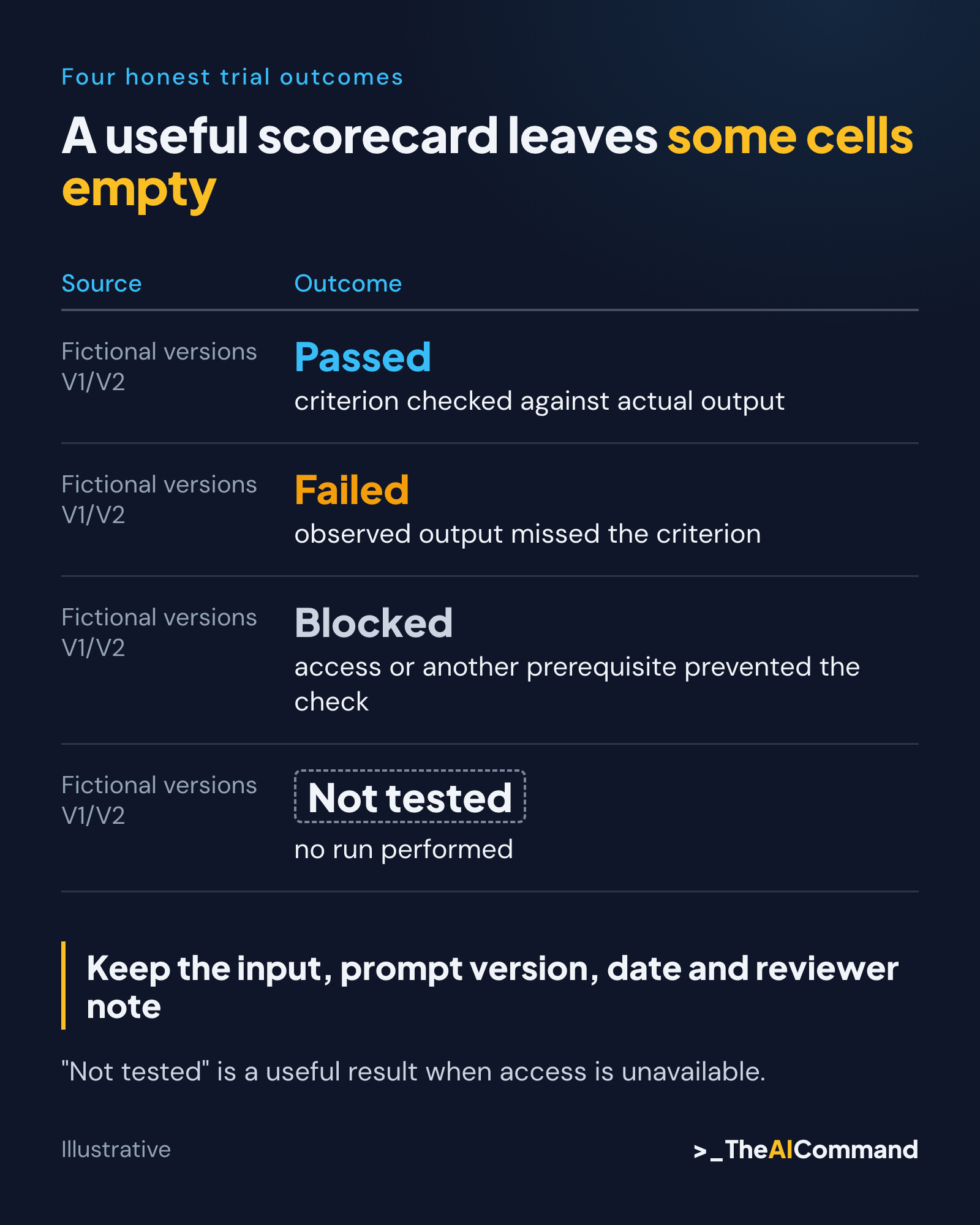
A useful scorecard leaves some cells empty
Use plain outcomes: passed, failed, not tested and blocked. Beside each outcome, keep the source input, prompt version, selected feature, date and review note. "Not tested" is a useful result when access is unavailable. It is more honest than awarding a middling score that makes an unknown look measured. Avoid a single weighted total until the non-negotiable requirements have been resolved.
Suppose, as a second constructed scenario, all three candidates can draft the briefing but one cannot provide a workable export on the tested surface. That narrows its role in this workflow; it says nothing about its general intelligence. Conversely, a product can have the required export and still invent a source. Functional fit and evidence quality need separate observations before anyone calls the result usable.
Keep the prompt steady for the first comparison. Record any later changes, including a reduced file, a different model or a new instruction. Otherwise the second candidate may appear stronger simply because the task became easier. Repeat the difficult case after an adjustment, and preserve the first failure. A comparison record should explain the decision to a colleague who did not watch the trial.
Count the review work before calling something cheaper
The subscription is one input to cost. Include preparation, checking, correction and transferring the result into its final document. Measure those activities during an authorised trial rather than assigning an attractive savings percentage. The current example has no measured timings, so it cannot support a return-on-investment claim or a statement that one product saves an hour each day.
Separate costs that recur from costs that happen once. Learning where to upload a file may be an initial effort. Checking changed obligations remains part of every relevant run. If the second task requires a separate service, name that dependency and price it independently. OpenAI's Plus and Anthropic's Pro help pages both distinguish their subscriptions from separately billed API usage; a chat subscription should not be treated as a general automation budget.
For a low-volume week, the practical comparison may be free access plus manual completion versus one paid month plus the same review obligations. For frequent work, usage interruptions and recovery effort may become material. Write down the threshold that would change the decision, such as repeated blockage of an approved recurring task, rather than assuming that a higher tier will justify itself later.
Make a small decision that can be revisited
The coordinator's proposed decision note now has a clear shape: keep using permitted free access while testing the defined cases, consider one paid month only if a documented restriction prevents useful work, and review before renewal. No provider wins in advance. The unresolved questions include account eligibility, actual capacity, output quality and the final Australian amount payable.
If a paid trial is authorised, nominate its owner and end date before starting. Keep the source pack and review record outside a disposable conversation so the decision remains understandable. Check how the work will continue if the subscription ends. Do not make one account the only place where approved instructions or important output can be found.
The existing tool-choice guide provides broader context. This exercise adds a task diary, documented plan checks and a payment decision tied to evidence. Apply the Verified Draft Method to the work itself, and return to the sources when product facts change. A subscription fits when the authorised tasks and review process fit together.
Price and commitment snapshot
Checked 24 October 2026. USD conversions use the RBA's 21 October rate and are illustrations before additional taxes or fees, not Australian checkout quotes. Prices and plans change; check each provider's current page before buying.
Sources: OpenAI Plus, USD confirmation, German-language help page, ChatGPT pricing, OpenAI Free, Claude pricing, Claude Pro, Google Australia, RBA.
Copyable weekly inventory
Reusable materials
All filled examples below are constructed for a fictional Australian private business. No live records or observed vendor results are represented.
Weekly task inventory
Small sample for W1
Constructed V1 paragraph 3: "The operations coordinator prepares the monthly procedure review. The manager approves changes."
Constructed V2 paragraph 3: "The quality coordinator prepares the monthly procedure review. The manager approves changes."
Expected illustrative output: preparation owner changed from operations coordinator to quality coordinator. Approval role unchanged. No evidence of a deadline change. This is an acceptance expectation, not an AI test result.
Small sample for W3
Expected illustrative output: two distinct supplier references; possible relationship requires human clarification. Retain both rows. Do not infer duplication from the trading name alone.
Copyable plan-fit prompt
Trial record template
- Task/source version:
- Account category, approved destination and surface:
- Model/feature selected, if shown:
- Date and time:
- Prompt version:
- Required output and acceptance criterion:
- Outcome: not tested / passed / failed / blocked.
- Exact limit or error message, with identifiers removed:
- Accuracy and evidence findings:
- Preparation, review and correction time actually measured:
- Output location and human reviewer:
- Change between attempts:
Subscription decision template
- Permitted task and reason for purchase:
- Free or already-funded alternative considered:
- Documented restriction or unmet need:
- Evidence from actual trial, or Not tested:
- Price currency, billing channel and amount:
- Billing frequency and upfront commitment:
- Tax and fees confirmed / unresolved:
- Optional dated FX illustration, distinct from checkout total:
- Additional services, approvals and review effort:
- Authorised decision owner:
- Decision: retain current approach / bounded paid trial / defer.
- Review date, renewal date and exit plan:
Review checklist
- Inputs contain no real employee, claim, customer or credential data.
- Every plan fact links to a current official source.
- Trial outcomes remain blank or not tested until observed.
- Missing evidence is visible, not scored as average.
- Upfront annual payment and monthly equivalents are separate.
- Public-sector users substitute their applicable approval requirements.
- No output or purchase is actioned automatically.
What to do next
Complete the weekly inventory before choosing a paid tier. Select one safe task, define its acceptance case and record actual results before making a purchasing decision.
Related reading
- Choosing Claude, ChatGPT, Gemini or Copilot for Your Job
- AI Tool Comparison, plans and prices for seven AI apps in Australian dollars, side by side
- Build, Buy or Stop: Make the AI Workflow Decision Explicit, the companion article for 7 November
References
- OpenAI: ChatGPT Free Tier FAQ
- OpenAI: Plus details
- Anthropic: Claude Pro details
- Anthropic: plan comparison
- Google: Australian Gemini subscriptions
- OpenAI currency guidance
- Reserve Bank of Australia: RBA exchange rates
- OpenAI: USD confirmation, German-language help page
- OpenAI: ChatGPT pricing
- Google: Google AI plans, Australia
General information only. Not legal, compliance, financial, or professional advice.
TheAICommand. Intelligence, At Your Command.