
The operations meeting starts with a subscription request. Someone has made a convincing demonstration that turns a weekly spreadsheet into a polished update. The proposed decision is whether to approve the tool. The more useful decision is whether this particular workflow deserves to exist in its proposed form.
A manager needs to know what happens before the demonstration starts and after its output appears. Who repairs the spreadsheet? Who checks that completed work has not been counted twice? Who answers questions when the person who wrote the prompt is away? Those activities belong in the comparison because someone must perform them whichever option is chosen.
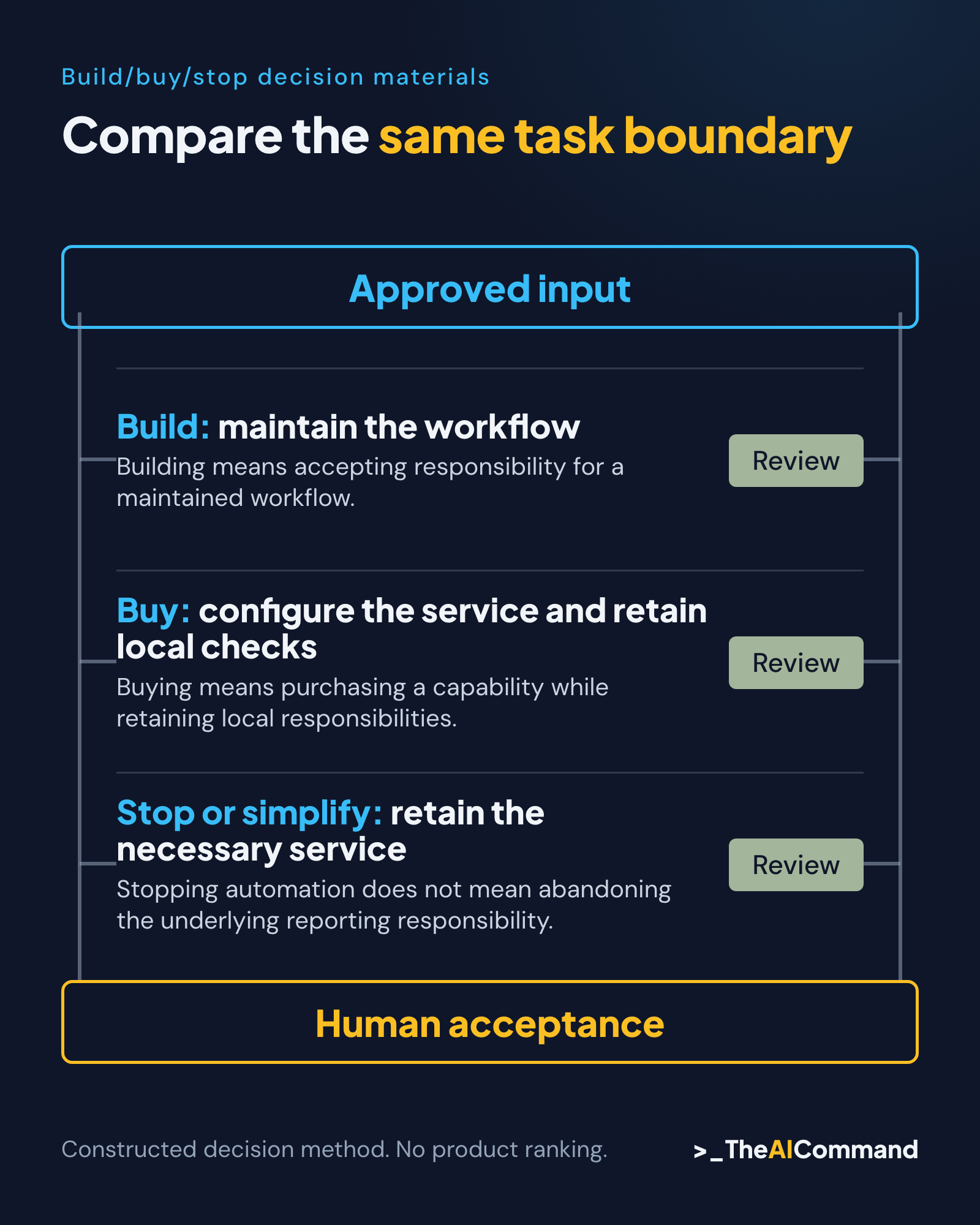
Build, buy or stop is a sourcing decision about a complete service. Building means accepting responsibility for a maintained workflow. Buying means purchasing a capability while retaining local responsibilities. Stopping can mean rejecting the automation, reducing the report or removing an unnecessary step. None of these decisions follows automatically from which model writes the best paragraph.
Describe a useful result before naming a tool
Write the outcome in terms a recipient can inspect. For a weekly operational update, that might mean a manager can identify overdue actions and unresolved dependencies from approved records. The report must preserve the reporting period, identify its sources and keep unconfirmed explanations visible. A fluent narrative that loses these distinctions fails the task.
Ask the recipient which parts of the existing report change a decision. A section that nobody uses may be removable with the appropriate owner's agreement. A required record cannot be dropped merely because its production is inconvenient. Establish that distinction before estimating the benefits of producing the same document faster.
Define the boundaries of the proposed improvement. Drafting a narrative from an approved table is different from collecting records, correcting them and emailing a result automatically. Each additional step changes the access, maintenance and review work. A useful decision brief identifies the exact starting input and the point at which a person takes responsibility for the result.
Use the current process as a credible alternative. It may have weaknesses, but people know how to recover it when an input is late. Capture those strengths alongside the inconvenience. Otherwise the comparison gives every known defect to the manual process and every untested promise to the proposed replacement.
Put the whole lifetime on the page
The value-for-money chapter of the Commonwealth Procurement Rules, published by the Department of Finance, requires officials to consider financial and non-financial costs and benefits. Its list of whole-of-life costs that could be considered includes maintenance and operating costs, licensing where applicable, and transition out costs. Those are useful prompts for identifying omitted work. The rules govern procurement by Commonwealth entities; the fictional private business below is not bound by them. Finance: Value for money.
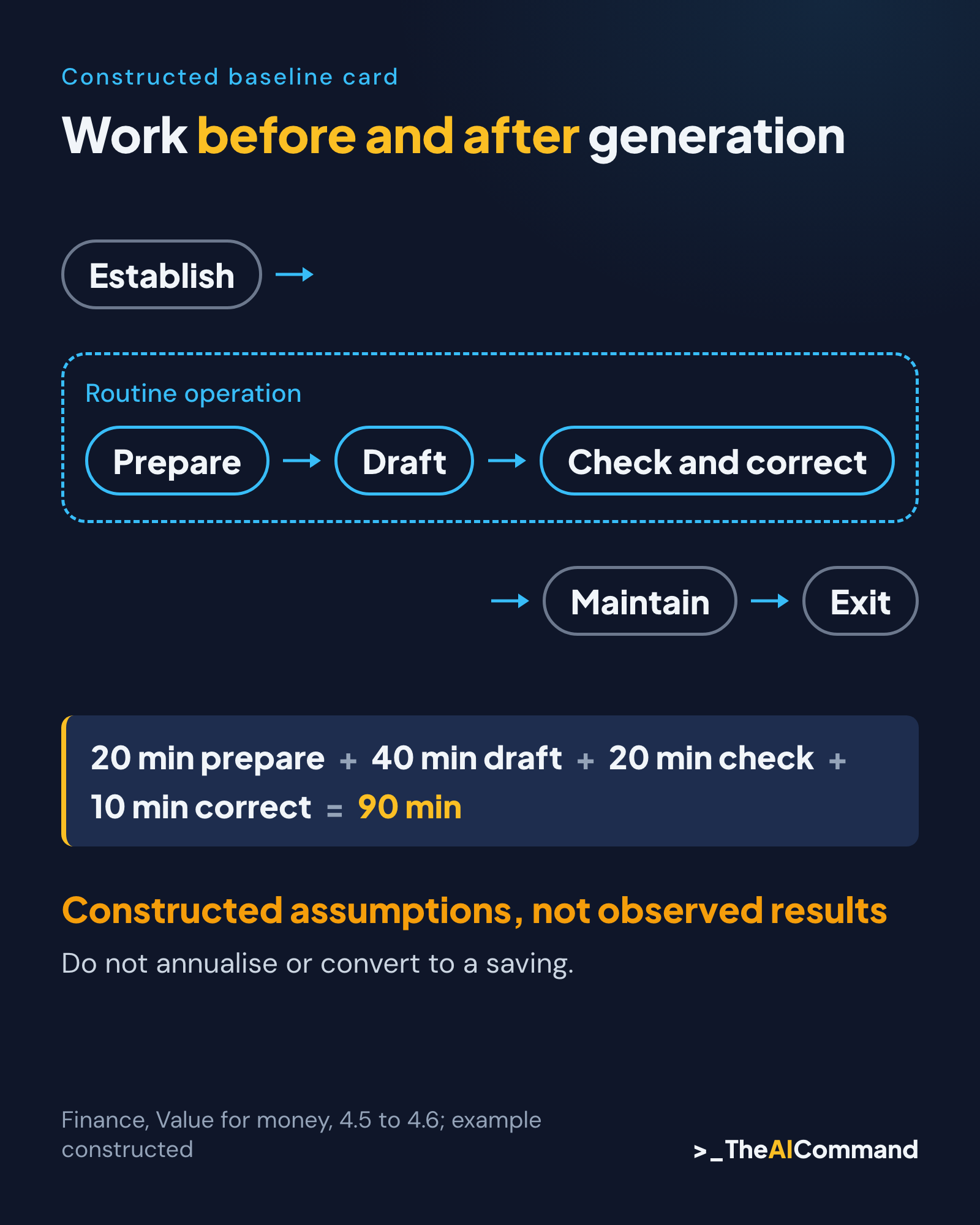
For this workflow, organise effort by when it occurs. Establishment covers selecting inputs, cleaning templates, setting permissions and preparing a representative test. Routine operation covers collecting the weekly material, producing a draft, reviewing it and resolving exceptions. Maintenance covers changes to the source, instructions, software and staff responsibilities. Exit covers recovering useful records and continuing the task after the chosen approach ends.
Keep time and cash separate until there is a defensible reason to combine them. A staff hour released in a short fragment does not automatically reduce expenditure. It may allow more checking, reduce overtime or absorb another task. Record the intended use of that capacity and let the responsible manager explain whether a financial benefit is realisable.
Avoid treating review as a fixed percentage added to every option. Review may differ in substance. A manual report might require checking copied figures; an assisted narrative might require checking whether the wording overstates progress. Estimate the actual checks, then measure them during an authorised trial. A faster draft can still create a slower approval process.
Uncertainty belongs beside the number it affects. If a proposed supplier has not explained export options, exit effort is unknown. If the internal builder has never maintained a recurring workflow, the maintenance estimate needs testing. Do not bury both gaps inside a general contingency percentage and call the comparison complete.
A constructed weekly update decision
Consider a fictional private Australian services business preparing a weekly work-order update. All records, timings and proposed outputs in this example are constructed for teaching. There has been no observed trial, supplier evaluation or measured saving. The task uses aggregate work-order categories, with no customer names, employee records or confidential free-text notes.
The constructed input pack contains a reporting brief, an approved status table and a sample report. The brief says the manager needs open actions, overdue items and dependencies awaiting confirmation. The table has a named reporting period and stable work-order references. The existing report also contains a long narrative history that the recipient has not yet confirmed is necessary.
The assumed manual baseline requires ninety minutes per weekly cycle. That comprises twenty minutes preparing inputs, forty drafting, twenty checking and ten correcting. These values illustrate a recording method. In a real decision the team would observe representative cycles, including an awkward week, and replace every assumed value with evidence or an explicitly bounded estimate.
Candidate A is an internally maintained document workflow that converts the approved table into a draft. Candidate B is a purchased reporting capability configured to use that table. These are hypothetical approaches, not claims about named products. Neither is assumed to improve quality, support a particular integration or satisfy the organisation's information requirements.
The third decision is to stop the proposed automation and improve the manual process. That could involve removing the unused narrative after the report owner confirms its purpose. It could also mean keeping the existing process while the business resolves inconsistent status labels. Stopping automation does not mean abandoning the underlying reporting responsibility.
Give the model only the constructed pack and a fixed comparison structure. Ask it to identify what each approach would require and which facts remain missing. Do not ask it to select a winner from general market knowledge. The model's useful contribution is making omissions legible, including the possibility that better source discipline would help every option.
The constructed output identifies three unresolved questions. The recipient has not confirmed whether the long narrative is needed. Candidate A has no tested replacement maintainer. Candidate B has no evidenced export and exit procedure. It also points out that preparation remains necessary for all alternatives. None of those observations is a measured product result.
A suitable constructed recommendation is to defer commitment, simplify the report with the owner's agreement and collect baseline evidence. The manager then authorises a bounded comparison using the same constructed or otherwise approved inputs. No annual saving is claimed. The immediate decision is what evidence to obtain, with responsibility and a revisit point attached.
Make each candidate carry its own obligations
For a build option, identify the smallest maintainable workflow that meets the outcome. A single controlled template may be sufficient. Adding scheduling, integrations and automatic distribution creates further responsibilities that need a reason. Record who can change the workflow, how changes are checked and what happens when the primary maintainer is unavailable.
For a buy option, ask the supplier to demonstrate the specific task using permitted material. Request evidence of the output controls, administrator responsibilities and usable export. A general feature list cannot show whether the recipient can trace a disputed statement to its input. A demonstration can inform the decision, but its conditions need to be recorded.
Include the work that remains inside the organisation after purchasing. Someone must decide which sources are permitted, keep access appropriate, review outputs and manage changes. A supplier may perform some maintenance, while the customer still owns the fit between the service and its business process. State which party performs each activity instead of assuming purchase transfers it all.
For the stop option, describe what continues and who accepts the consequences. If the team removes an unused report section, record the approving owner and the next review point. If it stops a pilot because evidence is weak, retain the learning. A clear stop decision prevents an abandoned experiment from surviving as an unsupported routine on one person's computer.
Compare evidence without hiding the vetoes
Set non-negotiable conditions before scoring preferences. If an approach cannot use approved inputs within the organisation's access controls, a low price does not compensate for that failure. If the workflow cannot preserve a required source reference, attractive presentation is irrelevant. Keep such conditions as explicit gates rather than small weights in a combined score.
Then compare the differences that can legitimately be traded. These might include setup effort, reviewer workload, flexibility and ease of exit. Use a narrative explanation where a number would imply more precision than the evidence supports. A decision-maker needs to see why a difference matters, not just which column has the largest total.
Use the same task boundary and reporting period for each option. A purchased service that includes input preparation cannot be fairly compared with an internal build estimate that excludes it. Equally, do not count a shared input-cleaning activity twice. Show common effort separately and identify the incremental work introduced by each candidate.
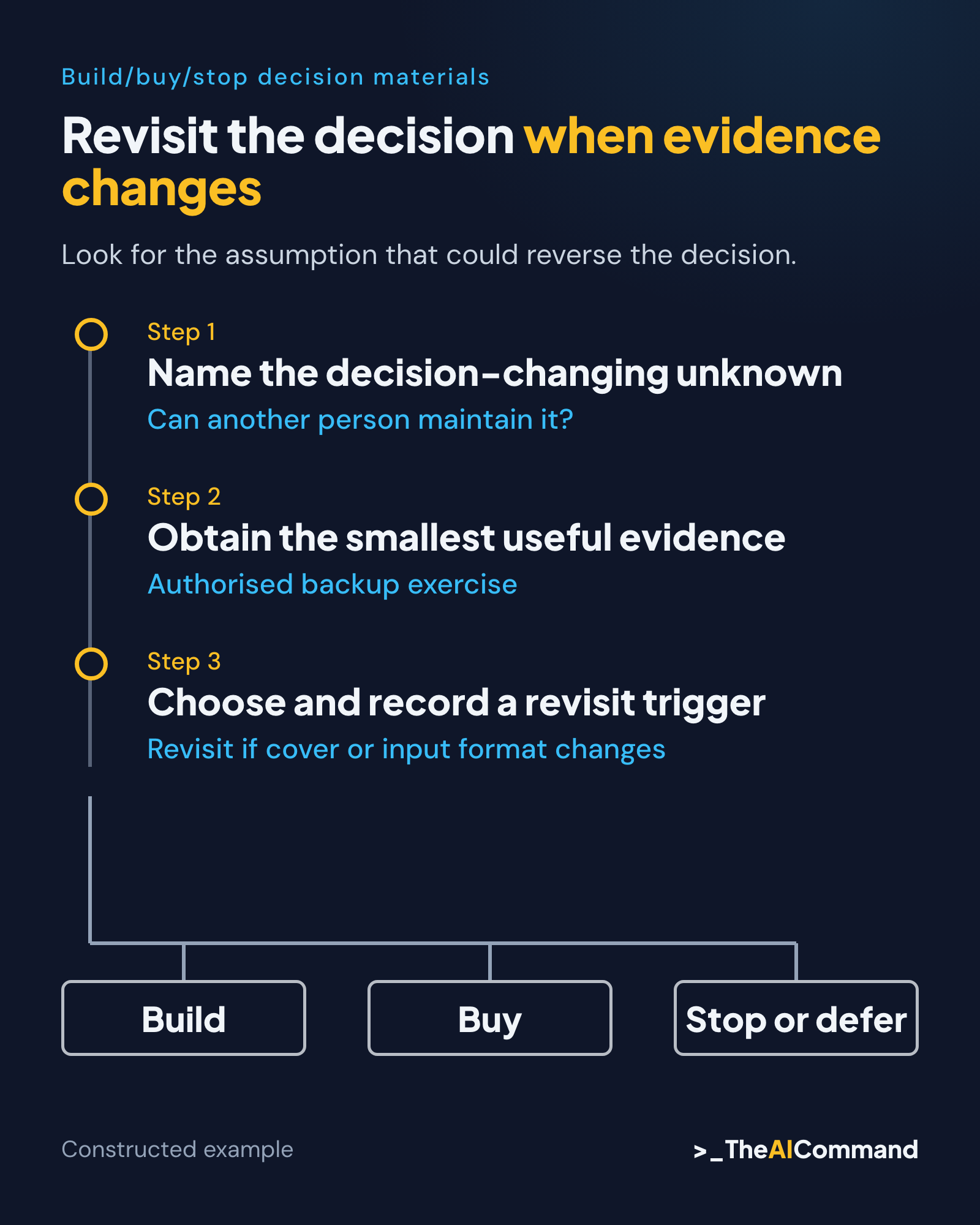
Look for the assumption that could reverse the decision. If the case for building depends on a second person maintaining the workflow, an exercise by that person is useful evidence. If buying depends on leaving cleanly, examine a usable export. If stopping depends on the report being unused, ask the recipient to demonstrate its role in an actual decision.
Avoid confusing low confidence with a requirement to gather everything. Some unknowns do not affect the current decision. The relevant question is whether resolving a gap could change the choice or expose an unacceptable consequence. Target evidence gathering at those gaps, with a limit on the effort spent deciding how to save effort.
Test the comparison on a difficult week
A representative trial needs an input that can expose the weaknesses of the method. In the fictional reporting task, include a status row whose explanation is blank and another with an unresolved dependency. The desired result preserves both gaps. If an approach turns them into reassuring commentary, record the defect and the work needed to correct it.
Measure the whole cycle with the reviewer involved. Record preparation, generation, checking and correction separately, using the same definitions for each candidate. Keep rejected drafts in the approved evidence location. Otherwise a comparison may record only the final acceptable output while losing the repeated attempts that made it costly to produce.
Ask the recipient to inspect the result without being told which option produced it. Their task is to identify the decisions the report supports and any source questions it leaves unresolved. This does not create a scientific benchmark, but it makes the acceptance discussion more concrete than a preference for attractive wording.
End the trial when it has answered the decision-changing questions or reached its agreed limit. If uncertainty remains material, the decision can stay deferred or the proposed automation can stop. An extended trial also consumes staff effort, which belongs in the eventual decision record.
Keep a decision open to correction
Record the chosen option, the evidence relied on and the conditions under which it remains acceptable. A provisional build decision might depend on successful review and backup operation. A buy decision might depend on confirmed access arrangements and an acceptable exit test. A stop decision might be revisited if reporting requirements change.
Give revisit triggers an owner and a practical route. A change in source format, a recurring review defect or a supplier change should reach someone who can pause the workflow. A date in a decision brief will not do that by itself. Attach the review to an existing operational meeting or another maintained process.
Keep the rejected alternatives and reasons in the record. When the team returns to the question, it should be able to see whether circumstances changed or the same unsupported assumption has returned. Retaining that reasoning also protects against selecting a new tool that recreates the maintenance burden the team previously rejected.
For managers, the next useful action is to choose one recurring task and write its manual baseline beside the proposed alternative. Include checking, exception handling and exit. Ask which missing evidence could alter the decision, then authorise only the smallest investigation needed. Build or buy when the whole workflow earns the commitment. Stop when it does not.
Copyable comparison
Reusable prompt
Build/buy/stop decision materials
Status: copyable template. Method and examples are editorial proposals, not procurement approval. Constructed timing figures are assumptions, not savings evidence.
One-page brief
- Task and recipient: [TASK] / [ROLE]
- Required output and decision supported: [OUTCOME]
- Scope begins and ends: [INPUT] to [HUMAN ACCEPTANCE]
- Current manual cycle: [DATE/PERIOD], [OBSERVED OR ASSUMED]
- Preparation minutes: [VALUE + EVIDENCE]
- Drafting minutes: [VALUE + EVIDENCE]
- Review minutes: [VALUE + EVIDENCE]
- Correction and exception minutes: [VALUE + EVIDENCE]
- Establishment work for each option: [ACTIVITY/OWNER/BASIS]
- Routine work for each option: [ACTIVITY/OWNER/BASIS]
- Maintenance, backup and exit work: [ACTIVITY/OWNER/BASIS]
- Cash costs: [CURRENCY/DATE/TAX/BASIS] or unknown
- Non-negotiable conditions: [CONDITIONS]
- Build option: [BOUNDARY/MAINTAINER]
- Buy option: [BOUNDARY/SUPPLIER EVIDENCE/INTERNAL OWNER]
- Stop/simplify option: [WHAT CONTINUES/APPROVING OWNER]
- Decision-changing unknowns: [GAP/EVIDENCE REQUEST/OWNER]
- Decision and rationale: [CHOICE/SUPPORTING RECORD]
- Revisit date or event: [TRIGGER/OWNER]
Constructed baseline card
Private Australian services business; weekly aggregate work-order update. Assumed minutes: preparation 20, drafting 40, checking 20, correcting 10. Total 90 minutes. No trial occurred. Do not annualise or convert to a saving. Replace with representative observations before a real decision.
Trial record to complete after an authorised trial
Keep staff time and cash separate. Record common work once. Never fill unknown supplier capability with a model guess. A private organisation must not treat the Finance reference as a statement that Commonwealth procurement rules bind it.
Decision prompt
Related reading
For related reading, see AI Decision Memos for Leaders and Build a Golden Test Set Before You Trust an AI Workflow.
Also see Which AI Subscription Fits a Week of Your Work?, the companion article for 7 November.
Do this Monday
- Select one recurring task and identify its recipient.
- Record a complete manual cycle, including checking and corrections.
- Compare the obligations of each alternative and one credible stop option.
- Name the evidence that could reverse the decision before committing.
References
- Department of Finance: Finance: Value for money
- Department of Finance: How to use the Commonwealth Procurement Rules, paragraphs 3.8 and 3.9
TheAICommand. Intelligence, At Your Command.