About this guide: it is based on Gamma's own help documentation, checked in October 2026, and a fully constructed briefing example. It does not report a hands-on run, a generated deck, an interface capture or an export result.
The caveat must survive the slide
A service manager has six slides to explain a proposed trial. The source paper says the trial covers one team and excludes complex requests. The slide draft says the new process is ready for the business. The layout looks clear, but the claim has expanded beyond the evidence that was meant to support it.
That is the practical problem this workflow addresses. A briefing needs to reduce reading effort without changing the decision. The author must preserve the scope, conditions and uncertainty that give a fact its meaning. A neat headline is useful only when the audience can still tell what the evidence supports.
This guide uses Gamma as the presentation tool. Gamma's current documentation describes several creation and export routes, and this guide relies on that documentation rather than a hands-on test. The example is an authored teaching scenario, not a report of Gamma's output. Check each documented step in your own account before relying on it.
The distinction affects what can be claimed. This guide can explain how to prepare a source pack, define a six-slide outline and check for a missing limitation. It cannot report which account controls were visible, how long generation took or whether an exported file retained its layout. Those observations have to come from a run in your own account.
Start with the decision the room needs to make
Write the requested decision in one sentence before selecting a theme. A briefing seeking permission for a limited trial needs a different structure from a progress update. State what the audience can decide now and what remains outside its scope. This gives every slide a purpose that can be checked against the brief.
Identify the audience's necessary context. A specialist reviewer may need the source method and exceptions. A manager may need the operational consequence and the next approval boundary. Give both enough information to interpret the proposal without loading the deck with every detail in the source pack. Supporting material can remain available separately.
Set the evidence boundary in writing. The source pack should list the documents the drafting tool may use, their versions and the passages relevant to the decision. It should also identify material that must not be uploaded. Real approval means the responsible person has authorised that use of those sources in that environment.
A fictional training pack can illustrate the process without claiming such real approval. In the example below, a fictional sponsor has approved the pack within the scenario. That is a constructed fact about the exercise. It is not a real approval, and it does not authorise uploading actual organisational documents to Gamma.
Build a source pack that exposes uncertainty
Give each source a short identifier and preserve its title, version and date. Attach limitations to the specific statements they qualify. A separate page of caveats is easy to omit when a tool compresses the material. The reviewer should be able to locate the evidence behind a claim without searching an entire folder.
Separate observations, proposals and decisions. An observation describes what the supplied material reports. A proposal describes an option someone wants considered. A decision records what an authorised person has agreed. If these appear as equivalent bullet points, the generator may produce a stronger narrative than the source material warrants.
Keep numerical information with its units and population. Twelve sample requests are not twelve customers, and a fictional scenario is not a measured pilot. If a figure lacks context, mark it incomplete before drafting. Do not ask the tool to supply a plausible denominator or create a chart that implies missing measurements exist.
Record contradictions rather than resolving them through fluent prose. If the scope note excludes complex requests while a proposed slide includes them, the pack contains a question for the owner. The drafting instruction should require that question to be surfaced. A presentation tool has no authority to choose which source controls the business decision.
Choose a documented route, then check it in your account
Gamma's creation guidance describes Generate, Paste and Import in its classic generator. The same page notes that Gamma 5 starts with an agent conversation. That means a reader's opening screen may differ from the classic instructions. Record the interface actually used rather than presenting one route as universal.
For this bounded workflow, prepare the text and slide order first. The classic Paste route is documented for formatting existing content, while Import accepts existing material. These are documented options, not guarantees that wording or source relationships survive unchanged. Inspect the actual draft against the supplied outline regardless of the route used.
Keep the initial visual request restrained. The classic creation guidance describes options for no images or image placeholders, which can support a first pass focused on claims and structure. Gamma's agent guidance says the agent can research, write, design and generate images end to end, and that its Research option pulls in sources from the web. The same guidance says the agent can still run a quick web search with Research off, so leave Research off and state in the prompt that only the supplied pack may be used. Check availability in the authorised account, then use genuine source visuals or clearly labelled diagrams where they improve understanding. Do not fabricate a product screenshot or documentary evidence.
The reusable prompt specifies the task boundary, required six-slide structure and source-map output. Treat those instructions as constraints to verify, not controls that make errors impossible. If the tool adds an unsupported benefit or statistic, remove it and record the correction. Repeating a request for accuracy does not replace the comparison.
A complete six-slide briefing scenario
The constructed example concerns a small internal service team considering a four-week routing trial. Source P1 is a fictional decision brief asking whether to authorise the trial. It permits draft routing suggestions for routine enquiries, with human review before action. Complex requests and individual employment matters are explicitly outside the proposed scope.
Source P2 is a fictional current-process note. It describes one handover with a clarification loop: a service coordinator checks the enquiry, then sends it to the appropriate service owner, and an ambiguous enquiry returns for clarification first. It contains no measured handling time, error rate or saving. Source P3 is a fictional trial plan covering one team, with weekly review and an unresolved start date.
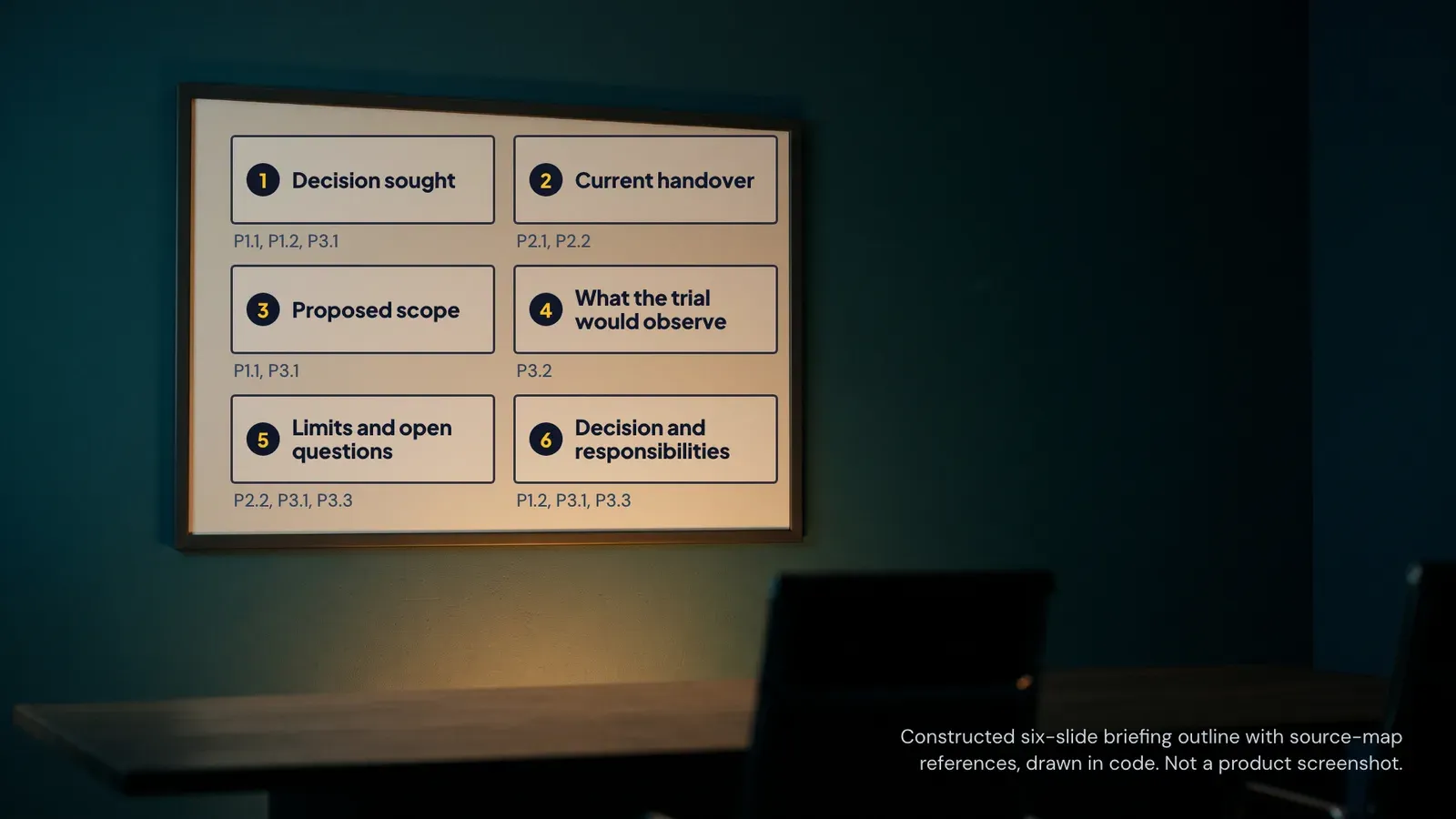
The requested deck has six slides. The opening slide states the decision: whether to authorise a limited routing trial. The second explains the present handover using only P2. The third sets out the proposed scope from P1 and P3. This sequence establishes the problem and boundary before asking anyone to consider the next step.
The fourth slide describes what the trial would observe. It proposes recording routing disagreements and missing source information for review. These are proposed measures, not measured improvements. The fifth displays limitations and unresolved questions. The final slide restates the decision sought and names the owner roles responsible for confirming any start date and review arrangements.
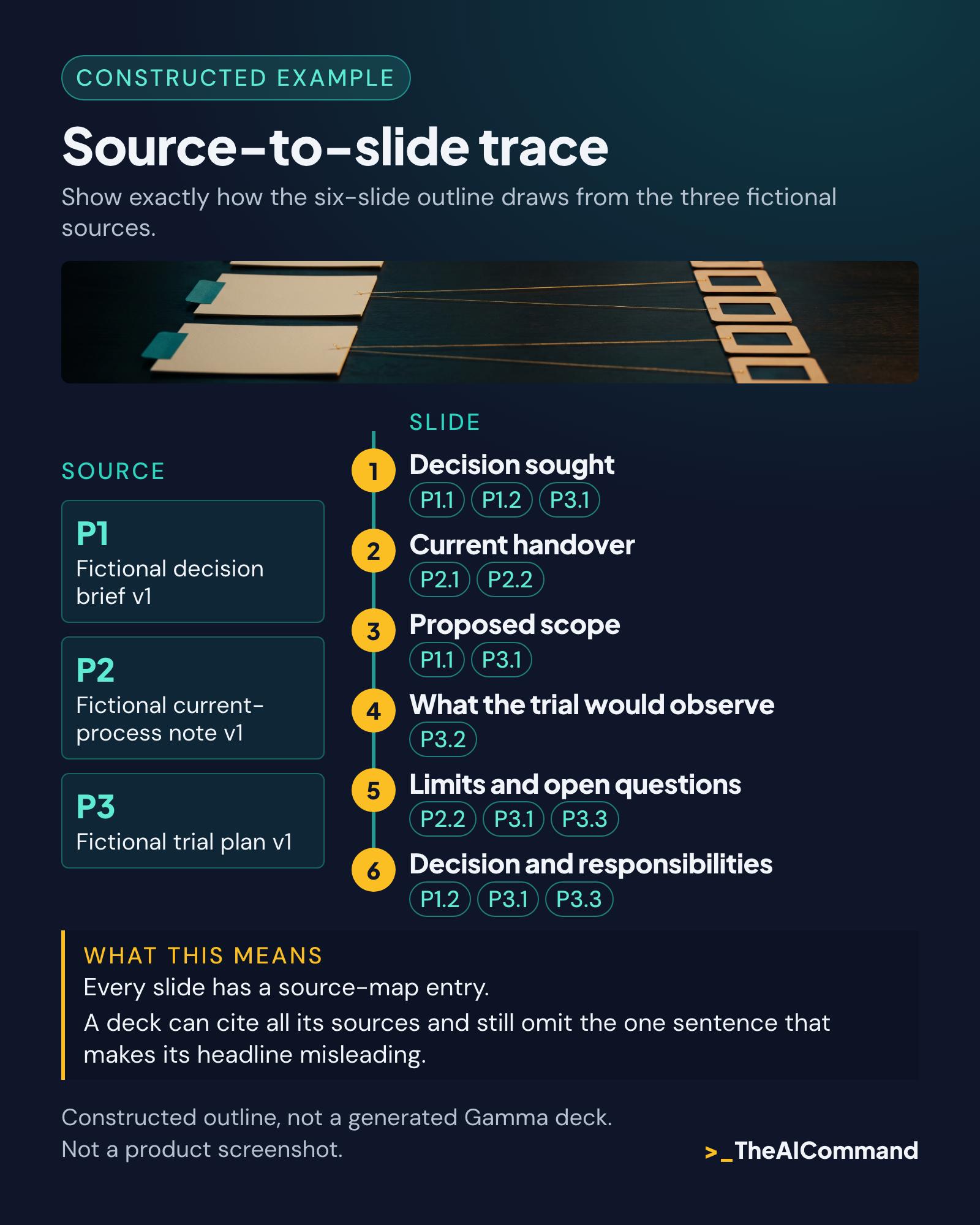
Every slide has a source-map entry. The current-process slide points to P2's handover passage. The scope slide points to the relevant sections of P1 and P3. The proposed-measures slide identifies the trial-plan proposal. A slide containing an editorial synthesis must say so and show the source statements from which that synthesis was formed.
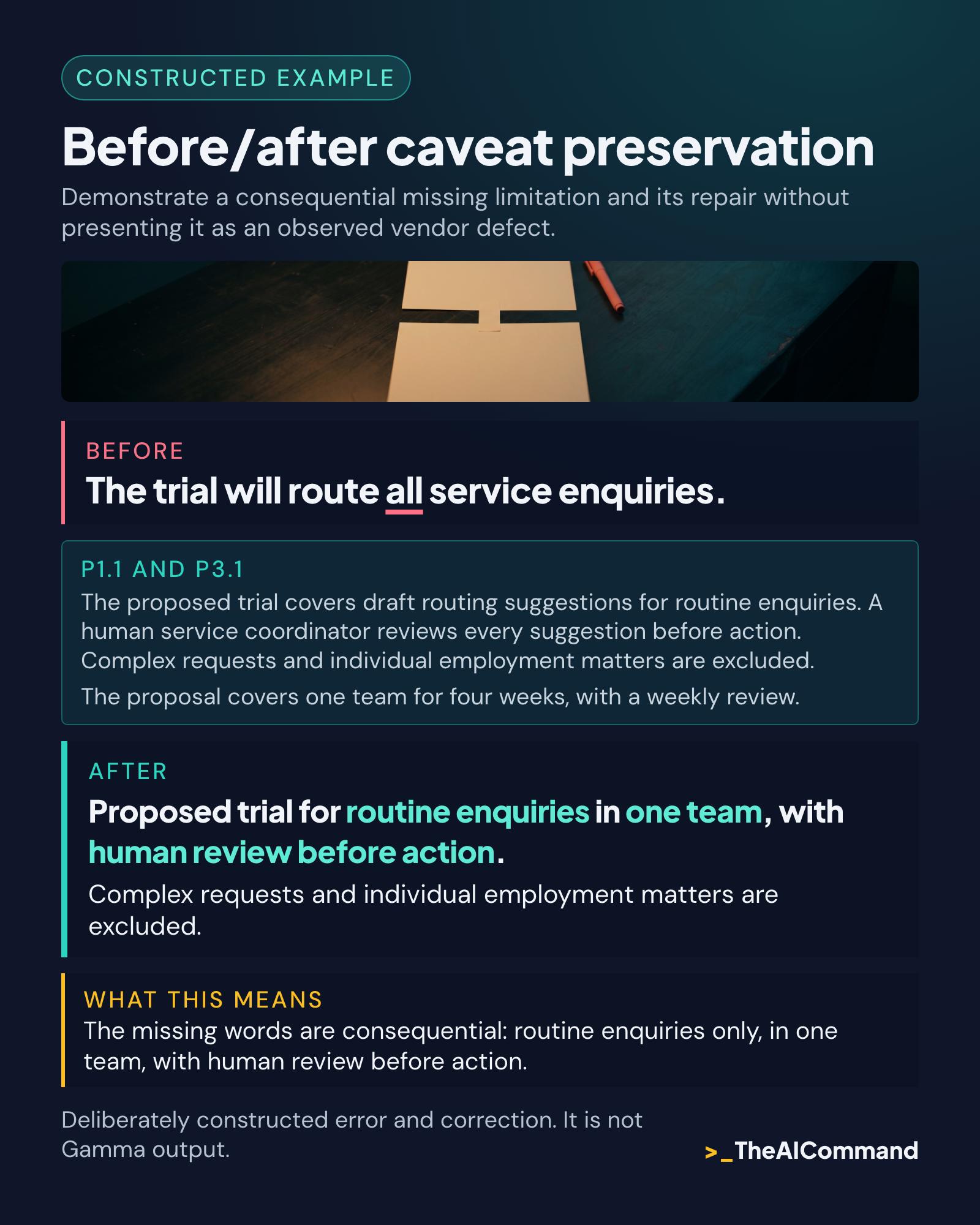
Now introduce a deliberate error into the exercise. A constructed draft of slide three says the trial will route all service enquiries. The missing words are consequential: routine enquiries only, in one team, with human review before action. The correction restores all three conditions and the exclusions for complex requests and individual employment matters.
This is not a defect observed in Gamma. It is an authored failure example designed to make the review test concrete. The reviewer compares the draft statement with P1 and P3, records the missing scope and replaces the wording. The change log should retain both versions and the reason for correction so the exercise can be repeated.
The corrected slide does not claim that the process is ready for wider use. It describes a bounded proposal whose start date remains unresolved. That is a useful briefing outcome. It helps the audience make the intended decision while preventing the deck from turning proposed activity into an approved operational commitment.
Review the argument before polishing the design
Read each slide as if it will be forwarded without its presenter. Can the reader distinguish what is known, proposed and undecided? Are limitations close enough to the claim they qualify? If the answer depends on an oral explanation, add the necessary wording to the slide or reconsider whether the claim belongs there.
Check the source map in both directions. Every material slide claim needs supporting evidence or an explicit proposal label. Every limitation that would change the decision needs to remain visible somewhere appropriate. A deck can cite all its sources and still omit the one sentence that makes its headline misleading.
Review visual meaning as well as words. An arrow can imply that approval has happened. A progress bar can imply measured completion. A chart can imply a quantitative comparison that the pack does not contain. Use a simple labelled process diagram when the evidence supports only a process, and avoid inventing numeric scales for decoration.
Apply the brand after the reasoning is stable. Use the organisation's approved template, readable text and restrained accent colours. Keep labels large enough for the intended viewing conditions. A limitation that is technically present but illegible on a phone or meeting display has not been communicated adequately to that audience.
Human review should cover the exact version proposed for use. If a later design edit shortens a caveat or changes a diagram, reopen the affected checks. The review record should identify the deck version and source-pack version together. Otherwise, the team may have evidence of approving content that is no longer on the screen.
Export creates a second review object
Gamma's export guidance lists PDF, PNG and PowerPoint formats, and describes Google Slides access through a PowerPoint upload. It also identifies differences that can occur in exported appearance. These documented capabilities establish what a reviewer can examine. They do not prove that this particular deck will export correctly.
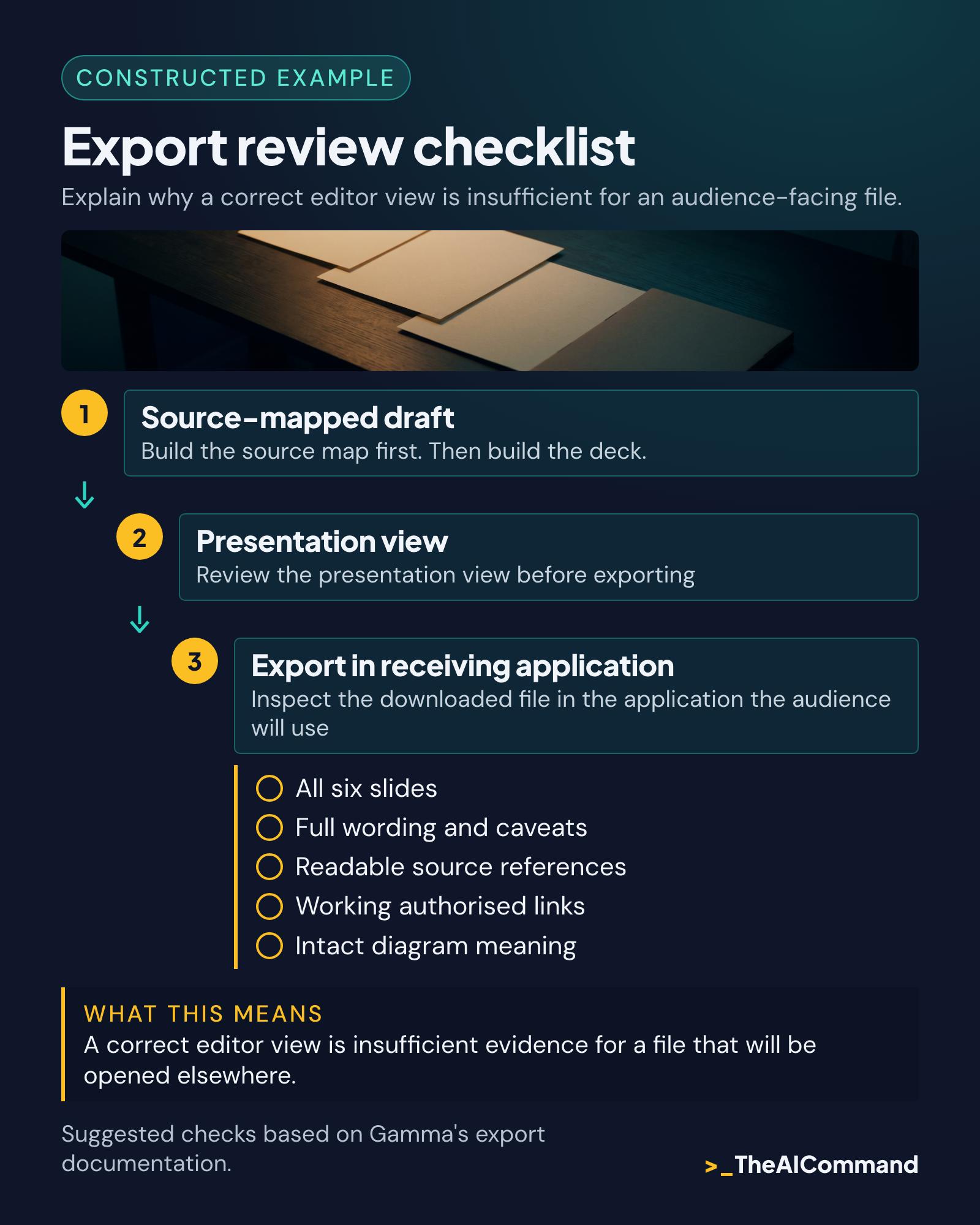
The same guidance says exported content follows Present Mode rather than Edit Mode. Review the presentation view before exporting, then inspect the downloaded file in the application the audience will use. A correct editor view is insufficient evidence for a file that will be opened elsewhere. Keep the output format and viewing application in the test record.
Inspect every slide for clipped wording, missing conditions, changed order and unreadable source references. Check that the output contains all six intended slides; Gamma's export guidance says to select All cards in the export menu, otherwise only the current card may be exported. Where the deck uses a hyperlink, test the destination and the audience's access. A source label may survive visually while its link is unavailable to the receiving reader.
Do not assume that interactivity or formatting transfers across formats. Decide which elements are necessary for understanding and verify those elements in the selected output. If an exported diagram loses meaning, simplify it or supply an accessible textual explanation. Record the limitation rather than claiming that every format is interchangeable.
Retain the reviewed export separately from the editable deck. A shared deck can change after review, while the reviewed file preserves the version used for that decision. Apply the organisation's records and access requirements to both. The existence of an export is not permission to distribute it beyond its authorised audience.
What your own trial should record
Before adopting the workflow, run a small authorised trial that records the account context, creation route, source input and resulting deck. It should preserve the initial draft, every substantive correction and the final source map. Capture screens only where the record needs them, removing confidential or identifying information before sharing them beyond the authorised audience.
Run the export checks against the real files and retain their results. Record failures and workarounds as observations, with enough detail for another reviewer to repeat them. If the six-slide example cannot preserve its scope limitations without extensive reconstruction, that is a finding about this workflow and configuration. It should not be hidden behind a favourable summary.
The trial also needs an explicit decision on fitness for the intended use. A technically valid file can still communicate poorly. Source verification, layout quality and permission to distribute are separate judgements. Keep design review distinct from the factual and technical checks, and do not approve the deck for use because one of them passes.
For a professional preparing a briefing, the reusable discipline begins before the tool: define the decision, prepare the evidence and preserve the limitations. Gamma can then be assessed as a way to arrange that material. Build the source map first. Then build the deck. The finished slides should make the decision easier without making the evidence stronger than it is.
Do this Monday
- Choose one bounded decision and a small source pack authorised for that use.
- Write a six-slide outline and source map before generation.
- Include a deliberate missing-limitation check in the review exercise.
- Review the actual presentation view and export before sharing.
Copyable briefing pack
The copyable pack that accompanies this article contains all three fictional source records, the six-slide outline and source map, the generation prompt, the constructed correction and the slide/export review checklist.
Source-grounded briefing deck: reusable materials
A constructed source pack, six-slide outline and authored correction for practice. Nothing here was generated in Gamma, and no interface observation, timing or export result is reported.
Fictional source pack v1
The following source approval exists only inside the scenario. The fictional sponsor permits this invented pack for an internal trial briefing. It does not authorise any real upload.
P1: Fictional decision brief v1, 1 November 2026
Purpose: decide whether to authorise a four-week routing trial for one internal service team.
Scope passage P1.1: The proposed trial covers draft routing suggestions for routine enquiries. A human service coordinator reviews every suggestion before action. Complex requests and individual employment matters are excluded.
Decision passage P1.2: The sponsor is asked to authorise the bounded trial. No decision has yet been made. Wider rollout is outside the decision sought.
P2: Fictional current-process note v1, 1 November 2026
Process passage P2.1: A service coordinator checks an enquiry and hands it to the relevant service owner. An ambiguous enquiry returns for clarification before routing.
Evidence passage P2.2: This note contains no measured handling time, error rate, cost saving or productivity result. It describes the current process only.
P3: Fictional trial plan v1, 2 November 2026
Trial passage P3.1: The proposal covers one team for four weeks, with a weekly review. The start date remains unresolved and requires sponsor confirmation after the decision.
Observation passage P3.2: Proposed observations are routing disagreements and missing source information. The team would record these for weekly review. No improvement target or measured result is established.
Ownership passage P3.3: The sponsor decides whether to authorise the trial. The service coordinator reviews suggestions. The service owner confirms the review arrangements. Any expansion requires a separate decision.
Exact six-slide outline and source map
No slide contains a real statistic. Four weeks and one team are constructed scenario constraints. Each slide's source identifiers must remain readable, with the source pack available to the intended audience.
Source-grounded deck prompt
Constructed missing-limitation correction
Before, deliberately flawed authored slide: The trial will route all service enquiries.
Detected by comparing P1.1 and P3.1. The statement incorrectly expands routine enquiries to all enquiries, omits one-team scope and human review, and loses exclusions.
After, corrected authored slide: Proposed trial for routine enquiries in one team, with human review before action. Complex requests and individual employment matters are excluded.
Change record: correction C1; slide 3; source pack v1; slide wording v1 to v2; reason: restore scope and human decision boundary. Reviewer approval: [REVIEWER] / [DATE]. This is an authored example, not an observed Gamma failure.
Slide verification checklist
- [ ] All six slides serve the stated decision.
- [ ] Each material statement has a precise source passage or proposal label.
- [ ] P1.1 scope and exclusions are intact on slide 3.
- [ ] Start date remains unresolved; no fabricated baseline or improvement.
- [ ] P2's clarification loop remains visible in the process diagram.
- [ ] Source identifiers are readable at intended viewing size.
- [ ] No visual implies approval, measurement or wider rollout.
- [ ] Real source-use authority is recorded for any actual inputs.
- [ ] Content and creative reviewers record decisions on the exact deck version.
Trial and export record template
Complete each field from your own trial. Leave a field blank rather than estimating a result.
Related reading
- Turn a Teams Transcript Into a Controlled HR SOP, on turning a controlled source into a reviewed document
- Give the Case Conference a Decision Agenda, the companion article for 13 November
References
- Gamma: How do I create a new presentation, document, or webpage in Gamma?
- Gamma: What's the easiest way to export my Gamma?
- Gamma: How do I create with Agent in Gamma?
General information only. Not legal, compliance, financial, or professional advice.
TheAICommand. Intelligence, At Your Command.