
Start with the meeting that is actually needed
The invitation says "case conference". The supervisor expects a discussion about available duties. The claims manager expects an update on outstanding information. The employee wants to explain why the current arrangements are difficult. Everyone can arrive prepared for a different meeting, even when everyone has read the same file.
An agenda should expose those differences before the conference. Write down what needs clarification, whose knowledge is required and what kind of outcome the meeting can produce. A question about whether equipment is available belongs with the employer. A question about the clinical meaning of a restriction belongs with the relevant practitioner. Neither becomes an AI decision because the documents sit in one folder.
This article concerns the Comcare scheme under the Safety, Rehabilitation and Compensation Act 1988, commonly called the SRC Act. It uses a return-to-work case conference as the worked example. It does not provide a process for state workers compensation schemes or substitute for a statutory assessment, determination or notice.
Comcare distinguishes return-to-work case conferences, claims manager and employer conferences, and bulk conferences. Their purposes and attendees differ. Its case conference guidance also says participants should be given enough time to contribute to the draft plan before it is finalised and circulated. That makes the invitation and preparation pack part of the substantive work, rather than administrative preliminaries.
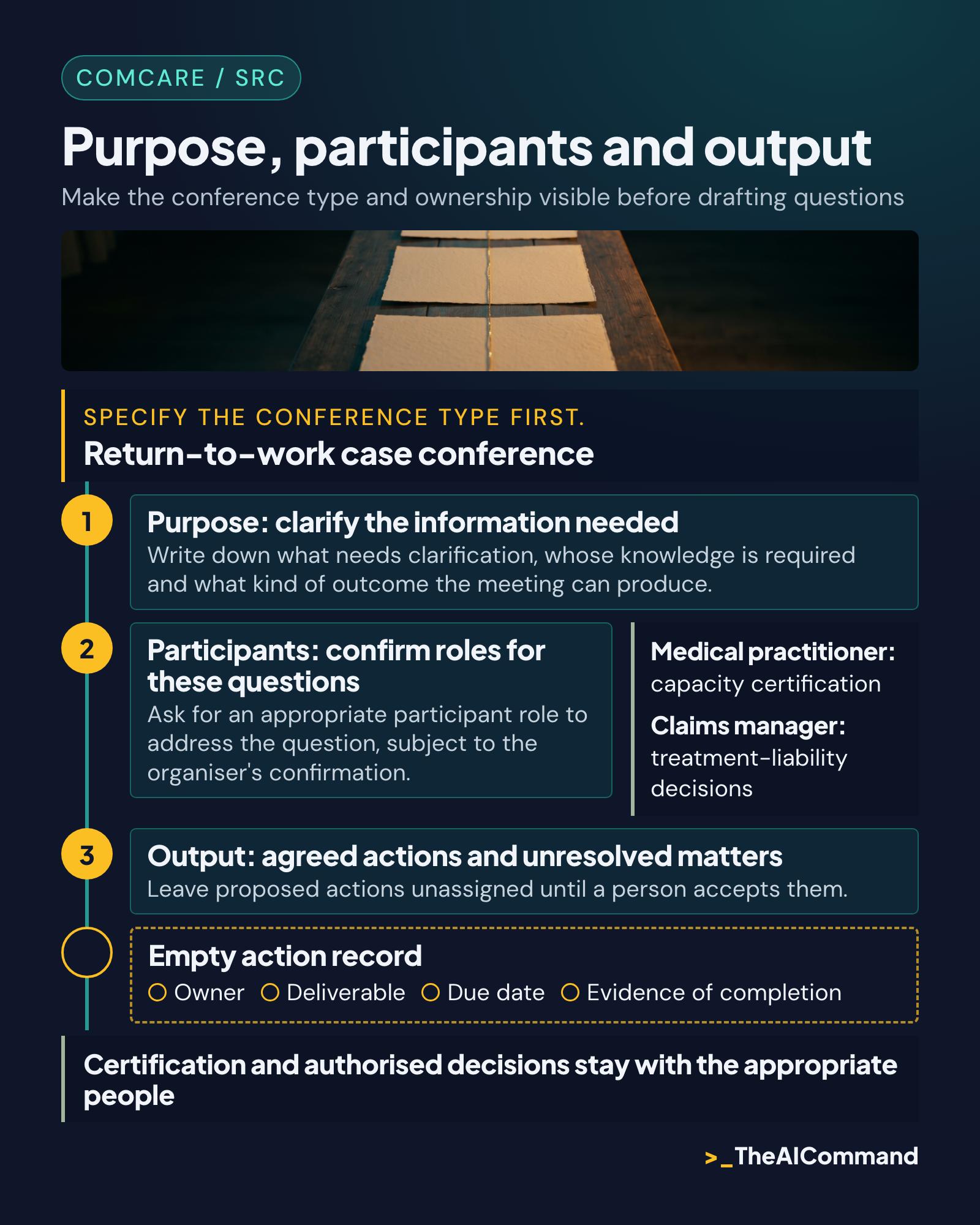
For this workflow, put the type and purpose at the top of every draft. Use a sentence such as "Return-to-work case conference to clarify the information needed before the proposed workplace arrangements can be considered." Avoid "approve return to work" where the necessary advice or authority is missing. A narrower purpose can make the conference more useful because participants know which questions require answers.
Build a source pack that answers the agenda
Begin with the question list, then select the minimum material needed to explain each question. An entire claims history is rarely a helpful first input for drafting a meeting agenda. Long background narratives can bury the outstanding issue and encourage the model to combine historical observations with current information.
Give each extract a source identifier, date, author role, document location and status. Record whether it is current, superseded or awaiting confirmation. A recent administrative email does not automatically supersede an older clinical statement. A document date describes when something was written; it does not prove the period to which it applies.
Include the employee's relevant concerns in their own meaning, alongside the employer's information about work demands and arrangements. Distinguish what a participant reported from what another participant confirmed. If a note says a task is difficult, the agenda can ask what makes it difficult. It cannot rewrite the note as a medical restriction or an established explanation for the difficulty.
Comcare's workplace rehabilitation services guidance describes tailored services informed by treating practitioners and health providers. It identifies rehabilitation case managers and workplace rehabilitation providers as service delivery roles. This supports asking who can clarify an issue. It does not give a drafting assistant authority to select a service or decide what a particular employee requires.
Keep actual records inside the organisation's authorised information environment. For a practice run, create fictional material from scratch. For any authorised operational use, assess the data pathway before selecting extracts. Removing a name while retaining an unusual job, location and event sequence can leave a person recognisable. The model should never receive a live file simply so that it can remove identifiers afterwards.
The reusable example retains [CLAIMANT_NAME], [CLAIM_NUMBER], [DATE_OF_BIRTH] and [TREATING_PRACTITIONER] as placeholders. The date of birth has no analytical role in drafting this agenda and remains unpopulated. Keeping a familiar form field does not create a reason to disclose its value. The same minimisation applies to attachments that happen to accompany the referral.
Ask for questions with a route to an answer
The drafting instruction should limit the model to organising supplied information. Ask it to propose agenda items, identify the source behind each one and state the answer or evidence still needed. Ask for an appropriate participant role to address the question, subject to the organiser's confirmation. Leave proposed actions unassigned until a person accepts them.
A useful agenda item contains more than a topic. "Duties" gives little direction. "Confirm whether the task description includes the handling step recorded in source D2" tells the supervisor what to prepare. The clinical follow-up can then refer to the corrected demands rather than an ambiguous job title. This sequence avoids asking a practitioner to interpret incomplete workplace information.
Require the model to preserve conflicting statements side by side. If two sources disagree about a task, it should identify the discrepancy and draft a clarification question. It should not choose the more convenient version, average the statements or assume that the later document is correct. The organiser decides who needs to resolve the discrepancy before the meeting can address the next question.
Comcare's role tables distinguish advice from certification. They identify medical practitioners as certifying capacity and claims managers as making treatment-liability decisions. They also allocate responsibilities for summarising and implementing conference outcomes. Use those distinctions when checking the draft. An AI-generated action must not quietly transfer a specialist or authorised function to a supervisor or to the drafting tool.
Give the agenda a manageable sequence based on dependencies. Confirm the question and relevant facts before considering an action. If missing information prevents progress, the meeting can agree who will obtain it and when the matter will return. A deferred decision with a clear reason is a more accurate outcome than an apparent agreement assembled from incomplete evidence.
Worked example: the unresolved handling step
This is a wholly constructed example involving a fictional employer within the Comcare scheme. No actual claimant material was used and no model performance trial was conducted. The sample outputs are editorial demonstrations of the requested format, not evidence that a particular product consistently produces them.
The fictional referral asks for a return-to-work conference concerning [CLAIMANT_NAME], claim [CLAIM_NUMBER]. It records [DATE_OF_BIRTH] as an unused placeholder and identifies [TREATING_PRACTITIONER] by role only. The purpose is to clarify outstanding information about a proposed records task and identify the next administrative steps. It does not ask the meeting to make a liability decision.
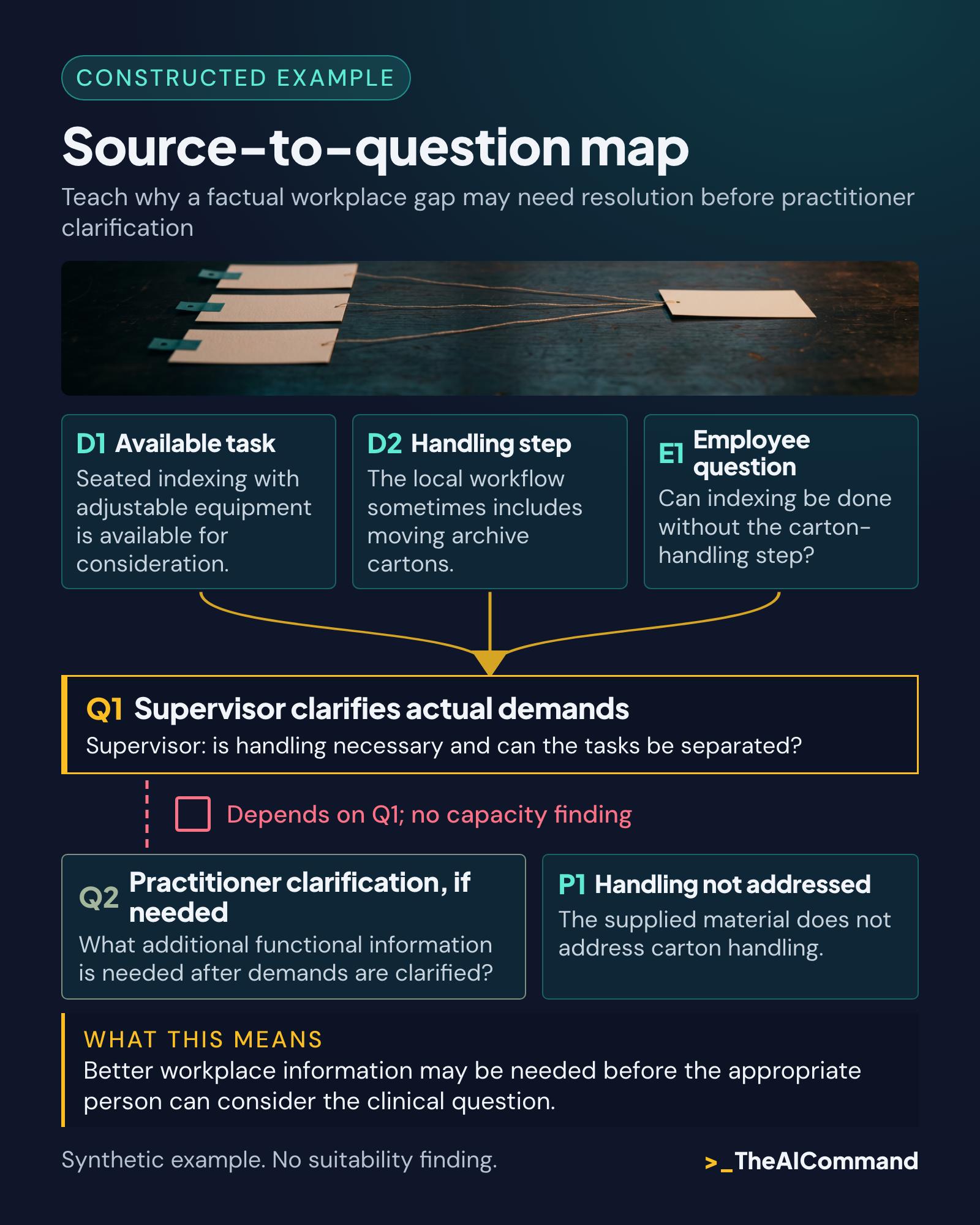
Source R1 is the referral. Source D1 is an employer-approved description of tasks available for consideration, consisting of seated indexing with adjustable equipment. Approval here means the employer confirms the description and availability. It does not mean those duties have been approved as medically suitable for this person. Source D2 adds that the local workflow sometimes involves moving archive cartons.
Source E1 records the fictional employee's question about whether indexing can be completed without that handling step. Source P1 records that the treating practitioner's supplied extract does not address the carton-handling demand. The pack contains no diagnosis, invented capacity restriction or assertion that the employee can perform either task. Those omissions are deliberate and remain visible in the output.
The expected draft identifies a factual gap between the headline duties description and the local workflow. It proposes asking the supervisor to clarify whether carton movement is an essential step or can be separated from indexing. It links that question to D1, D2 and E1. It then proposes a question for [TREATING_PRACTITIONER] about any functional information needed once the demand description is complete.
The organiser checks the sample agenda against the extracts and removes any suggestion that the task is already suitable. The employee receives the draft questions through the agreed process and can correct how E1 has been represented. The organiser also confirms who needs to attend and whether a qualified participant has enough information to address the proposed question.
One possible conference outcome is an agreement for the supervisor to supply a revised task description by an agreed date. That would be an administrative action, not a capacity finding. A second matter might remain open pending practitioner clarification. The action record should preserve both states. It must not say "duties approved" merely because the conference agreed how to obtain better information.
The value of the example is the dependency it makes visible. Better workplace information may be needed before the appropriate person can consider the clinical question. The AI contribution is a draft map of that dependency. The human contribution includes checking the facts, hearing the employee and determining which next step is appropriate within the applicable process.
Record an outcome without manufacturing agreement
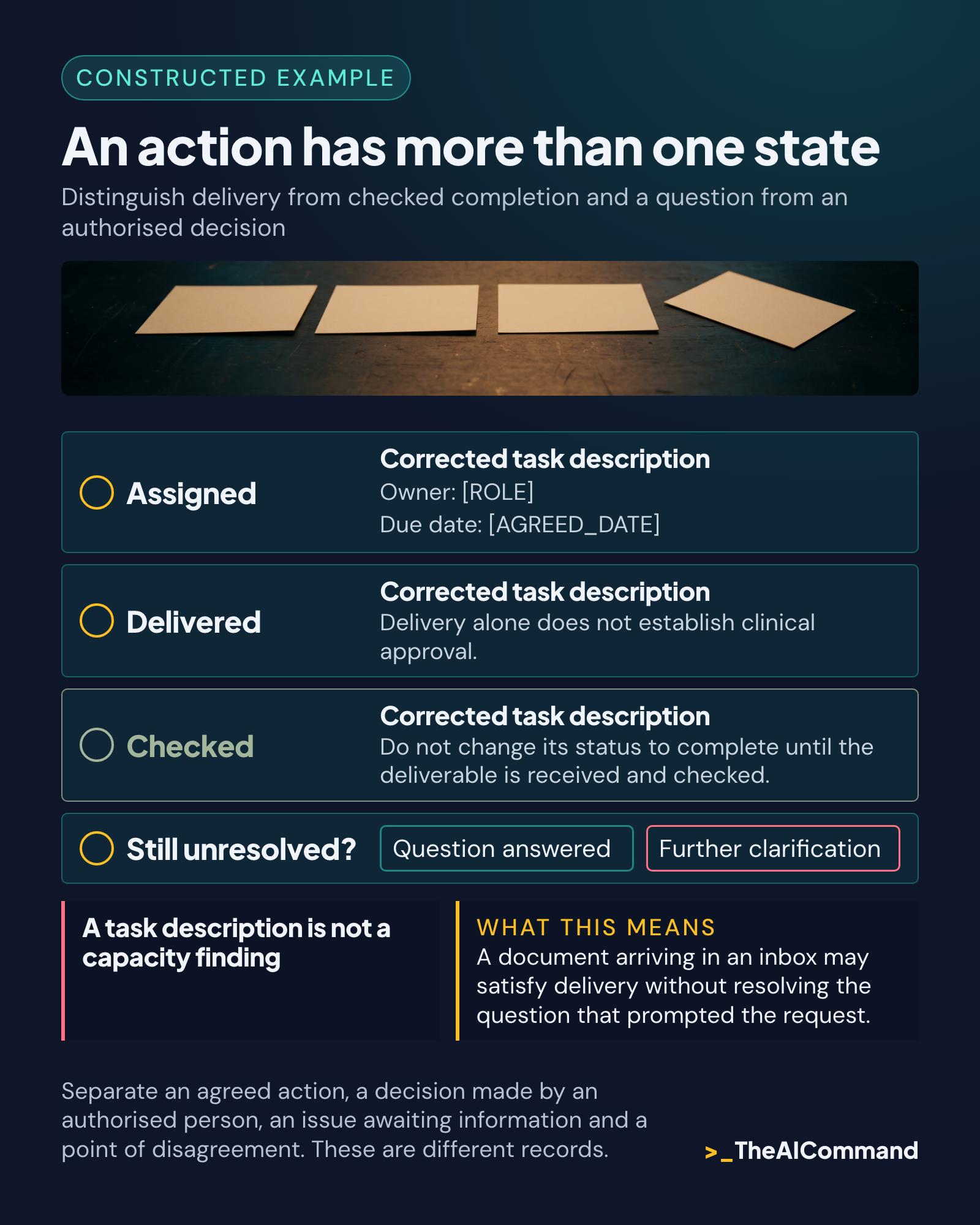
Prepare an empty action record before the meeting. Separate an agreed action, a decision made by an authorised person, an issue awaiting information and a point of disagreement. These are different records. A single "resolved" checkbox encourages the minute-taker to collapse them into one favourable-looking status.
For an action, capture its owner, deliverable, due date and the evidence that will show completion. "Supervisor to follow up" is difficult to close. "Supervisor to provide a corrected task description covering carton handling by the agreed date" gives the next reviewer something concrete to check. Keep that wording provisional until the named role accepts the task.
For a decision, record who made it, what information they considered and any conditions or separate documentation required. Do not allow a meeting summary to imply that every attendee approved it. If participants disagree about what was said, preserve the disputed point and the process for resolving it. Silence after circulation should not be rewritten by AI as positive agreement.
Comcare's conference process includes distributing the completed plan with actions and timeframes, followed by monitoring against those timeframes. Build the administrative follow-up around that guidance. Track whether an action is assigned, delivered and checked as separate events. A document arriving in an inbox may satisfy delivery without resolving the question that prompted the request.
If AI is used to format approved notes afterwards, restrict it to those notes and the agreed template. Do not ask it to reconstruct a conversation from memory or infer consensus from partial notes. Recording or transcribing a conference introduces separate information-handling questions; it is not a necessary part of this agenda workflow and has not been authorised by using this prompt.
Make the review practical enough to repeat
Review the draft by moving from each agenda item back to its source. Check that the wording retains who said what, the relevant time period and any qualification. Then move forward from the question to the proposed participant and expected output. Both directions matter: a source can be accurately quoted while the question assigns the wrong person to answer it.
Test the template with a deliberately incomplete fictional pack before operational use. Remove one source date and include two descriptions of the same task. A useful draft should expose both limitations. If it produces a confident plan, revise the instruction and review process. Do not measure success solely by whether the output is shorter or sounds more professional.
Retain the approved version of the agenda, source register and checked action record in the designated records system. Record who reviewed the draft and any material corrections. Where a source changes after circulation, identify the affected question and notify participants through the ordinary authorised process. Quietly replacing a document can leave attendees preparing from different versions.
For rehabilitation case managers, the immediate step is to choose one upcoming conference and write its purpose before collecting the pack. For claims managers and employer representatives, check whether each proposed question belongs in that conference and whether the right person can address it. If the agenda cannot identify the missing information or the next owner, revise it before sending the invitation.
Source-to-question example
All entries below are synthetic. Dates are placeholders and no suitability finding is made.
Copyable agenda prompt
Case conference agenda: reusable materials
Educational templates. Human-led Comcare/SRC return-to-work case conference only. All example material is fictional. The templates do not authorise use of real records, recording, external uploads or a statutory decision.
Ready-to-use synthetic source pack
Conference-agenda prompt
Expected output example
These rows are editorial examples, not observed AI test output. The participant roles are proposals for organiser confirmation.
Source-to-question working table
Action and outcome record
Example administrative action, only if actually agreed: supervisor supplies a corrected task description including carton handling by [AGREED_DATE]. Do not change its status to complete until the deliverable is received and checked. Do not label it duties approval.
Human review checklist
- [ ] Conference type, scope and purpose match the intended meeting.
- [ ] Every observation has a source and retains its qualification.
- [ ] Unused personal fields remain empty; input pathway is authorised.
- [ ] Employee concerns remain faithful and participants can contribute to the draft plan.
- [ ] Proposed participant roles are checked against current guidance and local arrangements.
- [ ] No capacity certification, clinical advice, liability outcome or program selection from AI.
- [ ] Conflicting information and dependencies remain explicit.
- [ ] Owners accept actions; dates are agreed, not invented.
- [ ] Decisions, actions, disagreement and missing information are separately recorded.
- [ ] Final checked record and review evidence are stored in the designated system.
Rehearsal and reuse
Practise with the synthetic pack only. Delete a date and introduce an incompatible description of D2. Check whether the draft retains both gaps. Reject unsupported certainty even if the table is polished. For later authorised use, replace the synthetic pack only after privacy and source-selection review; retain the prompt version, approved inputs and checked output. These templates are text only; no download or automation is provided.
Related reading
- AI Can Organise a Section 36 Rehabilitation Assessment. It Cannot Choose the Program, on the separate statutory assessment workflow
- Build a Briefing Deck in Gamma From Approved Sources, the companion article for 13 November
References
- Comcare: Case conferences
- Comcare: Workplace rehabilitation services
- Federal Register of Legislation: Safety, Rehabilitation and Compensation Act 1988, compilation C2026C00285 (No. 82, 1 July 2026)
TheAICommand. Intelligence, At Your Command.