
AI can organise a section 36 rehabilitation assessment file, building a de-identified source register, chronology, evidence map and question list, but it cannot conduct the statutory assessment, require an examination, select the assessor or choose the rehabilitation program. The file can be organised. The statutory judgement cannot.
Why does the section 36 workflow look ready for AI?
A section 36 rehabilitation assessment can begin as a document problem. Capacity certificates, treating-practitioner reports, workplace information, prior rehabilitation material, employee views and correspondence arrive at different times and answer different questions. A rehabilitation case manager has to work out what is current, what conflicts, what is missing and whether the existing material is sufficient.
That administrative weight makes the workflow look ready for AI. Parts of it are. A model can sort a de-identified evidence list, extract dates, compare statements and draft neutral questions. It can apply a consistent heading structure across a large file.
The danger is allowing that structure to slide into the decision. Section 36 of the Safety, Rehabilitation and Compensation Act 1988 is not a generic return-to-work planning exercise. It concerns the assessment of an employee's capability of undertaking a rehabilitation program. The Act identifies who can make the assessment and gives the rehabilitation authority specific powers and obligations.
Under subsection 36(1), where an employee suffers an injury resulting in an incapacity for work or an impairment, the rehabilitation authority may arrange for an assessment at any time, and must do so on the employee's written request. Subsection 36(2) says the assessment is made by a legally qualified medical practitioner nominated by the rehabilitation authority, a suitably qualified person other than a medical practitioner nominated by the authority, or a panel of such people. Subsection 36(3) permits the rehabilitation authority to require the employee to undergo an examination by the person or panel making the assessment.
AI is not one of the assessors in subsection 36(2). It is not the rehabilitation authority. It cannot turn a document summary into a statutory assessment simply by adding a confident heading.
What do sections 36 and 37 actually require?
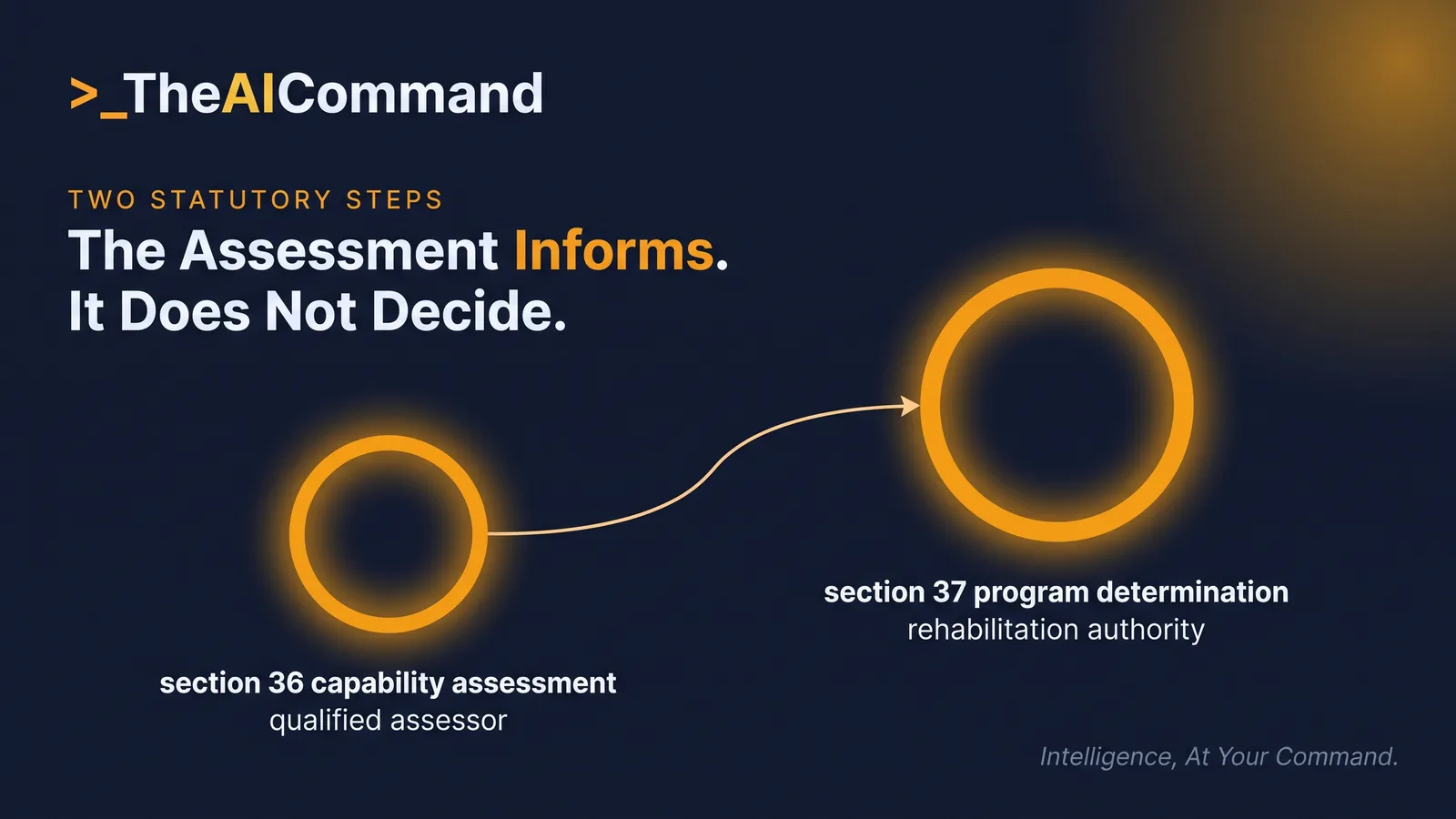
Section 36 and section 37 do different work.
Section 36 concerns capability assessment. Where an examination is carried out, subsection 36(8) requires the person or persons who carried it out to give the rehabilitation authority a written assessment of the employee's capability of undertaking a rehabilitation program, specifying, where appropriate, the kind of program the employee is capable of undertaking, and containing any other program information the rehabilitation authority requires.
Section 37 concerns the rehabilitation authority's determination that an employee should undertake a rehabilitation program. In making that determination under subsection 37(1), the authority must have regard to the matters in subsection 37(3): any written assessment given under subsection 36(8), any reduction in future compensation liability if the program is undertaken, the cost of the program, any improvement in the employee's opportunity to be employed after completing it, the likely psychological effect on the employee of not providing it, the employee's attitude to the program, the relative merits of any alternative and appropriate program, and any other relevant matter.
The distinction is practical. A section 36 report is an input into a later statutory decision. It does not automatically select the section 37 program. A model that turns the assessment material into a recommendation to impose Program A has crossed both the evidence boundary and the delegation boundary.
The Guide for Arranging Rehabilitation Assessments and Requiring Examinations 2024, a legislative instrument prepared by Comcare under section 57A, adds a required decision process. Subsection 36(3A) requires the rehabilitation authority to comply with the approved Guide when deciding whether to arrange an assessment or require an examination. Comcare's announcement of the Guide confirms it applies to assessments and examinations determined under subsections 36(1), 36(3) or 57(1) on and after 30 October 2024, regardless of when the injury occurred.
Comcare's overview for rehabilitation case managers sets out the sequence. Consider whether existing information about the employee's capability is sufficient. If it is insufficient or inconsistent, seek information or clarification from the treating practitioner first, and rely on the treating practitioner as much as possible. If the material is then sufficient, the assessment can be completed without an examination, as a desktop review under subsection 36(1). If it remains insufficient or inconsistent, an examination may be required under subsection 36(3). Before an examination, seek and take into account the employee's views about the assessor or panel and any support person.
The Guide also addresses assessor qualifications, written notices, reasons, rights and examination frequency. Except where an identified exception applies, an employee cannot be required to undergo more than one section 36 examination for the same injury more frequently than at six-month intervals. A model can flag the date of the last examination. A rehabilitation authority decides whether the Guide permits the next step.
One more piece of the frame matters. A section 36 assessment, with or without an examination, is a determination, and it must be notified in writing with terms and reasons. Where the rehabilitation authority is not the relevant authority, the employee may request Comcare to review the determination under section 38. Where the rehabilitation authority is itself the relevant authority, the reconsideration pathway in Part VI applies, which can flow through to review rights before the Administrative Review Tribunal. Either way, the notice and the reasons are statutory work product, not paperwork a model can finish, and the same limits described in a practitioner framework for AI-assisted determinations apply here.
The AI workflow, step by step
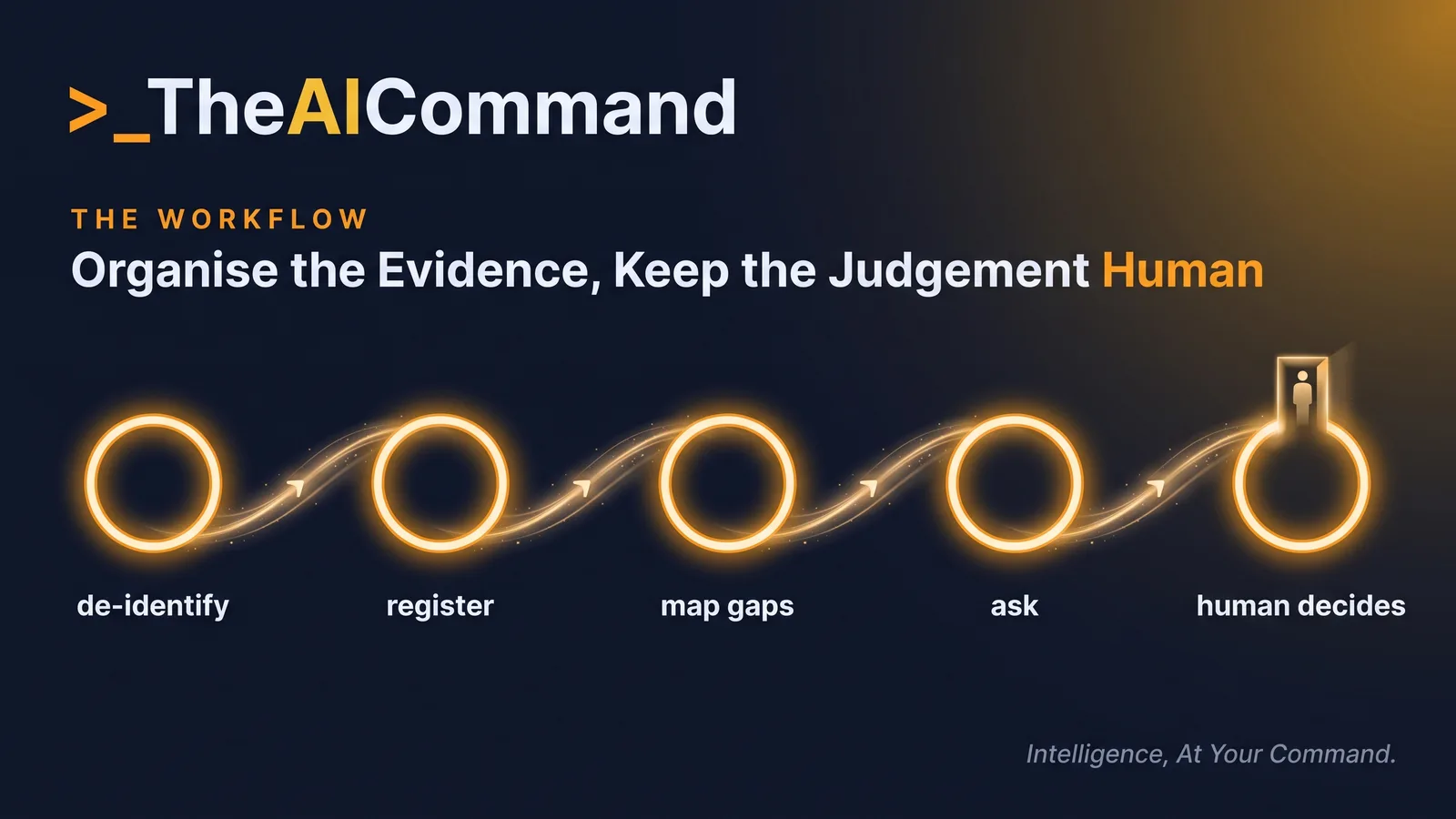
1. Lock the use case before opening the file
Define the AI task as document organisation only. Approved outputs might be a source register, chronology, inconsistency list, missing-information list and draft questions. Prohibited outputs should include capability findings, assessor selection, examination requirements, reasonable-excuse conclusions, program recommendations and any section 37 determination.
Use only an approved tool and workflow. A claims file can contain health information, employment details and combinations of facts that identify a person even after a name is removed.
2. De-identify at source
Replace personal information before anything reaches the model, following a de-identification approach built for case managers working with AI. Use [CLAIMANT_NAME], [CLAIM_NUMBER], [DATE_OF_INJURY], [CONDITION], [EMPLOYER], [TREATING_PRACTITIONER] and [ASSESSMENT_DATE]. Generalise dates or role details where the precise combination could identify the person and the precision is not needed for the organisational task.
Keep the re-identification key outside the AI workspace in the controlled claim system. Do not ask the model to de-identify a live file after upload. De-identification is the entry control, not a clean-up step.
3. Build a source register, not a narrative
Ask the model to list each item with its source type, date, author role, stated purpose, period addressed and the question it may inform. Require a source identifier for every extracted point. The register should say not stated when the document is silent.
This keeps the model away from blending documents into one fluent story. A polished narrative can hide that a statement came from an old certificate, an employer note or an assumption rather than current clinical information.
4. Map the Guide sequence
Create a process table with neutral status labels:
Do not ask the model to fill the human-decision column.
5. Generate questions, not conclusions
Convert each gap into a source-directed question. For example: the current material does not state whether [CLAIMANT_NAME] can sustain the proposed hours, so draft a neutral question for [TREATING_PRACTITIONER] seeking functional information, without suggesting an answer.
Questions should distinguish work capacity, capability of undertaking a rehabilitation program and the content of a possible program. Those concepts can overlap, but they are not interchangeable.
6. Preserve the assessment boundary
The nominated assessor under subsection 36(2) reads the source material, conducts any required examination and authors the assessment. AI may help the authorised workflow format a de-identified brief, but the final assessment must reflect the assessor's own professional work and the evidence they considered.
The rehabilitation authority then applies section 37 if a program is being considered. A qualified and authorised person chooses whether any determination is made and records the reasons. AI does not choose the program, decide what is reasonable or trigger the suspension consequences in subsection 36(4).
7. Record the review
The file note should identify the approved tool, de-identified inputs, AI outputs used, sources checked, errors corrected, reviewer, authorised decision-maker and the final document saved in the claim system. Store the verified human document as the record, not an unreviewed AI conversation.
Where can AI help, and where is human judgement non-negotiable?
AI helps where the work is mechanical and traceable. It can find duplicate documents, create a date sequence, compare functional statements, separate current and superseded material, and turn an identified gap into a neutral question.
Human judgement is non-negotiable where the Act or Guide assigns a function to a person. The rehabilitation authority decides whether to arrange an assessment or require an examination. The nominated qualified assessor evaluates capability. The employee's views are sought and weighed where required. The rehabilitation authority applies section 37 to any program determination. An authorised person decides whether the statutory notice and reasons are complete.
The human reviewer must also catch context a model cannot reliably infer: whether an apparent inconsistency is explained by a change in condition, whether a treating practitioner's response addresses the actual question, whether an examination request is proportionate, and whether a proposed step respects the employee's circumstances.
The same split between organising the file and making the statutory call runs through other SRC Act workflows, from mapping a section 29 household services claim to shaping recovery-at-work and suitable-duties information.
A worked example
[CLAIMANT_NAME], claim [CLAIM_NUMBER], has an accepted [CONDITION] with a recorded date of injury [DATE_OF_INJURY]. The file includes two capacity certificates, a treating-practitioner report, an employer duties list, an earlier rehabilitation-provider note and correspondence recording [CLAIMANT_NAME]'s views.
The approved AI workspace receives only de-identified extracts. It produces a source register and flags three matters: the current certificate does not address travel tolerance, the employer duties list describes physical demands differently from the earlier provider note, and the treating-practitioner report predates a reported change in symptoms. It drafts three neutral clarification questions and labels each with the source gap it addresses.
It does not state that [CLAIMANT_NAME] is capable of a program. It does not recommend an examination or provider. It does not choose modified hours.
The rehabilitation case manager checks the register against the file, corrects one date and obtains authorised advice on the next process step. The rehabilitation authority applies the Guide, decides whether existing information is sufficient and documents the reasons. If an examination proceeds, the nominated qualified assessor performs it. If a section 37 program is later considered, the authorised rehabilitation authority weighs the statutory matters and decides.
The productivity gain is real but narrow. The file becomes easier to navigate. The people named by the legislation still do the statutory work.
Prompt pattern: organise, do not assess

For practitioners
Use AI as a source-indexing assistant. Require every extracted point to carry a source ID and a page or section marker. If the output cannot show where a statement came from, do not carry it into the assessment brief. De-identify before anything reaches the model, and run the workflow only through a tool your organisation has approved for claims material.
For governance leads
Write the prohibited outputs into the control. The tool may not make a capability finding, select an assessor, require an examination, recommend a program or draft a completed statutory determination. Sample files for source traceability, de-identification and proof of authorised review, and confirm that every section 36 and section 37 decision on the file traces to a qualified and authorised person.
SRC Act sections referenced: section 36 (assessment of capability of undertaking a rehabilitation program, including subsections 36(1), 36(2), 36(3), 36(3A), 36(4) and 36(8)), section 37 (provision of rehabilitation programs, including subsections 37(1) and 37(3)), section 38 (review by Comcare of section 36 and 37 determinations made by a rehabilitation authority other than a relevant authority) and section 57A (the approved Rehabilitation Assessments and Examinations Guide).
Bottom line
AI earns its place on a section 36 file as a source-indexing assistant that builds registers, chronologies and neutral questions from de-identified material. It cannot make the capability assessment under subsection 36(2), require an examination, select the assessor or trigger a section 37 program determination. Keep the machine on the organisational side of every boundary and let the qualified assessor and the rehabilitation authority do the statutory work.
Do this Monday:
- De-identify at source with placeholders before anything reaches an approved tool.
- Limit AI outputs to a source register, chronology, inconsistency list and neutral questions.
- Require a source ID and a page or section marker on every extracted point.
- Keep capability findings, assessor selection, examination requirements and program choices with qualified and authorised people.
- Record the tool, de-identified inputs, corrections and authorised decision-maker in the claim system.
Content disclaimer: This article is for general educational purposes only and does not constitute legal advice, liability determination guidance, or a substitute for professional judgement. Workers compensation decisions must be made by appropriately qualified and authorised persons under the Safety, Rehabilitation and Compensation Act 1988. All AI outputs described in this article require human review before use in any claims management context.
TheAICommand. Intelligence, At Your Command.