
AI can map a de-identified section 29 household services claim by task and evidence, but it cannot decide what is reasonably required or what amount is reasonable, so an authorised claims manager weighs the evidence under the SRC Act. Reasonableness is a judgement, not a spreadsheet result.
Household services claims turn ordinary domestic work into evidence. Cooking, cleaning, laundry and gardening are easy to name but harder to assess. Under section 29 of the Safety, Rehabilitation and Compensation Act 1988, the claims manager needs to understand what [CLAIMANT_NAME] actually did before the injury, what the accepted condition now prevents, who lives in the household, what those people already did, what they can reasonably be expected to do now and whether extra duties would substantially disrupt their employment or other activities.
The evidence rarely arrives in one clean statement. A claim form may list hours. A treating practitioner report may describe restrictions without naming household tasks. An occupational assessment may use different categories. Quotes can bundle ordinary cleaning with services outside the statutory definition. Family statements can describe genuine strain but leave the pre-injury division of work unclear.
AI can help organise this material. It can build a task matrix, align dates, detect missing fields and show which source supports each point. It cannot apply the word reasonable for the delegate. That word carries the statutory judgement.
What does section 29 require in plain terms?
Subsection 29(1) applies where, as a result of a non-catastrophic injury, the employee obtains household services that they reasonably require. The relevant authority is then liable to pay compensation of such amount per week as it considers reasonable in the circumstances, not less than 50 per cent of the amount the employee pays or is payable for those services and not more than the indexed weekly maximum. Section 29 also covers attendant care services for non-catastrophic injuries, under subsections 29(3) and 29(4) with their own criteria and weekly cap and their own Comcare guidance. This article deals with the household services limb.
The definition in subsection 4(1) limits household services to services of a domestic nature, including cooking, house cleaning, laundry and gardening services, that are required for the proper running and maintenance of the employee's household. Comcare's scheme guidance on household services explains that the services must meet that definition and be reasonably required as a result of the employee's compensable injury.
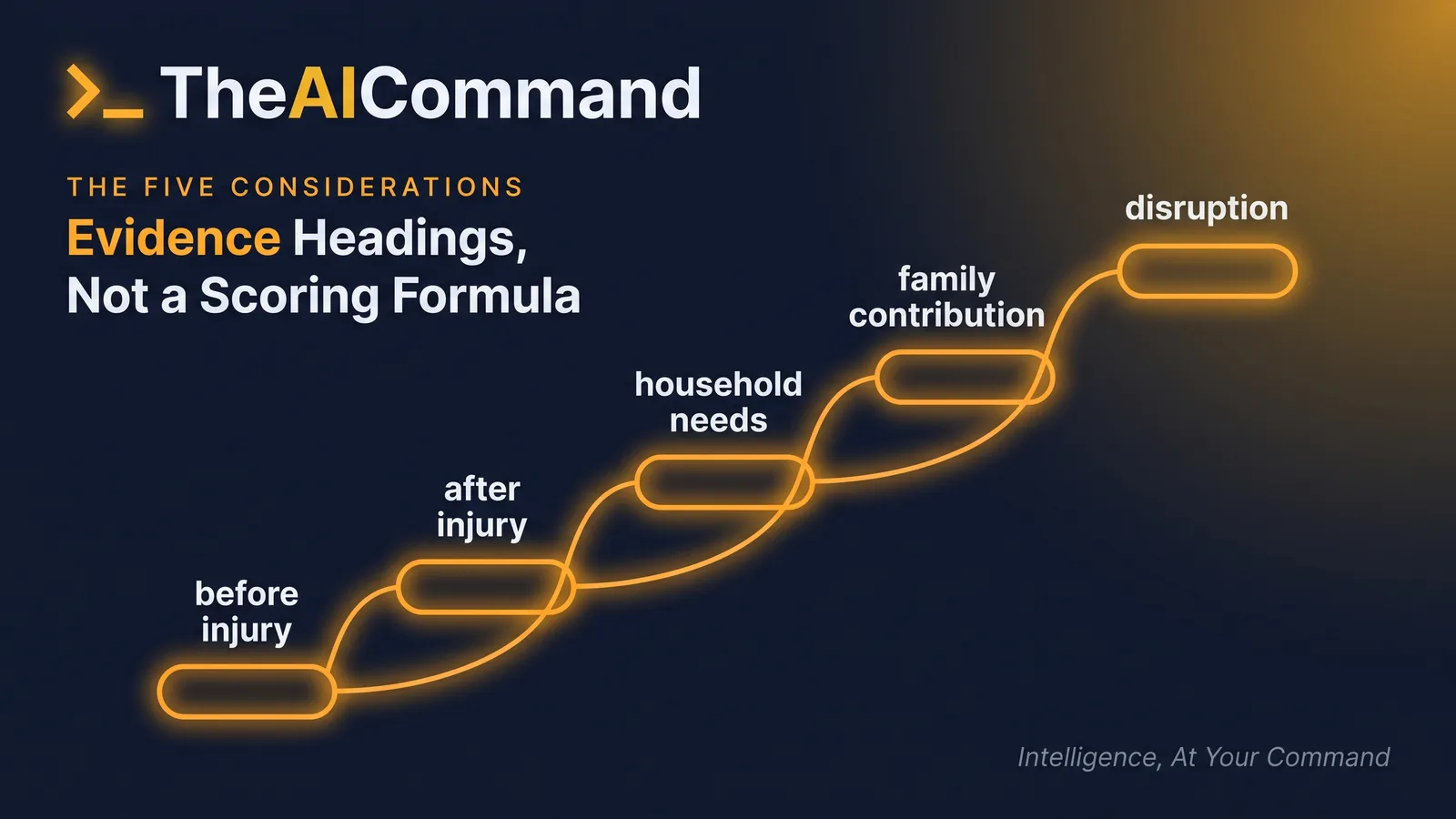
Subsection 29(2) then requires the decision-maker to have regard to five matters:
- the extent to which the employee provided household services before the injury and the extent to which they can provide them after it
- the number of people living in the household, their ages and their need for household services
- the extent to which those household members provided household services before the injury
- the extent to which those members, or any other members of the employee's family, might reasonably be expected to provide household services for themselves and the employee after the injury
- the need to avoid substantial disruption to those people's employment or other activities.
The subsection is expressed "without limiting" the matters that may be taken into account, so the list is mandatory but not exhaustive. Comcare's guidance says other relevant circumstances may include the time taken to recover and regain the ability to perform domestic tasks, and adaptive techniques or equipment that may change what assistance is required. Aids and appliances themselves are determined under section 39, not section 29. None of the five matters is a mechanical score. The claims manager considers the evidence as a whole and records why the services and amount are or are not reasonable in the circumstances.
There is also a timing rule. For a non-catastrophic injury, subsection 29(5) excludes household services compensation for any week within the 28 days beginning on the date of the injury, unless the relevant authority determines otherwise on the ground of financial hardship or the need to provide for adequate supervision of dependent children. Catastrophic injuries are dealt with under section 29A, which has no weekly cap and no first-28-days exclusion. The injury category and applicable provision must be confirmed by an authorised person, not inferred by a model.
The subsection 29(1) maximum weekly amount is indexed on 1 July each year and published on Comcare's statutory rates page. Do not hard-code an old figure into a prompt or template. Confirm the current rate from Comcare at the time of decision.
Why keep section 29 separate from section 36?
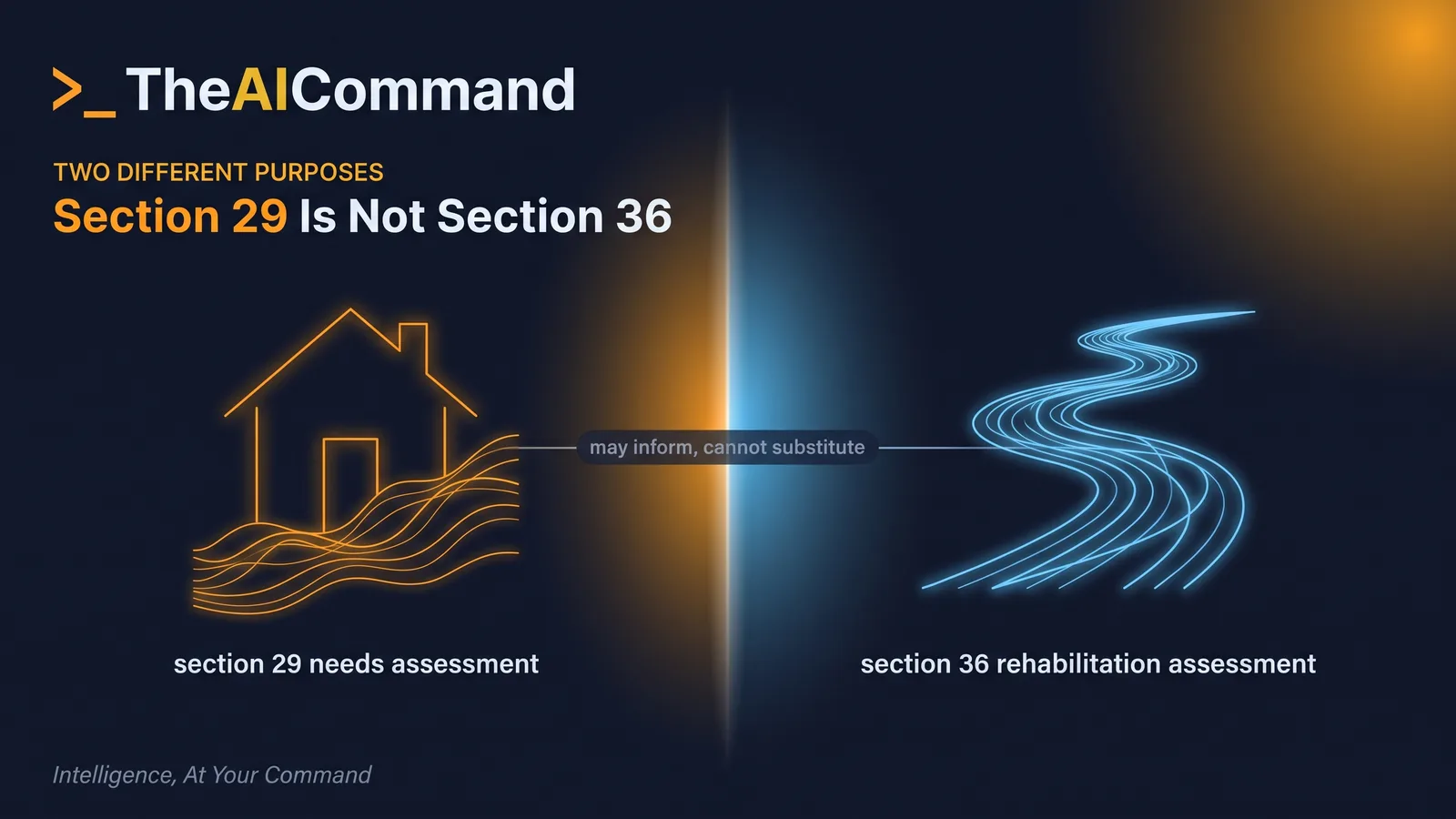
An important boundary is easy to miss. Comcare's guidance states that a rehabilitation authority's power under section 36 does not extend to an assessment of an employee's need for household services. A relevant authority may instead arrange and pay for a household services needs assessment under section 70 for Comcare or section 108F for licensees. That power does not extend to compelling the employee to attend or cooperate with the assessment.
A rehabilitation assessment may still contain relevant information and must be taken into consideration, but Comcare's guidance is explicit that it cannot be the sole basis for the household services decision. With the employee's consent, the relevant authority may obtain a household services assessment at the same time as a rehabilitation assessment. Administrative convenience does not merge the two statutory purposes.
This is a useful AI control. The source register should label each document by purpose. A section 36 report is rehabilitation capability evidence, not automatically a household services assessment. The model should never relabel it to close a gap.
The AI workflow, step by step
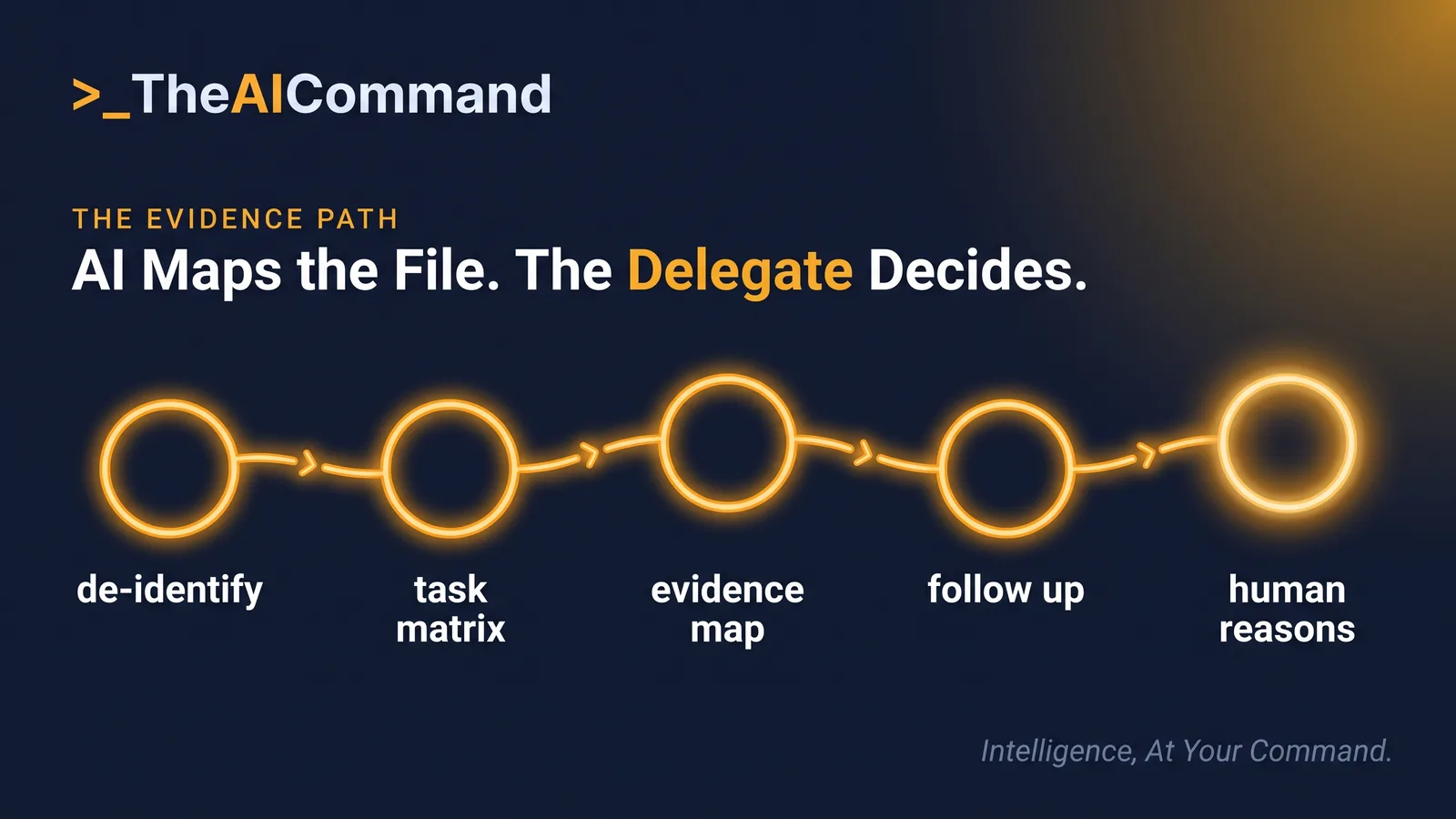
1. Approve the use case and remove identity
Limit the AI task to evidence organisation. Do not permit eligibility findings, reasonableness conclusions, compensation calculations, first-28-days exceptions or provider approval.
Before upload, follow a de-identification routine and replace live details with [CLAIMANT_NAME], [CLAIM_NUMBER], [DATE_OF_INJURY], [CONDITION], [HOUSEHOLD_MEMBER_1], [HOUSEHOLD_MEMBER_2], [TASK], [FREQUENCY] and [QUOTE_AMOUNT]. Generalise location, employer, provider and uncommon family details where combinations could identify the person. Keep the re-identification key in the controlled claim system, and use only a tool your organisation has approved for claims work.
2. Create a task-level evidence register
Do not let six hours of help remain one undifferentiated claim. Break it into discrete services. For each task, capture the claimed frequency and duration, pre-injury provider, current reported capacity, requested provider, quoted cost and every supporting source:
- Domestic task, for example [TASK: meal preparation]. It must fit the statutory definition before further mapping.
- Pre-injury contribution, for example [CLAIMANT_NAME]: [FREQUENCY]. Cite the claimant statement or assessment.
- Post-injury capacity, for example [LIMITATION]. Cite current clinical or functional evidence.
- Household contribution, for example [HOUSEHOLD_MEMBER_1]: [TASK]. Separate before and after injury.
- Disruption, for example [WORK_OR_ACTIVITY_IMPACT]. Record evidence, do not infer burden.
- Cost, for example [QUOTE_AMOUNT]. Record date, scope and provider status.
If a source does not answer a field, write "not stated". Do not have the model fill the blank with a likely domestic pattern.
3. Map evidence to subsection 29(2)
Create five evidence headings matching paragraphs 29(2)(a) to (e). Under each heading, separate supports, does not address, appears inconsistent and question for human follow-up.
This prevents one strong fact from being counted several times. It also shows the claims manager where a statement about incapacity does not answer who performed the task before injury or what household members can reasonably contribute.
4. Run a definition check
Ask the model to flag tasks that may sit outside the subsection 4(1) definition for human review. It may distinguish obvious domestic descriptions from ambiguous items, but it must not decide coverage.
For example, ordinary lawn mowing may be described as gardening. Work maintaining a commercial paddock, investment property or business asset raises a different question. The model can mark the purpose and location as unclear. The authorised claims manager checks the current Act, guidance and evidence.
5. Separate evidence from calculations
Quotes, paid invoices and weekly totals belong in a cost table. The model can calculate arithmetic if every input is supplied and independently checked. It must not apply the indexed cap, decide the reasonable weekly amount or choose between providers.
Label every number with source, date, period and whether it is quoted, paid or claimed. A monthly quote converted to a weekly figure should show the formula. The delegate confirms the current statutory rate and the proper calculation.
6. Draft questions, not a recommendation
Turn gaps into neutral questions. Examples include:
- Which of the listed tasks did [CLAIMANT_NAME] perform before [DATE_OF_INJURY], and how often?
- What functional restriction linked to [CONDITION] affects [TASK], and for what period?
- What tasks did [HOUSEHOLD_MEMBER_1] perform before the injury?
- What employment or other activity would be substantially disrupted by an additional task?
- Does [QUOTE_AMOUNT] include work outside the employee's household?
The questions gather evidence. They must not imply the answer or tell a practitioner how to determine the claim.
7. Human review and recorded reasons
An authorised claims manager checks every mapped point against the source documents, confirms the accepted condition and applicable provision, decides whether additional assessment is needed, weighs the statutory matters and determines the services and amount, if any. The final reasons are authored and approved by the human decision-maker.
Record the AI assistance, de-identified inputs, output used, errors corrected, current rate checked, sources relied on, reviewer and authorised decision-maker. Delete or retain working material under the approved records schedule.
Where does AI help, and where is judgement non-negotiable?
AI is useful for consistency. It can ensure each claimed task is tested against the same evidence headings. It can stop a long quote from obscuring which service is actually requested. It can show that evidence addresses current function but says nothing about the pre-injury household pattern.
Judgement remains human because "reasonably requires" is contextual, the same reasonableness line that AI cannot cross for reasonable medical treatment under section 16. The decision-maker must weigh the employee's prior contribution, current ability, household needs, family contribution and disruption rather than count completed cells. The decision also depends on causation, the compensable condition, timing, statutory category, provider evidence and current rates.
AI cannot decide that a partner is expected to do more, that a child can safely take over a task, or that employment disruption is acceptable. Those conclusions can affect dignity, family relationships and access to support. They require evidence and an authorised person who can explain the reasoning.
A worked example
[CLAIMANT_NAME], claim [CLAIM_NUMBER], has an accepted [CONDITION] from [DATE_OF_INJURY]. The request lists meal preparation, bathroom cleaning, laundry, lawn mowing and transport for [DEPENDENT_CHILD]. The household includes [HOUSEHOLD_MEMBER_1] and [HOUSEHOLD_MEMBER_2].
The approved AI workflow receives de-identified extracts. It builds a task matrix and identifies that the claimant statement describes pre-injury cooking and laundry but does not address lawn mowing. The current functional report discusses lifting and standing tolerance but not the expected duration. The quote bundles house cleaning and transport without separate prices. A household statement describes additional duties but does not explain the person's work hours or prior contribution.
The model maps those gaps to subsection 29(2) and drafts questions. It flags transport as requiring a definition and provision check rather than treating it as a household service. It does not say which services are to be accepted, how many hours are reasonable or what the family is expected to provide.
The claims manager checks the sources, seeks the missing information, confirms the correct statutory pathway and current indexed rate, and makes the decision under delegation. The evidence map improves consistency. It does not become the reasons.
Prompt pattern: map the evidence only
For practitioners
Build the matrix at task level and use "not stated" aggressively. A blank is a follow-up question, not permission for the model to infer how the household probably operated. Keep the prompt instruction "do not decide whether a service is covered or reasonably required" in place permanently, treat it as one entry in a reviewed prompt library, run only de-identified material through an approved tool, and reread every source document the model summarises before you rely on the summary.
For governance leads
Sample decisions for four failure modes: real personal data in prompts, a section 36 report treated as the household services assessment, an outdated indexed rate, and AI language that turns an evidence map into a reasonableness conclusion. Make the boundary explicit in policy: AI organises section 29 evidence, authorised decision-makers determine section 29 entitlements, and the two are never blurred.
Bottom line
AI earns its place on a section 29 household services claim by making the file consistent: one task matrix, every claimed service tested against the same five subsection 29(2) headings, and every gap marked rather than guessed. It cannot decide whether a service is reasonably required, what weekly amount is reasonable, whether the first-28-days exclusion applies or what a family member can be expected to provide. Those calls belong to an authorised claims manager under the SRC Act.
Do this Monday:
- De-identify every claim extract before it reaches an approved tool.
- Build the evidence register at task level and write "not stated" for any blank field.
- Map each point to paragraphs 29(2)(a) to (e), separating supports, gaps and inconsistencies.
- Confirm the current subsection 29(1) indexed weekly maximum from Comcare, never a hard-coded figure.
- Keep a section 36 rehabilitation report out of the household services assessment.
SRC Act sections referenced: subsection 4(1) (definitions of household services and attendant care services), section 29 (household services and attendant care services after non-catastrophic injury, including subsections 29(1), 29(2) and 29(5)), section 29A (catastrophic injury), section 36 (rehabilitation assessment, which does not extend to household services need), section 39 (aids and appliances), and sections 70 and 108F (assessment powers identified in Comcare scheme guidance).
Content disclaimer: This article is for general educational purposes only and does not constitute legal advice, liability determination guidance, or a substitute for professional judgement. Workers compensation decisions must be made by appropriately qualified and authorised persons under the Safety, Rehabilitation and Compensation Act 1988. All AI outputs described in this article require human review before use in any claims management context.
TheAICommand. Intelligence, At Your Command.