
AI genuinely helps with a section 5A reasonable administrative action determination by organising the file and framing the questions, but it must never decide the claim: the reasonableness call and the determination stay with the human delegate. Psychological injury is now the determination that defines the Comcare scheme's workload. On Safe Work Australia's most recent Key Work Health and Safety Statistics, mental health conditions kept rising through 2022-23p and now account for 11 per cent of all serious workers' compensation claims nationally, with the median time lost from work more than five times the figure recorded across all injuries and diseases (Safe Work Australia, Key Work Health and Safety Statistics 2024). The year before, the same body reported these claims at 9 per cent of serious claims and a 36.9 per cent increase since 2017-18 (Safe Work Australia, media release, 27 February 2024). Inside the Australian Government scheme the cost concentration is sharper still. Comcare's own material puts psychological injury at roughly 11 per cent of claims but about 30 per cent of the cost of claims, and 55 per cent of Australian Government psychological injury claims that reach four weeks of lost time continue on to 13 weeks (Comcare, Psychological Injury and Performance factsheet).
For a case manager, those numbers translate into a specific, recurring task: deciding whether a psychological injury claim is excluded because it was suffered as a result of reasonable administrative action. This is the section 5A exclusion, and it is the most contested call in the scheme. AI tools now sit on the same desk as these claims, and the temptation is to ask a model to assess the claim. That is the one thing it must not do. This piece sets out where AI genuinely helps with a section 5A determination, and exactly where the work stops being organisation and becomes judgement.
What does section 5A actually require?
Before any AI enters the picture, be clear about the legal test, because the workflow is built around it. Section 5A of the SRC Act excludes compensation for an injury suffered as a result of reasonable administrative action taken in a reasonable manner in respect of the employee's employment (Comcare, scheme guidance SRC316). The exclusion was inserted into the Act on 13 April 2007 to keep legitimate management action out of the compensation system, and in practice it will usually only apply to claims for psychological injuries, which are generally characterised as an ailment (Comcare, scheme guidance SRC331).
The analysis runs in a fixed order. First, is there a disease? A psychological condition is usually characterised as a disease, meaning an ailment, or aggravation of an ailment, that was contributed to, to a significant degree, by the employee's employment under section 5B(1), where significant degree means a degree that is substantially more than material under section 5B(3) (Comcare, SRC316). Ailment itself is defined broadly in section 4(1) as any physical or mental ailment, disorder, defect or morbid condition.
Only once employment has contributed to a significant degree does section 5A come into play. The decision-maker then asks whether any of those employment causative factors were reasonable administrative action. The Comcare guidance breaks this into four questions about each action: was it administrative, was it taken in respect of the employee's employment, was it reasonable, and was it taken in a reasonable manner (Comcare, SRC331).
The reasonableness test is two distinct questions, not one. The first is whether the decision to take the administrative action was reasonable. The second is whether the action was taken in a reasonable manner. Comcare's guidance is explicit that a decision-maker must consider both, and that the standard is objective: the consideration required is not whether the action could have been taken in a more reasonable manner, but whether it was reasonable in the circumstances, and an employee's preference for a different approach is not relevant (Comcare, SRC331, citing Comcare v Martinez (No 2) (2013) 212 FCR 272).
Finally, even where reasonable administrative action is present, the exclusion only applies if the injury was suffered as a result of it. That phrase in section 5A(1) is the causal connection test, and the High Court set the standard in Comcare v Martin [2016] HCA 43: the decision-maker considers whether the reasonable administrative action made the difference between the employee suffering and not suffering the disease (Comcare, SRC316). The action need not be the sole cause (Hart v Comcare [2005] FCAFC 16, as cited in the guidance).
Where must AI stop in a section 5A determination?
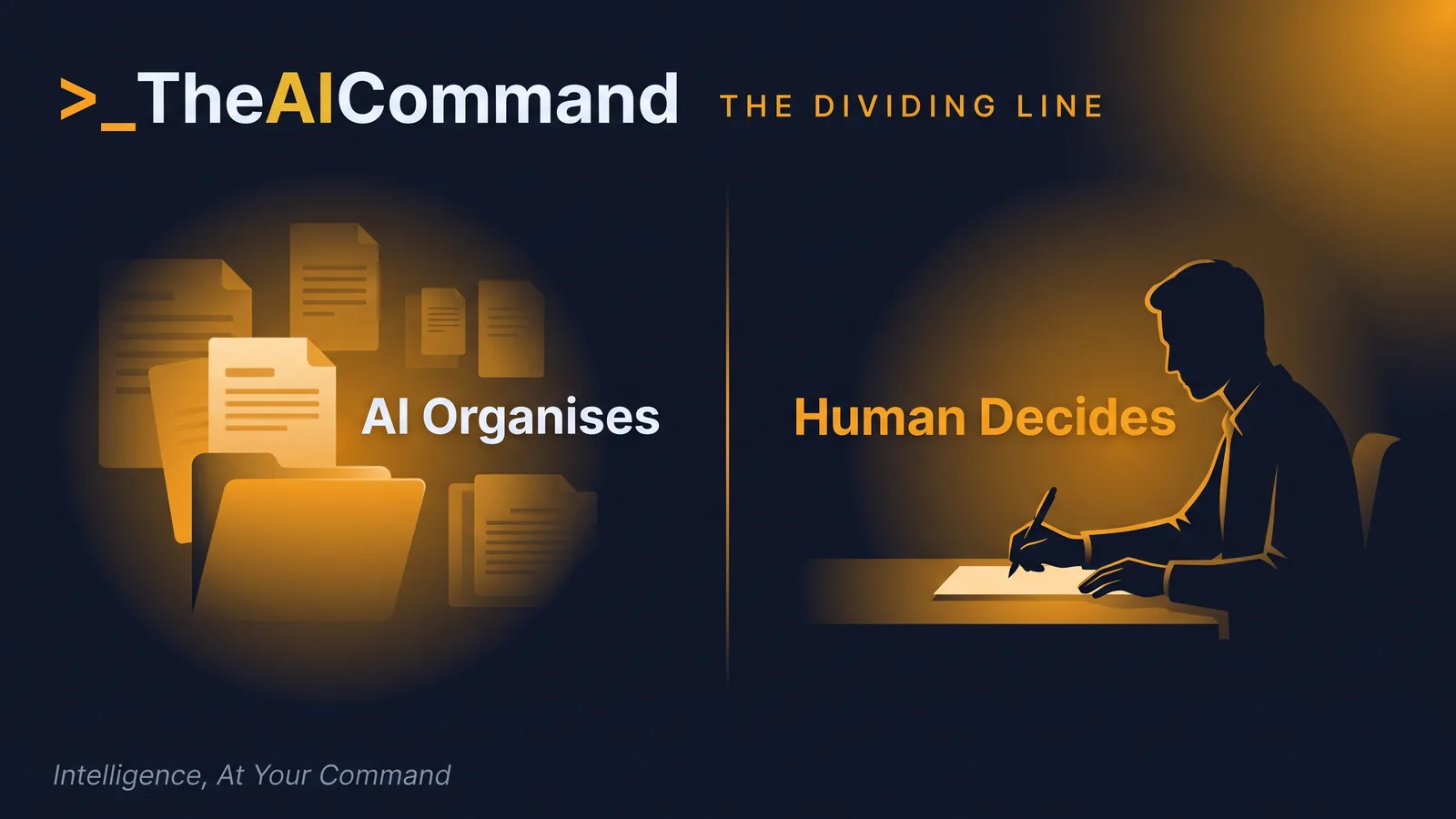
Read that test back and the dividing line for AI is obvious. Section 5A is a chain of human judgements: characterising the condition, weighing employment contribution against non-employment factors, classifying each action, and forming a view on whether conduct was reasonable and reasonably done. Those are evaluative calls a delegate is accountable for under the Act. A model cannot make them, and a model that appears to make them is worse than useless, because it produces a confident answer with no accountable reasoning behind it.
What AI is genuinely good at is the part that sits underneath the judgement: organising a messy file into a structure that matches the test, so the delegate spends their time deciding rather than collating. That is real value on a determination that is document-heavy and time-pressured. The rule is simple. AI organises the evidence and frames the questions. The human answers them.
The de-identified workflow
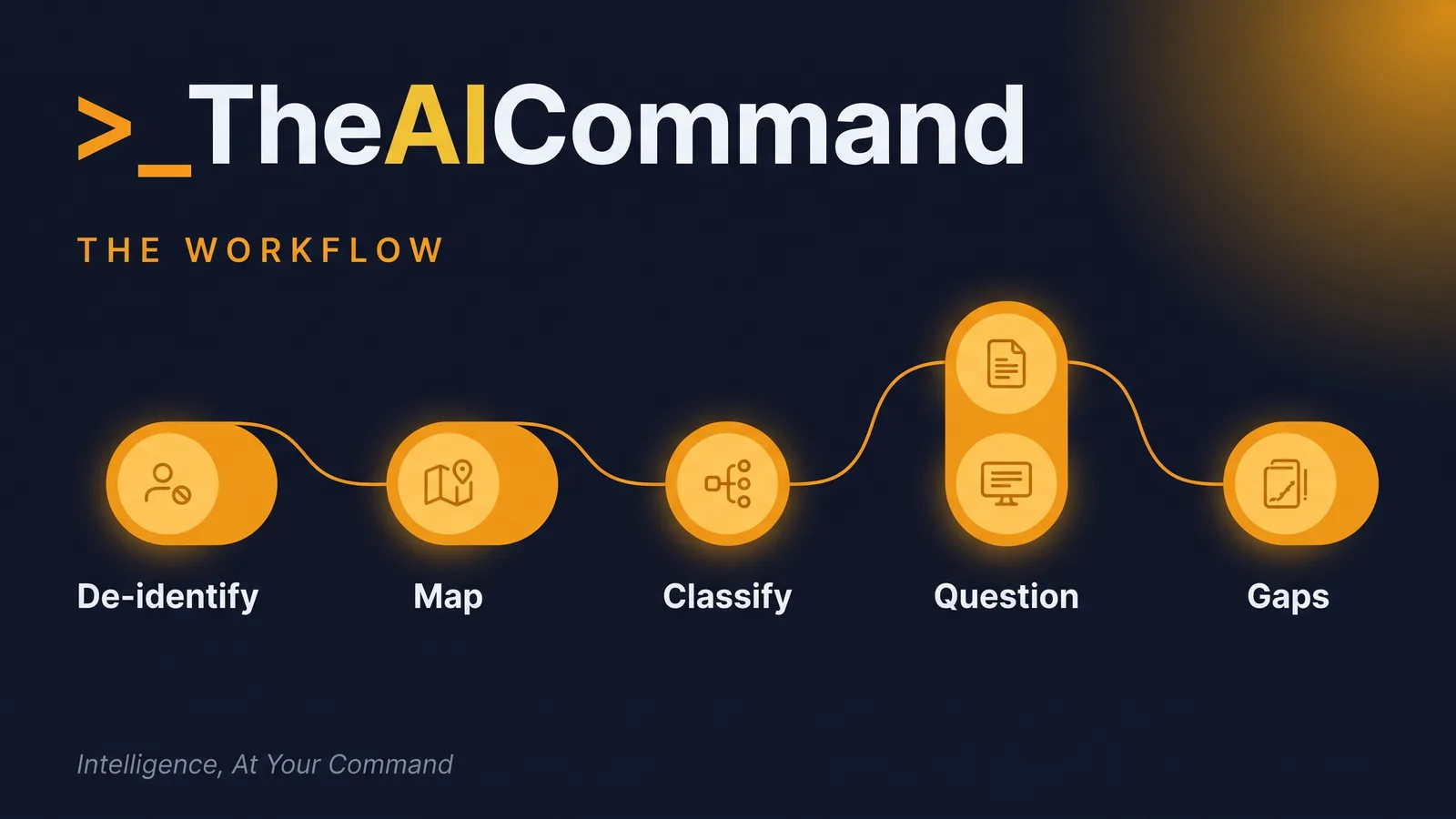
Here is a workflow a case manager can run today using a general assistant, with the judgement kept human at every step. Treat it as a drafting aid, not a decision tool.
- Step 1: De-identify before anything else. Claim material is sensitive information. Strip names, claim numbers, dates of birth and any identifier before a single line goes near a model, and work in placeholders such as [CLAIMANT_NAME], [CLAIM_NUMBER] and [DATE_OF_BIRTH]. If you cannot de-identify it, it does not go in. This is the precondition for everything below.
- Step 2: Build the administrative-action chronology. Ask the model to read the de-identified file and list, in date order, every action the employer took that bears on the claim: the date, what happened, who was involved and what document records it. You are not asking for an opinion, only an ordered index of events tied to evidence.
- Step 3: Classify each action as administrative or operational. This is the distinction that decides whether section 5A is even in play. Administrative action is directed specifically to the employee and their employment relationship, such as a performance appraisal, counselling, suspension or disciplinary action under the non-exhaustive list in section 5A(2). Operational action, a direction about how and when to perform the work itself, is not reasonable administrative action, and any resulting injury is compensable (Comcare, SRC331, citing Commonwealth Bank of Australia v Reeve [2012] FCAFC 21). Have the model tag each action and, crucially, flag the ones it is unsure about for human review.
- Step 4: Surface the two reasonableness questions, do not answer them. For each administrative action, have the model lay out the evidence that bears on the two limbs as questions: what informed the decision to act, whether policy was followed, whether the employee's known circumstances were considered, whether it was timely, whether natural justice was observed, and whether anything about the conduct reads as overly aggressive, unfair or untoward (the considerations in Comcare, SRC331). The output is a structured set of prompts for the delegate, never a verdict.
- Step 5: Flag the evidence gaps. Ask the model what is missing: an action asserted with no contemporaneous record, a policy referenced but not on file, a timeline with an unexplained gap. Comcare's own guidance stresses that contemporaneous records are what make these determinations defensible, and a gap list tells you what to request before you decide.
- Step 6: Draft a reasons skeleton, then write it yourself. The model can lay out the section 5A structure as headings and slot the agreed facts under each. The reasoning, the findings on reasonableness and the determination are written by the delegate. The skeleton saves typing, not thinking.
A worked example (de-identified)
Picture a claim from [CLAIMANT_NAME], [CLAIM_NUMBER], for an adjustment disorder said to arise from a performance management process. The de-identified file holds a performance appraisal, three counselling meetings, a formal underperformance notice and a fortnight of emails. Run the workflow and the model returns a clean chronology, tags the appraisal, counselling and notice as likely administrative action under section 5A(2), and flags one supervisor instruction about reallocating daily tasks as possibly operational and therefore outside the exclusion. It lists the reasonableness questions for each step and notes that the file shows no record of the employee's disclosed circumstances being considered before the underperformance notice issued.
None of that is a decision. It is a brief. The delegate reads it, requests the missing record, weighs the medical evidence on employment contribution, forms a view on each reasonableness limb, and writes the determination. If the exclusion is made out, the determination language is deterministic, not tentative: "Liability is rejected. The condition is a disease to which employment contributed to a significant degree, but it was suffered as a result of reasonable administrative action taken in a reasonable manner under section 5A of the SRC Act, and is therefore not an injury for which compensation is payable under section 14." If the operational action turns out to be the real driver, the call runs the other way and is recorded just as plainly.
Why must the judgement stay human?
The reasonableness test is not prescriptive, which is exactly why it cannot be delegated to a model. Comcare's guidance accepts that there may be more than one reasonable way to take an action, and asks only whether what was done was reasonable in the circumstances (Comcare, SRC331). That is a contextual, evidence-weighing judgement that depends on what the employer knew at the time and on the particular employee, including their psychological state. A model has no standing to make it and no accountability if it is wrong. The delegate does, and a determination has to survive reconsideration and review by the Administrative Review Tribunal on the strength of the human reasoning, not the tidiness of an AI summary.
There is also a quieter risk. A well-formatted model output reads as authoritative, and a busy decision-maker can drift into adopting its framing. Guard against it by treating every AI tag as a question, checking each classification against the source document, and keeping the reasons in your own words. The audit trail that matters is the one a person can stand behind.
What never to automate
- The reasonableness call. Whether an action was reasonable and reasonably taken is the determination, not an input to it.
- The causal weighting. Deciding whether employment contributed to a significant degree, and whether the action made the difference, rests on medical evidence a person must weigh.
- The classification you have not checked. Administrative versus operational decides whether section 5A applies at all; verify every tag against the record.
- Identifiable claimant data. Never put a name, claim number or date of birth into a general model.
- The determination itself. The finding, the reasons and the outcome are signed by the delegate.
Used this way, AI does not decide section 5A claims. It clears the desk so the person who is accountable can do the part only a person can do. The numbers say these claims are not going away. The discipline is to let the tool organise the evidence, and keep the judgement where the Act puts it.
The prompt
Paste this into ChatGPT or Claude to turn a de-identified claim file into a section 5A working brief. It organises and questions; it does not decide.
How to run it. Create a ChatGPT Project (or a Claude Project) called Section 5A briefs and paste the prompt into the project's custom instructions, so every new chat starts with the same rules and the same de-identification guardrail. Open a new chat per claim, paste one de-identified file, read the five-part brief, and correct the collation by feeding back fixes such as the third action is operational, here is why, redo the classification table. Then run one self-critique instruction asking the model to list anything it classified that the source does not clearly support and any reasonableness question it answered instead of leaving open, which catches the model's most common failure of drifting from organising into deciding.
Bottom line
Section 5A is a chain of human judgements, and a model cannot make any of them. Let AI organise the file and frame the questions, then answer them yourself in deterministic language. De-identify first, and treat every AI tag as a question to check against the source document, because the audit trail that matters is the one a person can stand behind.
Do this Monday:
- De-identify the claim file before a single line goes near a model, using placeholders for every identifier.
- Build the administrative-action chronology in date order, tied to the document that records each event.
- Classify each action as administrative or operational, and flag anything unclear for human review.
- Surface the two reasonableness questions, but leave them for the delegate to answer.
- Write the determination and the reasons in your own words, in deterministic language.
References
- Comcare. Scheme guidance SRC316 - Injury suffered as a result of reasonable administrative action. Last updated July 2020. https://www.comcare.gov.au/scheme-legislation/src-act/guidance/injury-suffered-reasonable-administrative-action
- Comcare. Scheme guidance SRC331 - Considerations when applying the RAA taken in a reasonable manner exclusion. Last updated October 2021. https://www.comcare.gov.au/scheme-legislation/src-act/guidance/considerations-when-applying-the-raa-taken-in-a-reasonable-manner-exclusion
- Safe Work Australia. Key Work Health and Safety Statistics 2024 (data for 2022-23p). Published 2024. https://data.safeworkaustralia.gov.au/insights/key-whs-stats-2024
- Safe Work Australia. New report on psychological health in Australian workplaces (media release), 27 February 2024. https://www.safeworkaustralia.gov.au/media-centre/media-release/new-report-psychological-health-australian-workplaces
- Comcare. Psychological Injury and Performance factsheet. https://www.comcare.gov.au/sites/default/files/docs/psychological-injury-and-performance-factsheet.pdf
Content disclaimer: This article is for general educational and informational purposes only. It does not constitute legal, compliance, claims, or professional advice, and it is not a determination under the Safety, Rehabilitation and Compensation Act 1988 (SRC Act). The SRC Act 1988 should always be consulted directly. Workers compensation decisions must be made by authorised individuals using current legislation, policy, evidence and delegation requirements.
TheAICommand. Intelligence, At Your Command.