Yes, AI can draft motivational-interviewing-informed scripts, open questions and follow-up messages that get a case manager ready for a recovery-at-work conversation, but the script is only a rehearsal aid: de-identify everything first, and a human reviews every draft and holds the conversation.
Recovery at work often turns on one conversation.
The claim file gets hours of preparation. The phone call usually gets none. Case managers and rehabilitation case managers in the Comcare scheme run these conversations constantly: first contact after an injury, the discussion before a rehabilitation assessment, the check-in after a setback, the talk about suitable employment. The information side of that work is generally well managed. The conversation side is improvised, and improvised conversations with worried people drift towards scripted bureaucracy or accidental pressure.
An earlier TheAICommand article covered using AI to organise recovery-at-work information and suitable duties. This guide covers the layer information management cannot reach. What you actually say. It walks through using AI to draft motivational-interviewing-informed scripts, talking points and follow-up messages, so the human arrives prepared rather than winging it.
Context for general readers: Workers compensation under the Safety, Rehabilitation and Compensation Act 1988 (SRC Act) is the Commonwealth scheme administered by Comcare. When an employee is injured, a rehabilitation authority, usually the employer, manages rehabilitation and return to work through its case managers. Much of that work happens in conversations: explaining assessments, discussing programs, planning a return to suitable duties.
De-identification callout: Never enter real claimant names, claim numbers, dates of birth, employee IDs, provider names, exact dates or identifying injury details into a public or unapproved AI tool. Use fictional scenarios and [PLACEHOLDER] fields. Removing a name is not enough if the remaining facts can still identify the person.
Why is the conversation itself a recovery variable?
Conversation quality is a measurable input to whether an injured employee returns to work and stays there, not soft-skills garnish.
The Australasian Faculty of Occupational and Environmental Medicine (AFOEM) anchors its Health Benefits of Good Work initiative in two evidence-based positions: good work is beneficial to health and wellbeing, and long-term work absence generally harms both.
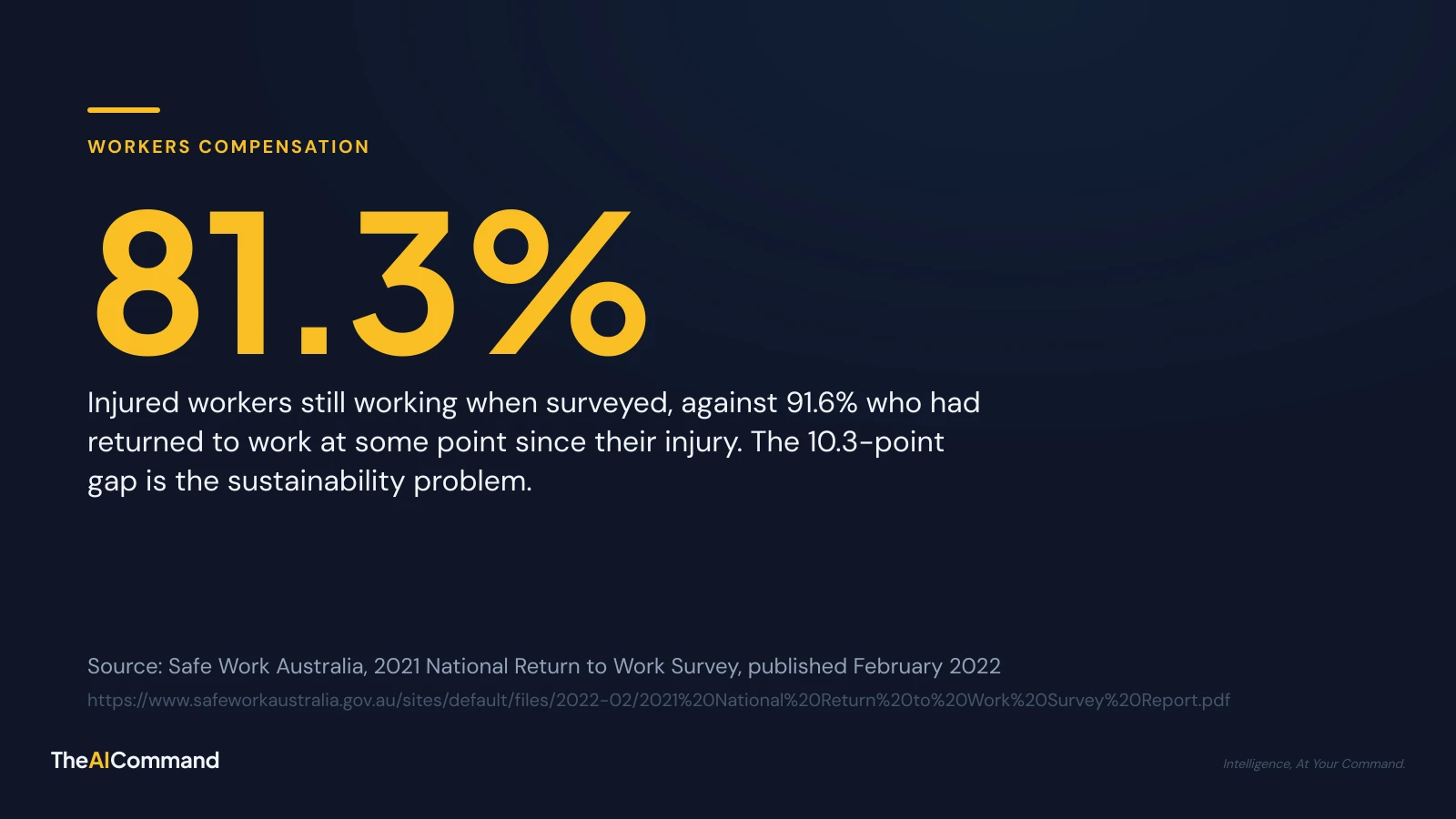
Australian survey data sharpens the picture. Safe Work Australia's 2021 National Return to Work Survey found 91.6 per cent of surveyed workers had returned to work at some point since their injury, but only 81.3 per cent were still working. The gap is sustainability, which is heavily social. The same agency's analysis of 2013-14 survey data found employer responsiveness, suitable duties, line manager involvement and perceived fairness all significantly help or hinder return to work, with psychological claims faring markedly worse than physical ones.
AFOEM's April 2022 It Pays to Care policy paper adds the scheme-side evidence: the same injury produces worse health outcomes in a compensable setting than a non-compensable one, psychosocial factors strongly influence outcomes, and schemes do better when they build cultures of fairness, collaboration, timeliness and trust. Each of those qualities is transmitted, or destroyed, in conversations. The call is an intervention, whether or not it is treated as one.
What is motivational interviewing, and what is it not?
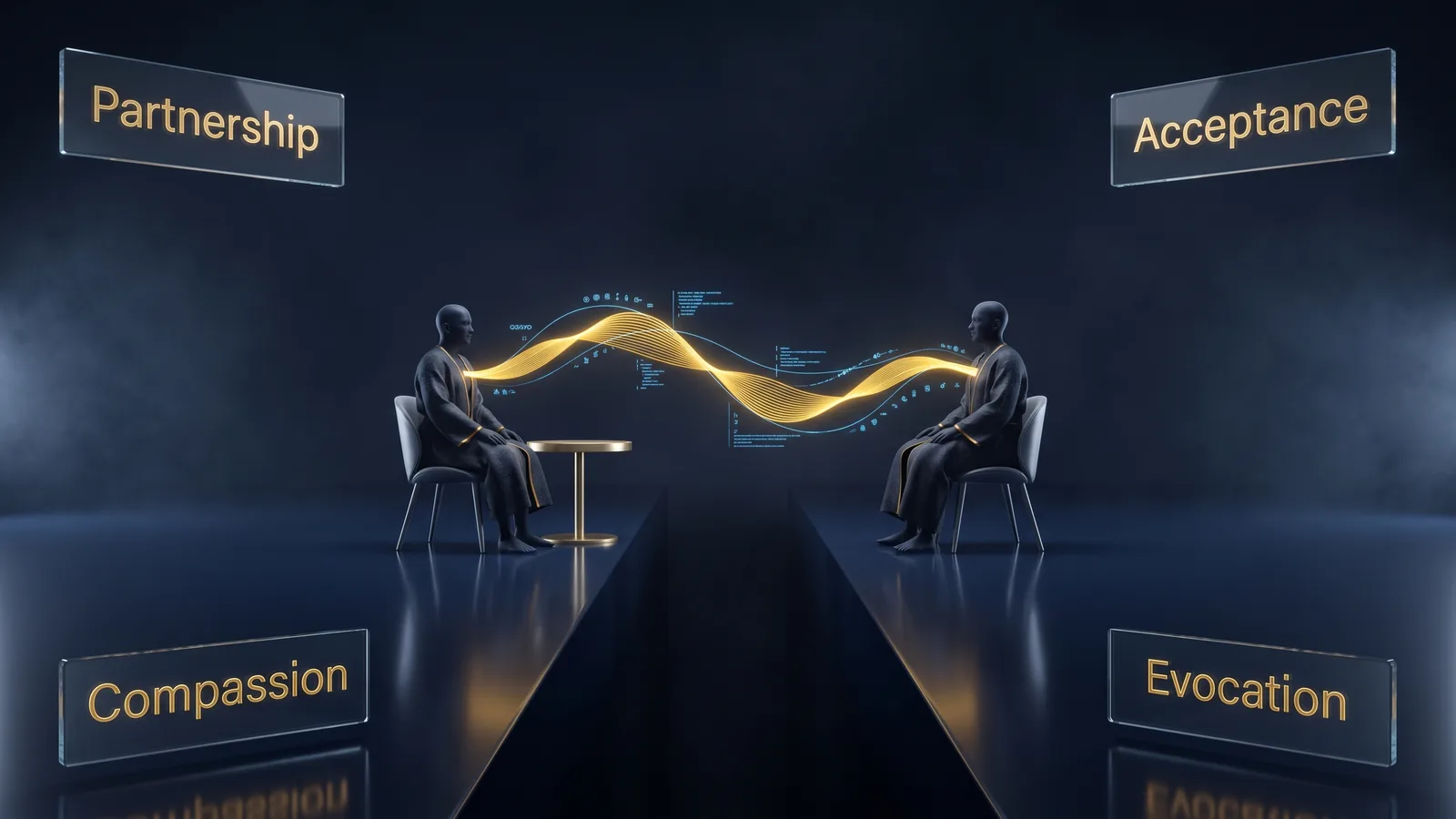
Motivational interviewing (MI) is the most structured framework available for these conversations. Miller and Rollnick, who developed it, define MI as "a collaborative, goal-oriented style of communication with particular attention to the language of change", designed to strengthen a person's own motivation for change. The third edition of their text describes a spirit with four elements: partnership, acceptance, compassion and evocation. The person is the expert on their own life; the practitioner draws out their reasons for change rather than installing them.
The working toolkit is summarised as OARS: open questions, affirmations, reflective listening and summaries. MI practitioners exchange information through an elicit-provide-elicit pattern: ask what the person knows, offer information with permission, ask what they make of it.
Two honesty checks. First, the return-to-work evidence is promising but thin. The strongest workers compensation result is Gross and colleagues' 2017 cluster randomised controlled trial in 728 Canadian claimants, where the MI group transitioned to modified duties more often and had roughly half the benefit recurrence of the control group. Against that, a 2021 systematic mapping review by Aanesen and colleagues found a huge research gap, with only two efficacy studies and conflicting results, and the 2022 Norwegian MI-NAV pragmatic trial found that adding two MI sessions to usual case management cut sickness absence by about seven days over six months, a difference that was not statistically significant. Promising in one workers compensation trial, unproven as a scheme-wide lever. Say it that way.
Second, the ethical line. MI exists to support autonomy. It is not a persuasion technology; a script used to engineer agreement inverts the technique into exactly the unfair treatment the It Pays to Care evidence warns against. MI-NAV carries a quieter warning: caseworker MI proficiency stayed low throughout the trial despite training. A script does not confer competence, and case managers are not therapists. MI-informed communication in a claims context is conversation support, not psychological treatment. Where a conversation surfaces clinical ambivalence, distress or psychological injury concerns, escalate to the treating practitioner or rehabilitation provider rather than reaching for a better reflection.
Where do these recovery conversations sit in the SRC Act?
The statute schedules the conversations even though it never mentions them. Under the SRC Act, the rehabilitation authority is responsible for managing rehabilitation and return to work, and Comcare's guidance for employers frames the case manager as the coordinator in practice. Three provisions in the Act generate most of the difficult calls. Section 36 covers the assessment of an employee's capability of undertaking a rehabilitation program: someone has to explain to a worried person why an assessment is being arranged and what it is for. Section 37 covers the provision of rehabilitation programs, and the matters considered include the employee's attitude to the program. Attitude is not a fixed trait; it is shaped partly by how the program was introduced. Section 40 places a duty on the employer to take all reasonable steps to provide suitable employment, and conversations about what counts as suitable are where trust is most easily lost.
Comcare promotes early intervention from the moment an employer becomes aware of symptoms or injury, and its Rehabilitation Case Manager Handbook sets out the practical expectations of the role. None of that guidance scripts the words. That gap, between a statutory step and the sentence introducing it to a human being, is where AI drafting support earns its place.
A five-step AI workflow for drafting the conversation
The workflow is tool-agnostic; it works in any capable AI assistant, provided the data discipline holds.
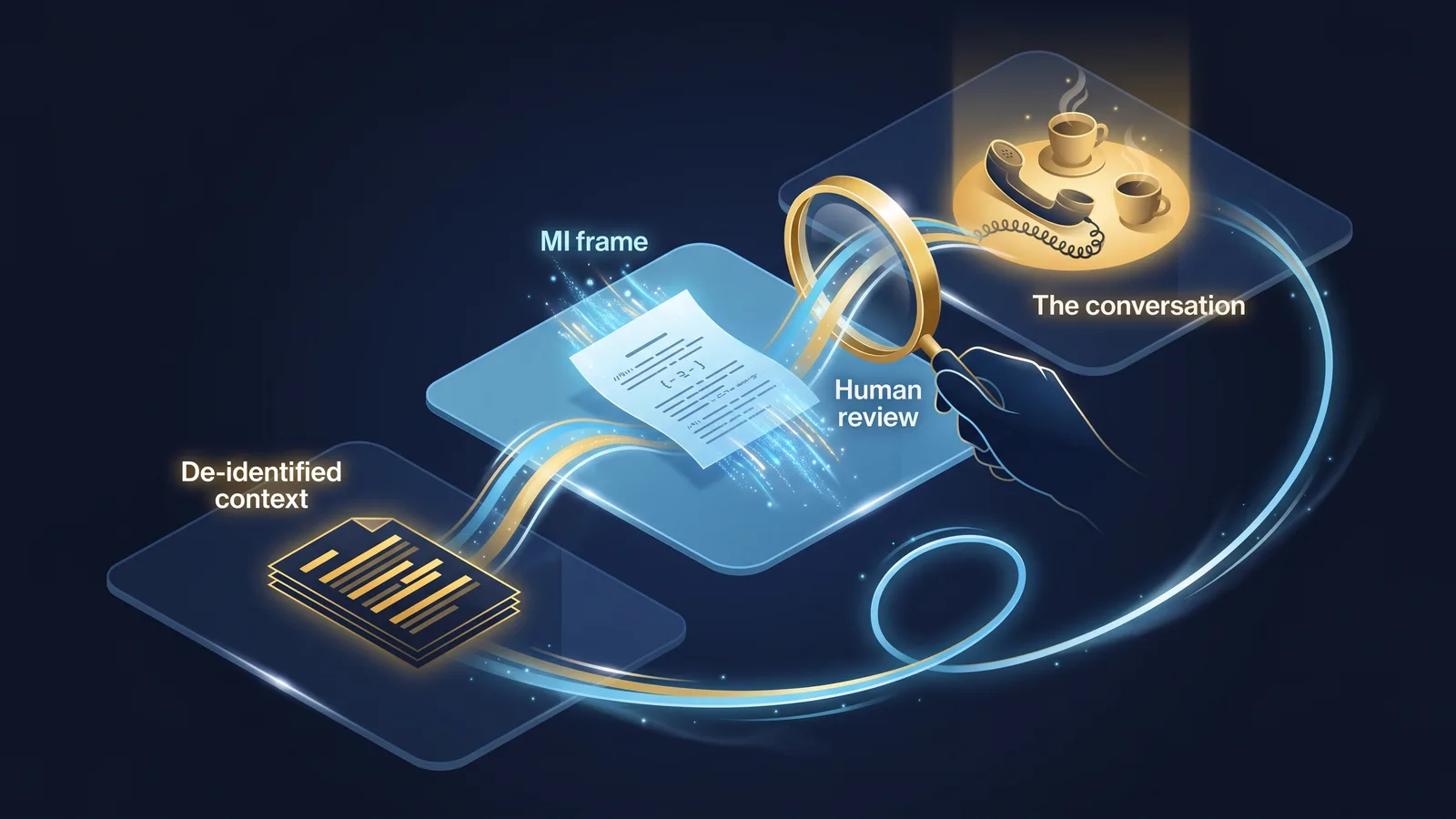
- Gather de-identified context. Build a short context block using [PLACEHOLDER] fields only: role type, broad injury category, time off work, the statutory step coming up, and any worry the employee has expressed. No names, no claim numbers, no dates of birth, no employer-identifying detail. This is the non-negotiable gate. If the context cannot be written without identifying information, the conversation is not a candidate for AI-assisted preparation.
- Set the MI frame. Name the four elements of the MI spirit, name OARS, and impose constraints: no persuasion or pressure, no medical advice or recovery predictions, no commentary on liability or claim outcomes, plain Australian English. Constraints matter more than style instructions; an unconstrained model defaults to upbeat salesmanship, the opposite of acceptance.
- Draft the script and the behavioural communication plan. Ask for a structured pack: a short opening that states the purpose of the call and asks permission to proceed, a handful of open questions, example reflections for the worries you anticipate, a closing summary confirming next steps and the employee's choices, and a brief follow-up message the employee can re-read afterwards. The follow-up message is the most underrated artefact; people absorb very little during a stressful call.
- Humanise and verify. This is the first hard human-in-the-loop checkpoint. Read the draft aloud. Strip anything that sounds like persuasion, promises an outcome, drifts into clinical territory or does not sound like you. Check every factual statement against the file and every process statement against the legislation. The draft leaves this step as your words or it does not leave at all.
- Debrief and refine. After the conversation, note what landed and what missed, in de-identified terms, and feed the patterns back into the team's prompt library. Never paste real conversation notes containing identifying details into the tool to improve the next draft. Refinement uses patterns, not people.
Where AI helps, and where judgement is non-negotiable
AI is good at the preparation layer and structurally incapable of the conversation layer.
The second human-in-the-loop reminder: no AI-drafted script, talking point or follow-up message reaches an injured employee without a human reviewing it, editing it and choosing to use it. Reflective listening cannot be pre-drafted, only rehearsed. The script prepares you the way a flight plan prepares a pilot. Nobody flies the plan when the weather changes.
A boundary worth restating: nothing in this workflow touches liability. Conversation preparation is rehabilitation-side support. It has no role in determining claims, and no script drafted this way comments on what a determination outcome will or will not be.
A worked example: preparing for a section 36 conversation
The scenario is fictional and fully de-identified. [CLAIMANT_NAME] is an administrative officer with an accepted claim, [CLAIM_NUMBER], for [CONDITION], a shoulder injury. Eight weeks off work. A rehabilitation assessment is being arranged under section 36, and [CLAIMANT_NAME] has told the supervisor they are worried the assessment is "a test you can fail". The case manager has 20 minutes before the call. The prompt:
A representative excerpt from the resulting draft:
"Thanks for making time, [CLAIMANT_NAME]. I wanted to talk through the rehabilitation assessment we mentioned, and just as importantly, hear what you would want it to take into account. Is now still an okay time?"
>
Open question: "What matters most to you about how a return to work would happen?"
>
Reflection: "It sounds like the assessment feels like a test you could fail, rather than something designed to help. That worry makes sense. Can I share what it actually looks at? It assesses what support and program would suit you, and your own view of what is realistic is part of that picture."
The opening asks permission instead of announcing. The open question hands over the agenda. The reflection names the worry without arguing with it, asks permission before providing information, and restores the employee's place in the process. That is elicit-provide-elicit, working.
Notice what the reviewing case manager still has to do. Confirm the description of the section 36 assessment is accurate for this case. Cut the reflection back if it reads as too smooth for the relationship. Decide whether the worry runs deeper than reassurance can reach, where the right move is the rehabilitation provider, not a better script. The draft took four minutes. The judgement is the job.
The bottom line
A well-drafted script in the hands of a prepared case manager supports a fair, respectful conversation that an injured employee leaves feeling heard. The same script read verbatim by someone watching the clock turns motivational interviewing into its opposite: a compliance routine wearing empathy as a costume. The technology only produces the first outcome when the data discipline, the MI frame and the human review hold. Draft the script with AI. Hold the conversation as a human.
Do this Monday
- Take the next recovery conversation on your list and write a de-identified context block for it using placeholder fields only: role type, broad injury category, time off work, the statutory step coming up, and any worry the employee has expressed.
- Stop there if that context cannot be written without identifying detail. This is a gate, not a preference, and the conversation is simply not a candidate for AI-assisted preparation.
- Set the MI frame explicitly in the prompt: partnership, acceptance, compassion and evocation, together with open questions, affirmations, reflections and summaries.
- Put the constraints in the same prompt rather than trusting tone instructions: no persuasion or pressure, no medical advice or recovery predictions, no commentary on liability or claim outcomes, plain Australian English.
- Ask for the follow-up message alongside the script. People absorb very little during a stressful call, and the written summary is the part they keep and re-read.
- Read the draft aloud before you use it, and strip anything that sounds like persuasion, promises an outcome, drifts into clinical territory or does not sound like you.
- Check every process statement in the draft against the legislation and every factual statement against the file, so what reaches the employee is accurate as well as warm.
- After the call, note in de-identified terms what landed and what missed, and feed the pattern back into the approved prompt library. Patterns, never people.
References
- Safety, Rehabilitation and Compensation Act 1988 (Cth), Federal Register of Legislation
- Comcare, Rehabilitation information for employers
- Comcare, Rehabilitation case manager handbook
- Comcare, Intervene early: support at work
- MINT, Understanding Motivational Interviewing
- Miller WR, Rollnick S. Motivational Interviewing: Helping People Change, 3rd edition, Guilford Press
- Gross DP et al. Motivational Interviewing Improves Sustainable Return to Work in Injured Workers After Rehabilitation, Arch Phys Med Rehabil 2017
- Aanesen F et al. Motivational Interviewing and Return to Work for People with Musculoskeletal Disorders: A Systematic Mapping Review, J Occup Rehabil 2021
- Aanesen F et al. The MI-NAV randomised controlled trial, Occup Environ Med 2022
- RACP/AFOEM, Health Benefits of Good Work
- AFOEM, It Pays to Care: about the policy
- Safe Work Australia, 2021 National Return to Work Survey Report
- Safe Work Australia, Return to work: a comparison of psychological and physical injury claims
Content disclaimer: This article is for general educational and informational purposes only. It does not constitute legal, compliance, claims, or professional advice, and it is not a determination under the Safety, Rehabilitation and Compensation Act 1988 (SRC Act). The SRC Act 1988 should always be consulted directly. Workers compensation decisions must be made by authorised individuals using current legislation, policy, evidence and delegation requirements.
TheAICommand. Intelligence, At Your Command.