
Prompt libraries make workers compensation AI safer only when de-identification and human review come first. Prompt libraries can make AI-assisted workers compensation work more consistent. A well-designed prompt can help format a file note, structure an evidence summary, create a chronology or draft a neutral process explanation. The problem is that consistency is not the same as safety. If the prompt contains personal information, medical detail, claim identifiers or unchecked legal assumptions, the output may create privacy, fairness and evidence risks.
Context for general readers: Workers compensation under the Safety, Rehabilitation and Compensation Act 1988 (SRC Act) is the Commonwealth scheme administered by Comcare. Claims teams handle highly sensitive personal and medical information, and the communications they produce, file notes, evidence summaries and claimant letters, must meet legal and procedural fairness requirements. A prompt library is a set of approved reusable prompts that teams use to make AI-assisted drafting more consistent. This article explains why those libraries are only safe when de-identification and human review come first.
The safest starting point is a prompt library that uses fictional scenarios, de-identified chronologies and [PLACEHOLDER] fields. The second control is more important: every AI-assisted output must be reviewed by a human before it is saved, sent or relied on.
De-identification callout: De-identification is more than removing a name. Claim numbers, employee IDs, provider names, exact dates, locations, unusual role details, injury facts, medical histories and combinations of facts may still identify a person. Use [PLACEHOLDER] fields and fictional examples unless the tool, workflow and data handling have been formally approved.
Why does de-identification matter in WC communications?
Workers compensation records contain sensitive personal and medical information. The OAIC explains that APP 11 requires reasonable steps to protect personal information from misuse, interference, loss, unauthorised access, unauthorised modification and unauthorised disclosure. The OAIC also notes that reasonable steps include technical and organisational measures, including governance, training, policies, access security, third-party providers, data breaches, destruction and de-identification.
In workers compensation, de-identification is not only a privacy discipline. It is also a trust discipline, a procedural fairness discipline and an audit discipline. A claimant is entitled to expect that information about their injury, employment and claim is handled carefully. A claims team is entitled to expect that AI tools do not quietly introduce unchecked facts, unsupported conclusions or inaccurate legal explanations into the claim record.
How should a WC prompt library handle claim data?
A prompt library is a set of approved reusable prompts. In WC work, the safest prompt library does not invite users to paste real claim material into a public or unapproved tool. It uses [PLACEHOLDER] fields and fictional scenarios. For example, a file-note prompt might say: "Create a neutral chronology using the following de-identified facts: [PLACEHOLDER DATE RANGE], [PLACEHOLDER EVENT], [PLACEHOLDER DOCUMENT TYPE], [PLACEHOLDER ACTION REQUIRED]. Do not add facts, do not infer motivation and do not state a legal conclusion." A chronology skill file built around the same de-identification discipline sets out one way to turn that prompt into a reusable, checkable tool.
This kind of design matters because AI tools are persuasive. They can produce polished wording that looks complete even when it is missing the source evidence. A prompt library should therefore tell the user what not to do, not only what to draft.
Do AI-assisted file notes and evidence summaries need human checking?
AI can help format file notes and evidence summaries, but it must not become the source of truth. Under section 14 of the SRC Act, liability to pay compensation is tied to an injury suffered by an employee if the injury results in death, incapacity for work or impairment, subject to the Act. Section 5A defines injury and includes important boundaries, including the reasonable administrative action exclusion. If an AI-assisted summary blurs those concepts, it can mislead the reader.
For communications about determinations, section 61 requires written notice setting out the terms of the determination, reasons and a statement about the ability to request reconsideration under subsection 62(2). Section 62 then sets out reconsideration pathways, including who may request reconsideration and the 30-day timeframe from when the determination first came to the requester's notice, subject to any further period the determining authority allows (section 62(3), as at 20 September 2026). A reconsideration request should be worked as an issue map, not an outcome prediction, and that discipline applies whether or not AI helped structure the request. Section 64 deals with applications to the Administrative Review Tribunal for review of a reviewable decision.
These are not optional details for AI to approximate. They are legal and procedural requirements that must be checked by a human, using the same evidence-check discipline as a determination evidence-check skill file.
What is a safer workflow for AI-assisted WC content?
A practical workflow starts before the prompt is written. The team should decide whether the use case is approved, whether the tool is approved, whether the data is allowed for privacy-safe use in regulated work, whether the prompt uses placeholders and whether the output is for internal drafting or claimant-facing communication.
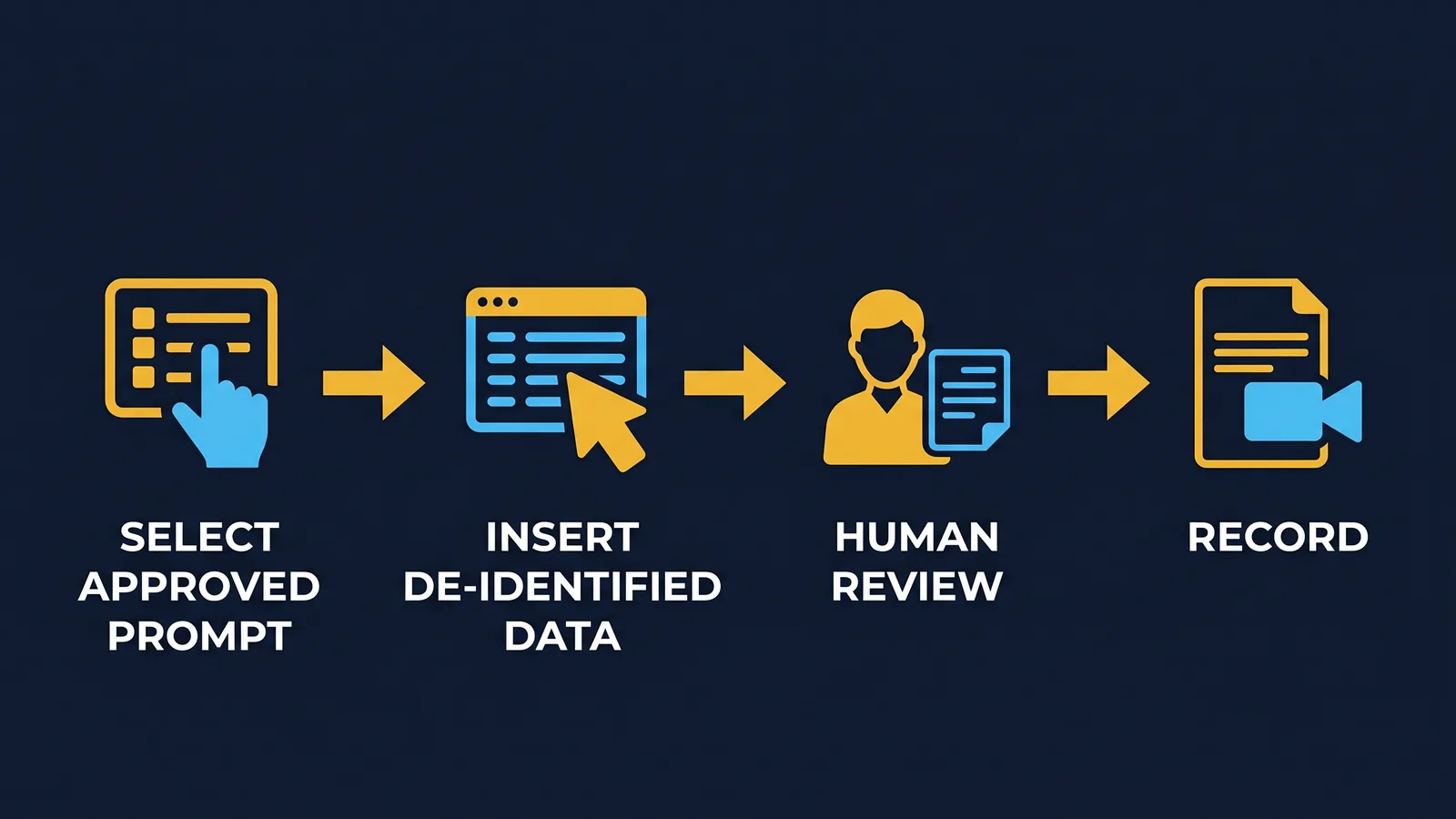
A safer workflow has four stages. First, select an approved prompt from the library. Second, insert only de-identified [PLACEHOLDER] facts or fictional scenario facts. Third, review the AI output against the source documents, legislation, policy and tone requirements. Fourth, record the review before the content is saved or sent.
This workflow should apply even when the output is internal. Internal notes can still influence later decisions, communications and file reviews.
Bad prompt, safer prompt, reviewed output
A risky prompt might say: "Summarise this claim and draft a letter telling the worker why their claim is unlikely to be accepted." That prompt is unsafe because it invites real claim information, asks AI to form a conclusion and risks claimant-facing language without human legal review.
A safer prompt is narrower: "Using the fictional information below, create a neutral internal file-note structure. Use [PLACEHOLDER] fields. Do not make a liability recommendation. Separate evidence, gaps, assumptions and actions. Mark the output as draft-only for human review."
The reviewed output should then be checked by a human. The reviewer should verify that no identifying information remains, that every factual statement is supported by source material, that the language is neutral and non-coercive, and that no legal or medical conclusion has been invented.
Combined checklist: de-identification, prompts, review and file notes
The bottom line
Prompt libraries can improve consistency, but they do not remove the need for professional judgement. In workers compensation, AI-assisted drafting is only safer when de-identification, approved prompts, source checking and human review operate together. The prompt may structure the work. The human must protect the claimant, the evidence and the integrity of the claim record.
References
- OAIC, Chapter 11: APP 11 Security of personal information
- SRC Act 1988, section 14
- SRC Act 1988, section 5A
- SRC Act 1988, section 61
- SRC Act 1988, section 62
- SRC Act 1988, section 64
Content disclaimer: This article is for general educational and informational purposes only. It does not constitute legal, compliance, claims, or professional advice, and it is not a determination under the Safety, Rehabilitation and Compensation Act 1988 (SRC Act). The SRC Act 1988 should always be consulted directly. Workers compensation decisions must be made by authorised individuals using current legislation, policy, evidence and delegation requirements.
Do this Monday
- Collect the prompts your team actually uses, including the ones living in personal chat histories, and put them in one place where they can be reviewed.
- Rebuild each of them around fictional scenarios and placeholder fields, so nothing in the library invites real claim material into an unapproved tool.
- Write the prohibitions into every prompt: no added facts, no inferred motivation, no liability conclusion, and evidence, gaps, assumptions and actions kept separate.
- Mark every output as draft-only, so the library never reads as though it produces finished work.
- Confirm the tool and the use case are approved before anything claimant-facing goes near them, and keep internal drafting and claimant-facing drafting on separate tracks.
- Verify every SRC Act reference, review-right statement and process explanation against the legislation rather than against the draft's own confident tone.
- Record the review on file: that AI assisted the drafting, who reviewed it, which source documents were checked and what changed.
- Take one recent AI-assisted file note through the combined checklist and see which line fails first, then fix that prompt before the next one is used.
TheAICommand. Intelligence, At Your Command.