
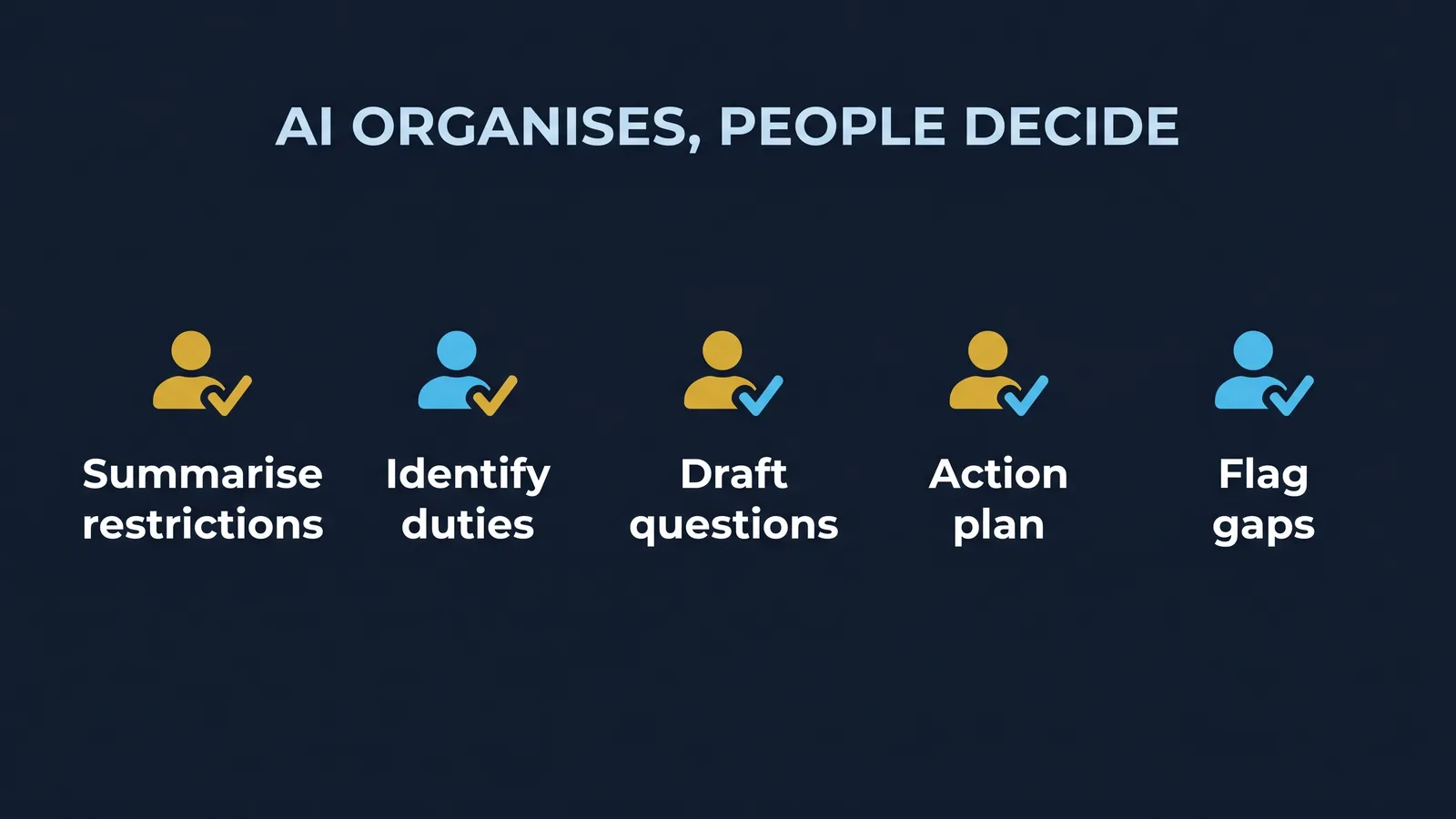
AI can organise recovery-at-work information, but authorised people must decide suitable duties. It can help claims and rehabilitation teams compare medical restrictions with role demands, draft questions for a suitable duties discussion, identify missing evidence and structure a review checklist. Used carefully, that can reduce administrative burden and improve consistency. Used poorly, it can make an unsafe or unfair plan look more authoritative than it is.
Context for general readers: Workers compensation under the Safety, Rehabilitation and Compensation Act 1988 (SRC Act) is the Commonwealth scheme administered by Comcare. When an employee is injured at work, a rehabilitation authority helps plan their recovery, often through suitable duties: modified or alternative work that fits the employee's current medical capacity. Those decisions must be made by authorised people using current medical evidence, knowledge of real work demands, and consultation with the injured employee. This article looks at where AI can support that work and where it must not.
The control principle is simple: AI may organise information, but people must decide. Suitable duties are not a spreadsheet exercise. They require current medical evidence, knowledge of real work demands, consultation with the injured employee and careful review when circumstances change.
De-identification callout: Do not enter real claimant names, claim numbers, employee IDs, provider names, exact dates, locations or medical details into unapproved AI tools. Use fictional examples and [PLACEHOLDER] fields. Removing a name is not enough if other facts can still identify the person.
Why do suitable duties need evidence discipline?
Under section 5A of the SRC Act, an injury includes a disease, a physical or mental injury arising out of, or in the course of, employment, and an aggravation of a physical or mental injury that arose out of, or in the course of, employment, subject to the reasonable administrative action exclusion. That definition matters because recovery-at-work planning must remain connected to the accepted injury, the current capacity evidence and the actual work context.
Section 36 allows a rehabilitation authority to arrange an assessment of an employee's capability of undertaking a rehabilitation program where an employee suffers an injury resulting in incapacity for work or impairment, a step covered in more detail in how AI can support a section 36 assessment. Section 37 allows a rehabilitation authority to determine that an employee should undertake a rehabilitation program and sets out matters to consider, including written assessments, future liability, cost, improved employment opportunity, likely psychological effect of not providing the program, the employee's attitude to the program, alternative programs and any other relevant matter. Section 40 then places a duty on the relevant employer to take all reasonable steps to provide the employee with suitable employment, or to help the employee find it, while a rehabilitation program is underway or once it is complete, and section 4 defines suitable employment by reference to the employee's age, experience, training, language and other skills, suitability for rehabilitation or retraining, and whether a change of residence would be reasonable, among other relevant matters. Non-compliance with a section 36 examination or a section 37 program engages the suspension provisions in sections 36(4) and 37(7), and whether a suspension is appropriate turns on whether the employee had a reasonable excuse, a test examined in Reasonable Excuse Under the SRC Act: AI Can Structure the Analysis, Not Make the Finding.
The risk is not that AI produces a table. The risk is that the table is treated as the answer, a risk explored further in a chronology-building pattern that keeps every SRC Act decision with the authorised delegate.
What is the safe role for AI in suitable duties?
A safe AI-supported workflow starts with combined evidence. The claims or rehabilitation team should gather the current certificate, treating practitioner guidance, supervisor information, role demands and employee feedback before using AI to organise anything. AI can then support a draft view of possible duties, restrictions, hazards, review questions and evidence gaps.
The output should be labelled as a draft. It should be checked by a human reviewer before it informs any discussion with the employee, supervisor or rehabilitation provider. The reviewer should ask whether the AI output stayed within the evidence, whether it separated medical evidence from workplace observations, and whether it made any assumptions about capacity, motivation or credibility.
This structure is especially important where the accepted injury is psychological, or where psychosocial factors affect recovery.
How should AI handle psychological injury claims?
Psychological injury and psychosocial risk make tone, pacing and consultation more important. A generic AI output may match restrictions to duties without understanding the employee's perceived safety, trust, communication needs or the likely effect of a proposed program. Section 37 expressly includes the likely psychological effect on the employee of not providing a rehabilitation program as a relevant consideration.
For psychological injury, AI should not be used to infer attitude, motivation or credibility from language. It should not summarise an employee's concerns as resistance, reluctance or non-compliance unless the evidence genuinely supports that language and the authorised decision-maker has considered the context. A safer approach is to use AI to draft neutral prompts such as: "What information do we need to understand whether [PLACEHOLDER DUTIES] are safe and sustainable?" or "What questions should be discussed with [PLACEHOLDER EMPLOYEE] before duties are finalised?"
Comcare guidance on rehabilitation suspension emphasises clear explanation, consultation, taking account of employee views and regular effective communication in rehabilitation processes. Even where the context is not suspension, those principles are useful safeguards. Recovery-at-work planning works best when it is understood, reviewable and grounded in evidence.
Consultation is a control, not a courtesy
Consultation with the injured employee is not a box to tick after the plan has already been built. It is a control that helps test whether proposed duties are realistic, safe and understood. It also supports procedural fairness and trust.
A practical consultation discussion should explain the purpose of proposed duties, identify the medical restrictions relied on, confirm the duties are genuinely available, ask whether there are barriers or concerns, agree review points and record unresolved issues. AI can draft the agenda, but it cannot conduct the trust-building work.
The strongest recovery-at-work plans are not merely generated. They are discussed, adjusted and documented.
Review rhythm matters
AI-supported plans should be reviewed whenever new medical evidence is received, at agreed checkpoints with the employee, supervisor and claims team, and whenever duties, symptoms or concerns change. Review dates should be recorded clearly, since a passed review date is a trigger for human attention, not a capacity or entitlement decision in itself. If an AI tool helps maintain a tracker, the tracker should be checked against the claim file and not treated as the official record unless approved for that purpose.
The review should ask four questions. First, is the plan still supported by the current evidence? Second, are the duties still safe and genuinely available? Third, has consultation identified any concerns requiring adjustment? Fourth, has the human reviewer recorded any changes made to AI-assisted drafts?
Practical checklist: evidence, consultation, review and recordkeeping
The bottom line
AI can make recovery-at-work planning more organised, but it must not become the decision-maker. Suitable duties need evidence, consultation, review and human judgement. Under the SRC Act rehabilitation framework, the safest use of AI is to support disciplined human review, not to replace it.
Do this Monday
- Gather the combined evidence before AI organises anything: the current medical certificate, treating practitioner guidance, supervisor input on real and available duties, employee feedback and the review history.
- De-identify first. Keep real claimant names, claim numbers, employee IDs, provider names, exact dates, locations and medical details out of unapproved tools, and use fictional examples and placeholder fields instead.
- Label every AI output as a draft, and have a human reviewer check it against the evidence before it informs any discussion with the employee, supervisor or rehabilitation provider.
- Ask the reviewer the three questions that matter: did the output stay within the evidence, did it separate medical evidence from workplace observations, and did it assume anything about capacity, motivation or credibility.
- For psychological injury, keep the prompts neutral and do not let AI characterise an employee's concerns as resistance, reluctance or non-compliance.
- Run consultation as a control rather than a courtesy: confirm the duties are real and genuinely available, ask about barriers, agree review points and record unresolved issues.
- Set the review triggers now, on new medical evidence, at agreed checkpoints and whenever duties, symptoms or concerns change, and check any AI-maintained tracker against the claim file rather than treating it as the record.
References
- SRC Act 1988, section 4 (definitions, including suitable employment)
- SRC Act 1988, section 5A
- SRC Act 1988, section 36
- SRC Act 1988, section 37
- SRC Act 1988, section 40
- Comcare, Suspension of compensation under the rehabilitation provisions of the SRC Act 1988
Content disclaimer: This article is for general educational and informational purposes only. It does not constitute legal, compliance, claims, or professional advice, and it is not a determination under the Safety, Rehabilitation and Compensation Act 1988 (SRC Act). The SRC Act 1988 should always be consulted directly. Workers compensation decisions must be made by authorised individuals using current legislation, policy, evidence and delegation requirements.
TheAICommand. Intelligence, At Your Command.