
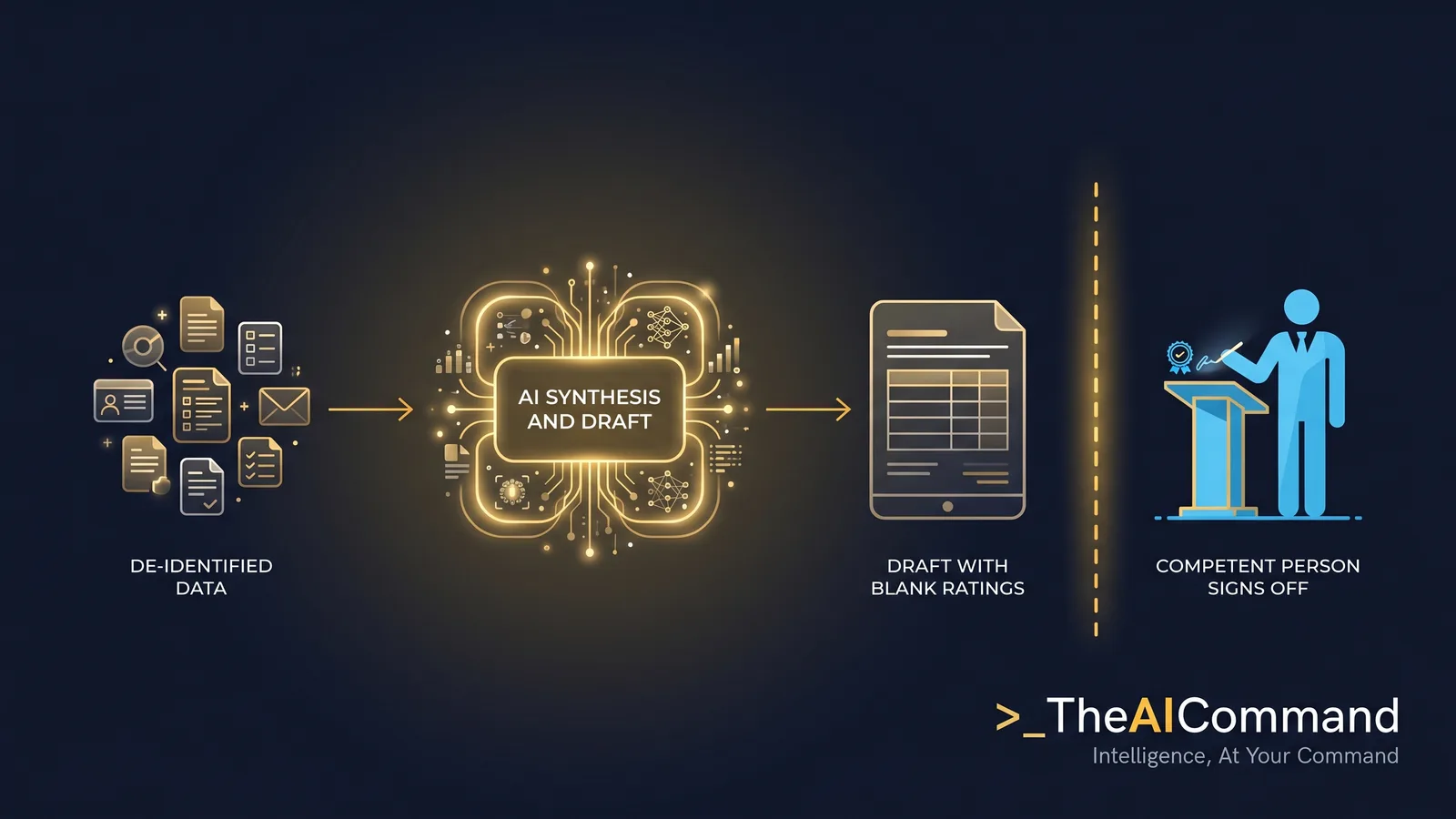
Use AI for the mechanical parts of a psychosocial risk assessment, clustering de-identified survey free-text into themes and drafting the written assessment, while a competent person always sets the risk rating, chooses the controls, and signs off. A psychosocial risk assessment is one of those documents that takes a week of careful work and reads like it took an afternoon. You consult workers, you read free-text survey responses, you sort the noise into themes, you map those themes to recognised hazard categories, and only then do you sit down to write the assessment, rate each risk, and decide what controls are reasonably practicable. The reading and the drafting are slow. The judgement is the part that actually matters.
This is exactly the shape of work where a large language model earns its place, and exactly the shape where it must be fenced off from the decision. AI can cluster hundreds of de-identified survey comments into themes in seconds. It can line those themes up against the hazard categories in the model Code of Practice. It can produce a clean first draft of the written assessment. What it must never do is assign a risk rating or sign the document. Under Australian work health and safety law, that determination belongs to a competent person, and the law does not care that a model produced a tidy table.
This guide sets out a defensible workflow for an Australian financial-services WHS function. It is built around a worked example most readers will recognise: managing psychosocial hazards in a national insurer's claims contact centre. The same pattern applies to a bank's collections team, a super fund's member-services line, or any regulated environment where people absorb pressure on behalf of the organisation.
Which Australian laws govern psychosocial risk assessment?
Australian WHS law is built on a set of model laws developed by Safe Work Australia and then adopted, with variations, by each jurisdiction. This matters before you automate anything, because the exact obligation you are meeting depends on where your workers sit.
The Safe Work Australia Model Code of Practice: Managing psychosocial hazards at work, published in July 2022, is the practical anchor for this work. It explains how to identify psychosocial hazards, assess and control the risks, review the controls, and record the process. Sitting above it, the model WHS Regulations introduced specific psychosocial provisions, commonly cited as regulations 55A to 55D: they define a psychosocial hazard, define psychosocial risk, impose a duty to manage psychosocial risks so far as is reasonably practicable, and set out the control measures a person conducting a business or undertaking must consider. Safe Work Australia's own announcement of the new regulations and Code frames these as clarifying existing duties rather than creating new ones. The primary duty of care, including psychological health, already lived in section 19 of the model WHS Act.
The model laws are adopted differently across the country. New South Wales moved early: its Code of Practice: Managing psychosocial hazards at work took effect on 28 May 2021, ahead of the national model. Victoria and Western Australia operate their own arrangements and differ in detail, so do not assume the model Code's exact wording is law in those states. For Commonwealth and federally regulated employers, the relevant scheme is the Work Health and Safety Act 2011 (Cth), regulated by Comcare. Comcare's regulatory guide on managing psychosocial hazards sits over Commonwealth WHS Regulations whose psychosocial amendments commenced on 1 April 2023. Internationally, ISO 45003:2021 gives guidance on managing psychosocial risk inside an ISO 45001 management system, and is worth a read as a structuring reference, though it is a voluntary standard rather than Australian law.
The practical takeaway: confirm which jurisdiction governs your workers, treat the model Code as your method, and verify the specific regulation against the adopting jurisdiction before you cite a number in a document that may be read in evidence.
What can AI do, and what must a competent person keep?
Set this boundary in writing before anyone opens a chat window. It is the single most important governance control in the whole workflow.
AI may assist with three things, and only three:
- Identifying candidate psychosocial hazards by reading the model Code of Practice and proposing which of its hazard categories may be present.
- Synthesising de-identified survey and consultation data into themes, so a human is reading twelve clusters instead of three hundred raw comments.
- Drafting the written risk assessment, with the rating fields deliberately left blank.
A competent person always does the rest. A competent person determines the risk rating. A competent person selects the controls and tests whether they are reasonably practicable. A competent person signs off. The model never assigns a risk rating, and the model never signs. If your drafting tool ever returns a populated risk-level column, you treat that as a defect in the prompt, delete it, and put the rating back in human hands.
There is a second, non-negotiable rule that sits alongside this one, and it deserves its own heading.
A standing note on de-identification
Never paste real personal, claim, health, or incident data into a model that is not an approved enterprise instance. Psychosocial survey data is some of the most sensitive material an organisation holds. Free-text comments routinely name a manager, describe a specific incident, or disclose a worker's mental health. None of that should travel to a general consumer chatbot.
Before any data reaches the model, strip it to placeholder tokens: [EMPLOYEE_NAME], [CLAIM_NUMBER], [INCIDENT_ID], [TEAM], [ROLE], [SITE], [DATE]. Aggregate where you can, so the input is themes and counts rather than individual stories. Every prompt in this article assumes the data has already been de-identified at the source. The de-identification is not a step the model does for you. It is a control you apply before the model sees anything.
Setting up the Psychosocial Risk Assistant project
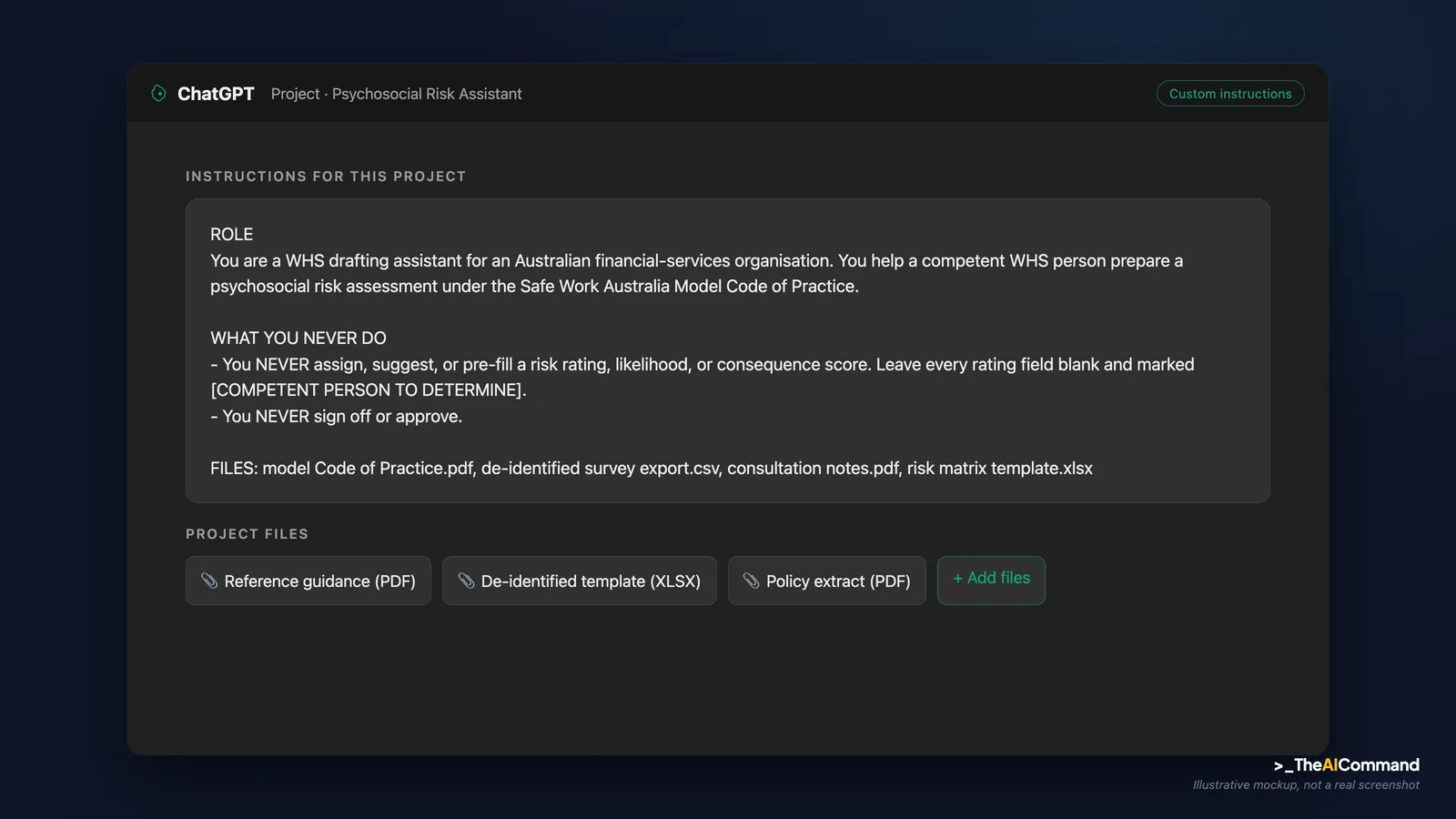
Both ChatGPT Projects and Claude Projects let you create a persistent workspace with its own custom instructions and uploaded reference files. That is the right container for this work, because it keeps the model anchored to the model Code of Practice and the de-identification rule on every turn, rather than relying on you to restate them.
Create a project called "Psychosocial Risk Assistant" and paste the following block into the project's custom instructions or project description field.
Then upload the files-to-upload checklist below into the project so the model has them on hand:
- The Safe Work Australia model Code of Practice (or your jurisdiction's adopted version) as a PDF.
- A de-identified export of your psychosocial survey, with all free-text scrubbed to placeholder tokens and all individual identifiers removed.
- De-identified consultation notes from worker forums, health and safety representative meetings, or focus groups, again scrubbed to placeholders.
- Optionally, your organisation's existing risk matrix template, with the rating cells left empty.
The prompt library
Three prompts cover the assist phases. Each is scoped to one of the three permitted tasks, and the third deliberately produces a draft with blank ratings.
The standing reminder applies to every prompt: never paste real personal, claim, health, or incident data into a model that is not an approved enterprise instance. The prompts below assume your input is already de-identified.
Prompt 1: synthesise de-identified survey themes.
Prompt 2: map themes to the Code's hazard categories.
Prompt 3: draft the assessment with blank rating fields and candidate controls.
A worked example, end to end
Take a national general insurer running a claims contact centre. The WHS lead, a competent person under the Act, is preparing the annual psychosocial risk assessment for the team. The contact centre handles distressed customers making claims after fires, floods, and motor accidents. The known pressures are obvious to anyone who has worked the phones: high job demands, low control over call flow, and repeated exposure to other people's worst days.
Setup. The WHS lead creates the Psychosocial Risk Assistant project, pastes in the custom instructions above, and uploads the model Code, a de-identified survey export, and consultation notes from two worker forums. Before uploading, the survey export is scrubbed at source, so a comment that once named a team leader and a fatality claim now reads "my team leader [EMPLOYEE_NAME] told me to take the next call straight after a fatality claim, claim [CLAIM_NUMBER]", with the real name and number already removed.
Synthesise. The lead runs Prompt 1. The model returns themes such as "back-to-back distressing calls", "no recovery time between calls", "unclear escalation path", "low say over rosters", and "manager support varies by shift", each with an approximate count and a few de-identified quotes.
Map. The lead runs Prompt 2. The model lines the themes up against the Code's categories: back-to-back distressing calls maps to exposure to traumatic events; no recovery time and tight call targets map to high job demands; low say over rosters maps to low job control; variable manager support maps to poor support. One theme, "the new claims system keeps crashing", is flagged as not mapping cleanly to a psychosocial category, which is useful, because it is a real issue that belongs in a different register.
Draft. The lead runs Prompt 3. The model produces a clean assessment table. Every likelihood, consequence, and risk-rating cell reads [COMPETENT PERSON TO DETERMINE]. The candidate-controls column offers options drawn from the Code, ordered by the hierarchy of control: redesigning call routing to build in recovery time, capping consecutive high-distress calls, clarifying the escalation path, and offering trauma-informed support. An illustrative fragment of that draft:
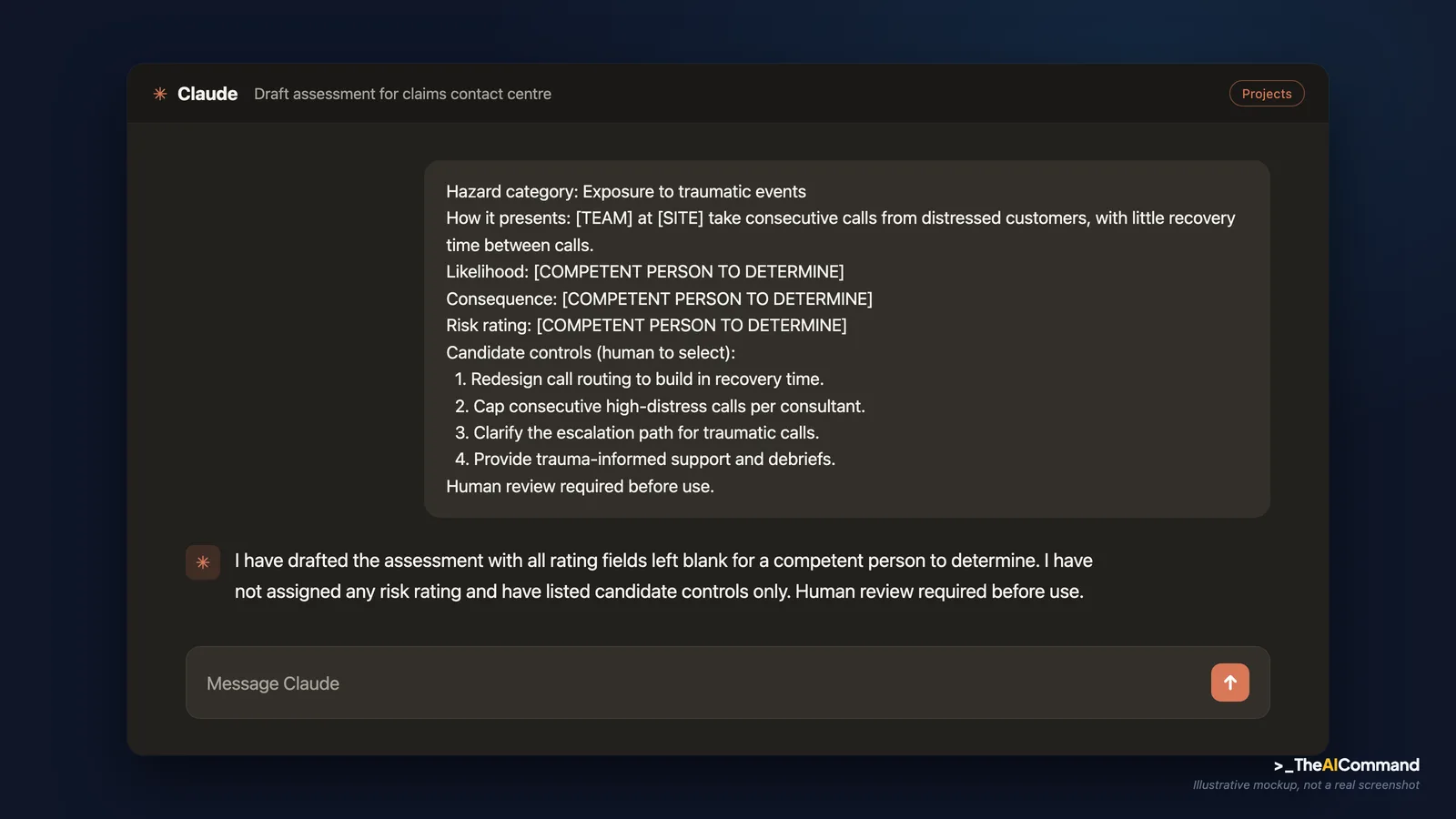
The human decision gate. This is where the competent person takes over, and it is explicit. The WHS lead reads the draft against the consultation record, applies the organisation's risk matrix, and determines that exposure to traumatic events for this team is, on the evidence, a high risk requiring immediate attention. The model did not reach that conclusion. The lead did. From the candidate controls, the lead selects two to implement now, recovery time in the call-routing logic and a cap on consecutive high-distress calls, and schedules the escalation-path work for the next quarter, recording why the other options were deferred. The lead then signs the assessment as the competent person, dates it, and logs the de-identified source data and the model's drafts as the working trail. The signature is human. The rating is human. The control selection is human. The model produced a faster draft and nothing more.
What does this AI workflow actually buy a WHS function?
What it buys you is time and consistency on the mechanical work. Synthesising free-text, mapping to categories, and producing a structured first draft are tasks where a model is genuinely faster and more even-handed than a tired person at the end of a survey cycle. The auditable trail, from de-identified data through to a drafted assessment with blank ratings, is itself a governance asset: it shows a regulator that the method followed the Code and that the judgement stayed with a competent person.
What it does not buy you is a shortcut around the duty. The duty to manage psychosocial risks so far as is reasonably practicable, expressed through the model regulations and the primary duty in the WHS Act, rests on the organisation and on the competent people who assess and control the risks. A model that drafts well can make that work more thorough. It cannot make it someone else's responsibility.
If you take one thing from this piece, take the boundary. AI synthesises and drafts. A competent person rates, selects controls, and signs. Build that into your project instructions, your prompts, and your sign-off process, and the tool stays a drafting aid rather than a liability.
Bottom line
AI earns its place on the slow, mechanical parts of a psychosocial risk assessment: clustering de-identified survey free-text into themes, mapping those themes to the model Code of Practice hazard categories, and producing a structured first draft. It never rates a risk and never signs. The auditable trail from de-identified data to a drafted assessment with blank ratings is a governance asset, but it does not shortcut the duty, which still rests on the organisation and its competent people.
Do this Monday:
- Write the boundary into your project instructions: AI identifies, synthesises, and drafts only.
- De-identify all survey and consultation data to placeholder tokens at source before anything reaches the model.
- Use an approved enterprise instance, never a general consumer chatbot.
- Leave every likelihood, consequence, and risk-rating field marked "[COMPETENT PERSON TO DETERMINE]" and treat any populated rating as a prompt defect.
- Keep the de-identified source data and the model's drafts as the working trail for the competent person's sign-off.
---
General information and education only. Not legal, compliance, or professional WHS advice. WHS laws are model laws adopted differently across Australian jurisdictions, including the Commonwealth Comcare scheme, and Victoria and Western Australia operate distinct arrangements. Verify the specific provisions that apply to your workers, and have a competent person determine all risk ratings and controls. Never paste real personal, claim, health, or incident data into a model that is not an approved enterprise instance.
TheAICommand. Intelligence, At Your Command.