
AI can stress-test a de-identified emergency plan against scenarios, missing roles and failure points, but it cannot run the drill, because regulation 43 keeps the testing, the training and the physical implementation human. Paper plans fail quietly. Drills fail where everyone can see.
An emergency plan often looks strongest when nobody is using it. The contacts are current. The steps are numbered. The map is attached. Then an evacuation exposes the real system: a door that opens the wrong way, a contractor who never received induction, a warden covering two floors, or a communication channel that depends on the same network the emergency has disabled.
AI is useful before that moment. It can act as a fast, tireless challenger of the written plan. It can run structured tabletop scenarios, ask what happens if two controls fail together and turn a debrief into a clean action register. That is preparation. It is not the test itself.
What does regulation 43 require?
Start with the duty the plan serves. Under section 19 of the WHS Act, a person conducting a business or undertaking must ensure, so far as is reasonably practicable, the health and safety of workers while they are at work. Emergency planning is one of the specific regulations that give that primary duty its operational shape.
Regulation 43 of the Work Health and Safety Regulations 2011 (Cth) requires a PCBU to ensure an emergency plan is prepared for the workplace. The plan must provide for emergency procedures, including an effective response to an emergency, evacuation procedures, notifying emergency service organisations at the earliest opportunity, medical treatment and assistance, and effective communication between the person authorised to coordinate the emergency response and all persons at the workplace. It must also provide for testing of the emergency procedures, including the frequency of testing, and for information, training and instruction to relevant workers on implementing those procedures. The model WHS Regulations carry the same regulation 43 across the jurisdictions that have adopted them, and Safe Work Australia is blunt about the baseline: "It is a legal requirement for every workplace to have an emergency plan."
The duty is not satisfied by owning a document. Regulation 43(2) requires the PCBU to maintain the plan so that it remains effective, and regulation 43(4) requires the PCBU to implement it in the event of an emergency. In preparing and maintaining the plan, the PCBU must have regard to the nature of the work, the nature of the hazards, the size and location of the workplace, and the number and composition of the workers and other persons there. The Commonwealth regulations apply that requirement in the Comcare jurisdiction. Other jurisdictions must be checked against their current local law, and Victoria in particular retains its own OHS framework.
Safe Work Australia also says you must consult your workers and their health and safety representatives when making and reviewing emergency plans. Shared workplaces add another practical layer: PCBUs who share duties at a workplace must coordinate with each other, and Safe Work Australia points to a master emergency plan for exactly this situation. A tenant's elegant internal procedure is no use if the building's alarms, wardens and assembly arrangements operate differently.
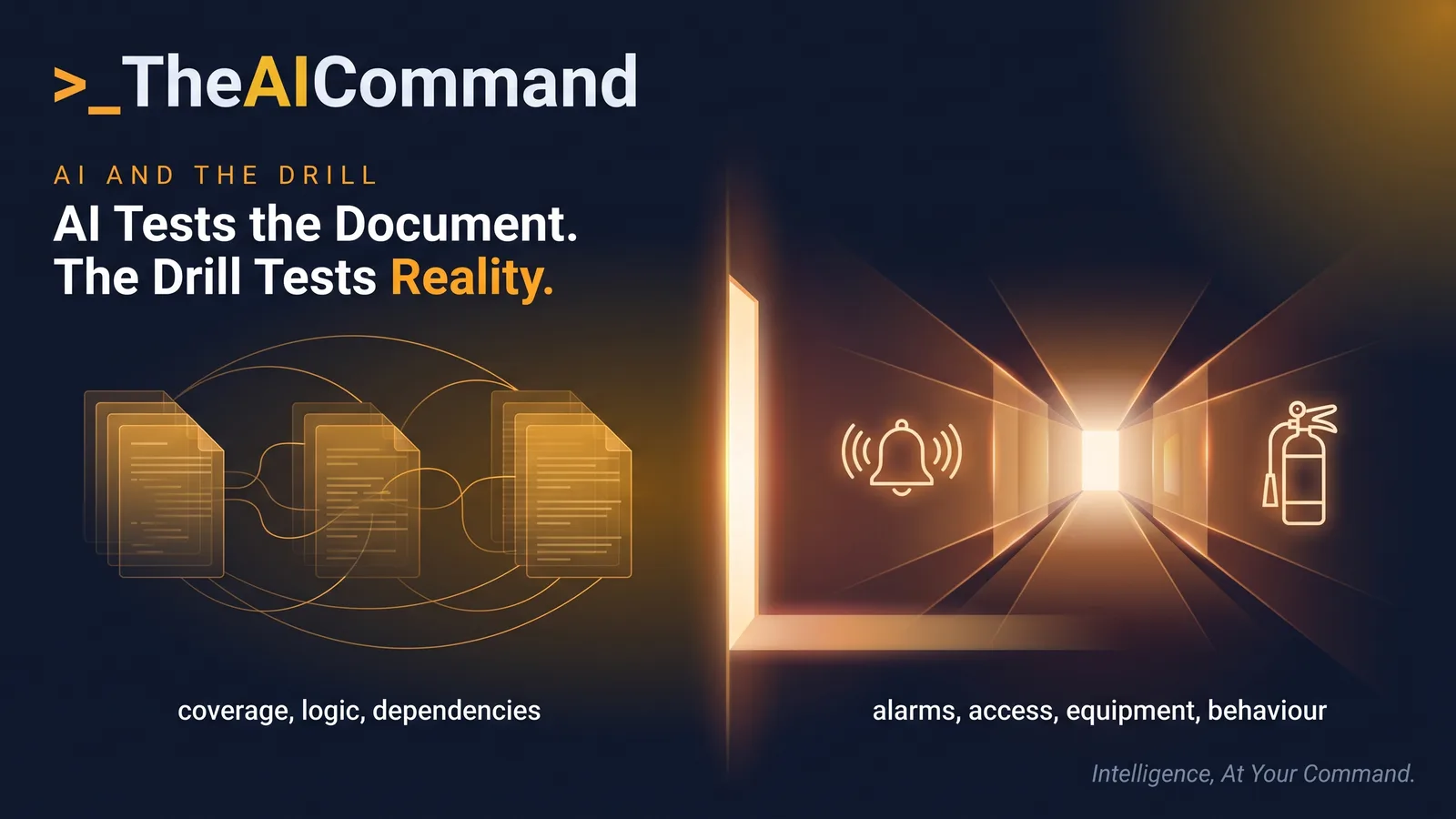
This is why a document review and a drill answer different questions. A document review asks whether the plan describes a plausible system. A drill asks whether the system works with real people, real access constraints, real equipment and real confusion.
Where does AI stop and the competent person decide?
AI may identify, compare, organise and draft. A competent person decides whether the plan is suitable, what emergency scenarios need to be tested, how the exercise will be run, whether risks created by the exercise are controlled, what findings are valid and whether the revised plan is effective.
Keep four boundaries explicit:
- The model does not determine compliance with regulation 43.
- The model does not set a risk rating or approve a control.
- The model does not replace worker consultation, warden training or emergency-service input.
- The model does not turn a tabletop discussion into evidence that physical procedures were tested.
That boundary matches the broader duty to verify AI safety controls. A polished response is not proof. In emergency planning, proof comes from observation, records and competent review.
A standing note on de-identification
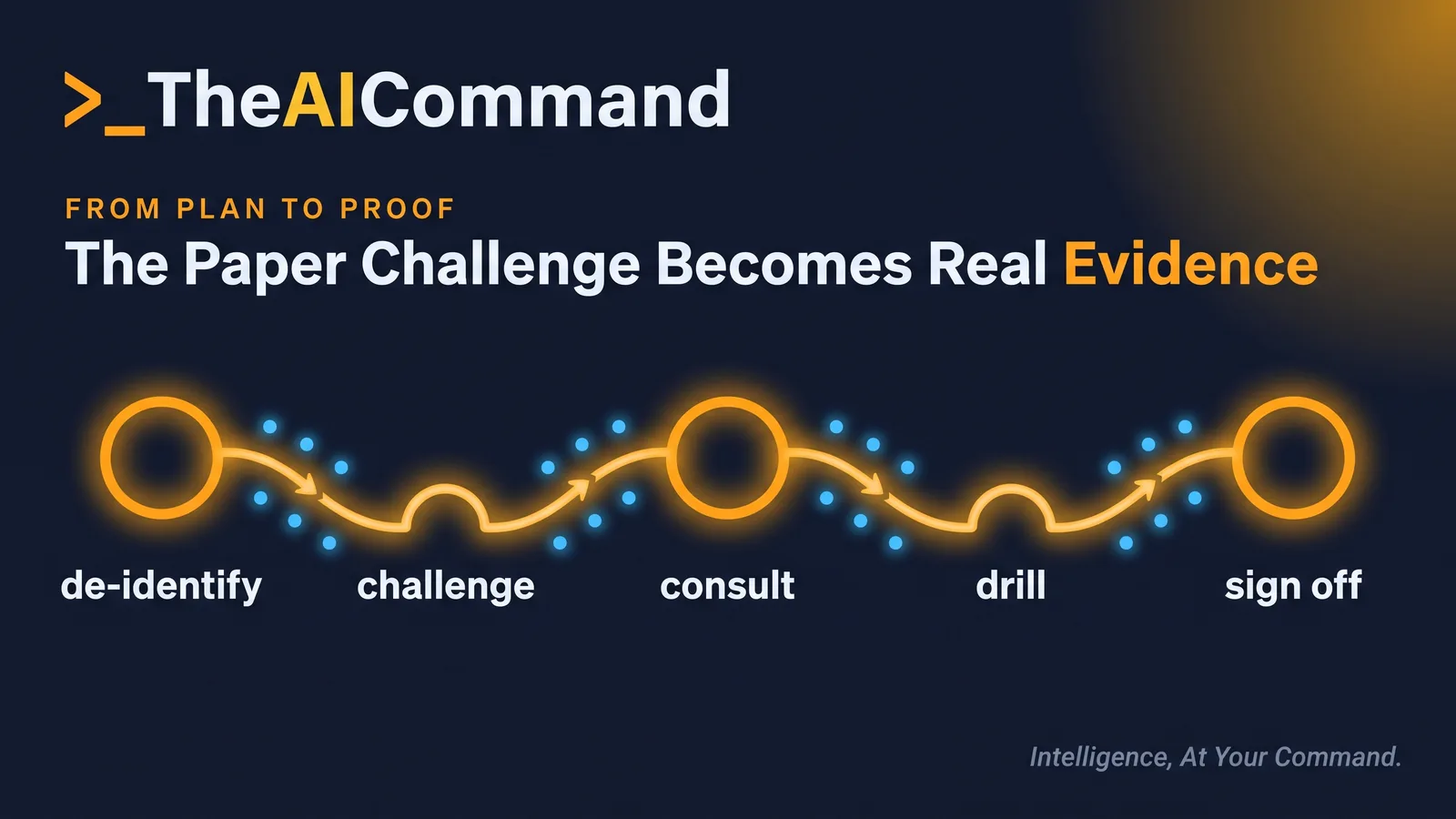
De-identify at source, before material enters the model. Do not upload worker names, personal mobile numbers, disability details, access-card records, medical information, visitor logs, alarm credentials, security arrangements or a floor plan that creates an avoidable security risk.
Replace personal and sensitive details with tokens such as [SITE], [FLOOR], [WARDEN_ROLE], [SHIFT], [ACCESS_NEED], [EMERGENCY_TYPE] and [COMMUNICATION_CHANNEL]. Where exact building information is essential, use an approved enterprise environment and apply the organisation's information-security rules. De-identification is a control owned by the organisation. It is not a cleaning task delegated to the model after disclosure.
Build an emergency-plan challenge pack
The most useful setup is a small, controlled project space with six inputs:
- The current de-identified emergency plan.
- Regulation 43 and the relevant jurisdictional guidance.
- A plain-language workplace profile covering work, hazards, location, shifts, visitors and shared-duty arrangements.
- Roles and dependencies, described without names.
- Findings from previous drills, incidents and maintenance checks, de-identified.
- A review rule that requires every claim to point back to a source or be labelled as an assumption.
Do not ask, "Is this emergency plan compliant?" That invites a confident conclusion from incomplete context. Ask the model to produce a challenge log. Each entry should identify the plan clause, the scenario, the dependency being tested, the uncertainty, the evidence needed and the competent owner who must review it.
Use a scenario library that reflects the workplace rather than generic disaster theatre. A city office may need to test an inaccessible stairwell, a visitor without an access pass, a smoke-affected floor and a network outage. A remote service team may need to test loss of communications and lone-worker escalation. A shared site may need to test competing instructions from tenant and building wardens.
The prompt library
Four prompts cover the cycle from written plan to verified action. Each one refuses the conclusion and hands the judgement back to a competent person.
1. Coverage challenge
2. Compound-failure tabletop
3. Inclusive response check
4. Debrief to action register
How to run the library. Put the four prompts into a single ChatGPT or Claude project with three standing rules so nobody has to re-type them: work only from the supplied de-identified sources, never state a compliance conclusion or close an action, and label every assumption. Run one plan at a time. A useful second turn asks the model to act as a sceptical exercise reviewer and find the three ways the proposed drill could mislead the debrief, for example an inject that tests two procedures at once or an observer position that cannot see the assembly point. The model sharpens the exercise design. The facilitator owns it.
Turn scenario breadth into a disciplined exercise
More scenarios do not automatically create a better test. Select a small set that probes different failure types: an initiating hazard, a failed communication, an unavailable person and a blocked physical dependency. Tie each inject to one procedure and one observable result. This keeps the exercise diagnosable. If ten variables change at once, the debrief may reveal confusion without showing which control failed.
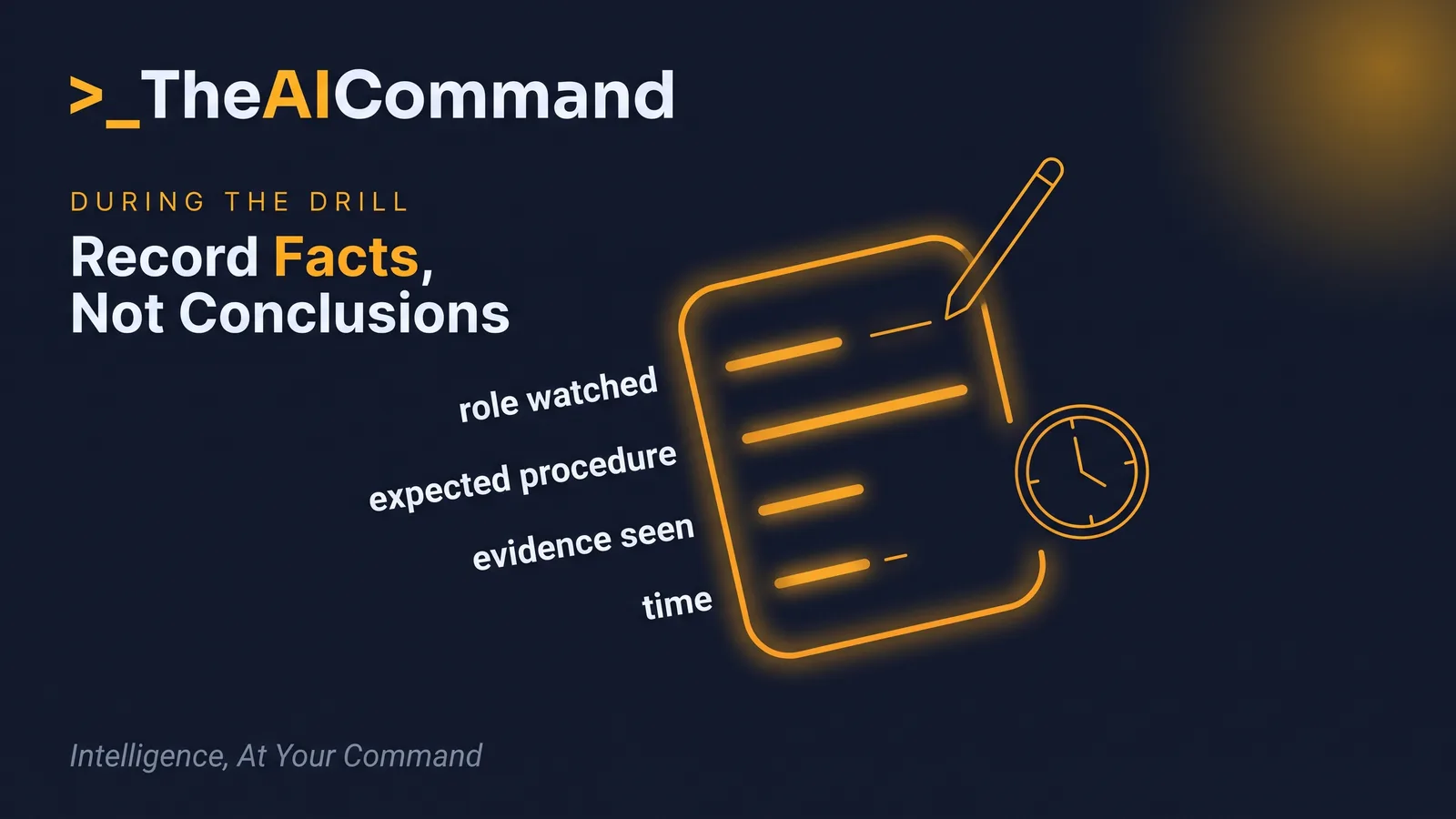
Prepare observer cards before the drill. Each card should state the location or role being observed, the expected procedure, the evidence to record and a space for unexpected behaviour. Observers should record times, actions and words rather than conclusions such as "communication was poor". A useful note is: "The assembly-area message reached [TEAM] four minutes after the alarm, through a supervisor's personal phone." A competent reviewer can assess what that fact means.
AI can draft observer cards and propose inject timing from the approved scenario. The facilitator checks that the exercise will not create new risk, confuse emergency services or disadvantage people with access needs. After the exercise, keep contradictory observations visible. Do not let a summary model collapse them into one convenient narrative before the debrief group examines the evidence.
A worked example, end to end
Consider [SITE], a four-level office shared by three PCBUs. The written plan assumes the building announcement system and staff messaging platform will both operate. A previous drill recorded slow movement from [FLOOR], but the note did not say whether the delay came from congestion, unclear instructions or an access need.
The WHS lead removes names, contact details and the actual floor plan, then provides the model with the plan clauses, a simple dependency list and the de-identified observation. The compound-failure prompt generates a scenario in which smoke affects the primary stairwell while the messaging platform is unavailable.
The AI output suggests questions. Who can authorise the alternate route? How will contractors receive the instruction? Can the announcement be heard in enclosed meeting rooms? Does the alternate assembly area have enough space? What happens if [WARDEN_ROLE] is absent?
Those questions are not findings. The emergency-planning group checks them with workers, HSRs, facilities, building management and the warden team. The facilitator then builds a controlled exercise. Observers record whether the alarm is audible, instructions are understood, the alternate route remains accessible and accountability at the assembly area works.
After the drill, AI converts the de-identified notes into a draft register. A competent person reviews each entry against the evidence, assigns actions and decides whether a procedure needs revision. The next exercise verifies the change. That closes the loop from written assumption to observed behaviour.
What this buys the function
The gain is not an AI-approved plan. It is a better challenge process.
AI can broaden the scenario set without requiring a facilitator to write every inject from scratch. It can surface hidden dependencies across communication, access, staffing and shared-duty arrangements. It can apply the same structure to multiple site plans and reduce the administrative work of converting observations into actions.
It can also connect emergency planning with incident analysis and leading indicators. Repeated findings such as unclear role handovers, contractor gaps or failed communications can be tracked as control weaknesses rather than rediscovered at each drill.
There is a records dividend too. Regulation 43 expects testing with a stated frequency, training for relevant workers and a plan that is maintained so it remains effective. The artefacts this workflow produces, a challenge log with named human owners, consultation questions and their answers, observer cards, a drill report and a verified action register, are exactly the records that show those things happened. Keep them. The AI transcript can sit in the file as working papers, but the signatures on the scenario selection, the exercise plan and the action closures belong to people.
What can AI not do for an emergency drill?
It does not reproduce noise, smoke, time pressure, blocked access, human hesitation or the physical needs of a particular workforce. It cannot confirm that equipment works or that training transferred into action. It does not consult workers simply because it summarised old feedback.
Most importantly, AI can make a weak plan sound coherent. Treat fluency as a reason to demand more evidence, not less. And if the organisation introduces AI into the planning workflow, that introduction is itself a workplace change that should follow the consultation and risk-management approach described in Rolling out AI is a workplace change.
Bottom line
AI earns its place before and after an emergency exercise, not during it. Use it to challenge a de-identified plan, generate injects and draft an action register, but keep the testing, the consultation and the drill itself human, because that is what regulation 43 requires and what a person signs. Treat fluent output as a reason to demand more evidence, not less.
Do this Monday:
- De-identify the emergency plan at source, before anything enters the model.
- Build a small challenge pack: the plan, regulation 43, a workplace profile, roles and prior drill findings.
- Ask the model for a challenge log, not a compliance verdict.
- Consult workers, HSRs and wardens on the questions the model surfaces.
- Keep the signed records: challenge log, observer cards, drill report and verified action register.
References
- Safe Work Australia, Emergency plans and procedures: WHS duties, accessed 10 July 2026. https://www.safeworkaustralia.gov.au/safety-topic/managing-health-and-safety/emergency-plans-and-procedures/whs-duties
- Federal Register of Legislation, Work Health and Safety Regulations 2011 (Cth), regulation 43, current compilation, accessed 10 July 2026. https://www.legislation.gov.au/F2011L02664/latest/text
- Safe Work Australia, Model Work Health and Safety Regulations, accessed 10 July 2026. https://www.safeworkaustralia.gov.au/doc/model-work-health-and-safety-regulations
- Safe Work Australia, Emergency plans fact sheet, accessed 10 July 2026. https://www.safeworkaustralia.gov.au/doc/emergency-plans-fact-sheet
- Comcare, Emergencies and visitors (Office safety tool), accessed 10 July 2026. https://www.comcare.gov.au/office-safety-tool/spaces/reception-areas/emergencies-and-visitors
- Safe Work Australia, How to consult with workers, accessed 10 July 2026. https://www.safeworkaustralia.gov.au/safety-topic/managing-health-and-safety/consultation/how-consult-workers
---
This article is general information for work health and safety practitioners and people with safety duties. It is not legal advice and not a substitute for the model WHS Act, the WHS Regulations, the approved Codes of Practice, or advice from your regulator (Comcare, Safe Work Australia, or your state or territory WHS regulator) on your own circumstances.
TheAICommand. Intelligence, At Your Command.