AI can draft a safe work method statement in seconds, but for high-risk construction work a SWMS is a regulated document, and the site walk and the consultation that make it lawful are exactly the parts AI cannot do. You can now paste "installing precast concrete panels on level three" into an AI tool and get a formatted safe work method statement back in under a minute. A growing product category goes further, marketing a SWMS generated from a short task description or even from a photo of the site. For a safety lead buried in documentation, that looks like relief. It is also the fastest way to put a professional-looking, non-compliant document in front of a crew that is about to do high-risk work.
A SWMS is not a generic form. For high-risk construction work it is a regulated document with statutory content and a statutory way it must be produced. The two things an AI model is structurally worst at, knowing this particular site and consulting these particular workers, are the two things the law treats as load-bearing. So the honest position is neither "never use AI" nor "let AI write it". AI can help you draft. It cannot walk the site, and it cannot hold the conversation, and those are the parts that make a SWMS lawful and useful rather than decorative.
The safety duty AI touches
Under the model Work Health and Safety Regulations, a SWMS is required only for high-risk construction work, but that category is broad. Safe Work Australia's duties tool lists nineteen activities that trigger the requirement, among them a risk of a person falling more than two metres, work in or near a confined space, work in or near a shaft or trench deeper than 1.5 metres, work on or near energised electrical installations or services, disturbing asbestos, demolition of a load-bearing element, tilt-up or precast concrete, and work in an area where powered mobile plant is moving (Safe Work Australia, High risk construction work requiring a SWMS). The Commonwealth scheme that much of this audience works under sits inside the same framework: Comcare administers the Work Health and Safety Act 2011 and the Work Health and Safety Regulations 2011 and is the national work health and safety regulator (Comcare). The model regulations are mirrored across the Commonwealth, New South Wales, Queensland and most states and territories, with equivalent duties under Victoria's Occupational Health and Safety Act 2004.
The duty AI touches is narrow. Regulation 299 of the Commonwealth WHS Regulations 2011 requires that, before high-risk construction work commences, a person conducting a business or undertaking ensures a safe work method statement for the proposed work is prepared. That is a strict-liability offence, which matters: the question at an inspection is whether the document existed and was right, not whether anyone intended well. The same regulation sets out what the document must contain. It must identify the high-risk construction work, specify the hazards and the risks to health and safety associated with them, describe the measures to be implemented to control the risks, and describe how those control measures are to be implemented, monitored and reviewed (regulation 299(2)).
An AI draft can fill in all four of those headings. That is precisely the trap. A document that looks complete is not the same as a document that is correct for this site, and the regulation is explicit about the difference.
Why is a generic AI-generated SWMS the precise failure mode?
The decisive clause is regulation 299(3). A SWMS must be prepared taking into account all relevant matters, including circumstances at the workplace that may affect the way in which the high-risk construction work is carried out, and it must be set out and expressed in a way that is readily accessible and understandable to persons who use it. Read those two requirements together and a generic document fails on both counts: it cannot have taken account of circumstances at a workplace it never described, and a long, templated statement is rarely the thing a crew actually reads before they start.
This is why regulators are consistent on the point. SafeWork NSW puts it directly: a SWMS must be site-specific, and a generic SWMS used at different workplaces may be acceptable for regularly conducted activities only where it is reviewed and amended to take into account the site-specific hazards and risks before use. An AI-generated SWMS is, by construction, generic. It is built from a task description and a training corpus, not from your site. That does not make it useless. It makes it a first draft that is not yet lawful, and the gap between the two is the work.
Where does AI genuinely earn its place?
It is worth being fair about what the tools do well. AI is good at the blank page and the structure. It will lay out the SWMS in the required format, list the standard hazards for a task type so you are less likely to miss one, surface controls you might not have reached for, and rewrite dense safety language into plain English, which is exactly what regulation 299(3)(b) asks for. For a crew that does not all read English as a first language, an AI rewrite into short, clear instructions is a legitimate aid rather than a risk.
Used as a drafting assistant against your own template and your own knowledge of the site, AI removes the slow part and leaves the judgement to you. The problem was never the draft. As with AI-drafted WHS training, where a person still has to verify competence, the problem is treating the draft as the finished SWMS and skipping everything that makes it true.
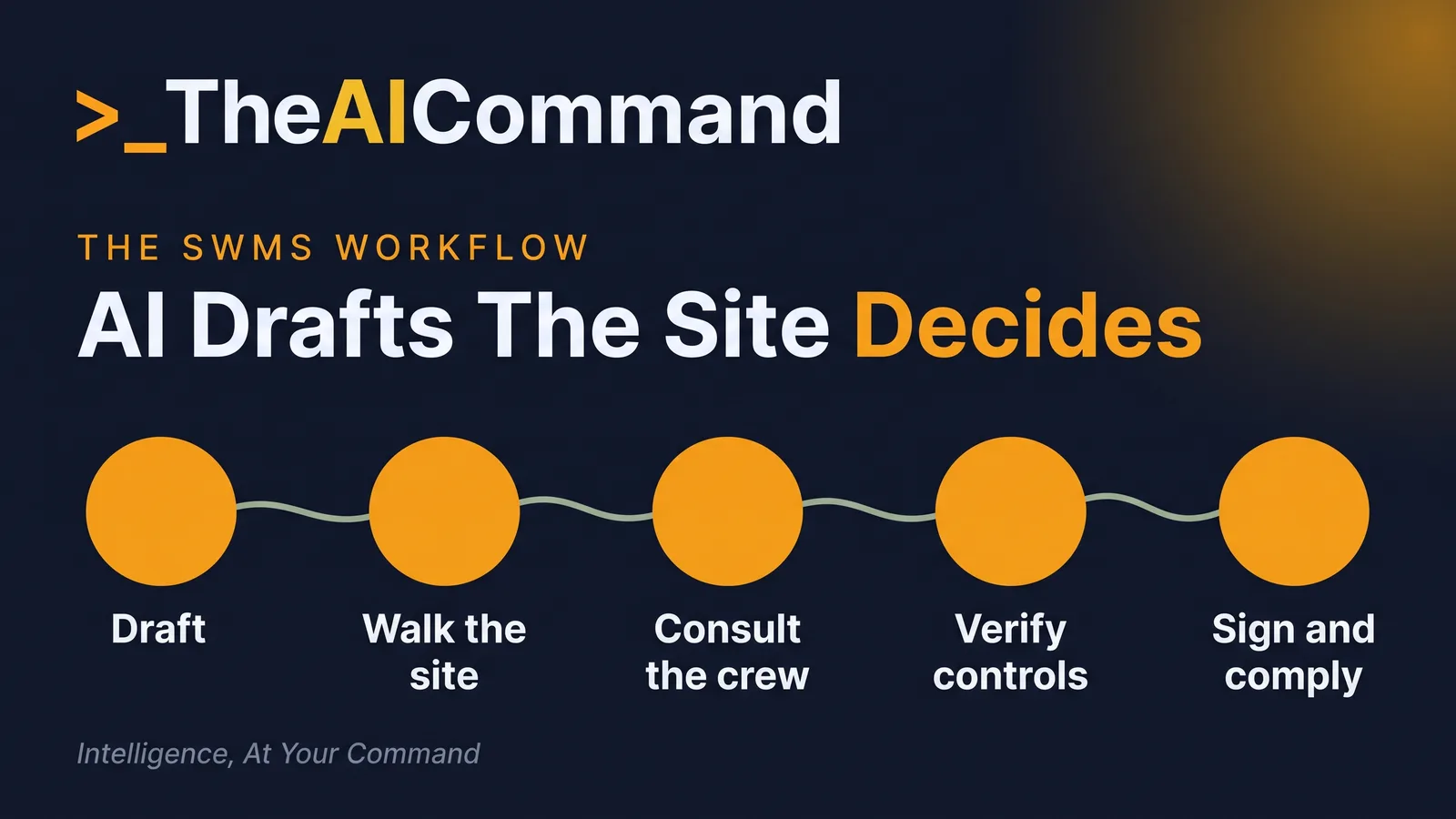
The practical workflow: AI drafts, the site decides
Here is a sequence that uses AI for speed without losing what the law requires. It keeps the model on the blank page and keeps the duty with the people.
First, draft from the task, not the site. Give the AI the activity and the high-risk category and ask for a structured starting SWMS. Treat what comes back as a checklist of candidate hazards and controls, never the final document.
Second, walk the actual workplace. Regulation 299(3)(a)(i) requires the SWMS to take into account circumstances at the workplace that may affect how the work is carried out. The model has never seen your site. This is where you add the live service next to the trench, the access constraint that changes the lift, the adjacent trade, the weather, the plant moving nearby. It is also where you delete the controls the AI listed that do not apply here, because a SWMS padded with irrelevant controls is as dangerous on the tools as one missing the relevant ones.
Third, consult the workers who will do the work. Safe Work Australia is clear that a PCBU must consult when identifying hazards, assessing risks and deciding how to manage them, and when developing work procedures, and that consultation is a legal requirement (Safe Work Australia, Consultation). The crew know the real method, the workaround and the thing that always goes wrong at this stage, which is why consulting the people who do the work matters well beyond a single SWMS. AI can draft the questions for the toolbox talk; the conversation itself is the control.
Fourth, verify the controls against the hierarchy. AI tends towards the easy administrative answer: wear PPE, take care, follow the procedure. A person checks whether elimination or an engineering control is reasonably practicable first, and accepts a lower-order control only when the higher ones are not. The model does not weigh reasonably practicable; the duty holder does, because an AI-suggested safety control is still just a control you have to verify.
Fifth, make it usable where the work happens. Tighten the document to what the crew will actually read. A long AI statement that sits in a folder is the paper compliance that regulation 299(3)(b) exists to prevent.
Sixth, sign, comply, review and keep. The accountable person signs, not the model. Regulation 300 requires the work to be carried out in accordance with the statement, and if it is not, the work must be stopped immediately or as soon as it is safe to do so and resumed only in accordance with the statement. Regulation 302 requires review when relevant control measures change, and regulation 303 requires the SWMS to be kept until the work is complete, or for at least two years if a notifiable incident occurs.
At a glance, the sequence keeps the model on the draft and the duty with the people.
A worked example
[TEAM] is scheduled to work in a trench 1.8 metres deep, close to an energised underground electrical service, on [SITE]. Two high-risk categories are live at once: a trench deeper than 1.5 metres and work near energised electrical services. An AI draft will reliably produce the generic hazards, trench collapse and electric shock, and the generic controls, shoring, isolation and PPE. What it cannot produce is that the only safe access point puts the spoil on the side where the cable runs, that the locate plan is two years old, or that the crew has flagged groundwater after rain. Those facts come from the walk and the consultation, and they are the difference between a SWMS that protects [TEAM] and a tidy document that protects no one.
The psychosocial and WHS-law line
The WHS-law line is unforgiving and worth stating plainly. Regulation 299 sets the content. Regulation 299(3)(a)(i) makes site-specificity a legal requirement, not best practice. Regulation 300 turns comply or stop into a duty. These are strict-liability provisions, so the inspector's question is not whether you meant well but whether the SWMS reflected this site and the work was carried out in accordance with it.
There is a psychosocial line too, and it is specific to this failure mode rather than a general caution. When AI writes a crew's SWMS for them instead of with them, it quietly removes worker voice over how their own high-risk work is done. Low job control and poor consultation are recognised psychosocial hazards, and health under the WHS Act includes psychological health. A thorough-looking AI document can also create a false sense of safety, where the paperwork looks rigorous so the team skips the conversation that would have surfaced the real risk. The fix matches the legal fix, as it usually does in work health and safety: keep the workers in the authorship.
One data guardrail belongs here, and it is the same discipline that privacy-safe AI for regulated work depends on. Do not paste anything that identifies people, the client, or commercially sensitive site detail into a public AI tool while drafting. A SWMS is about the work and the controls, and it does not need names to do its job.
What stays human in an AI-assisted SWMS?
The site walk. The consultation. The judgement that a control is adequate for these circumstances. The decision to proceed or to stop the work under regulation 300. The signature of the person who carries the duty. AI cannot hold the primary duty of care; the PCBU and its officers do, and that responsibility does not move to a tool because the tool produced the first draft.
The test is simple. If you could not stand in front of an inspector and explain that this SWMS reflects this site and was built with this crew, the AI did not save you time. It manufactured risk with a clean layout. Used the other way, as a fast first draft that a person then makes true, it is one of the more useful things AI can do on a safety desk: it clears the blank page so the duty holder can spend their time on the site, the crew and the controls, which is where the safety actually lives.
The prompt: a SWMS reviewer, not a SWMS author
Paste this into ChatGPT or Claude. It reviews a draft SWMS for high-risk construction work and finds where the draft is too generic to be lawful and where consultation is missing. It does not write the SWMS and it does not replace the site walk or the sign-off.
How to run it. In ChatGPT or Claude, create a Project called SWMS reviewer, paste the prompt into the project's custom instructions, and add your organisation's blank SWMS template plus a short note of the high-risk categories you work with, with no client names, addresses or personal detail. Run it one task and one site at a time, then do a self-refine pass: make the fixes the review surfaced, paste the amended draft back, and ask "what is still generic or unconsulted now". Two passes is usually enough, and the second pass should return mostly "needs a site walk", which is your cue that the remaining gaps can only be closed by people, not by the model.
Bottom line
For high-risk construction work a SWMS is a regulated document, and regulation 299(3) makes site-specificity a legal requirement rather than best practice. AI is genuinely useful for the blank page, the format, the standard hazard list and the plain-English rewrite, but the site walk, the consultation and the sign-off are the parts the regulation treats as load-bearing, and they stay with a competent person. Use the model to clear the draft, then make it true on site.
Do this Monday:
- Use AI to produce the SWMS format and a candidate hazard list for the task type, and treat it as a first draft only.
- Walk the actual workplace, add the site conditions the model never saw, and delete the controls that do not apply here.
- Consult the workers who will do the work in the toolbox talk, because the conversation is the control.
- Verify each control against the hierarchy, preferring elimination or an engineering control before an administrative one.
- Sign it yourself, comply under regulation 300, and strip identifying detail before anything reaches a public AI tool.
References
- Safe Work Australia. High risk construction work requiring a SWMS (Know your WHS duties tool). Accessed 27 June 2026. https://www.safeworkaustralia.gov.au/duties-tool/construction/hazards-information/high-risk-construction-work-requiring-swms
- Commonwealth of Australia. Work Health and Safety Regulations 2011 (F2011L02664), regulations 291, 299, 300, 301, 302 and 303. Federal Register of Legislation, current compilation accessed 27 June 2026. https://www.legislation.gov.au/F2011L02664/latest/text
- Comcare. Work Health and Safety Act (WHS Act). Accessed 27 June 2026. https://www.comcare.gov.au/scheme-legislation/whs-act
- Safe Work Australia. Consultation (Managing health and safety). Accessed 27 June 2026. https://www.safeworkaustralia.gov.au/safety-topic/managing-health-and-safety/consultation
- SafeWork NSW. Prepare safe work method statement. Accessed 27 June 2026. https://www.safework.nsw.gov.au/your-industry/construction/construction/general-requirements/prepare-safe-work-method-statement
- Safe Work Australia. Interactive SWMS tool (published 25 January 2024). Accessed 27 June 2026. https://www.safeworkaustralia.gov.au/doc/interactive-swms-tool
---
General information only. This article is general information for work health and safety practitioners and managers. It is not legal advice and it is not a substitute for the model WHS Regulations, the codes of practice, or advice from your work health and safety regulator. Confirm the duties that apply in your jurisdiction before relying on anything here.
TheAICommand. Intelligence, At Your Command.