
A claim file arrives with a long chronology and a short message: everything needed is in the documents. The receiving claims manager can see what happened last month. What remains unclear is whether the request mentioned on the last page was sent, who is awaiting a response and which action can safely proceed.
A handover has to bridge that gap. Its purpose is to make the next piece of work identifiable without making the new manager reconstruct every conversation. The full file remains the evidence. The handover is a checked navigation aid that points to the current position, outstanding dependencies and matters requiring clarification.
AI can help organise a bounded pack into that structure. It cannot know whether an omitted email was sent, decide that a conflicting note is wrong or infer a statutory outcome from a short summary. The receiving practitioner needs to see those limits in the actual wording, especially where a polished sentence would otherwise conceal uncertainty.
Start with the role receiving the file
This article concerns the Comcare scheme and the Safety, Rehabilitation and Compensation Act 1988, known as the SRC Act. It does not cover state workers compensation schemes. Its example is a fictional Commonwealth workplace where a claims manager is receiving responsibility for administrative follow-up. The material is entirely constructed and contains no real claim or claimant information.
Comcare describes claims managers as managing compensation claims, including decisions about acceptance, liability, support and benefits. It separately describes rehabilitation case managers as coordinating rehabilitation and return to work on behalf of the employer. Those roles need distinct action owners in a handover. A shared file does not merge their responsibilities. Sources: Comcare, claims managers and rehabilitation case managers.
Name the receiving role before choosing the content. A claims manager may need a question referred to the rehabilitation case manager, rather than an instruction to decide that issue personally. Record that referral as a proposed administrative action for human confirmation. Do not let a model assign authority simply because a role appears in the contact list.
The same discipline applies when another person covers temporarily. State the scope and duration of the handover in the organisation's approved record. Receiving an action list is not evidence of delegation. Check authority through the proper channel before acting on any matter that requires it; the AI output cannot supply that authority.
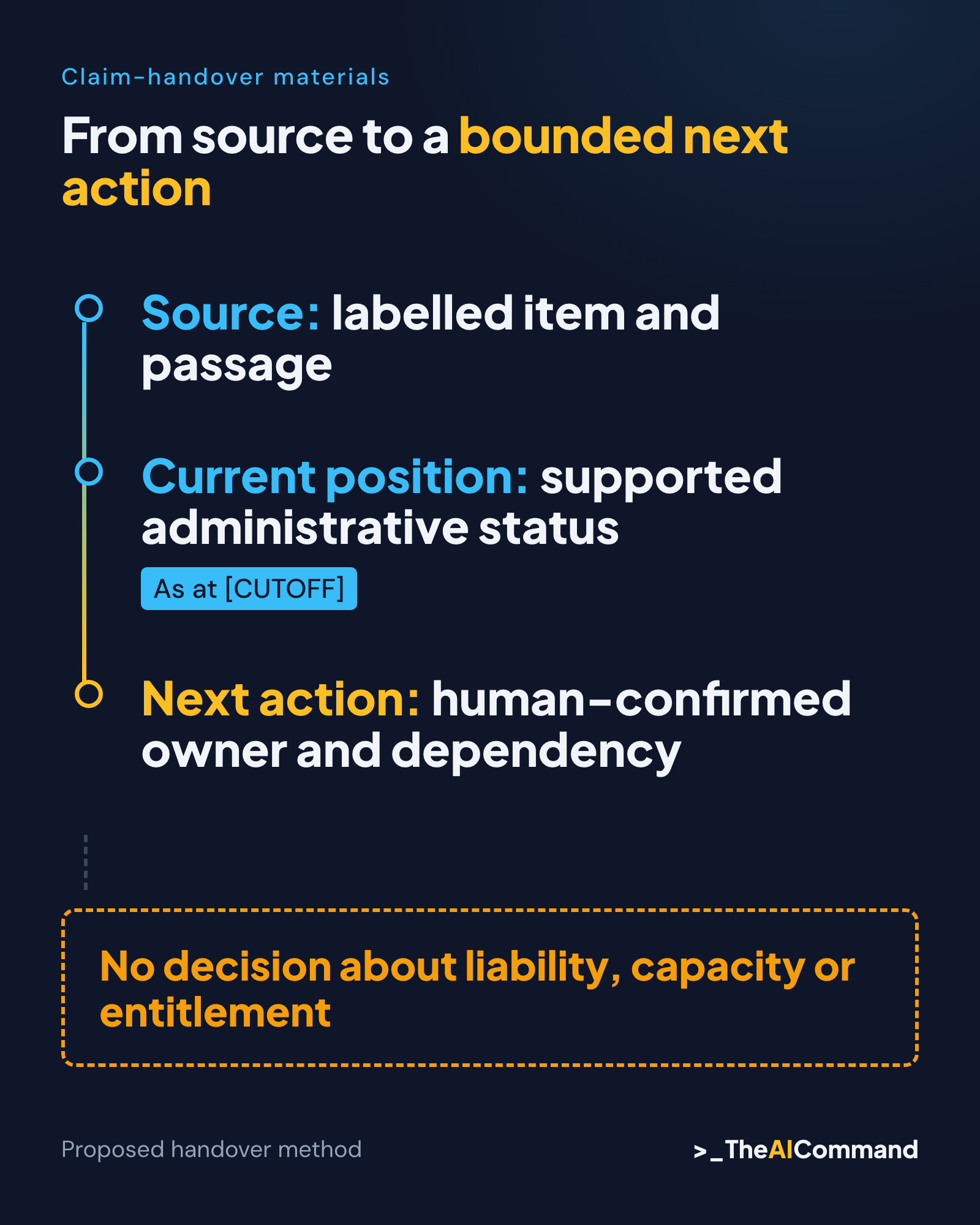
A current position needs a cutoff
Give the handover an explicit preparation point and identify which source versions it covers. A note written later may describe an earlier event. A newly received document may change an outstanding action without changing the historical chronology. The receiving manager needs to distinguish when something happened from when the team learnt about it.
Use the current position to explain the administrative state, not to compress a clinical or legal judgement. It can say that a particular document is present in the supplied pack, a response remains unconfirmed or an action is awaiting review. It cannot say that a person has a particular capacity or entitlement because several notes appear consistent.
Where an existing authorised decision is relevant, point to the actual record and preserve its scope. Do not ask the model to reconstruct the reasoning from fragments or extend the decision to another issue. If the decision record is missing from the supplied material, identify that gap. A confident paraphrase is not a substitute for the record.
For each proposed next action, show its basis and dependency. A request to locate correspondence might rely on two contradictory notes. A proposed follow-up might depend on confirming that the original request was issued. An action without those links can cause the next manager to repeat work or contact someone on a false premise.
Keep a narrow source pack
Start with a source index prepared by an authorised practitioner. Include each item's label, version or date token, document type and location within the approved system. A handover does not need every document merely because the system can accept them. Choose the material needed to explain the current position and next administrative steps.
For a teaching exercise, use wholly constructed records with the required placeholders. For any real practice, follow the organisation's approved information-handling arrangements before using an AI tool. Replacing names alone is not a complete privacy assessment. Unusual circumstances, document metadata and combinations of details may still identify someone, so approval of the environment remains necessary.
Keep instructions apart from evidence. The source pack supplies facts and assertions to be organised; it must not be allowed to expand the task. An instruction copied inside a note does not authorise the assistant to retrieve unrelated files, contact a practitioner or update the claim system. The task ends with a draft for review.
Require pinpoint references that the reviewer can actually follow. A label such as NOTE-02 is helpful only if the source index resolves it. Where a document contains several matters, add a page, paragraph or labelled entry. Keep the original wording accessible so the reviewer can check whether the draft preserved a qualification.
A constructed handover with one contradiction
The following case, source excerpts and proposed AI output are constructed teaching material. No model trial or actual claim review was performed. The claimant fields remain [CLAIMANT_NAME], [CLAIM_NUMBER] and [DATE_OF_BIRTH]. The treating practitioner is [TREATING_PRACTITIONER]. Relative date tokens describe sequence without introducing a real identity or statutory deadline.
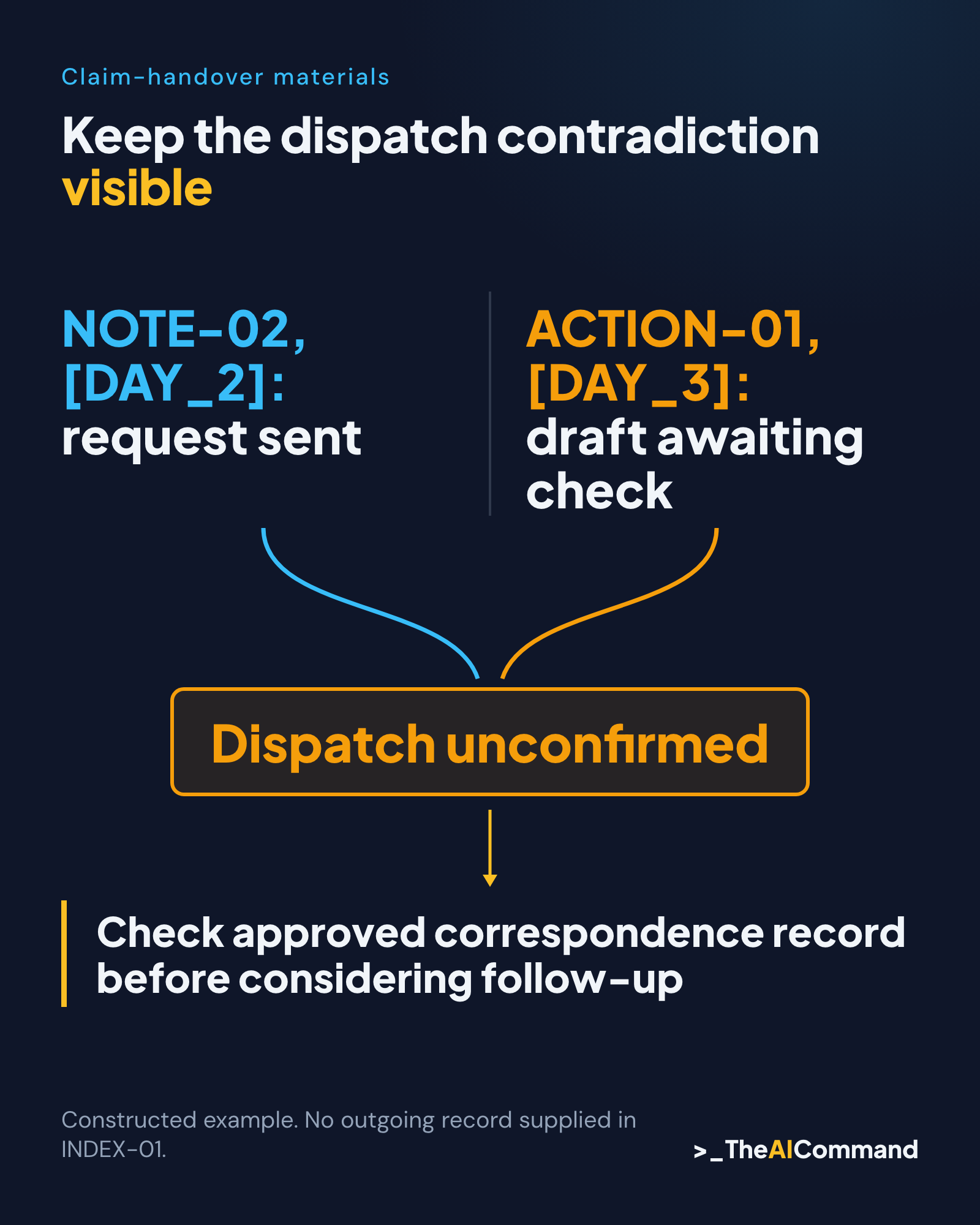
The fictional source index contains four items. NOTE-01 records a planned request for clarification from the treating practitioner. NOTE-02 records that the request was sent. ACTION-01 records that the same request is still in draft awaiting an internal check. INDEX-01 lists the supplied documents and contains no outgoing copy or transmission record for that request.
The contradiction is deliberately narrow: whether the request was sent. NOTE-02 and ACTION-01 cannot both establish the same present status without further information. Perhaps the action register was not updated. Perhaps the note referred to a different request. The supplied pack does not resolve the discrepancy, and the assistant must not choose an explanation.
A weak constructed output would say that the team is awaiting the practitioner's response. That wording quietly treats dispatch as established and may prompt an unnecessary follow-up. The corrected constructed output says that dispatch is unconfirmed because NOTE-02 and ACTION-01 conflict, and the supplied index contains no resolving evidence.
The proposed next action is for the receiving claims manager to inspect the approved correspondence record and reconcile the status before arranging any follow-up. This is a bounded administrative proposal, not an instruction to issue a request automatically. The responsible practitioner confirms the action, its owner and any necessary authority before it enters the operational list.
If a supplied source records a draft handover discussion with the rehabilitation case manager, the model may identify that discussion as an administrative dependency. It must not turn the discussion into a conclusion about suitable duties or work capacity. Those questions stay with the appropriate people and evidence, outside this drafting task.
The handover's current-position paragraph therefore remains modest. The supplied notes record a planned clarification request; dispatch cannot be confirmed from this pack; the corresponding action remains unresolved pending a record check. That paragraph is useful because it tells the next manager exactly where to start without pretending the contradiction has disappeared.
Constructed source excerpts and draft output
Review the action, not just the sentence
The reviewer first checks whether every statement is supported by the cited item. Then check whether the proposed action follows from that evidence without assuming an unproved step. A sentence can quote a note accurately and still create a misleading action. In this example, a note saying sent does not justify ignoring the contrary action record.
Check the difference between missing from the pack and missing from the entire claim file. The assistant has access only to what it was given. Its output should say that the supplied pack contains no resolving record, not that no record exists. This qualification matters because it directs a file check rather than declaring a documentation failure.
Check status words individually. Completed requires evidence appropriate to the action. Pending names an identified unfinished step. Unconfirmed describes a question the supplied material cannot settle. Cancelled requires a source showing the cancellation. These are proposed administrative labels for this method, not statutory classifications or universal case-management system fields.
The reviewer also checks for invented owners, dates and priority. A model may supply them to make the action list look complete. Where the source does not identify an owner, use a role to confirm rather than silently assign responsibility. Where timing is missing, leave it for practitioner review instead of manufacturing a deadline.
Separate an internal follow-up target from a statutory due date. If a legal time requirement becomes relevant, check the current legislation, applicable instrument and factual trigger through the authorised process. This example supplies no statutory period or section number. A date copied from an old template cannot establish a current legal requirement.
Preserve the employee's communication position
An administrative handover can lose the context of a pending communication even when its source references are correct. Record what the approved material says has been communicated, what remains a draft and whether the next contact depends on clarification. Do not infer that the employee has been informed because an internal action is marked complete.
In the constructed example, the disputed dispatch concerns the treating practitioner. That does not establish any communication with [CLAIMANT_NAME]. If the source pack contains no relevant communication record, the handover leaves that matter unknown. The receiving manager checks the appropriate record before describing an earlier conversation or promising a response.
Keep proposed correspondence separate from the handover itself. A model may help draft a neutral question for later human review, but the handover task does not include sending it. The practitioner confirms the recipient, purpose, permitted information and wording through the organisation's normal arrangements. No access or consent is inferred from a placeholder appearing in a template.
Where a source contains an employee's account, retain its attribution rather than rewriting it as an established conclusion. The same applies to an employer's assertion or a practitioner's opinion. This helps the receiving manager understand why a matter needs clarification without the handover silently deciding which account prevails.
Make acceptance a receiving-side activity
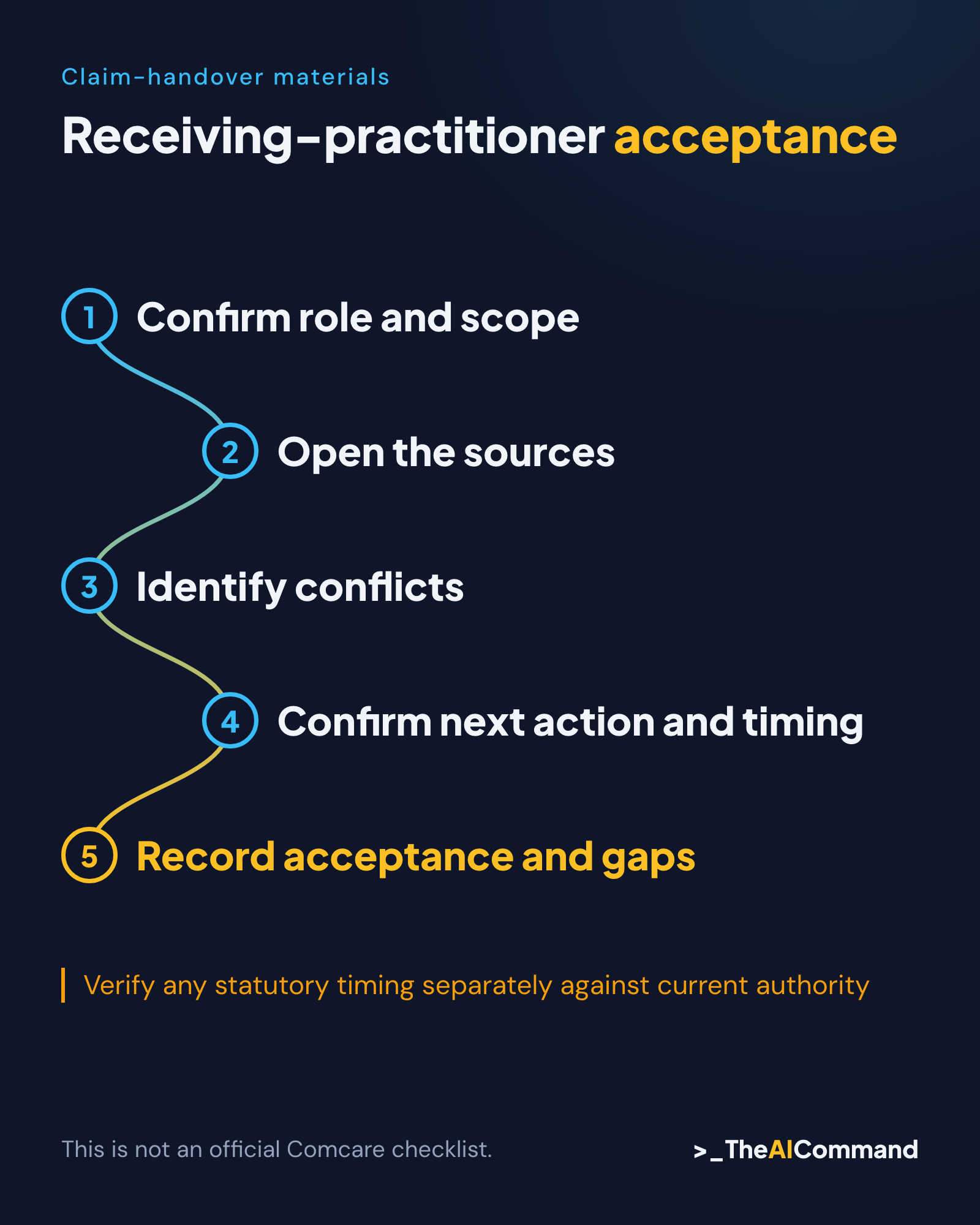
The outgoing practitioner can prepare a clear pack, but the receiving manager needs to demonstrate that its references resolve. Open the cited items in the approved record, identify the unresolved dependency and explain the first intended action. This is a practical acceptance check. Merely acknowledging an email does not show that the handover is usable.
Ask the receiving manager to state what remains uncertain in their own words. In the constructed example, the useful answer is that dispatch needs confirmation before follow-up is considered. If the answer instead assumes that a response is overdue, the handover has failed to carry its central qualification and needs correction before use.
Record corrections in the appropriate place without overwriting the source history. Once a practitioner resolves the contradiction, update the handover status with the supporting record and review details. Keep the earlier draft identifiable so the reason for the change can be followed. Do not treat the AI draft as an authoritative historical record.
A source-linked chronology can support this process, but the handover has a different job. The existing claim chronology skill file explains how to organise events and preserve source distinctions. Here the focus is what the receiving manager needs to do next, including what must be checked before that action proceeds.
For claims teams, start with one constructed file and one deliberately conflicting action status. Ask another practitioner to use the handover to locate the conflict and identify the next check. Improve the pack wherever that person has to guess. A useful handover transfers the work while keeping uncertainty visible and professional decisions with authorised people.
Copyable handover prompt
Receiving-case-manager checklist
- Confirm receiving role, scope and appropriate authority.
- Open every source used for the current position and proposed next actions.
- Resolve or retain conflicting action statuses explicitly.
- Confirm action owners, dependencies and separately verified timing.
- Record corrections, acceptance and any remaining gaps in the approved system.
Claim-handover materials
Status: administrative aid for Comcare/SRC practitioners. Every sample below is constructed. No real case information is supplied and no statutory due date is proposed.
Handover template
Source index
The worked contradiction is dispatch status. NOTE-02 says sent; ACTION-01 says draft awaiting check. INDEX-01 contains no resolving outgoing copy. Do not infer which source is correct or declare that no record exists in the complete file.
Source-bounded prompt
Acceptance checklist
- Confirm scheme, receiving role and appropriate authority separately.
- Match each source reference to the actual approved file item.
- Preserve assertions and opinions as attributed material.
- Keep conflicting action statuses unresolved until a person checks the record.
- Confirm owner, dependency and timing of each proposed action.
- Verify any statutory timing from current authority before adding it.
- Record correction and acceptance without altering source history.
This template does not determine liability, capacity or entitlement. Use approved information-handling arrangements; replacing names is not sufficient to establish permission to use an AI environment.
Do this Monday
Choose a constructed claim pack. Add one conflicting administrative status. Draft the handover, then ask a receiving practitioner to locate each source and explain the next check before accepting it.
Related reading
- A Claim Chronology Skill File Built for De-Identification
- The Person Who Built the Workflow Is Away. What Happens Next?, the companion article for 9 November
References
- Comcare claims managers
- Comcare: rehabilitation case managers
- Federal Register of Legislation: Safety, Rehabilitation and Compensation Act 1988, compilation C2026C00285 (No. 82, 1 July 2026)
TheAICommand. Intelligence, At Your Command.