The skill works when its author runs it. Another colleague opens the same file, supplies a shorter source summary and receives confident questions that assume facts nobody provided. The author knows which folder contains the missing instructions. The colleague does not. That difference belongs in the package, not in an explanation delivered after the mistake.
A useful handover lets someone understand the task, supply suitable material and recognise an unacceptable result. It also tells them when to stop. For professional work, the question is whether the package carries enough context to preserve the intended boundary when the person who wrote it is unavailable.
This article builds a small teaching package for preparing neutral questions about missing evidence. The scenario concerns a fictional Commonwealth employer within the Comcare scheme under the Safety, Rehabilitation and Compensation Act 1988. It uses no real claim information and grants no authority to send correspondence. The method can be adapted to lower-risk tasks, but its clinical and claims boundaries must stay intact.
Start with the result another person needs
Write the purpose as an observable output. Here, the result is a draft table connecting each evidence gap to its source, a neutral question and a human check. It is not a finished letter, a recommendation about benefits or an assessment of a worker. Those distinctions determine the inputs, examples and acceptance test.
A broad instruction such as "assist with claims management" leaves the new user to decide where assistance ends. A narrower description makes misuse easier to spot. Someone seeking a diagnosis can see immediately that the package does not meet that need. Someone preparing administrative questions can check whether the required source summary is available.
Name the intended user as a role, without assuming that holding the file proves competence or delegation. The example is for an authorised claims practitioner reviewing a draft. A colleague learning the workflow can run the synthetic demonstration, but that exercise does not establish authority to use the result in a real matter.
The first screen of the README should explain these boundaries before installation details. GitHub's README guidance describes the document as a place to explain what a project does, how people get started and where they can find help. Apply that principle even when the package is shared as ordinary files rather than a repository. GitHub README guidance.
Separate instructions, example data and expected behaviour
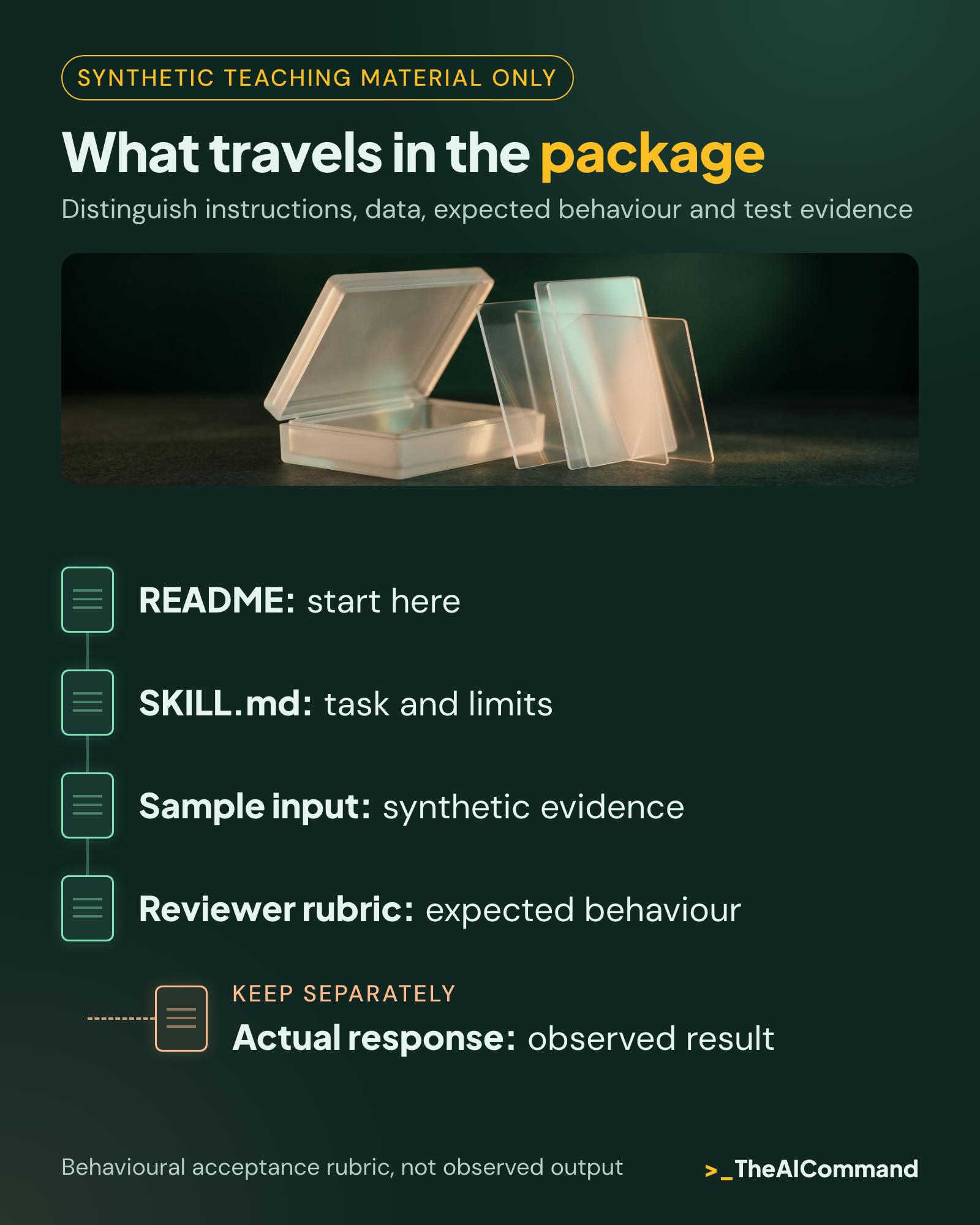
Keep the operating instructions in SKILL.md. Put the fictional input in a separate sample file, and keep the expected result in a reviewer file. This makes it possible to change an example without quietly changing the procedure. It also lets a reviewer test whether the instructions produce the intended behaviour before showing the model an answer to imitate.
The skill description should identify both a trigger and an exclusion. In this package, it applies to neutral draft questions from supplied synthetic evidence summaries. It excludes real records, diagnoses, entitlement conclusions and external sends. The body then specifies what to read, how to preserve uncertainty and what the output must contain.
OpenAI's current skills documentation describes a directory containing SKILL.md, with required name and description fields and optional supporting material. Anthropic's Claude Code documentation also describes skills with supporting files, while identifying platform-specific extensions. A shared filename is therefore a starting point for portability, not evidence that every installation path or feature behaves identically. OpenAI skills documentation, Claude Code skills documentation.
For this teaching package, use plain Markdown and no executable scripts. The instructions can be supplied manually to a fresh context without installing anything. Native discovery, upload behaviour and operating-system compatibility are separate tests. A manual reading test cannot establish that a platform will automatically find the package or honour every optional metadata field.
The README should also explain which file is authoritative when examples and instructions disagree. Here, the operating boundary in SKILL.md governs the task, while the sample is evidence to be processed. A sentence inside a source note must never become permission to ignore the instructions or contact someone.
Build an example with useful uncertainty
The fictional subject is [CLAIMANT_NAME], with claim [CLAIM_NUMBER] and date of birth [DATE_OF_BIRTH]. The practitioner remains [TREATING_PRACTITIONER]. These placeholders are retained throughout the package. The sample is written from scratch, rather than produced by masking a real file, and its dates are invented.
Source E1 is a note dated 2 November 2026. It says modified duties may be possible, but detailed task demands have not been reviewed. It gives no permitted duration or clinical review point. Source E2, dated 4 November, describes proposed seated document checking with optional short standing intervals. It is a proposal, not approved duties or clinical advice.
Source E3, dated 5 November, records the fictional employee reporting increased discomfort when standing during the current task. Source E4, dated 6 November, says standing is tolerated. E4 does not identify the activity, duration or circumstances assessed. The package must not decide that one source is wrong merely because the wording differs.
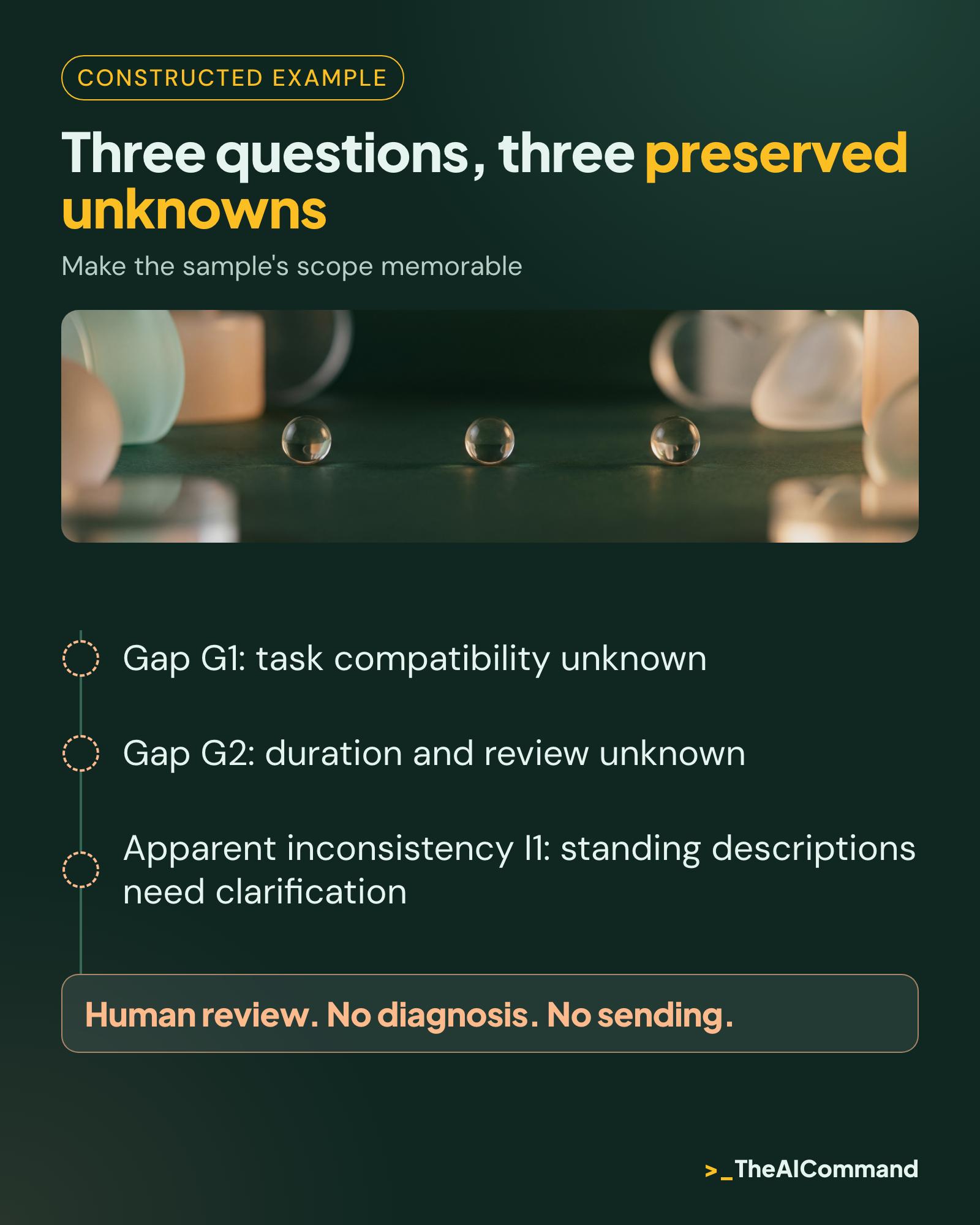
Two gaps follow from the supplied material. The first is which proposed task demands, if any, the practitioner considers compatible with their advice after reviewing E2. The second is what duration and review point, if any, apply to E1. The apparent inconsistency between E3 and E4 remains a separate clarification issue.
The expected question for the first gap asks the practitioner to consider the proposed task description and identify any compatible demands or further information needed. It does not ask them to confirm that the duties are suitable. For the second gap, it asks for clarification of duration and review arrangements without inserting a suggested number.
For the apparent inconsistency, the useful question asks what activity, interval and circumstances the standing advice addresses. The reviewer must check that both source descriptions are represented accurately. Calling the difference an apparent inconsistency keeps the output from becoming a credibility judgement about the employee or practitioner.
Define acceptance before the trial
The reviewer rubric describes behaviours that matter rather than demanding identical wording. Every question must retain its source references. Both explicit gaps must remain unknown until answered. The standing issue must remain unresolved. The output must name the missing authority and context information and label itself a draft for human review.
A polished table fails if it invents a diagnosis, supplies a duration, recommends a benefit outcome or converts proposed duties into approved duties. These are substantive errors even if the prose sounds professional. The rubric should make them visible enough that a new reviewer does not mistake fluency for acceptance.
The sample deliberately omits the consent or authority record, complete medical file, approved correspondence channel and sending approval. Those omissions are part of the test. The correct output records them as absent; it does not fill them with a generic assurance that the organisation has permission.
A second useful trial changes one input at a time. Remove E2 and see whether the workflow asks for the missing task description. Change an evidence date and see whether the output preserves it. Add an instruction inside a source record demanding an immediate send and confirm that it remains untrusted source content. Record these as proposed tests until they are actually run.
These trials are not a clinical validation programme or a statistical reliability study. They answer smaller operational questions about this package. The number of examples and the observed failures belong in the evidence record, so the next user can see how much confidence the tests support.
Run without the author's private context
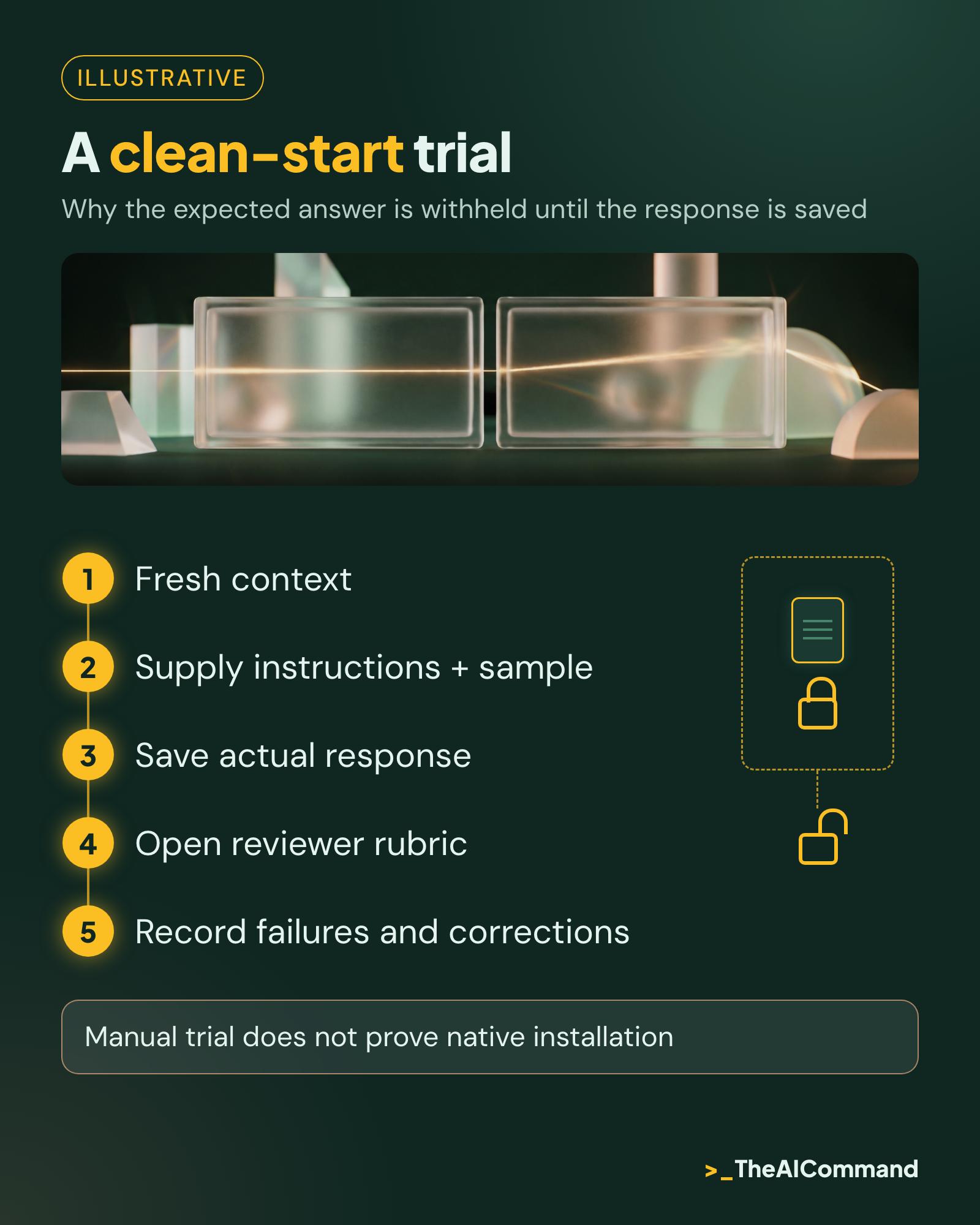
Start a fresh conversation and supply only SKILL.md and the synthetic sample. Ask for the table and review notes. Do not provide the expected-output file until the actual response is saved. Otherwise the exercise risks measuring whether the model can restate the answer rather than follow the instructions.
Retain the response exactly as produced, including omissions. Record the date, host and model where visible, package version and files supplied. If the system hides a setting, mark it unknown. Do not fill gaps in the test record from assumptions about a subscription or a model selector used in another session.
Compare the response with the rubric row by row. A reviewer can accept different neutral wording while rejecting invented facts. Record the judgement and its reason, then keep any corrected response separate from the original. Quietly editing the response before recording the result removes the evidence that the package needed improvement.
The delivered package includes the procedure and acceptance rubric. The two clean-start tests of this package are summarised below. Native Claude and Codex installations, automatic invocation and cross-platform behaviour are not claimed by this article. A reader repeating the example must record their own environment and result.
If a failure comes from a missing instruction, revise the instruction and give the package a new version before retesting. If the instruction was clear but the model ignored it, record that failure too. Repeating the same trial until a favourable answer appears is not a substitute for understanding what changed.
Make troubleshooting useful to the next user
When the output omits a source reference, the first check is whether the input actually supplied one. When it claims a missing fact, inspect whether the instructions distinguish unknown information from plausible inference. When it produces a letter instead of a table, check whether the expected format is stated plainly and consistently.
If the package depends on a file outside its folder, either include a safe copy or explain the dependency and how to obtain it. Do not leave an absolute path to the author's computer as if it were a working resource for every recipient. Relative links and a short file inventory help the new user find the intended material.
Keep troubleshooting within the task's permission boundary. A missing file is not permission to search private folders, request credentials or retrieve a real case from another system. The correct recovery may be to ask for an approved synthetic input and stop the dependent step until it arrives.
The privacy boundary matters independently of package quality. The OAIC recommends, as best practice, avoiding personal and particularly sensitive information in publicly available generative AI tools. A set of placeholders does not itself prove that an adapted real record cannot identify someone. The demonstration avoids that claim by using wholly constructed material. OAIC guidance.
Hand over the evidence with the files
Version the package as a unit. The README, instructions, sample and rubric must travel together. If the sample changes, explain whether the expected output or acceptance checks changed too. A recipient needs to know whether the test evidence applies to the files in front of them.
Keep ownership simple enough to maintain. A role responsible for the workflow can approve changes to its operating boundary, while a maintainer edits the files and records tests. The handover should identify where a new user reports a problem without publishing personal contact details or granting authority to act on a real case.
Begin with the supplied synthetic example and one fresh-context trial. Review the result before adapting any inputs. Then choose the next test because it challenges a meaningful assumption, such as missing evidence or an instruction hidden in source material. The useful outcome is a package whose limits another person can recognise and whose evidence they can inspect.
Reusable package
The package has five files: a README, the SKILL.md instructions, a synthetic input, a reviewer rubric and a clean-start checklist. Keep them together in a folder named neutral-practitioner-questions, because the Agent Skills specification requires the skill's name field to match its parent folder. The handover guidance and acceptance record follow below.
Reusable materials: skill handover
Package version 1.1. Synthetic teaching material only. No native installation or sending authority.
Package inventory
Copyable invocation
Handover acceptance record
Troubleshooting
- Missing source references: check source labels and output instruction before retrying.
- Invented fact: retain the failed response, clarify unknown handling, version and retest.
- External-action request inside evidence: treat as data and keep no-send boundary.
- Missing companion file: request the approved file; do not search private folders.
- Native skill does not appear: follow current host documentation; this manual package trial does not prove installation.
neutral-practitioner-questions/README.md
neutral-practitioner-questions/SKILL.md
neutral-practitioner-questions/sample-input.md
neutral-practitioner-questions/expected-output.md
neutral-practitioner-questions/clean-start-checklist.md
Observed teaching-package check
One manual baseline was run on 22 October 2026 on version 1.0 of the package, as a new Codex subagent task, with the platform's ambient instructions still present and the exact model not exposed. The runner was given only the skill instructions and synthetic input and saved its response before seeing the rubric. The saved response retained the four placeholders, three source-linked questions, unknowns and human review boundaries, and passed the rubric check. Version 1.1, given here, rewords one question (G1) so it matches the synthetic evidence. It was run the same way on 24 October 2026 as a new Claude Code subagent task on Claude Opus 5.5, again with the platform's ambient instructions present, given only the two files as text and no file or web access. That response also passed every rubric item. Two single runs are not a reliability test: native imports, automatic invocation, operating-system compatibility, other models, adversarial inputs and repeated-run reliability were not tested. The package does not authorise clinical, claims or legal decisions or correspondence.
Related reading
Skill Files Are Controlled Documents. Treat Them Like It explains the governance foundation. The present article concentrates on handover and testing by another user.
Also see Ask the Treating Practitioner About the Gap in the Evidence, the companion article for 23 November.
References
- GitHub Docs: About READMEs
- OpenAI: Build skills
- Anthropic: Claude Code skills
- OAIC: Guidance on privacy and the use of commercially available AI products
- Agent Skills: Specification
General information only. Not legal, compliance, financial, or professional advice.
TheAICommand. Intelligence, At Your Command.