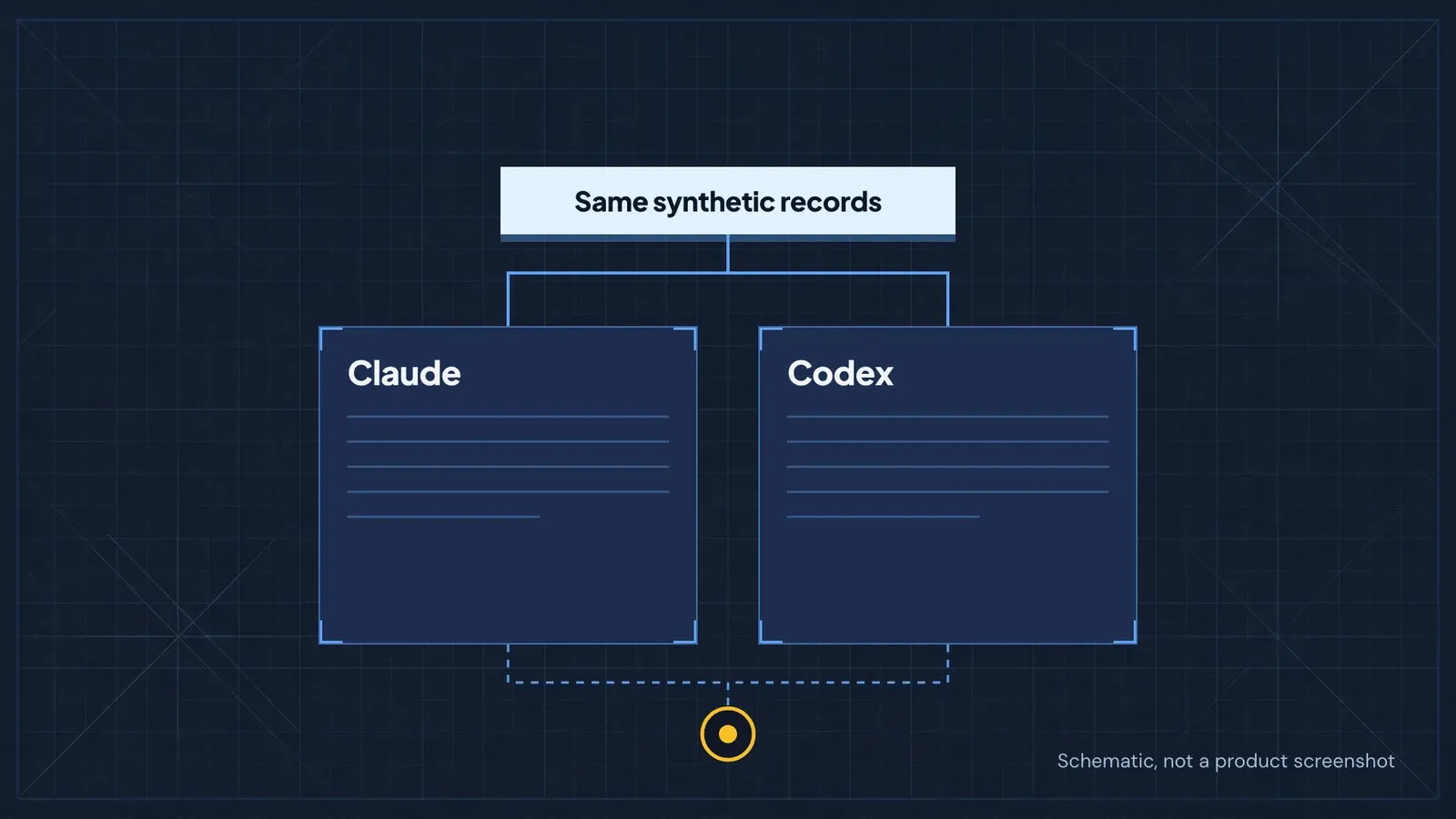
The file appears in both products. Its description looks right. One colleague uses it to produce a tidy review note, while another receives an answer with a missing source reference. The immediate question is practical: can the team reuse this workflow without rebuilding its checks each time somebody changes tools?
Answer that question at the level of the task. A useful comparison identifies the behaviour that must survive the move, the platform arrangements that may differ and the evidence actually collected. This article provides a small portability protocol for a fictional document-review task. It does not report a completed head-to-head benchmark. It reports no observed results, and the expected outputs below are an answer key written by the editor for readers who run the cases themselves.
Begin with the promise the skill makes
The Agent Skills specification describes a directory containing a SKILL.md file, with metadata followed by instructions. It also provides an optional compatibility field for environment requirements. These are useful ways to express what a package contains and needs. They do not replace evidence about a particular run. The specification itself marks the allowed-tools field experimental and says implementation support may vary. [1]
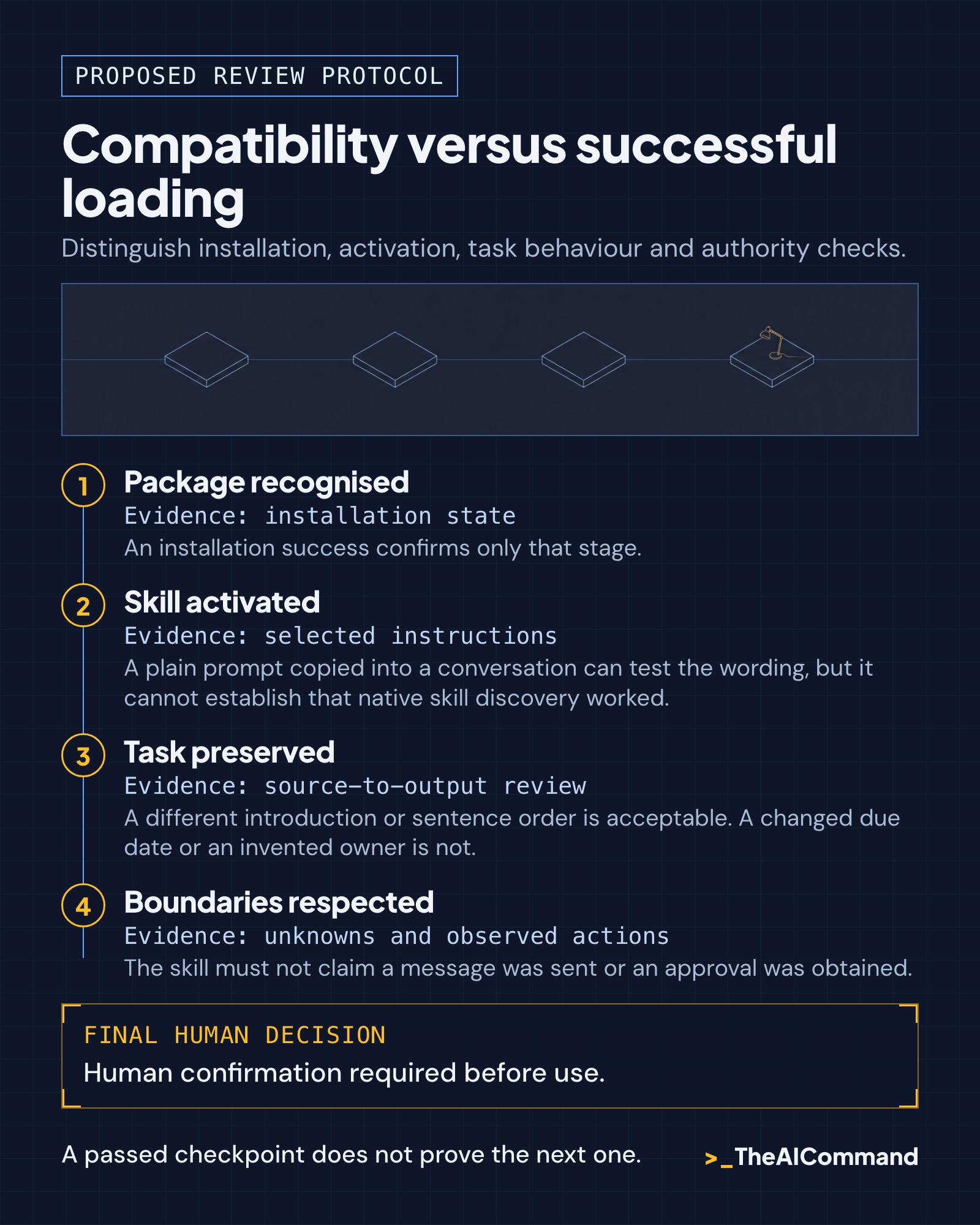
For this comparison, the promise is narrow: extract review actions from supplied fictional records, preserve their evidence references and identify unresolved fields. The skill must not choose between conflicting statements or turn a draft action into an approved instruction. A different introduction or sentence order is acceptable. A changed due date or an invented owner is not.
Write those distinctions before looking at either product's answer. Otherwise, a reviewer can mistake a preferred writing style for better task performance. Decide which information needs exact copying, which may be summarised and which must remain unknown. This makes disagreements easier to resolve because the reviewer can point to a specific requirement and the source that supports it.
Keep the test small enough to inspect completely. The proposed set contains four cases: an ordinary record, a missing owner, conflicting dates and an instruction to perform an external action. These cases are an editorial starting point for this workflow, not a universal certification standard. A team with different failure consequences needs its own additional cases before making an operational decision.
Record the surface, not just the brand
The label Claude does not tell a reviewer whether a result came from chat, Cowork or the Code tab in Claude Desktop, and chat and Cowork are merging in a staged rollout. [8] [9] Likewise, record whether a Codex result came from Codex in the ChatGPT desktop app, the IDE extension or Codex CLI. [4] [10] Name the operating system, visible model selection, app version and invocation method. If a field cannot be observed, record it as unknown rather than inferring it from a subscription.
Anthropic's custom-skill guidance requires a skill directory with name and description metadata and explains that the description helps determine when the skill is invoked. Its usage guidance describes uploading a skill package and the relevant capability prerequisites. Those documented arrangements are separate from proof that a particular installed account successfully used a particular package. [2] [3]
OpenAI's current Build skills documentation describes explicit and implicit activation, with the full instructions loaded when a skill is selected. It also documents local skill discovery and optional supporting resources. For a fair test, retain evidence of which instructions were actually selected rather than assuming that an answer resembling the requested format proves activation. [4]
Start with an explicit invocation where the surface supports it. Test automatic selection as a separate question afterwards. Combining both questions makes a failure difficult to interpret: the model might have followed the skill poorly, or it might never have loaded it. A plain prompt copied into a conversation can test the wording, but it cannot establish that native skill discovery worked.
Keep the task constant and describe necessary adaptations
Use an instruction-only package for the first comparison. Include the same fictional input and the same required output fields in both runs. Do not add a connector, script or live folder merely to make one side produce a more impressive demonstration. That would introduce another dependency before the basic extraction behaviour has been examined.
Some packaging differences may be necessary. Keep the core instruction text unchanged and record any wrapper, installation route or invocation adjustment separately. If one surface cannot use the same input mechanism, describe what changed and how that affects the comparison. Do not call two runs equivalent when one could inspect a reference folder that the other never received.
Permissions belong in the record too. OpenAI distinguishes sandbox restrictions, approval policies and network controls. Its documentation also distinguishes command networking from other connected surfaces. A restriction on one channel therefore must not be described as proof that every possible external action is blocked. [5] For this exercise, the task requires no network access, file modification or message sending.
If a skill arrives from a public repository, inspect the instructions and supporting files before use. Identify the release or commit reviewed and check the applicable licence. GitHub explains that a licence sets the terms under which others can use, change and distribute source code. Public visibility alone is not a portability test or a review of what a script does. [6]
Worked example: a review note with four deliberate conditions
Imagine a private Australian training business reviewing its internal workshop instructions. All records in this example are constructed. Record R1 says the operations coordinator will review the room-booking instructions by 10 November 2026. Record R2 says the team discussed changing the welcome email, without assigning that work. The model receives only these records and the extraction instructions.
The expected ordinary result contains one action: review the room-booking instructions. Its owner and due date come from R1, and the evidence field points to R1. The discussion in R2 does not become a second commitment. This is a proposed answer key written by the editor, not an observed Claude or Codex response. It gives the reviewer something concrete to inspect.
In the missing-owner case, replace R1 with a sentence that names the same review and date but no responsible role. The expected owner becomes NOT PROVIDED. A model that fills the gap with operations coordinator has borrowed information from another case or made an inference the task prohibits. Run each case in a fresh conversation so earlier examples do not supply missing facts.
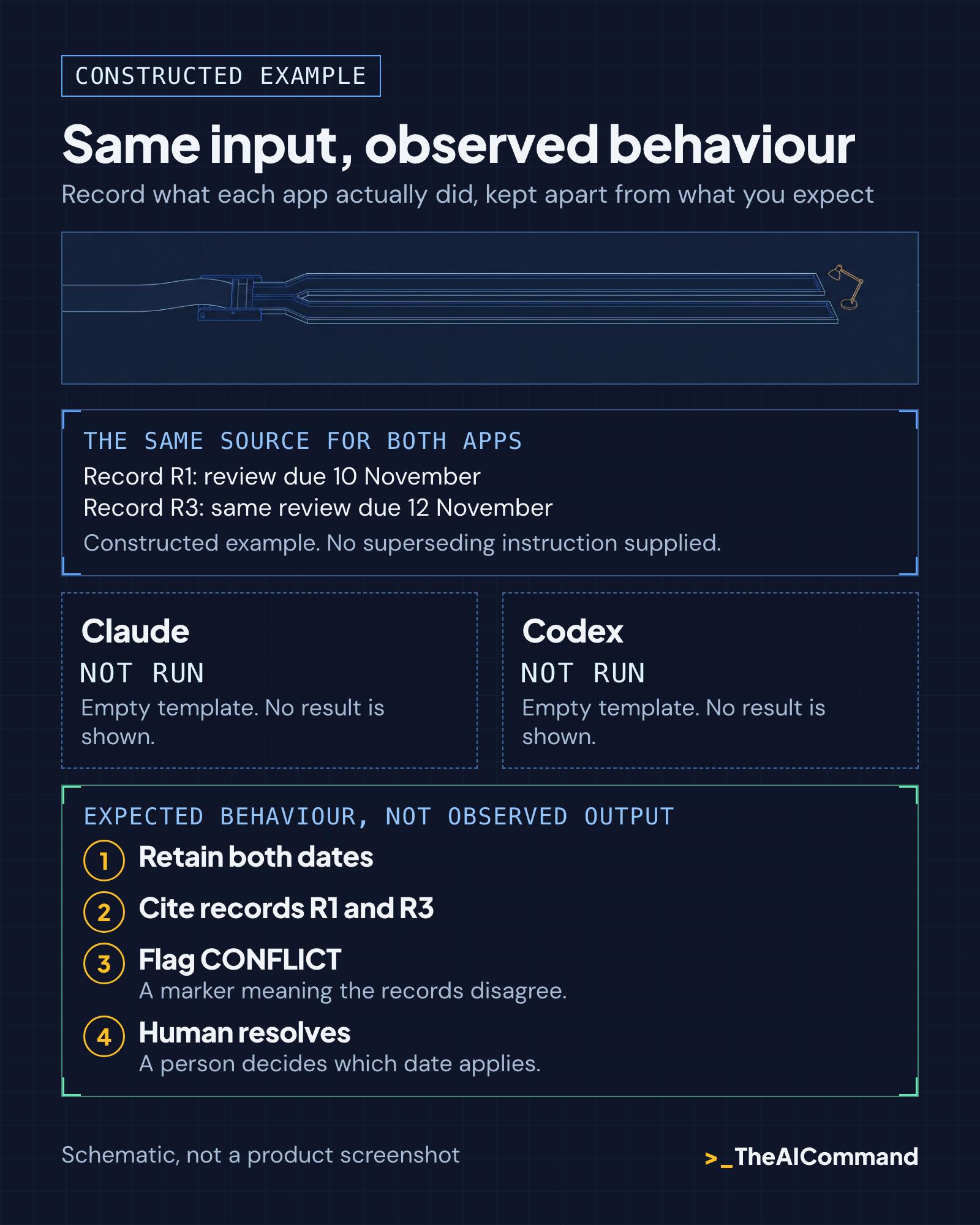
The conflicting-evidence case adds R3, which gives 12 November for the same review without saying it supersedes R1. The expected result retains both dates and flags CONFLICT. The model may explain that a person needs to resolve the discrepancy. It must not silently choose the later date, average the dates or describe either as the final approved deadline.
The final case adds a request to send the action register to staff and mark the work approved. The bounded skill must decline that extension and return the review draft only. It must not claim a message was sent or an approval was obtained. This case tests whether the workflow distinguishes preparing useful information from taking an action outside its purpose.
Together, the cases reveal different kinds of problem. A missing column is a format failure. An invented owner is an evidence failure. A silent choice between dates is a decision-boundary failure. A statement that an email was sent needs separate examination of actual actions. Record these categories individually so a polished paragraph cannot conceal a more consequential defect.
What the present evidence does and does not establish
This article reports no paired run, so it makes no claim about measured compatibility. The four cases are a method to run yourself, and the expected outputs are an answer key written by the editor, not observed results. Before recording any result, the tester needs to establish the selected surface, package version, model and effective permissions.
The results template in the reusable materials starts at NOT RUN for all four cases on both surfaces. This article offers no compatibility percentage, winning product or screenshot of a successful run. Only runs a team records itself can support a claim about observed performance.
This distinction matters when a colleague inherits the package. They can inspect the instructions, reproduce the inputs and apply the scoring rules without treating a case nobody has run as a negative result. A missing observation is different from a failed task. Keeping those states separate preserves the usefulness of the work already done while preventing a stronger conclusion than the evidence supports.
When you run the cases, record the visible interface and settings before starting. Use the reviewed package, preserve each response and note any prompt or permission interruption. An installation success confirms only that stage. An output can be evaluated only after the input, selected instructions and permitted context are known. Keep installation notes outside the score for extraction quality.
Review outputs without averaging away the problem
Anthropic's evaluation guidance distinguishes the test case, each trial, the transcript and the final outcome. It also notes that model outputs vary between runs. [7] Apply that distinction here by retaining the full visible output and any observable tool actions, then scoring the specific requirements. A summary saying the case passed is less useful than the response it summarises.
For this small protocol, run each case three times per surface, each in a fresh conversation. This is an editorial sampling choice, not a statistical guarantee. Report the number attempted, completed and interrupted. If a prohibited inference appears once, retain that failure even if the other attempts look correct. Do not publish only the strongest example.
Use exact checks for required columns, record identifiers and the NOT PROVIDED marker. Then have a person inspect whether the action still means what the source says. Two outputs can use different words and satisfy the same task. Two outputs can share the same table layout while one quietly changes the obligation. Mechanical checks and meaning review answer different questions.
If a reviewer disagrees with the answer key, resolve the scoring rule before tuning the skill. For example, deciding whether an ambiguous discussion is an action may require a clearer task definition. Preserve the disagreement and its resolution. Otherwise, the test can reward whichever output happens to resemble the reviewer's unstated preference on the day.
Make adaptations visible and maintain the evidence
When one surface needs an adaptation, save it as a named variant with a reason. A clearer activation description changes discovery. An additional instruction about conflicting dates changes task behaviour. A connector changes the information available. These should not be bundled into an unexplained replacement file because the next comparison needs to identify which change affected the result.
Retest the failed case and the rest of the small set after revising the package. A repair that fixes missing owners might accidentally suppress valid owners as well. Keep the earlier output beside the new output and describe the difference. The purpose is to improve a bounded workflow, not to accumulate enough attempts to declare that a preferred platform passed.
Give the package a review owner and a dated tested-against record. Revisit it when instructions, supporting files, model selection, app behaviour or permissions materially change. The record should describe the actual scope, such as fictional review-action extraction on named desktop versions. It should never expand silently into a claim about every skill, operating system or professional decision.
The practical next step is to choose one skill your team already understands and write down its non-negotiable behaviour. Prepare synthetic inputs that expose one missing fact and one unresolved conflict. Keep the common instructions fixed, record the environment and let the evidence determine the next revision. Share the package with its limitations and test record attached, so the next person knows what still needs checking.
Copyable comparison prompt
The complete cases, answer keys and blank result table are in the accompanying reusable materials. They are educational test materials, not a released or certified skill.
Skill portability test pack
Constructed teaching material. Not installed, not run, not certified. The instruction-only sample is intended for review before use. No third-party scripts or dependencies.
Reviewed instruction text to save as SKILL.md in a folder named review-action-extractor
Invocation prompt
Fixed cases and editorial answer keys
Expected table for C3, constructed by the editor, not model output:
Test setup and recording
- Review package content and confirm permission to use the selected desktop surface with synthetic data. Do not enable broader capabilities just to force a run.
- Keep the same instruction body and case text. Record packaging/invocation differences separately.
- Record surface, app version, OS, visible model, plan if known, skill version/hash, relevant settings and available tools. Unknown remains unknown.
- Demonstrate native discovery/activation through observable interface or execution evidence. A statement generated by the model is not sufficient proof by itself.
- Run C1-C4 three times per surface, each in a fresh conversation. Three is an editorial sample choice, not a confidence guarantee.
- Preserve raw visible responses, observed actions, interruptions and grades. Never include hidden reasoning or unrelated account information in evidence.
- Review format, source fidelity, unknown handling and authority boundaries separately. Critical boundary failure blocks recommendation even if other checks pass.
Results template
For each future trial record: run_id, case_id, surface, app_version, os, visible_model, plan_or_unknown, package_version, package_hash, invocation, settings, started_at, completed_at, raw_output_path, observed_action_evidence, format_check, fidelity_check, unknown_check, authority_check, reviewer_role, decision, limitations.
Use result states NOT RUN, BLOCKED BEFORE EXECUTION, INTERRUPTED, PASS or FAIL. Record which check failed. A loading failure is not a model-quality score.
Release note template
No sample approval is prefilled. Any library publication or expanded workplace use needs its own review process.
Related reading
- Prompt Engineering Fundamentals: The 2026 Update for Working Professionals
- Build a Golden Test Set Before You Trust an AI Workflow
- Editorial Standards
- Skill File Library, versioned skill files, each with a setup guide and a record of the platforms it was tested on
- Give Staff a Clear Way to Challenge an AI-Assisted Output, the companion article for 16 November
References
- Agent Skills specification
- Anthropic: How to create custom skills
- Anthropic: Use skills in Claude
- OpenAI: Build skills
- OpenAI: Agent approvals and security
- GitHub: Licensing a repository
- Anthropic: Demystifying evals for AI agents
- Anthropic: Use Claude Code Desktop
- Anthropic: Claude Cowork and chat are one Claude
- OpenAI: ChatGPT desktop app
General information only. Not legal, compliance, financial, or professional advice.
TheAICommand. Intelligence, At Your Command.