
A team member reads a polished weekly report and sees two problems. One sentence says every service issue is resolved. Another says the team needs additional capacity. The first conflicts with the issue register. The second could be a reasonable concern, but the report has not explained its reasoning. Sending both back with "the AI got this wrong" leaves the reviewer without a useful distinction.
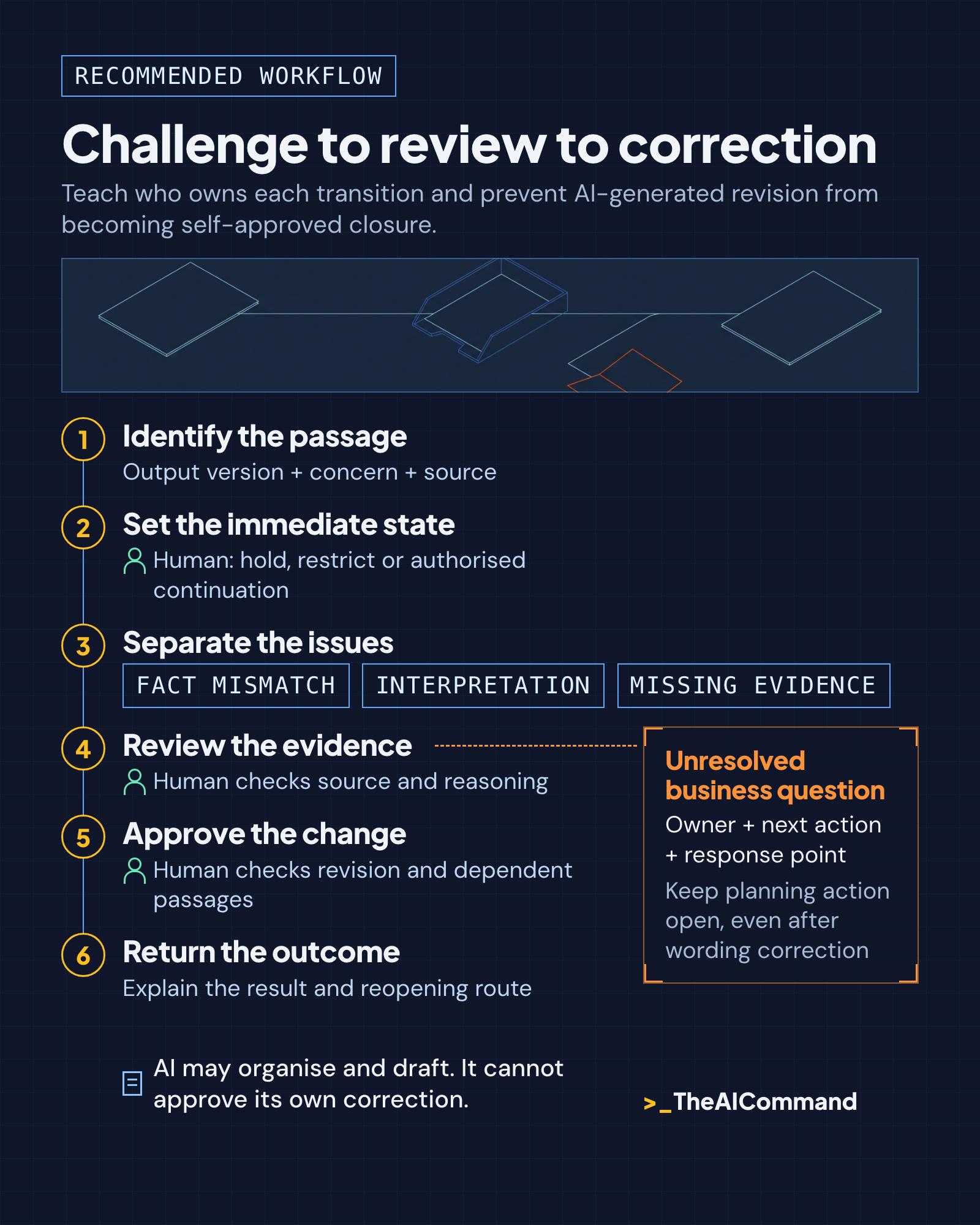
The task is to make each concern answerable without requiring the person raising it to write a replacement report. A challenge route needs room for an incomplete concern, a missing source or a disagreement that survives review. The following procedure is a recommended editorial workflow for ordinary team reporting. It does not replace workplace grievance processes or the organisation's formal reporting obligations.
Start with the disputed output
Ask for the document version, the passage in question and the reason for concern. A staff member can identify a mismatch without knowing whether its cause was retrieval, drafting or a human instruction. Accept "the register still shows an open item" as a useful starting point. Diagnosing the model is the reviewer's task, if diagnosis is needed at all.
Keep the original wording with the challenge. Quietly editing the report before recording the issue makes later discussion harder: people may remember different versions. Preserve an appropriately restricted copy or version reference, then identify the current working copy. This is about tracing the correction, not creating an unrestricted archive of workplace information.
The route also needs a place for concerns about meaning. A sentence can reproduce every number correctly and still imply more than the evidence supports. Ask what conclusion the reader draws and which alternative interpretation needs consideration. Do not force every challenge into a binary "true or false" field. That structure can conceal the very judgement the reviewer needs to examine.
Make the route available outside the producing bot. A person who thinks the assistant misunderstood the evidence needs a way to reach a human without persuading that assistant first. A shared form or ordinary email can work if ownership and access are clear. Offer another receiver where the usual reviewer is directly involved in the disputed decision.
Decide the immediate state before investigating
The receiving manager records whether the output is held, restricted or continuing under an authorised control. That decision considers what could happen before review finishes. An internal draft awaiting a meeting may simply remain a draft. Material already used to direct work can require a separate containment response through the established process.
An acknowledgement should identify the two issues, the reviewer and the next response point. It need not promise a final answer before the evidence is available. "Report version 3 is held; the service owner will review the status statement and the capacity inference separately" gives the challenger something concrete. An automated receipt without ownership does not complete this step.
Avoid turning receipt into an employment judgement. Do not ask the model to score how reasonable, loyal or competent the challenger appears. Keep personal allegations and confidential employment matters out of the drafting assistant. If the concern belongs in a formal workplace process, the authorised human redirects it while preserving the appropriate record and immediate safeguards.
Fair Work Ombudsman's best-practice guide favours accessible and fair dispute procedures with confidentiality and transparency. It also distinguishes informal resolution from matters needing a formal approach. That supports careful process design, not a claim that this particular AI challenge form satisfies every workplace obligation. Applicable procedures and employment requirements need their own review. [1]
Worked example: two issues in one fictional report
Consider a constructed private-sector maintenance business preparing an internal weekly service report. Every document, value and role below is invented for this teaching example. No real employee records were used, and no model run or successful intervention is being reported. The exercise concerns reporting quality, not individual performance or staffing decisions.
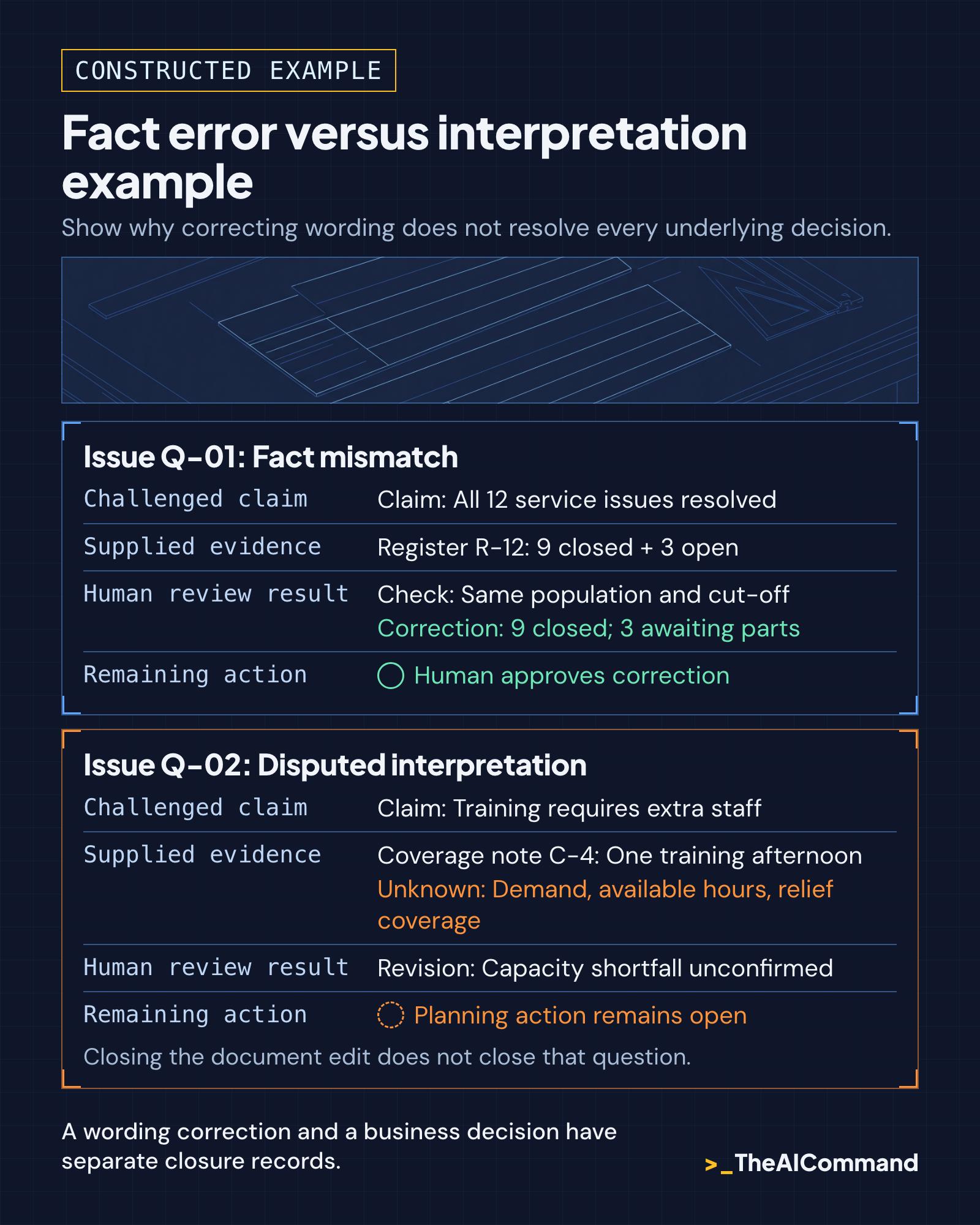
The source pack contains register R-12 and coverage note C-4. R-12 lists twelve service issues: nine closed and three open at the reporting cut-off. The three open items are awaiting parts. C-4 records one planned training afternoon next week. Neither document records demand forecasts, working hours, the age of each open issue or available relief coverage.
The fictional draft says, "All twelve service issues were resolved this week. Next week's planned training means the team cannot meet customer demand without extra staff." The first sentence is an unsupported completion claim. The second makes an inference about future capacity using information that does not establish either demand or available coverage.
A staff member challenges both statements. For issue Q-01, the evidence is specific: three rows in R-12 remain open. For Q-02, the concern is that planned training alone does not establish a capacity shortfall. The person need not prove there is enough capacity. The challenge concerns the strength of the report's conclusion, not a competing guarantee.
The reviewer holds version 3 and asks AI to prepare two evidence summaries from the approved synthetic pack. The bounded task is to identify the challenged wording, relevant source passages and unanswered questions. It cannot decide staffing, rank the challenger or declare the report fit for circulation. If a source does not answer a question, the summary must say so.
For Q-01, the expected draft summary reads: "R-12 records nine closed and three open issues at cut-off. The statement that all twelve were resolved conflicts with the supplied register. Confirm the reporting population and cut-off before replacing the sentence." That final check matters because a register and a report can refer to different periods even when their totals match.
The human reviewer checks the period and population and confirms that they are the same in this constructed case. The proposed replacement becomes, "Nine of twelve service issues are recorded as closed at cut-off; three remain open awaiting parts." It describes the register accurately without implying that closure proves service quality or that the open items are overdue.
For Q-02, the expected summary reads: "C-4 confirms planned training. The pack does not establish demand, available hours or relief coverage. A capacity shortfall remains unconfirmed." The reviewer requests those missing inputs from the operations owner. The model must not fill the gap with an industry staffing ratio or invent a typical demand pattern.
Suppose the operations owner can confirm training arrangements but cannot yet supply a reliable demand forecast. The corrected report can state that coverage requires review before the roster is finalised. It cannot say that extra staff are necessary or unnecessary. Q-02 remains open for the planning decision even if the overconfident wording has been removed from the report.
This produces two outcomes with different meanings. Q-01 is a supported factual correction after checking the source boundary. Q-02 is a revised statement of uncertainty plus an unresolved operational question. Closing the document edit does not close that question. The service owner records a separate action and response point so the remaining work stays visible.
Give the reviewer a decision they can explain
A useful review record connects conclusion to evidence. For each issue, preserve what was challenged, what the reviewer checked and why the wording changed or remained. "Amended following feedback" is too vague to distinguish a correction from a preference. "Status wording now matches R-12 at the confirmed cut-off" explains the first decision without recreating the entire discussion.
For an interpretation dispute, record the strongest relevant alternative and the evidence that would change the conclusion. The reviewer can decide that the original interpretation remains reasonable, but the record must explain why. A challenge process does not require agreement on every judgement. It does require an answer that addresses the concern rather than the seniority of the person raising it.
In internal audit, specific professional requirements govern correction and disagreement. The IIA's Standard 11.4 addresses significant errors or omissions in final engagement communications. Standard 13.1 addresses unresolved differences over engagement results. Those standards apply within internal audit; they do not mandate this workflow for every manager or endorse AI as a reviewer. [2]
Keep the producing bot outside the approval step. Asking it to compare version 3 with version 4 may help locate changed passages. Asking it whether its own work is now acceptable does not supply the independent human judgement this procedure requires. A second model can also assist with questions, but its agreement is not the approval record.
The reviewer should inspect adjacent wording after a correction. Changing "all resolved" to "nine closed" may leave an executive summary, chart label or action recommendation inconsistent. Check each affected representation against the revised evidence. The boundary is practical: examine the places the disputed claim travelled, rather than treating the corrected sentence as an isolated object.
Return the outcome to the person who raised it
The closure message identifies the issue, the outcome and the remaining action. In the example, it explains that Q-01 changed because the source register contained open items. It explains that Q-02 no longer presents a capacity shortfall as established, while the operations owner still needs to assess coverage. The challenger sees both the correction and the unresolved question.
If the original report has already circulated, identify its recipients and any known downstream use. The accountable owner decides the appropriate correction communication under the organisation's established rules. Replacing a shared file may be insufficient if a recipient has copied its conclusion into another report. Record which audience received the revised information without claiming that every copy has been retrieved.
Offer a route to reopen the issue with new evidence or to escalate a process concern. Do not make the original reviewer the only available destination where their own interpretation is disputed. The route can be proportionate to the work, but it needs an accountable alternative. The model must not reject a reopening because an earlier ticket says "closed".
Separate feedback about the process from the substantive result. The challenger may accept the corrected figure while reporting that the route was difficult to find. That is a process improvement item. A response survey or informal comment must not be used to infer employee sentiment or future cooperation. Collect only the information needed to repair the workflow.
Learn from corrections without profiling staff
A modest issue register can reveal recurring source mismatches, unsupported certainty or forgotten recipients. Review those patterns against the task and source pack. If the same stale register keeps appearing, fix how the approved source is selected. Repeating a warning to "check carefully" leaves the underlying ambiguity in place for the next draft.
Do not rank people by how often they challenge outputs. A high number may reflect their role, workload or access to evidence. A low number does not establish that everything is correct. Use fictional exercises to check whether the route is usable, and discuss obstacles directly with the people expected to use it.
Choose a small drill that contains both kinds of issue from the example. Observe whether the receiver separates fact from interpretation, keeps unresolved work visible and returns a reasoned answer. Record what actually happened. A completed drill can demonstrate that those steps occurred in that exercise; it cannot prove that the process will succeed in every consequential situation.
Make the next challenge easier
For the next report cycle, attach a short challenge route to the working document. Name the human receiver, identify the immediate hold option and provide space for a source reference or an unanswered question. Agree how another reviewer can become involved. Keep the form short enough to use while the concern is still fresh.
Then rehearse the two-issue example with the people receiving challenges. Check whether a factual correction can close while an interpretation question stays open. That distinction makes the route useful: staff can question the output without having to settle the whole business decision. Give the concern an owner, preserve the reasoning and return the answer.
Copyable resource
Use the output-challenge form and evidence-summary prompt on this page. It includes the constructed report, source facts and separate closure records.
Output-challenge form and evidence-summary prompt
Recommended editorial workflow. All example records are constructed, not observed runs. Human approval and adaptation to applicable workplace procedures remain required.
Output-challenge form
Do not require a diagnosis of the model or a proposed replacement sentence. Keep employee grievances, health information and other confidential material in the authorised process, outside this AI evidence-summary exercise.
Constructed source pack
- R-12, weekly service register at the confirmed example cut-off: twelve service issues, nine closed, three open awaiting parts. No overdue assessment supplied.
- C-4, next week's coverage note: one planned training afternoon. No demand forecast, available-hours assessment or relief coverage supplied.
- Report version 3: "All twelve service issues were resolved this week. Next week's planned training means the team cannot meet customer demand without extra staff."
- Q-01: completion statement conflicts with R-12.
- Q-02: training alone does not establish a future capacity shortfall.
Evidence-summary prompt
Expected example records, not model observations
Human closure checklist
- [ ] Original output and source versions retained under approved access arrangements.
- [ ] Each concern answered separately, with unknowns preserved.
- [ ] Immediate state decided by an authorised human.
- [ ] Corrected passage and dependent summary/visual checked.
- [ ] Unresolved business question transferred with an owner and response point.
- [ ] Relevant recipients and challenger receive the authorised outcome.
- [ ] Reopening or escalation route stated.
- [ ] Producing bot has not approved its correction or assessed the challenger.
Related reading
- Silence Is Not Human Oversight
- Does the Same Skill Behave the Same in Claude and Codex?, the companion article for 16 November
References
- Fair Work Ombudsman: Effective dispute resolution best practice guide
- The Institute of Internal Auditors: Global Internal Audit Standards, condensed edition, published 9 January 2024, Standards 11.4 and 13.1
TheAICommand. Intelligence, At Your Command.