A draft request repeats several pages of a claim history and ends by asking the treating practitioner to confirm a preferred conclusion. The file becomes longer, but the unanswered question remains unclear. A more useful starting point is a short statement of what the supplied evidence does not establish and why clarification matters to the current task.
This workflow prepares that statement and turns it into a reviewable question. It is designed for practitioners working within the Comcare scheme under the Safety, Rehabilitation and Compensation Act 1988, referred to here as the SRC Act. It does not determine liability, assess clinical evidence or choose whether an examination is required.
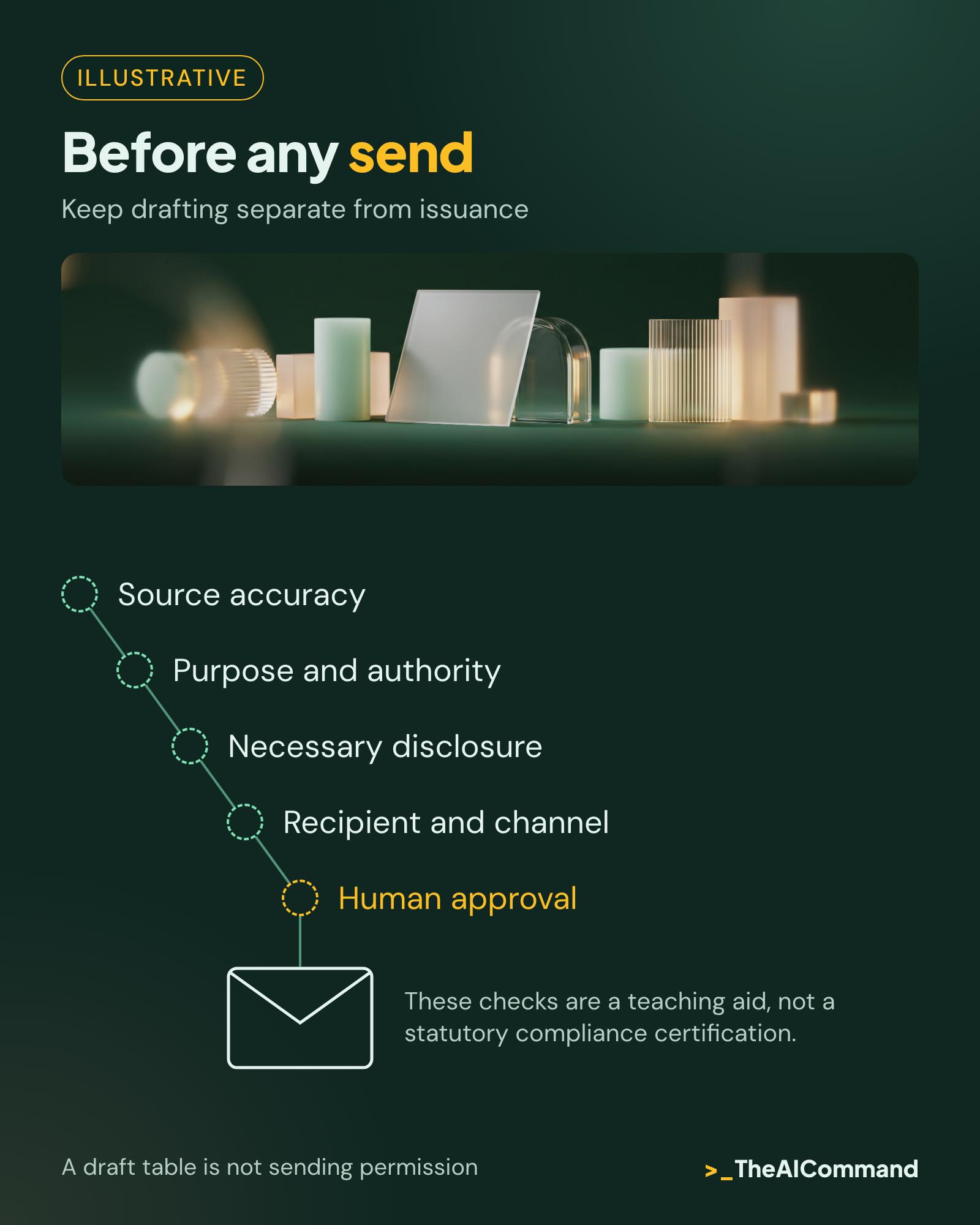
The model's contribution is bounded. It organises supplied source references, identifies stated omissions and proposes neutral wording. The human reviewer decides whether a request is appropriate and authorised. A complete draft table is still a working aid; it is not permission to disclose information or send correspondence.
Give the request a specific purpose
Before opening a model, write one sentence explaining the administrative task. In the example below, the purpose is to prepare questions clarifying functional information for an authorised claims practitioner's review. That purpose is narrower than asking for every piece of medical information that might become useful later.
Comcare explains that a claims manager may ask for a medical report to help manage a claim, recovery or return to work. That establishes a general context for obtaining information, but it does not make every suggested question necessary or appropriate in a particular matter. The reviewer must connect the proposed request to the actual task and governing process. Comcare, Medical reports.
A useful purpose statement also limits the output. If the task concerns what an existing note means, the model does not need to write an entire determination or rehearse unrelated medical history. If the task concerns a specific proposed duty, the actual description of that duty matters more than a generic description of the employee's occupation.
Keep authority separate from relevance. A question can be relevant and still require further checks before it is issued. The drafting table should leave space for the authorised reviewer to confirm the basis, recipient, consent or other applicable requirements, approved channel and recordkeeping arrangements. The model cannot supply missing authority from the usefulness of its own draft.
Preserve what each source actually says
Build a short source summary with stable references. Each item needs its document type, date, relevant passage or faithful summary, and any qualification that changes its meaning. Distinguish a worker's report from a practitioner's observation, a proposed task from an approved arrangement, and a preliminary view from a final opinion.
An uncertainty can disappear through small edits. "May be possible" does not mean "is suitable". "Standing is tolerated" does not establish duration or explain which activity was assessed. If the summary removes those distinctions, even a careful question-writing prompt will be working from a distorted record.
Use the smallest source set sufficient for the drafting exercise. This is not an invitation to upload a complete case file. The article's example is wholly synthetic and uses [CLAIMANT_NAME], [CLAIM_NUMBER], [DATE_OF_BIRTH] and [TREATING_PRACTITIONER]. None of the invented notes describes an actual person or event.
The OAIC's guidance recommends avoiding personal and particularly sensitive information in publicly available generative AI tools as best practice. Replacing names does not establish that a real narrative is anonymous, because circumstances may still identify someone. For training and workflow development, a constructed example avoids the need to make that unsupported assurance. OAIC guidance.
Work through two gaps and one apparent inconsistency
Consider a fictional Commonwealth employer within the Comcare/SRC scheme. The source packet concerns [CLAIMANT_NAME], claim [CLAIM_NUMBER], date of birth [DATE_OF_BIRTH], and [TREATING_PRACTITIONER]. All dates and statements in this example are invented. The packet is deliberately incomplete so the workflow can demonstrate how unknown information remains visible.
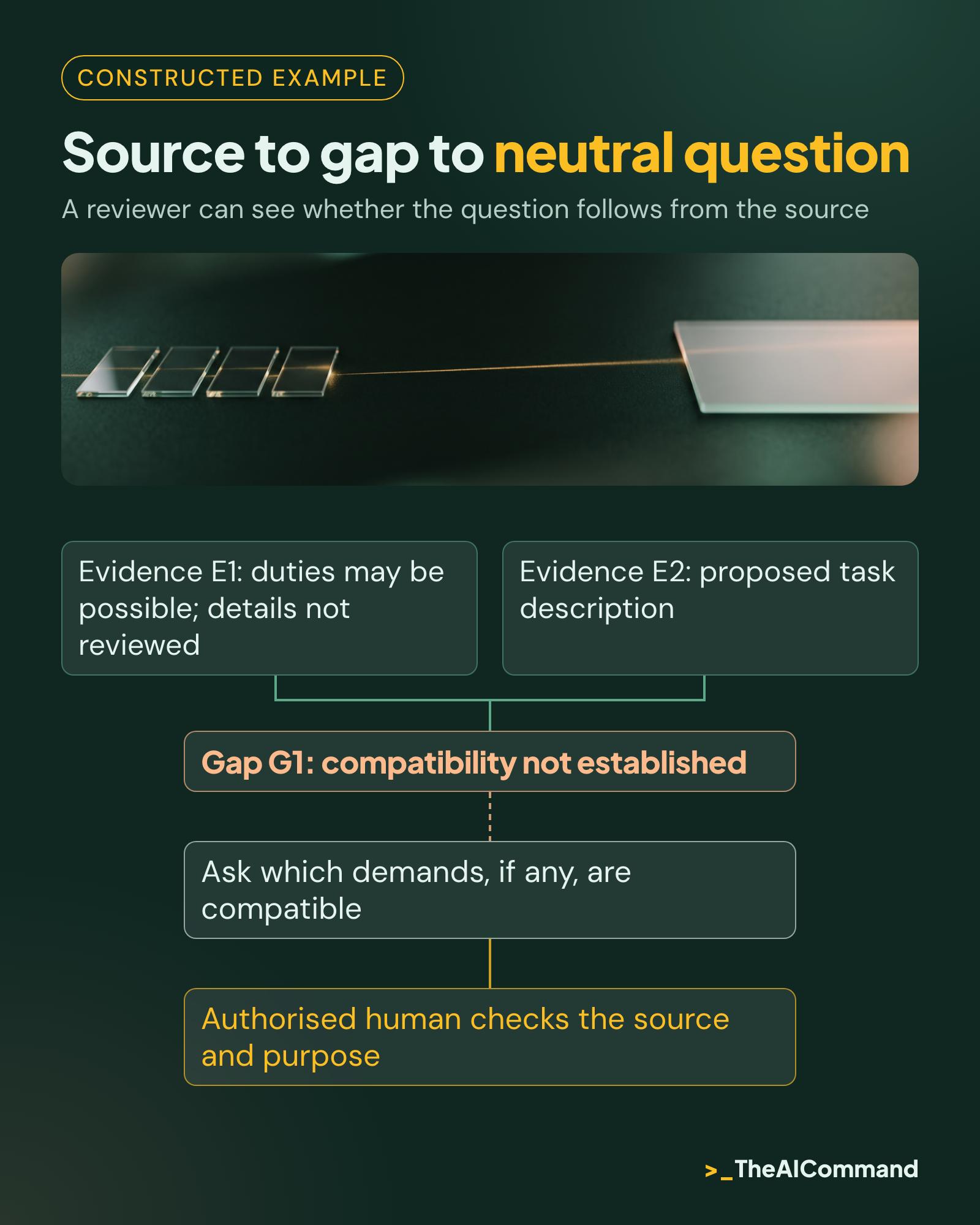
Evidence E1 is a treating-practitioner note dated 2 November 2026. It states that modified duties may be possible, while noting that detailed task demands have not been reviewed. It does not give an applicable duration or clinical review point. The phrase about possible duties is therefore conditional, and the condition belongs in the draft.
Evidence E2 is a proposed task sheet dated 4 November. It describes seated document checking with optional short standing intervals. The sheet is not approved duties and does not establish clinical suitability. It provides something specific for a practitioner to consider, subject to the reviewer confirming that the description is accurate and complete.
Evidence E3 is an employee report dated 5 November saying that standing during the current task increases discomfort. Evidence E4 is a treating-practitioner note dated 6 November saying that standing is tolerated. E4 does not identify the activity, interval or circumstances assessed. There may be a difference between the situations described; the source packet does not resolve it.
The first gap, G1, concerns which E2 demands, if any, the practitioner considers compatible with their advice after reviewing the task sheet. A neutral draft asks the practitioner to identify those demands and any further information needed. It leaves open the possibility that none can be assessed from the supplied description.
The second gap, G2, concerns the duration and review point associated with E1. The question asks what period and review arrangements, if any, apply to the advice. It does not offer a suggested duration, invent a review date or convert a missing answer into an indefinite restriction.
The apparent inconsistency, I1, concerns the meaning of standing in E3 and E4. A useful draft asks what activity, duration and circumstances the advice in E4 addresses and whether the difference needs clarification. It does not ask why the employee is wrong or demand that the practitioner defend a conclusion the source did not contain.
Make the reasoning visible beside the question
For each row, record the source reference, what remains unknown, the proposed question and the human check. This makes the drafting logic inspectable. A reviewer can see whether the question follows from the source or whether the model has introduced a new topic that needs separate justification.
For G1, the human check is whether E2 accurately describes the proposed work and whether the relevant restrictions are actually supplied. If the task sheet omits physical demands, supervision arrangements or other material context, the reviewer may need to repair the input before seeking a clinical view. The model does not invent the missing demands to make the question look complete.
For G2, the reviewer checks whether another part of the real file already answers the duration or review issue. The teaching packet is incomplete by design, but a real request must be checked against the authorised record. Asking again for information already supplied can create unnecessary work and obscure the precise remaining issue.
For I1, the reviewer compares the original language and dates before accepting the word "inconsistency". The descriptions could refer to different activities or conditions. The table therefore uses "apparent inconsistency" and leaves the interpretation open. It is a prompt to inspect the evidence, not a finding about credibility or reliability.
The expected result is deliberately short enough to review against the sources. More rows do not necessarily improve it. If a model adds speculative gaps about diagnosis, causation or prognosis that the defined task does not require, remove them or justify them separately through the authorised process before they enter a request.
Remove the answer hidden in the wording
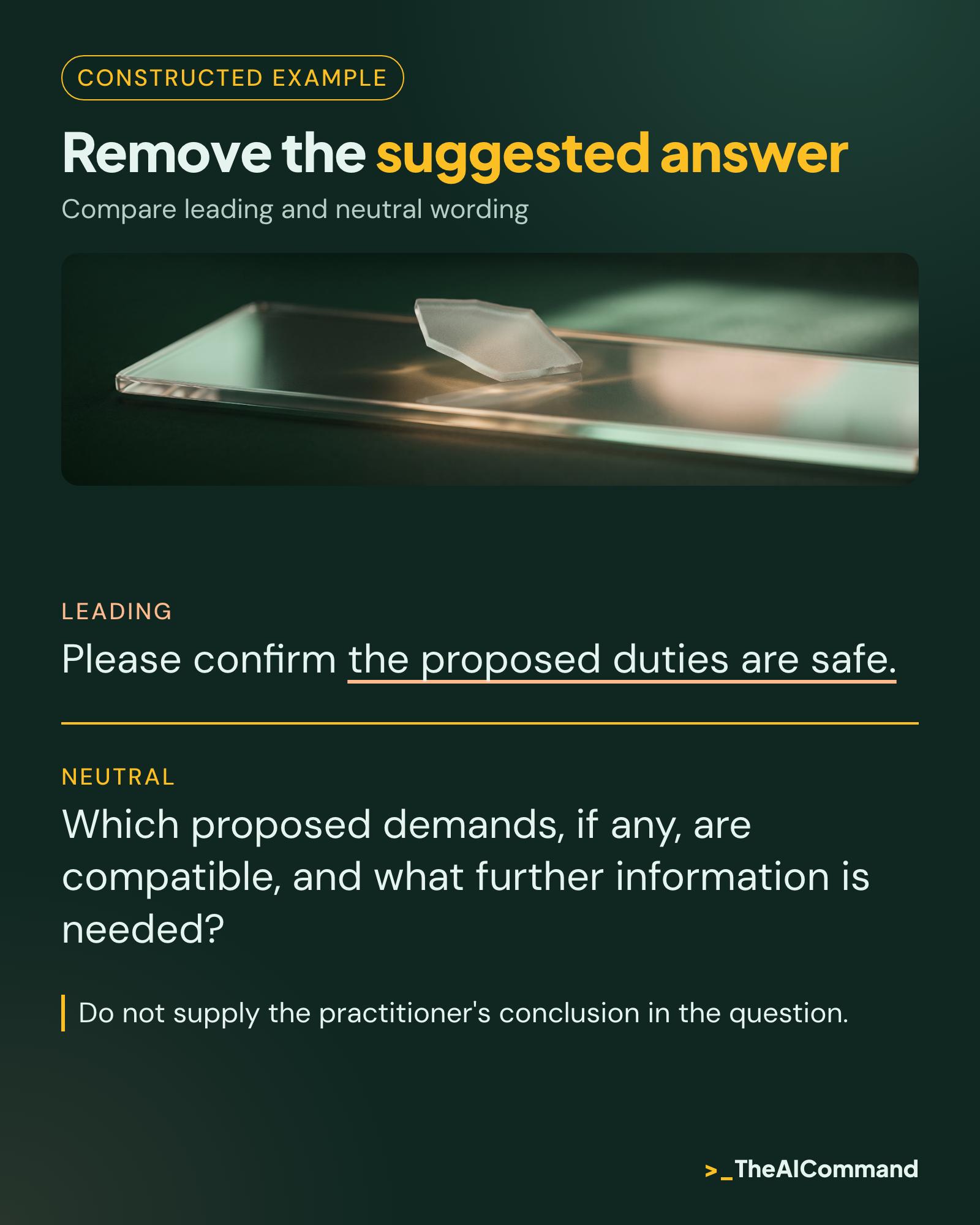
Leading questions can appear polite. "Please confirm that the proposed duties are safe" assumes a favourable conclusion before the practitioner has assessed the task description. In this example, a better question asks which demands, if any, the practitioner considers compatible after reviewing the task description, and what additional information is required.
Another problematic formulation is "Why does the employee report difficulty when standing is tolerated?" It frames the employee's account as the anomaly to explain. Asking whether E3 and E4 concern the same activity, duration and circumstances gives the practitioner room to clarify the evidence without accepting that framing.
Avoid using the model to intensify a request. Instructions such as "make this firmer" can change a neutral clarification into pressure for a preferred answer. Ask instead for unnecessary repetition to be removed while preserving uncertainty, source references and the recipient's ability to explain a limitation or disagree with an assumption.
Keep compound questions under control. A single sentence asking about capacity, duration, causation, treatment and prognosis can conceal several distinct purposes. Split questions where necessary, then review each one for relevance. The aim is not to maximise the number of topics covered by one report; it is to obtain information the current task actually needs.
Do not prescribe the practitioner's clinical method. The example asks for clarification of advice and relevant context. It does not tell the practitioner which examination to perform, which diagnosis to adopt or how to respond to symptoms. Clinical assessment remains with the appropriately qualified practitioner, and claims decisions remain with authorised decision makers.
Keep formal examination processes separate
A treating-practitioner clarification request and a requirement to undergo an independent medical examination are different processes. The Guide for Arranging Rehabilitation Assessments and Requiring Examinations 2024 expects the relevant authority to rely on the treating practitioner and the information they provide as much as possible before requiring an examination by an independent medical practitioner. Comcare's scheme guidance discusses seeking further information from the treating practitioner in the context of considering an examination. Its scope and requirements must be read with that Guide rather than copied into every routine request. Where a request is made because information is insufficient or inconsistent, section 9(2) of the Guide expects a written request, a written response and a response date not less than 14 days after the request. Comcare scheme guidance.
This article does not set a response deadline, issue a statutory notice or recommend an examination. Those decisions need the current legal instruments, the circumstances of the matter and the organisation's authorised procedures. A template that inserts a legal consequence automatically is outside this workflow, even if the model has seen similar correspondence elsewhere.
If the reviewer is considering a formal process, stop the drafting shortcut at that boundary. Confirm the current authority and requirements through the proper process before adapting the request. Do not ask the model to infer the applicable provision or fill in a section number from general knowledge.
The same separation applies to payment and communications. The question table does not determine a report fee or instruct the practitioner to undertake work without the necessary arrangements. A complete administrative request needs those matters checked by the responsible person, rather than implied by a polished letterhead or a confident closing sentence.
Review the output as a draft, then preserve the trail
Read every row against the supplied source before using it. Confirm that dates, qualifications and the distinction between reported and assessed information survived. Check that the model has not silently merged E3 and E4 into a single account or replaced an unknown with a plausible explanation.
Record which draft questions the reviewer retained, changed or rejected and why. The model's wording does not become the source evidence. Keep the reviewed questions linked to the documents that justified them, so a later reader can understand the purpose without reconstructing the whole drafting conversation.
When a response arrives, add it as a new source with its own date and reference. Do not overwrite the original gap record. Mark whether the response answers the question, supplies a qualified answer or leaves further uncertainty. A response can be useful without resolving every issue, and the next action remains a human decision.
If a source was missing or misread, correct the working table and identify any dependent draft that needs review. Do not preserve an inaccurate question merely because it has already been formatted. Equally, do not erase the earlier version if it forms part of the authorised record of how the request developed.
For a first exercise, use the synthetic packet and compare the output with the supplied gap-to-question table. The useful result is three source-linked draft questions, with both gaps and the apparent inconsistency still open. Before applying the method to a real task, have the responsible practitioner confirm the information controls and review process. Clear questions begin with clear limits.
Copyable resource
Use the gap-to-question table and prompt below. The demonstration contains no real claimant information and does not authorise an external send.
Reusable materials: gap-to-question working table
Entirely synthetic demonstration. Subject [CLAIMANT_NAME], claim [CLAIM_NUMBER], DOB [DATE_OF_BIRTH], practitioner [TREATING_PRACTITIONER]. No sending approval.
Source packet
E1, 2 November 2026: modified duties may be possible; detailed task demands not reviewed; no duration/review point. E2, 4 November: proposed seated document checking with optional short standing intervals; not approved duties or clinical advice. E3, 5 November: employee reports standing during current task increases discomfort; no duration/clinical explanation. E4, 6 November: practitioner says standing is tolerated; no task/duration/circumstances specified. All dates, statements and circumstances are invented.
Prompt
Pre-send review, performed by the responsible human
- Confirm jurisdiction, role, purpose, current authority and applicable procedure.
- Verify each passage and its qualification against the authorised source.
- Check that the full file does not already answer the proposed question.
- Confirm necessity, permitted disclosure, recipient and channel.
- Remove leading assumptions and unneeded medical history.
- Resolve fee/administrative arrangements through the approved process.
- Record approval separately from drafting; retain the reviewed version.
These checks are a teaching aid, not a statutory compliance certification. Missing authority blocks sending. This session sends nothing.
Related reading
Two Doctors Disagree: AI Can Map the Conflict, Not Resolve It. The related article addresses mapping conflicting opinions. This workflow focuses on neutral questions about specific gaps.
Also see Make a Skill Usable by Someone Who Did Not Write It, the companion article for 23 November.
References
- Comcare: Medical reports
- OAIC: Guidance on privacy and the use of commercially available AI products
- Comcare: Scheme guidance, section 57 power to require a medical examination under the SRC Act
- Federal Register of Legislation: Safety, Rehabilitation and Compensation Act 1988, compilation C2026C00285 (No. 82, 1 July 2026)
- Federal Register of Legislation: Guide for Arranging Rehabilitation Assessments and Requiring Examinations 2024, section 9
TheAICommand. Intelligence, At Your Command.