
A return-to-work record can look current while describing work that no longer exists. A workstation has moved, a supervisor has changed or a task has been reassigned. The adjustment remains marked complete because someone completed it under the previous arrangement. Nobody has yet confirmed that it carries across.
For rehabilitation case managers in the Comcare scheme, the useful task is making those differences visible. [5] The record needs to answer what was agreed, which duties that agreement covered and what happened after a change. A summary saying that arrangements remain in place cannot answer those questions without supporting evidence.
This article develops a constructed tracking method for a fictional Commonwealth agency within the Safety, Rehabilitation and Compensation Act 1988 context. It begins after people have made the relevant decisions. All examples are invented for teaching. They are neither findings about a worker nor evidence that a model or monitoring service has been tested.
Keep the record inside its role
Comcare's suitable-employment guidance describes consultation with the employee and treating medical practitioner, including consideration of capacity, restrictions and requested adjustments. Its rehabilitation-services guidance describes specialist assessment and support to develop and monitor the rehabilitation program. Those are human professional processes. Comparing two administrative records is a much narrower task. [1][2]
Define that task before opening an AI tool. Give the model approved descriptions of agreed actions and the authorised duty-change records. Ask it to locate differences and missing evidence. Do not supply a medical report and ask whether a previously agreed arrangement remains suitable. That changes the task from organising records to making an individual assessment.
Comcare also describes regular review of rehabilitation progress and contact with the parties to check agreed activities. An adjustments register can support that work by making outstanding implementation questions easier to find. It does not replace consultation, professional advice or the rehabilitation case manager's review of the rehabilitation program. [3]
The distinction matters when a record becomes stale. Missing confirmation means the record lacks confirmation. It does not establish that equipment is absent, that an adjustment failed or that a worker can perform a different duty. Keep the observation and the decision separate so the next person can see exactly what needs checking.
Start with three agreed actions
The fictional case file uses [CLAIMANT_NAME], [CLAIM_NUMBER], [DATE_OF_BIRTH] and [TREATING_PRACTITIONER]. These are placeholders throughout, with no underlying personal record. The working example sent to the model contains only an invented reference key and administrative extracts. It does not need a date of birth or clinical information to compare versions.
In the constructed baseline, human reviewers have agreed three adjustments. A1 is a designated adjustable workstation for the recorded desk duties. A2 is reassignment of archive-box handling to a nominated support role. A3 is protected time in the work schedule for the agreed rehabilitation appointments. These are illustrative actions, not recommended adjustments for any condition.
Each action receives a stable identifier. The baseline includes the exact agreed wording, the duty version, responsible role, evidence reference and review point. A1 points to a setup confirmation. A2 points to the approved task allocation. A3 points to the agreed roster entry. None of these references is a real document or an actual approval.
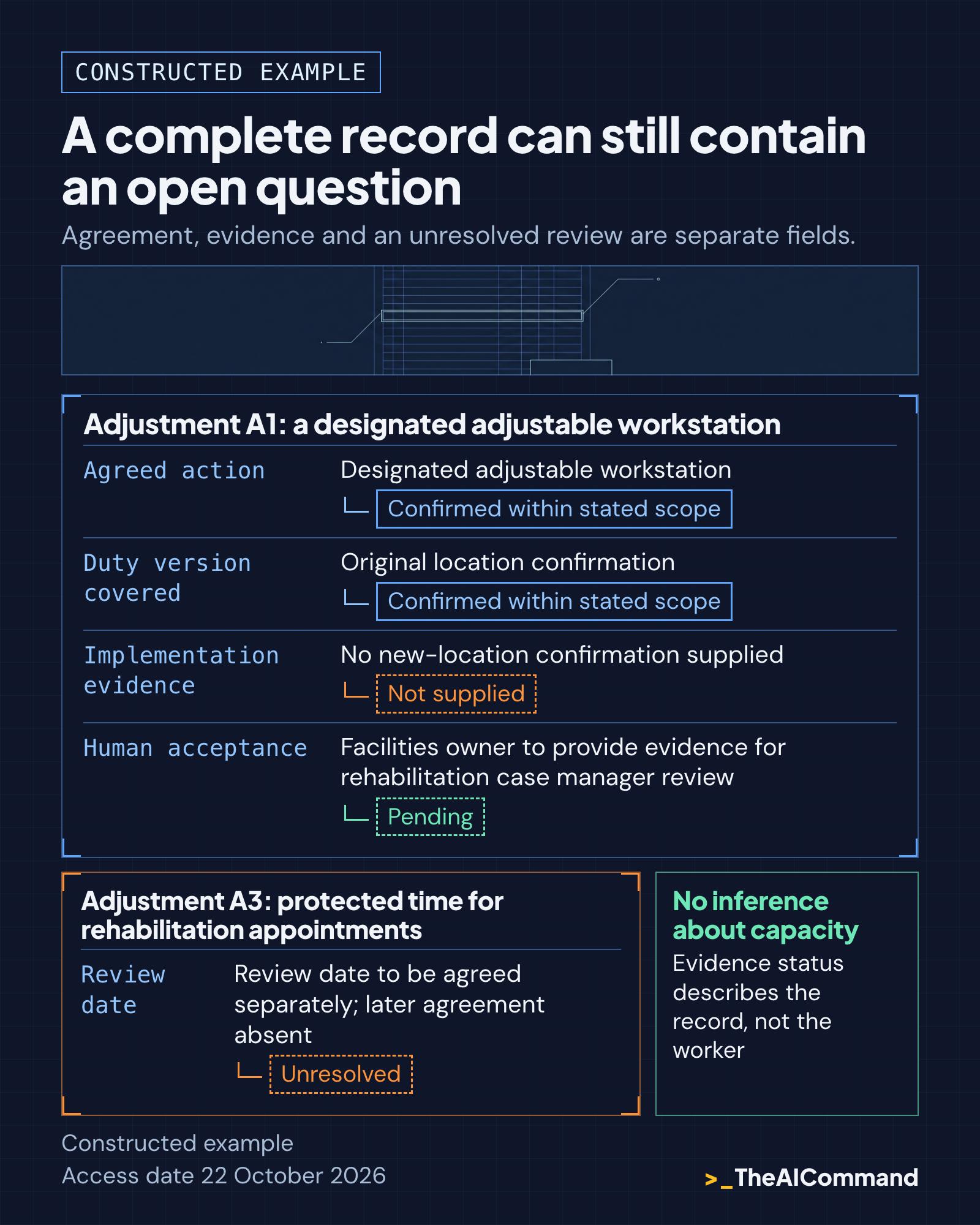
The record also distinguishes agreement from implementation. The decision record establishes that an action was agreed. A separate confirmation records what was put in place. If a row contains only the decision, its implementation status remains unconfirmed. This prevents a signed plan from being mistaken for evidence that every operational arrangement exists.
Retain the scope of each confirmation. The workstation evidence covers a specified location and duty version. The task allocation identifies the support role for that version. The roster entry covers its stated period. Avoid converting these limited statements into a permanent assurance that an adjustment applies to all future arrangements.
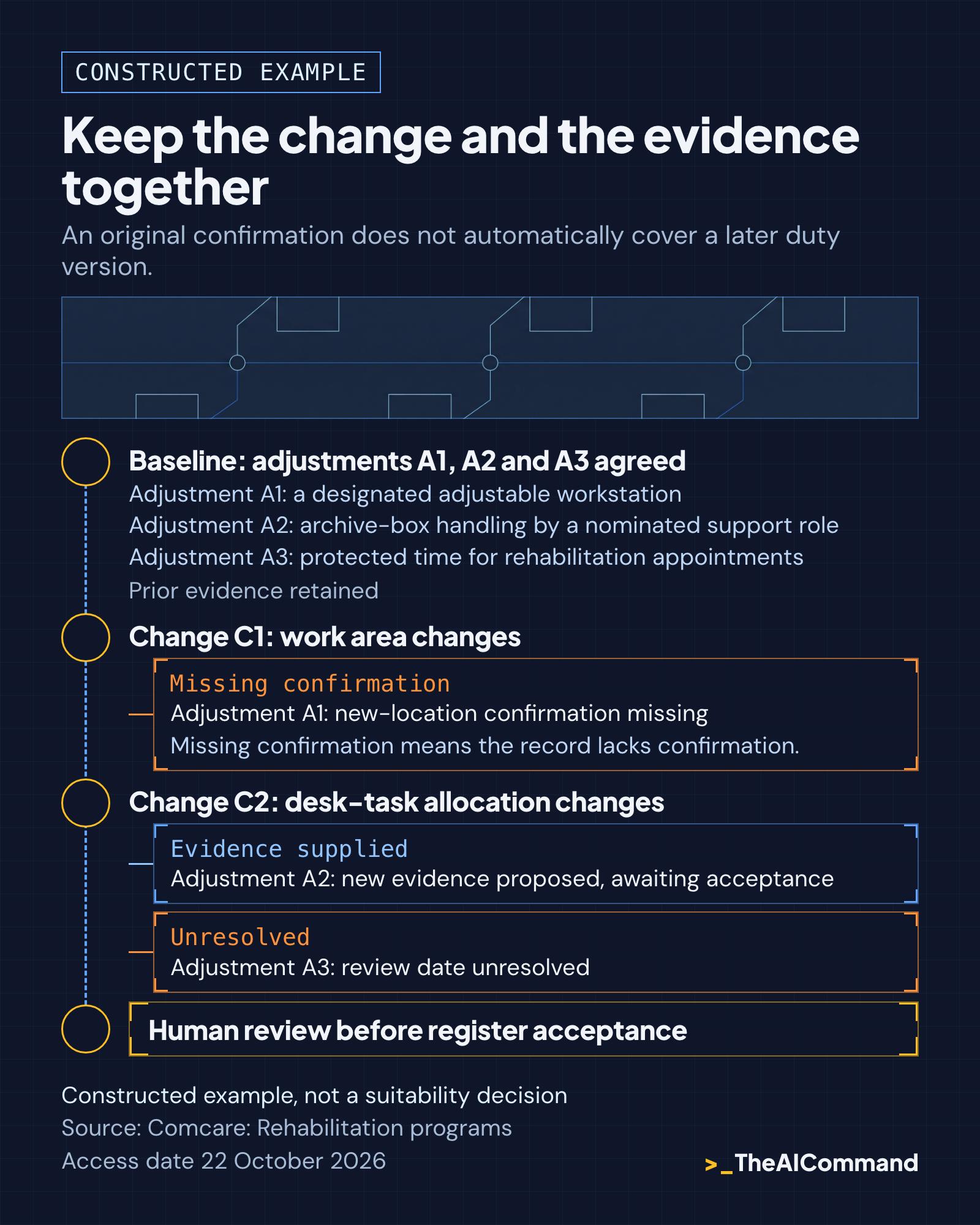
First duty change: a different work area
Change C1 is an approved move of the desk duties to another work area. Within this fictional example, the human-approved duty-change record specifies the new location and effective date. It does not contain confirmation that A1 has been installed there. Approval of C1 is therefore not evidence that A1's implementation record is current.
The bounded comparison finds that A1 references the previous location while C1 references the new location. Its useful output is a short exception: location differs; new-location confirmation absent from supplied sources; facilities owner to provide evidence for rehabilitation case manager review. It retains the earlier confirmation as history instead of replacing it with a guess.
The model does not announce that the workstation is unsuitable. It does not tell [CLAIMANT_NAME] to move, continue or stop work. The rehabilitation case manager and relevant workplace roles resolve the operational question through the established process. The administrative draft cannot change an instruction already issued through that process.
C1 also creates a useful check on A2. The new work area may have different people, but the supplied change record says nothing about archive-box handling. The output identifies the absence of a carry-forward statement. It asks whether the existing allocation has been reviewed, without declaring that it has ended or silently assigning it to a new colleague.
A3 remains linked to its current roster evidence. The comparison records that C1 contains no supplied amendment to that entry. This means no amendment was found in the provided documents. It is not a fresh confirmation of suitability or a statement that no other relevant decision exists elsewhere in the controlled record.
Second duty change: the task allocation changes
Change C2 is a later approved reallocation of desk tasks within the same fictional rehabilitation program. Its attached allocation record expressly confirms that archive-box handling remains with the nominated support role. A2 can therefore gain a new evidence link after a human reviewer checks the document and accepts the proposed register update.
The same C2 record refers to a revised schedule for A3 but says the review date will be agreed separately. No later date is supplied. The comparison preserves that absence as an unresolved field. It does not reuse the previous review date merely because the new row would otherwise look incomplete.
That unresolved date becomes a question for the rehabilitation case manager. The draft can identify who owns the question and the document that created it. The accountable person then sets or obtains the appropriate review arrangement. Until that occurs, the system has an unresolved review point, not a model-generated deadline dressed as a clinical requirement.
At the end of the example, A1 has a missing new-location confirmation. A2 has a candidate updated evidence link awaiting human acceptance. A3 has an unresolved review date. Those three statuses are deliberately different. A single green indicator for the case would conceal them, while a single red indicator would fail to explain them.
The useful handover is consequently a versioned change log. It shows the last confirmed position and the new question beside it. A person can reconstruct why the question arose and which source could answer it. The model's wording is secondary to preserving that chain of evidence.
Make unknowns difficult to erase
A blank cell is ambiguous. It could mean not applicable, not checked, unavailable or forgotten. Use an explicit status and a reason. For example, record review date unresolved because C2 refers to a later agreement that was not supplied. That is specific enough to check without disclosing any clinical content.
Separate a document date from an effective date and a review date. They answer different questions. A newly signed document might describe an earlier arrangement, while a future review may be agreed before a duty change starts. Ask the model to reproduce supplied dates under their original labels rather than selecting whichever looks most recent.
Keep contradictory sources visible. If a supervisor note describes completion but a facilities record refers to a different location, preserve both references. The reviewer decides whether they conflict, describe different events or require further evidence. A fluent merged sentence can hide the very distinction that the change log exists to expose.
An acceptance entry records the human reviewer, the accepted change and the evidence checked. A rejected suggestion also deserves a short reason when it would otherwise recur. For example, two differently worded location names may refer to the same authorised work area. Record that resolution in the controlled source, rather than teaching the model an undocumented shortcut.
A monitor can identify an exception, not resolve it
The simplest monitoring rule compares the current duty version with the version attached to each adjustment. A mismatch creates a review item. A second rule finds required confirmation fields that have no evidence reference. A third identifies unresolved review dates. These are proposed administrative rules, subject to the organisation's approval and testing.
A scheduled scan also needs a visible operating status. If it cannot read a source or did not run, it cannot report that no exceptions exist. Record the last successful comparison and the sources included. The human owner needs to distinguish an empty exception list from an incomplete check.
Choose how notifications reach people through the organisation's established arrangements. This article does not authorise a bot to contact workers or issue instructions. A draft exception can be reviewed by the rehabilitation case manager before entering the operational record. Any future automated notification needs its own approved recipients, content boundary and failure process.
Avoid scoring a worker or ranking recovery from administrative gaps. A late facilities confirmation says something about evidence availability. It says nothing about motivation, compliance, recovery or capacity. The report can describe the gap without attaching a judgement to the person whose adjustments happen to be affected.
Review the draft against the originals
Check each proposed change against both versions. Confirm that the model retained every adjustment, copied the correct identifiers and attached each observation to the right source. Check negative statements especially carefully. The phrase not found in supplied records is narrower and more defensible than not done.
Then read the output as the next supervisor would read it. Could pending be mistaken for approved? Does a copied task description appear to be a fresh instruction? Is the owner of the unresolved date clear? This review is about the effect of the words as well as their correspondence with the source documents.
The method can be rehearsed with the three fictional actions before any operational use is considered. Give a reviewer deliberately incomplete inputs and check whether the draft keeps the gaps visible. This is a proposed exercise, not a reported test. Record observed errors if an exercise is actually run, and revise the instructions accordingly.
The practical result is modest but useful: a reliable route from a changed duty record to a human review question. It gives the rehabilitation case manager something concrete to resolve. It does not promise improved recovery, reduced claim duration or a quantified time saving, because this constructed example establishes none of those outcomes.
Put one changed arrangement through the method
Start with a single duty change and its existing adjustment record. Establish the authoritative versions, copy only the permitted administrative fields and identify the person who can accept an update. Use the prompt below to prepare a comparison, then check every proposed entry against the originals before using it.
For employers, the immediate action is to make implementation evidence specific to the arrangement it confirms. For rehabilitation case managers, it is to keep missing confirmation and unresolved review dates open until people resolve them. A complete-looking register is less useful than an honest one that shows the next question clearly.
Reusable comparison prompt
The change-log template and monitoring specification provide copyable fields and proposed test cases.
Reusable materials: adjustments change log and monitoring rules
Educational material only. No monitoring deployment and no clinical or entitlement authority. Comcare and SRC Act example. All values below are constructed.
Adjustments change log
Case-level placeholders: [CLAIMANT_NAME], [CLAIM_NUMBER], [DATE_OF_BIRTH], [TREATING_PRACTITIONER]. Do not substitute real values into this example. These are not required inputs to an administrative comparison.
Blank record for adaptation
Proposed monitoring-rule specification
These rules are original administrative design suggestions, not Comcare-mandated rules or a tested service.
Proposed rehearsal cases: moved location without confirmation; changed duties with express carry-forward; missing review date; contradictory location names; unreadable source. These are tests to run, not tests completed. Expected behaviour is preservation of uncertainty with source anchors and no worker instruction.
Bounded prompt
Review requirement
Check the output against every supplied source. Reject invented values, implied approvals and unsupported conclusions. Preserve the earlier version and record the accountable human decision. The main article sets the jurisdiction and role boundaries.
Related reading
- Section 39 Requests Need a Branching Evidence Map, Not One Checklist
- Three Business Bots, Clear Jobs and One Monitoring View, the companion article for 18 November
References
- Comcare: Providing suitable employment
- Comcare: Workplace rehabilitation services
- Comcare: Rehabilitation programs
- Federal Register of Legislation: Safety, Rehabilitation and Compensation Act 1988, Compilation No. 82 (C2026C00285), compilation date 1 July 2026, sections 62 and 64
- Comcare: Rehabilitation case managers
TheAICommand. Intelligence, At Your Command.