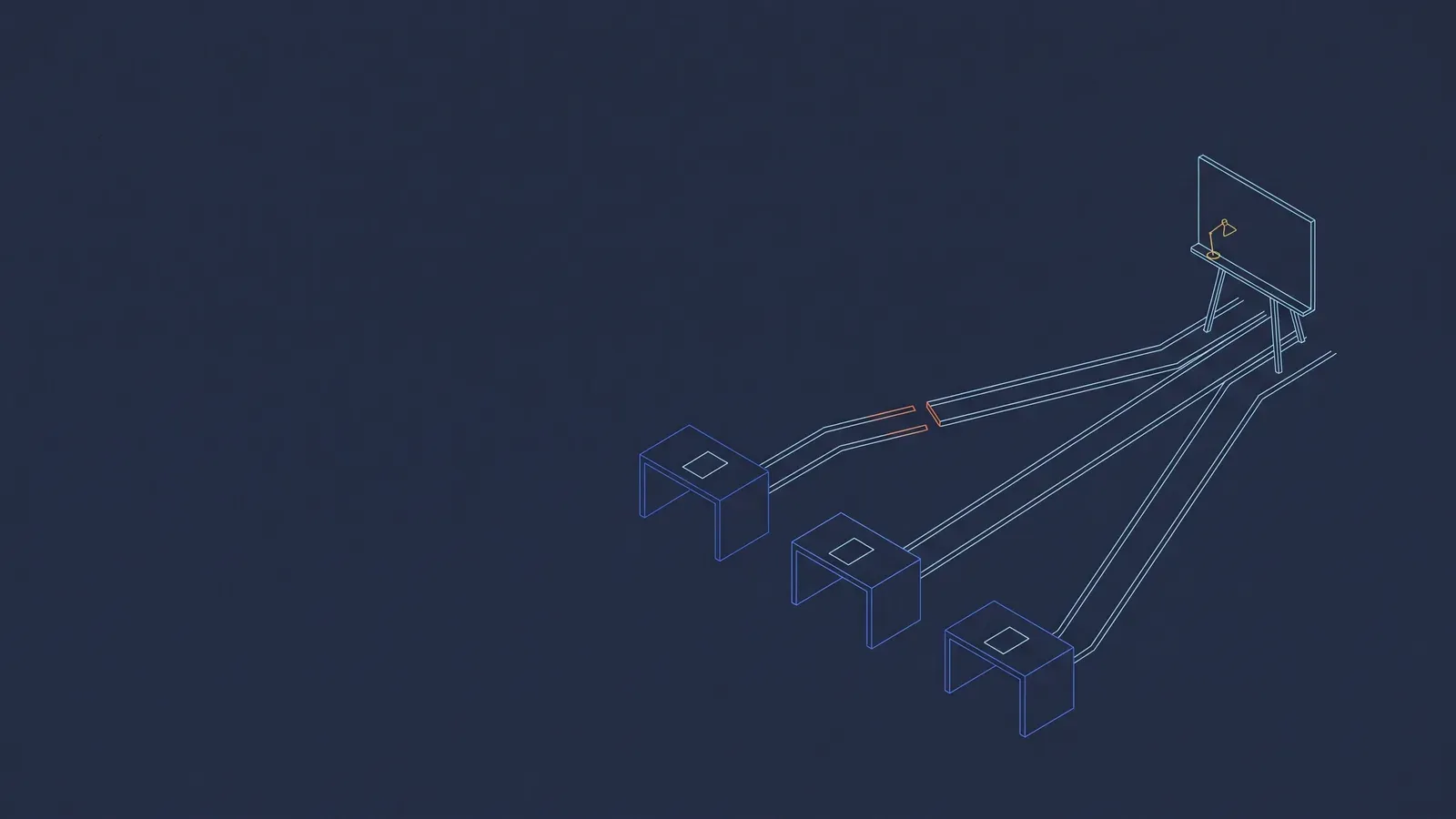
A small-business owner asks one assistant to prepare the morning work brief, write a promotion and answer an enquiry. Later, the owner sees three confident responses but cannot tell which source each used or whether anyone checked them. The difficulty is locating the unfinished work. Adding more instructions to the same conversation does not resolve that reporting problem.
This starter kit uses three bounded roles and one monitoring view. It is a recommended design that can first be rehearsed with documents and a spreadsheet. It does not install bots, connect accounts or turn on background work. The example is entirely constructed. No product comparison, measured saving or successful automated run is claimed.
Give each role a recognisable deliverable
The operations role prepares a private daily brief from an approved worklist snapshot. It identifies items due, missing dependencies and questions for the operations owner. It cannot change a booking, allocate work to a person or tell a customer that a job is complete. Its deliverable is a brief linked to the source version and cut-off.
The marketing role prepares a private draft from the current approved service description and a supplied audience brief. It preserves exclusions and avoids unsupported benefits, prices or availability claims. It cannot publish, schedule or send the draft. The marketing owner checks whether the proposed message accurately describes the service before considering any external use.
The support role prepares a private reply from a controlled frequently asked questions document. It identifies the relevant answer and flags what the document does not cover. It cannot issue refunds, make commitments or decide whether a customer's circumstances qualify for an exception. The support owner checks the answer and decides how the enquiry is handled.
These boundaries are functional. They make it easier to see where a question belongs and what evidence a reviewer needs. They do not require three paid subscriptions or three independent vendors. Before implementation, check which approved environment can separate the inputs, permissions and records. The role names alone provide no technical isolation or security guarantee.
Keep the first source packs deliberately small
For rehearsal, use a synthetic worklist, a fictional approved service description and a fictional FAQ. Construct them independently of real customer records. Exclude names, contact details, payment information, staff records and sensitive case material. The exercise only needs enough information to show the intended task and its stop conditions.
The Office of the Australian Information Commissioner recommends, as best practice, keeping personal and especially sensitive information out of publicly available generative AI tools. Its guidance also calls for product suitability and privacy due diligence. That is a reason to check the actual environment before real use, not to assume that calling a bot "private" makes its inputs safe. [1]
A private draft describes the intended audience of the output in this kit. It says nothing by itself about vendor retention, access or training settings. Those settings require separate checks against the selected service and the organisation's requirements. Keep the rehearsal disconnected from real inboxes and records until the authorised owner has resolved that distinction.
Every source pack needs a version and a clear owner. A bot given both an old service description and a new one must not quietly choose whichever is easier to summarise. The role specification tells it to stop on unresolved source conflicts. The human owner supplies the authoritative version and records the correction before a new attempt begins.
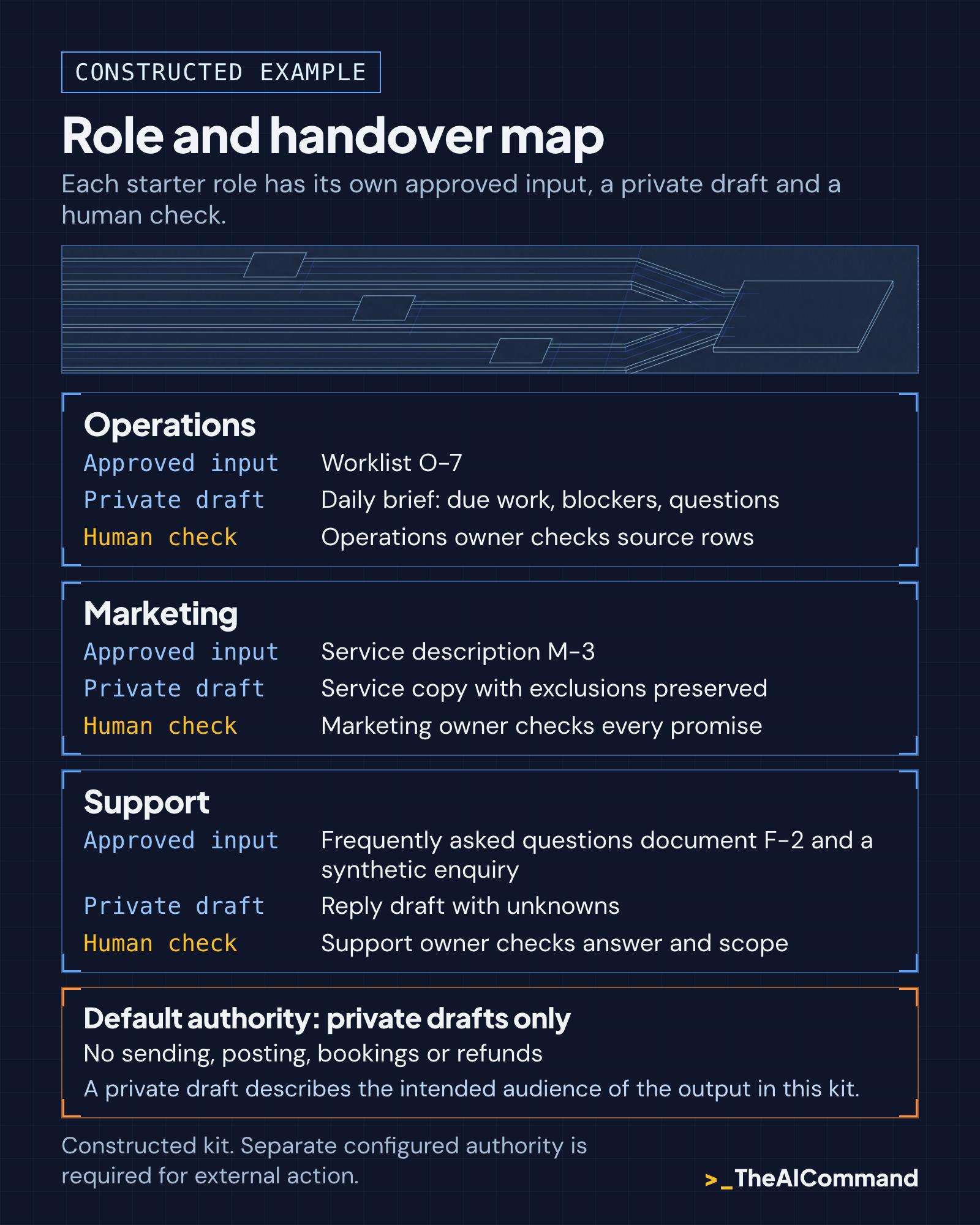
Constructed example: a maintenance business
The fictional business provides booked equipment inspections during ordinary business hours. The exercise contains three source packs, three intended outputs and three human reviewers. The records and times are invented to demonstrate state changes. They are not observations of a deployed system, promises about model speed or evidence of business performance.
The operations pack contains worklist O-7. It shows inspection J-21 booked for Tuesday morning, J-22 awaiting a replacement part and J-23 missing a confirmed access window. The bounded prompt asks for a short brief with due work, blockers and questions. It prohibits filling missing fields, contacting customers or treating a booking as completed work.
A suitable constructed output says, "J-21 is booked for Tuesday morning. J-22 awaits the recorded part. J-23 has no confirmed access window in O-7; operations owner to confirm before planning attendance." The reviewer can trace each sentence to a row. The bot has not decided which technician attends or whether access is legally or practically sufficient.
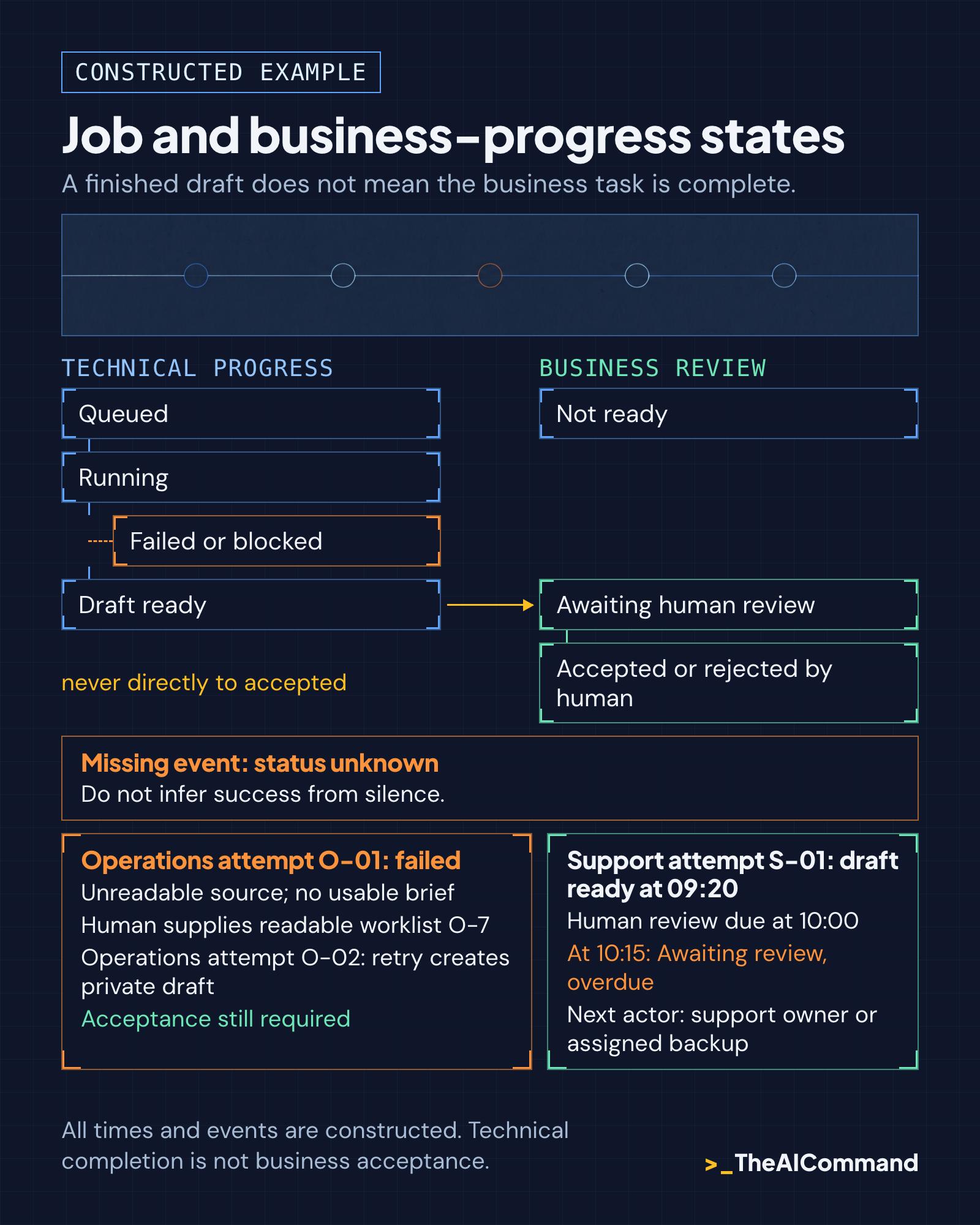
Now introduce the failed run. In attempt O-01, the supplied worklist is unreadable, so the assistant cannot establish those facts. The correct result is a failure record with no usable brief. It must not fall back to yesterday's schedule, invent today's bookings or mark the task completed because it produced an apologetic paragraph.
The monitor records O-01 as failed and names the operations owner as the next actor. After the owner supplies a readable O-7, attempt O-02 produces the example brief. Both attempts remain attached to the same business job. The successful retry does not erase the failure, and the brief still awaits human acceptance before it is used.
The marketing pack contains service description M-3. It permits the wording "booked equipment inspections during business hours" and explicitly excludes emergency call-outs. The audience brief asks for a short website paragraph for local business owners. A suitable draft offers the described inspection service and invites an enquiry about available bookings without promising an appointment time.
An unacceptable alternative would say "same-day emergency inspections". That phrase contradicts the supplied scope even if it sounds commercially attractive. The marketing owner rejects it and records the unsupported promise. The assistant can revise the paragraph, but it cannot decide that a more persuasive message justifies changing what the business offers.
The support pack contains FAQ F-2. Its booking answer says that requests are reviewed during business hours and that confirmation follows a staff check. A constructed enquiry asks, "Can an inspection be guaranteed for tomorrow?" The draft explains the confirmation process and records tomorrow's availability as unknown. It does not turn an enquiry into a booking.
For the monitor exercise, the support draft is technically complete at 09:20 on a fictional workday. Its human review is due at 10:00 under the exercise's local convention. At 10:15, it remains awaiting review. Those invented times show an overdue action; they are not a recommended universal response target or evidence that a model ran for a particular duration.
The monitoring view therefore shows different problems. Operations has a failed attempt followed by a draft awaiting acceptance. Marketing has a draft requiring factual review. Support has a completed draft with an overdue human action. A single green "bots finished" banner would conceal the work the owner actually needs to address.
Record events that explain what happened
Use a business job identifier to connect attempts to the same requested outcome. Give each attempt its own run identifier. Otherwise, a retry can appear to be an additional completed job. Include the role, source-pack version, event time, current technical state and any output reference. Record the time zone alongside timestamps so reviewers can interpret the sequence.
Keep business status separate. The simplest useful fields are review state, acceptance decision, accountable owner, next action and action due time. Technical completion comes from the run record. Human acceptance comes from a human review record tied to the exact output version. The model must not be allowed to generate the acceptance event that approves its own work.
A monitoring view needs to show uncertainty as well as known failure. If an expected completion event never arrives, display "status unknown" or "overdue for check" according to the agreed rule. Do not infer success from silence. The owner checks the underlying run before deciding whether to retry, because an unobserved result and a failed attempt are different situations.
The spreadsheet can initially be updated manually from the rehearsal. Label the example rows as constructed so they cannot be mistaken for system telemetry. Later implementation can automate event collection after testing, but automation is not required to agree what the events mean. Start with a view that a person can explain without opening three chat histories.
OpenAI's Services Agreement places responsibility for evaluating output accuracy and suitability with the business customer under that agreement. This is one provider's contractual allocation, not a feature shared by every product or a promise about these bots. The kit makes the human review explicit without assuming that a provider has accepted the business decision. [2]
Route failure and overdue review differently
A technical failure needs investigation of the attempt, its inputs and the applicable permissions. The operations owner in the example supplies a readable source, then authorises another private drafting attempt. Repeating the same unreadable input without a change would add noise rather than information. Preserve the failure reason and connect the retry to it.
An overdue human action needs a workload or ownership response. Restarting the support assistant will not make the reviewer available. The nominated backup can take the review, the owner can revise the expected response, or the task can remain held. Record the chosen action and communicate any service effect through the established human process.
A review rejection is different again. If marketing invents emergency availability, the system may have run without a technical error while producing unacceptable work. Keep the rejection reason in the business record and revise the relevant role instruction or source boundary. Do not count the output as accepted merely because it was delivered in the requested format.
Use limited, approved retries. A loop that keeps generating until something looks plausible can obscure the first failure and consume resources without resolving the cause. Before a retry, identify what changed and what the new attempt is meant to establish. If the input remains ambiguous, ask the owner for the missing information instead.
Add permissions only after the draft workflow works
Begin with read access to the approved rehearsal material and a private output destination. Test that each role refuses an out-of-scope request and leaves missing facts unknown. Check that the monitoring record captures a failed attempt, rejected draft and overdue review. Also test whether the human owner can stop work and identify the latest output version.
If the business later wants external action, define it separately. Specify the exact destination, action, limits, approving role and recovery procedure, then verify the actual tool permissions. Permission to draft a marketing paragraph does not include permission to post it. Permission to draft a reply does not include permission to send it or change a customer record.
Progression is a human decision supported by test evidence. A successful rehearsal demonstrates behaviour on the exercised cases. It does not establish general reliability, sufficient privacy controls or suitability for consequential decisions. Keep employment, clinical, entitlement and safety judgements outside these starter roles. Escalate them to the relevant authorised process rather than adding another prompt exception.
Make the monitoring view part of ordinary work
The owner needs a practical review routine, not another dashboard to admire. At the agreed check point, inspect failed runs, unknown states and overdue human actions before counting accepted outputs. Confirm that each item has someone who can act. An owner who is absent needs a nominated backup, not an assistant guessing who might be available.
Keep records proportionate. The shared view can hold role names, synthetic job identifiers and restricted links without copying entire prompts or enquiries. Decide access and retention through the organisation's approved arrangements before using real material. A central monitor is useful precisely because it summarises work; it need not become a second uncontrolled store of the underlying data.
Start with one rehearsal across all three roles
Copy the role specifications and constructed source pack into an approved workspace. Walk through the operations failure and the support review delay before adding a schedule. Ask a colleague to identify what is finished, what is blocked and who acts next using only the monitoring view. Repair any field that requires an explanation from memory.
Then decide whether the three drafts are useful enough to justify implementation. Keep that decision separate from product selection, account configuration and permission to act externally. A clear job and a visible human handover are the starting point. Build those first, then decide which parts of the process warrant bounded automation.
Copyable starter kit
The three role specifications, source packs, event schema and permission checklist are complete enough for a document-based rehearsal. They do not execute tools or configure live services.
Starter kit: three drafting roles and one monitoring view
This is a constructed, provider-neutral design for a private document-based rehearsal. No bots, event collector, account links, schedules or external permissions have been implemented.
Three role specifications
The owner must configure actual access controls before any implementation. These textual role specifications do not prove isolation. Default external action permission is NONE.
Synthetic source packs
Operations O-7
Failure exercise: attempt O-01 receives an unreadable O-7 file. Expected state: failed, no usable brief. After a human supplies a readable O-7, attempt O-02 may create a private draft, linked to O-01 as a retry. It still requires acceptance.
Marketing M-3
Approved fictional scope: booked equipment inspections during business hours. Emergency call-outs excluded. No price, same-day promise, turnaround or guaranteed booking availability supplied.
Audience: local business owners seeking routine inspections. Expected copy: "Arrange a booked equipment inspection during business hours. Contact the team to discuss available bookings. Emergency call-outs are outside this service."
Reject "same-day emergency inspections" because it conflicts with the source. Any actual contact details would need separate approved content and are absent here.
Support F-2
Approved fictional answer: booking requests are reviewed during business hours; confirmation follows a staff check. Enquiry: "Can an inspection be guaranteed for tomorrow?"
Expected private reply: "The team reviews booking requests during business hours and confirms availability after a staff check. Tomorrow's availability is not established in the supplied information."
No booking is made. Support owner decides the response and any further question.
Prompt wrapper, run separately for each role
Monitor event schema
This is a recommended data contract, not implemented telemetry or a claim about vendor event APIs.
Rules: an accepted state requires a valid human acceptance reference. A failed run cannot also be draft_ready. A missing event produces unknown status pending investigation, not assumed success. A new attempt does not create a new completed business job. Preserve immutable event history; a derived current view must not erase failed attempts.
Overdue rule for the rehearsal: if action_due_at is earlier than the view time and review_state is awaiting_review, flag overdue. Do not infer fault. Reopening accepted work needs a new recorded human action, not deletion of history.
Constructed monitor view
View time: 2026-11-18T10:15:00+11:00. All timestamps and states below are invented instructional values.
No actual event logger or monitoring dashboard exists. Rehearse the view manually before deciding whether to build it.
Permission progression checklist
- [ ] Confirm approved environment, source handling and secure access controls.
- [ ] Rehearse each role with only constructed inputs and private outputs.
- [ ] Check missing inputs, conflicting versions, out-of-scope instructions and unsupported claims.
- [ ] Check failed attempt, retry, human rejection, absent event and overdue human action.
- [ ] Check owner can stop the workflow and identify the latest output version.
- [ ] Retain actual test evidence separately from these constructed rows.
- [ ] Owner decides whether results justify implementation; no automatic progression.
- [ ] For any later external action, define exact action, destination, scope, limits, approval, logging and recovery.
- [ ] Verify actual tool permissions, privacy settings and supplier terms before granting that authority.
- [ ] Keep business acceptance distinct from execution and any later delivery confirmation.
Related reading
- An Agent Queue Is Not a Workforce Plan
- Your Team Is Still Prompting. The Reviewable Work Moved Upstream.
- Keep Workplace Adjustments Visible as Duties Change, the companion article for 18 November
References
- Office of the Australian Information Commissioner: Guidance on privacy and the use of commercially available AI products, published 21 October 2024, updated 17 January 2025
- OpenAI: Services Agreement, updated 1 December 2025, effective 1 January 2026, section 4.3
General information only. Not legal, compliance, financial, or professional advice.
TheAICommand. Intelligence, At Your Command.