
A full calendar can still miss the work
The requests arrive before the month has finished. One team wants an advanced spreadsheet course. Another asks for a session on writing clearer handovers. A manager forwards an attractive AI webinar. All three can be placed in a calendar within minutes. The harder question is whether they belong there, and what happens to the work while people attend.
For an HR learning team, the useful output is a defensible draft allocation of time. It connects a stated work need to suitable learning, records what remains uncertain and leaves room to check application. Course names alone cannot do that. A calendar can be busy while the same incomplete handovers continue to arrive at the next team.
AI can help arrange the evidence and expose gaps in the request. Give it a bounded set of task observations, available resources and scheduling constraints. Ask it to explain a proposed order using those inputs. Do not ask it to diagnose employees, predict who will struggle or certify competence. Those conclusions are outside this planning exercise.
This method is an editorial workflow for learning-needs planning. It is not a formal performance-management procedure or an assessment standard. Use the organisation's actual employment, accessibility and training arrangements where they apply, and obtain specialist advice when a request raises an individual employment issue.
Describe the task before selecting the course
A useful request names the work someone needs to do differently. "Improve spreadsheet skills" is broad. "Check that a monthly reconciliation includes the current source period before submission" is a task that can be discussed. The second description also makes it possible to ask whether learning is the right response. An outdated template may be part of the problem.
Keep the observation separate from the interpretation. "Four sample handovers lacked an owner" describes a feature of those documents. "The team does not understand accountability" is an interpretation that the documents alone cannot establish. Preserve the observation, record who selected the sample and ask the people involved what happened before choosing a training activity.
The Fair Work Ombudsman's managing underperformance guide is best-practice guidance for employers and managers. It encourages clear expectations, specific feedback and support, including training or mentoring. The Fair Work Ombudsman works with the national workplace relations system, which covers most Australian workplaces; some state public sector, local government and Western Australian employers are covered by state systems instead. That is relevant context for a conversation about learning needs. It does not turn a calendar exercise into a finding of underperformance or authorise an AI system to make an employment judgement.
A request can also be forward-looking. A new workflow may need preparation before anyone has made an error. In that case the supporting evidence is the approved change, the task it introduces and the roles affected. Label it as preparation for a change, rather than inventing a history of poor performance to justify the allocation.
Assemble a small planning packet
Bring together the minimum information needed for this decision. Use role-level task descriptions, approved work standards, neutral observations, resource descriptions and actual availability. Give each input a stable reference. The eventual draft can then say that a session responds to observation O1 and uses resource R1, rather than offering an explanation that nobody can trace.
Exclude private performance files, medical information and unnecessary identifiers. If an individual issue requires a confidential discussion, handle that through the proper channel. The learning calendar does not need the detail. Likewise, record that an accessible format or alternative arrangement is needed without distributing a person's diagnosis to everyone who can open the planning sheet.
Ask learners about access before fixing the format. The Australian Human Rights Commission's induction guide discusses accessibility, reasonable adjustments and support for new employees with disability across the induction period. Its setting is induction. Applying early access checks to this monthly planning exercise is an editorial recommendation, not a claim that the guide prescribes this calendar.
State the units in every capacity constraint. Two hours available to a facilitator is different from two learner-hours across a team. A session for six people consumes six times its duration in participant time, before preparation or follow-up. Count release time and review work separately so a short event cannot hide a much larger workload commitment.
A constructed December planning example
Consider a fictional private-sector service team planning December learning. Its six coordinators prepare internal case handovers and monthly activity reports. The records below are wholly constructed for this article. They are not observations of real employees, evidence of a successful AI trial or estimates of what a typical organisation will gain.
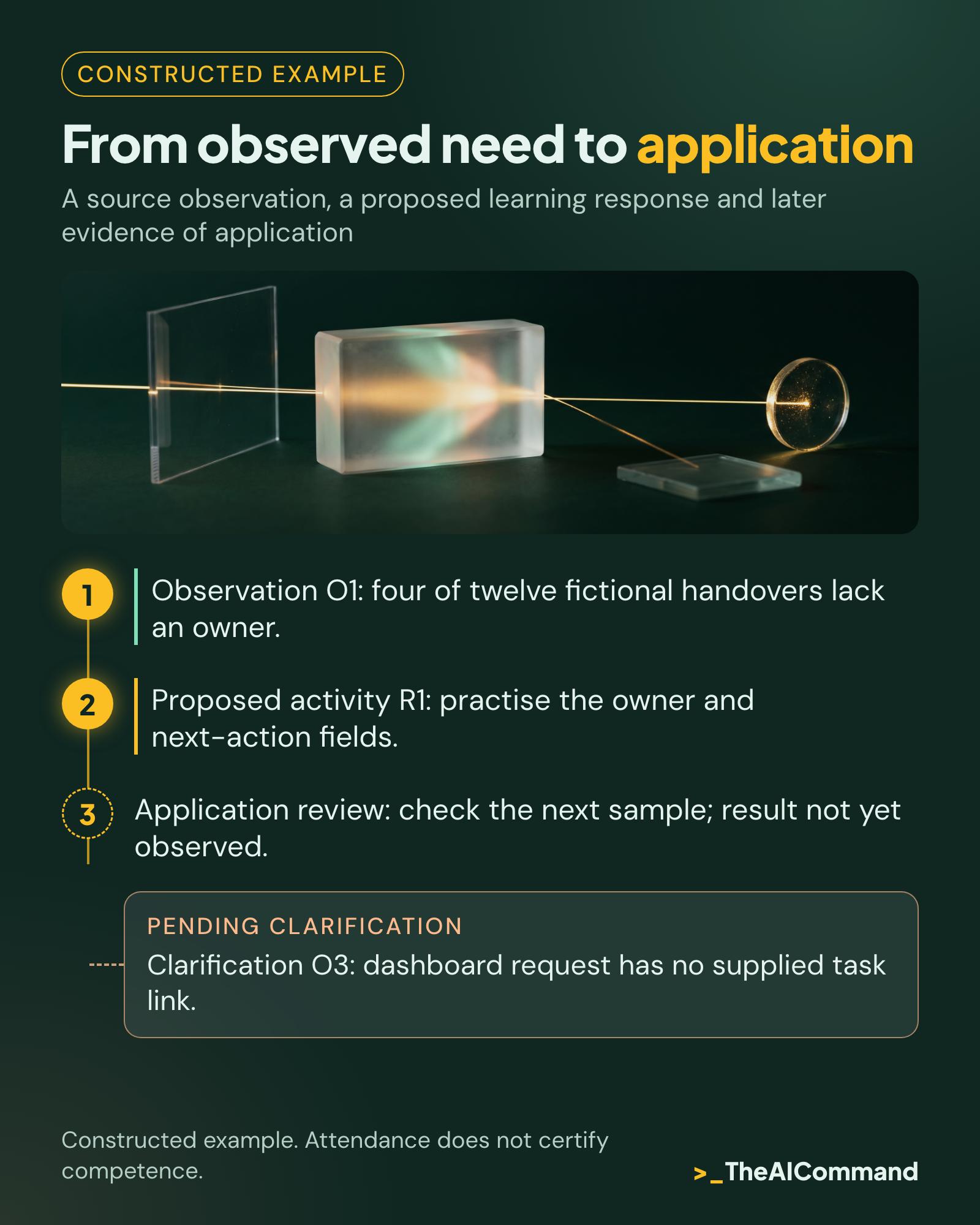
Observation O1 describes a sample of twelve fictional handovers. Four have no next-action owner. Observation O2 describes eight fictional monthly report drafts, three of which omit the reporting period beside a source reference. The manager confirms that the current template asks for both details. These samples identify planning questions, not individual capability ratings or population-wide error rates.
Request O3 asks for an advanced dashboard course because "everyone else is learning it". It provides no task requirement, approved change or example of work it would improve. Keep that request in the packet. Excluding weak requests before analysis would conceal an important planning decision. The appropriate next step is clarification, not an invented justification for a fashionable course.
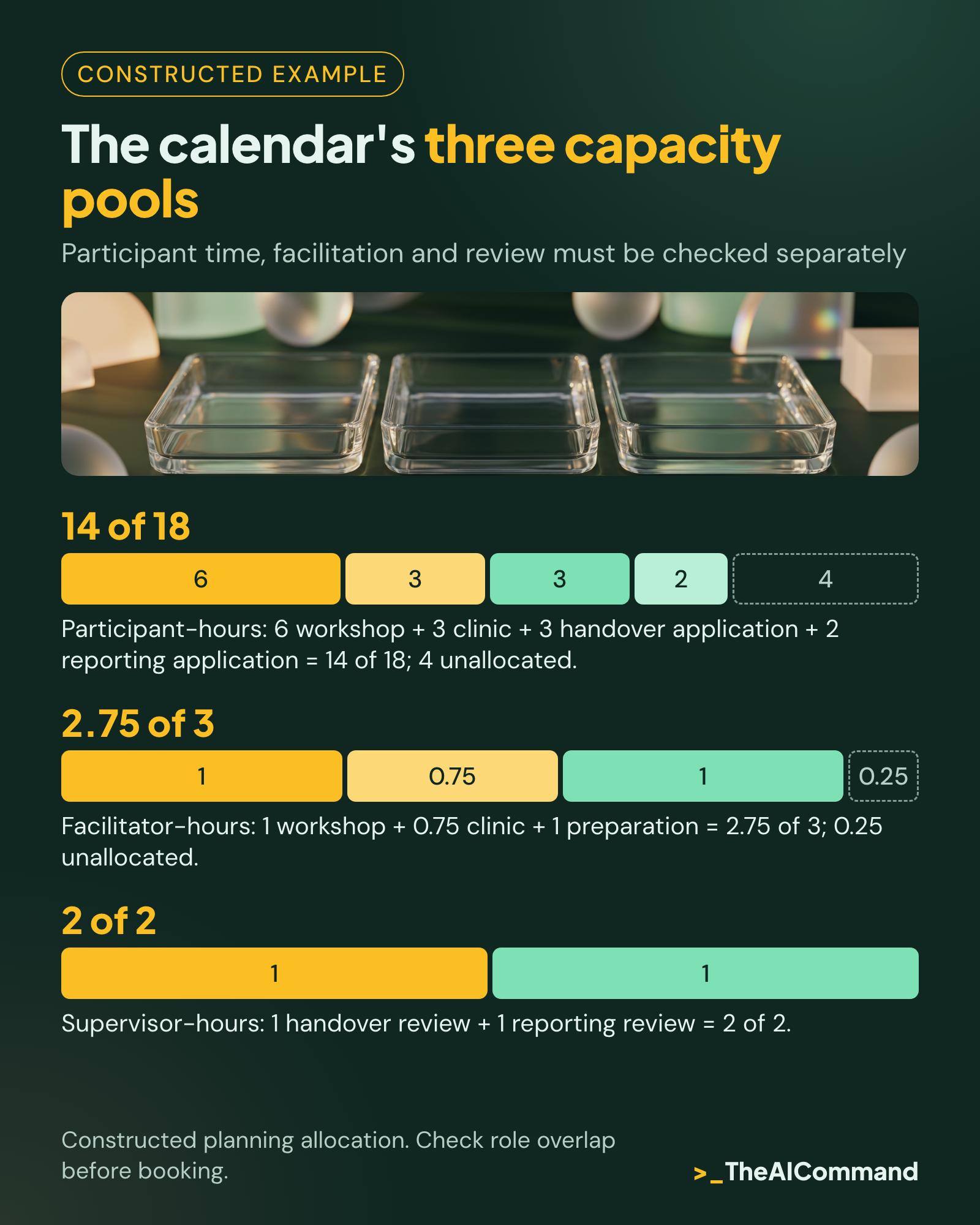
The fictional team has eighteen participant-hours available for the month. Its facilitator has three hours available, and a supervisor has two hours for application reviews. Resource R1 is a one-hour handover workshop for all six coordinators. Resource R2 is a forty-five-minute reporting clinic for four coordinators who prepare the monthly report. These are planning assumptions, not externally recommended durations.
A possible allocation uses six participant-hours for R1 and three for R2. Reserve a further three participant-hours for half an hour of handover application per coordinator. Reserve two participant-hours for half an hour of reporting application per reporting coordinator. That totals fourteen participant-hours, leaving four unallocated. The remaining capacity is visible instead of being automatically filled.
For this example, facilitator delivery uses one hour plus forty-five minutes. Set aside another hour for preparation, giving two hours and forty-five minutes against the three-hour limit. The supervisor reserves one hour for each application review, using the full two hours. The arithmetic distinguishes participation, preparation and review rather than adding incompatible time categories together.
Ask for a proposal that can be challenged
Give the model that packet and ask for a draft calendar, a rationale tied to the input references and a list of unresolved questions. Require the output to retain the supplied capacity units. It must not invent a resource, change a duration or quietly assume that a person can attend outside their available work time.
The constructed target output schedules the handover workshop in week one and its application review in week two. It places the reporting clinic in week two, before the monthly report work, and checks application in week three. The dashboard request stays in a clarification queue. No fourth activity appears simply because the calendar has blank space.
The reason for placing handovers first is explicit: all six coordinators use that task, the supplied example contains missing ownership details and the resource addresses that exact field. The reporting clinic has a smaller stated audience and a later work deadline. This is one reasonable planning choice under the example assumptions. It is not a universal ranking formula.
A human reviewer may choose differently. Perhaps the report deadline moves forward, the facilitator becomes unavailable or a team conversation reveals that the missing owner field comes from a broken export. Record the changed input and revise the allocation. The useful feature of the AI draft is its visible reasoning against supplied evidence, not its ability to produce a confident order.
Check what the proposal has assumed
Before approving the calendar, trace each activity to its request and evidence. Check whether the proposed resource actually teaches the stated task. A general presentation on communication may be interesting without helping someone complete an owner field. Where the match is weak, improve the resource description or ask for another option rather than accepting a plausible course title.
Recalculate time independently. In the example, fourteen participant-hours does not include facilitator preparation or supervisor review. Those sit in separate limits. If the facilitator is also one of the six participants, identify that overlap before allocating their work. The same person cannot be treated as independently available in two roles at the same time.
Look for invented diagnoses in the explanatory text. A model might change "owner field missing" into "low accountability" or call the dashboard request "low motivation". Remove those judgements and restore the supplied facts. A missing task link warrants a clarification question. It does not justify an adverse conclusion about the person who asked to learn.
Check whose voice is absent. The sample may have been selected by one supervisor, and the proposed session may suit only one shift. Ask the affected team whether the task description, constraints and activity are workable. Keep any disagreement in the decision record. A neat summary is less useful if it erases the reason a plan cannot operate.
Make application a separate appointment
Attendance tells the planner that someone attended. Completion tells the planner that the stated learning activity was completed. Neither demonstrates that the person can apply the learning independently to every relevant task. Put a modest application check into the calendar and explain what it will and will not establish.
For the constructed handover activity, the review examines a small set of subsequent fictional handovers for a named next-action owner and an intelligible action. It also asks coordinators whether the template supports the task. For reporting, the reviewer checks the period and source reference in the next draft. These are proposed checks; the article reports no improvement result.
Choose the review sample and method before looking for a success story. Keep the work context alongside the result. A different task mix, a revised template or extra supervision may explain an apparent change. The team can decide whether the learning was useful without asserting that the session alone caused every observed improvement.
The existing article Stop Counting Prompts. Measure the Work That Improved explores workflow measurement in more depth. Here, the narrower purpose is to reserve the time and identify the work evidence that a learning review needs. The calendar becomes a commitment to revisit the original need, not merely a record of events delivered.
Keep the decision visible next month
Save the approved calendar with its input references, assumptions and decision owner. Retain a separate status for requests awaiting evidence, activities booked, learning completed and application reviewed. If the dashboard request returns next month with an approved reporting task and a suitable resource, it can be reconsidered on that evidence without rewriting the earlier decision.
Do not turn the clarification queue into a permanent rejection list. Assign a person to ask what task the requested learning supports and when an answer is needed. Where evidence cannot be obtained, record that limit. The aim is a useful conversation about work, not an administrative contest in which the most polished request always wins.
At the next planning meeting, return to the two questions that shaped the calendar: what needed to change, and what evidence now describes the work? Keep attendance, application and wider outcomes distinct. If the need remains, consider whether the activity, the available time or the work process needs adjustment before booking another version of the same course.
Start with next month's three most concrete learning requests. Prepare a small source packet, make capacity explicit and ask AI for a reviewable proposal. Then let the people responsible for the work approve the priorities and the follow-up. A useful calendar explains why the time is being spent and how the team will learn whether it helped.
Reuse the planning method
The learning-needs matrix, constructed inputs and copyable planning prompt follow below.
Reusable learning-needs planning materials
All quantities and records below are constructed. No real employee records or product-test results are represented.
Learning-needs-to-calendar matrix
Do not use the sample fractions as estimated rates for a real team. The sample size, selection and observations are invented teaching inputs.
Resource and capacity packet
- R1: one-hour workshop, six participants; content is completion of next-action owner and action fields using supplied fictional handovers.
- R2: 45-minute clinic, four participants; content is reporting-period and source-label practice using fictional drafts.
- Participant capacity: 18 hours total for this month.
- Facilitator capacity: 3 hours total including preparation and delivery.
- Supervisor review capacity: 2 hours total.
- Delivery sequence: R1 week one; handover application week two; R2 week two; reporting application week three.
- Role overlap, leave, accessibility and specific booking times are not supplied. Resolve these before approval.
Proposed allocation, not an approved booking
Facilitator: 1 + 0.75 + 1 preparation = 2.75 hours, leaving 0.25 hour. Supervisor: 1 + 1 = 2 hours, leaving zero. These are different capacity pools and must not be summed as if they were one person's availability.
Copyable planning prompt
Reviewer checklist
- [ ] Every activity traces to an observation or approved future task.
- [ ] An observation has not become an individual deficit claim.
- [ ] Role overlap and availability have been checked with the affected people.
- [ ] Resource content matches the task.
- [ ] Capacity calculations are independently correct in their stated units.
- [ ] Access arrangements are resolved without unnecessary disclosure.
- [ ] Attendance, completion, application and competence are separate.
- [ ] Clarification requests have owners and review dates.
- [ ] No outcomes or improvement percentages are claimed before observation.
Related reading
- Stop Counting Prompts. Measure the Work That Improved
- Create a Video Learning Notebook With Source Timestamps, the companion article for 21 November
References
- Fair Work Ombudsman: Managing underperformance, best practice guide
- Australian Human Rights Commission: Creating an accessible and inclusive induction
- Fair Work Ombudsman: The Fair Work system
TheAICommand. Intelligence, At Your Command.