
Opportunities workflow
An employee sees a short-term project mentioned in a team message. The message names the project, but not the time commitment, closing date or whether a manager's approval is required. A second opportunity lives in a slide deck. A third has closed but still appears in search. The obstacle is incomplete information before anyone considers an application.
An internal opportunities directory can address that obstacle without collecting employee profiles. Its purpose is to help someone understand what is available and how to ask about it. The useful AI task is editing and checking the opportunity descriptions. There is no need to infer ambition from work history, predict potential or rank employees against a role to make its details easier to find.
This article uses a fictional Australian private-sector services organisation with six approved opportunities. The descriptions and their gaps are constructed teaching inputs. They do not represent actual vacancies or an observed product trial. A public-sector organisation would need to preserve its own recruitment and mobility arrangements; this directory method does not establish a common set of eligibility rules across employers.
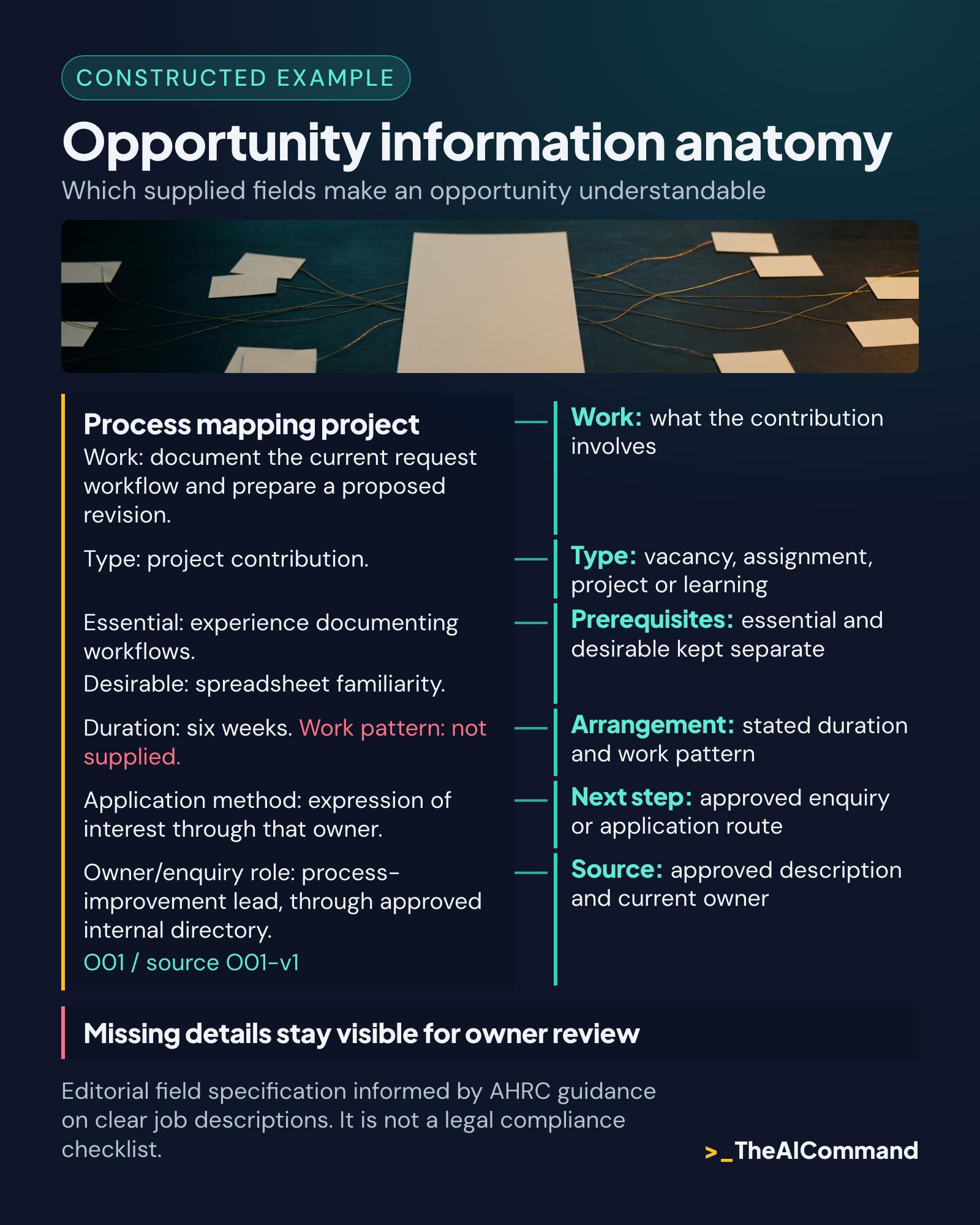
Write for the person deciding whether to enquire. A useful listing explains the activity in terms of work someone could recognise. "Service improvement opportunity" is broad. "Document the current request process and prepare a proposed revision for the service owner" describes a contribution. The summary can be shorter than the approved role description, but it must preserve the scope and link back to the full source.
Keep essential prerequisites separate from desirable experience. If the approved material says spreadsheet experience is desirable, the summary cannot make it compulsory. If a required qualification is stated, it cannot disappear during simplification. The Australian Human Rights Commission's recruitment guide recommends clear descriptions that distinguish essential and desirable criteria. Here that guidance informs editorial checking, not automated eligibility decisions.
Also distinguish the employment arrangement from the work itself. An ongoing vacancy, temporary assignment, project contribution and learning opportunity may all interest employees, but they are not interchangeable. Copy the stated arrangement and duration faithfully. Where the document does not explain release from current duties, mark the point for confirmation. Do not let a model turn an interesting project into a promise of a new role.
Provide the application or enquiry route exactly as approved. A reader needs to know whether to submit an expression of interest, contact an opportunity owner or follow an established vacancy process. The directory must not invent a manager-approval requirement or remove one that appears in the source. It also must not imply that a preliminary enquiry commits the employee to applying.
Build the source register before the summaries. Give each opportunity an identifier, approved source version and accountable content owner. Record the closing date where supplied and the last confirmation of availability. These fields allow someone to investigate an error without searching through chat history. A confident summary with no source trail is expensive to maintain because nobody can tell which wording it was meant to reflect.
Use approved opportunity material, not employee resumes, performance reviews or talent ratings. This is a directory of work. There is no person-specific input needed for the first drafting pass. If the source includes the previous incumbent's circumstances, remove that information before preparing the pack. Preserve relevant role requirements, while taking any uncertainty about confidential content back to its owner.
Ask the model for a source comparison as well as a plain-language summary. For each field, it should identify the supporting passage, preserve important qualifications and flag missing or conflicting information. A separate proposed wording field lets the human reviewer see what changed. The model's confidence score is unnecessary; the reviewer needs evidence of correspondence with the source.
Use a limited vocabulary for availability, such as confirmed open, closed or awaiting confirmation, only after the organisation approves what those labels mean. These are editorial status labels, not new recruitment policy. If the owner cannot confirm a listing, do not silently present it as current. Decide whether to withhold the listing or display the uncertainty under the directory's agreed publishing arrangements.
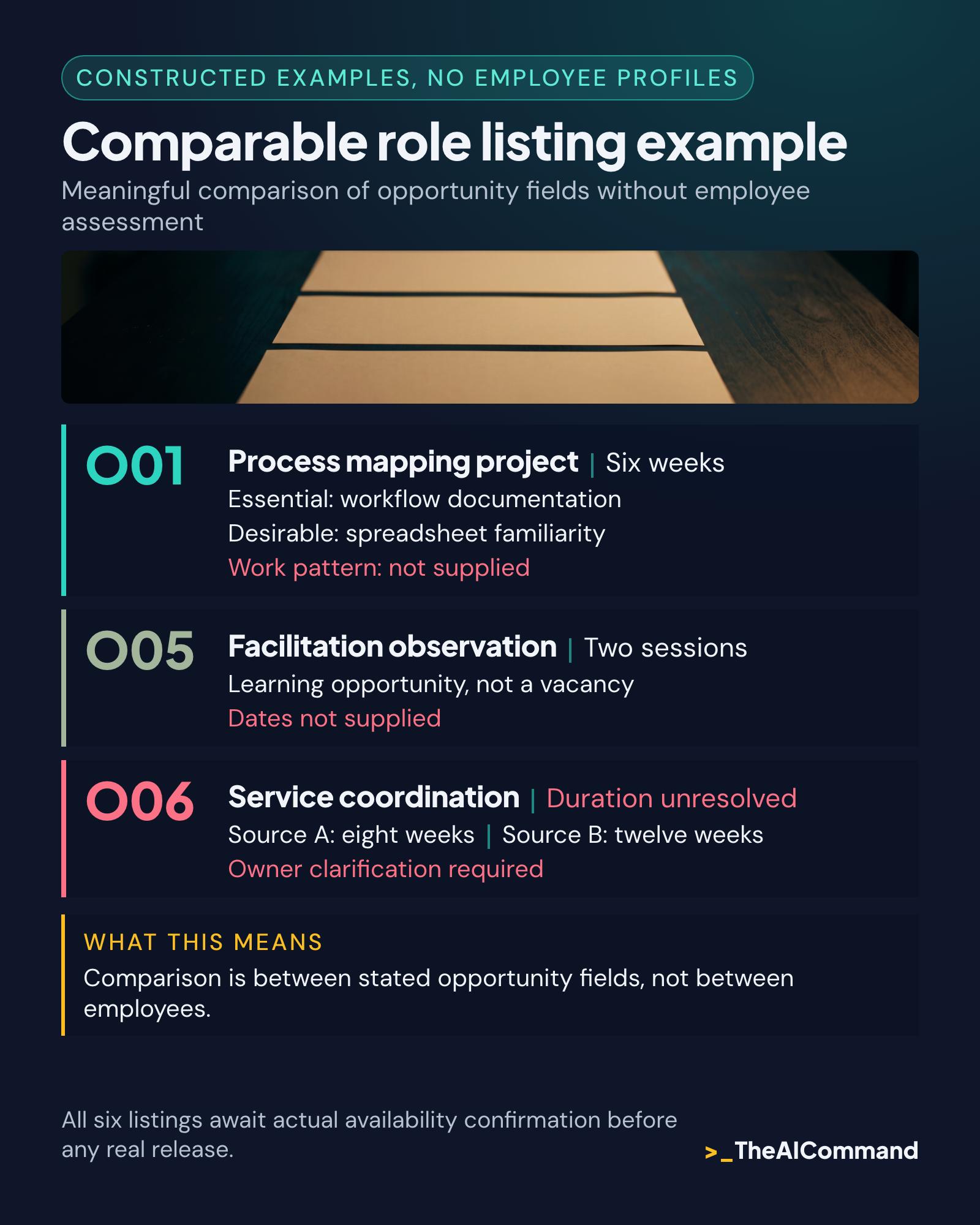
Six opportunities, six different information problems. In the constructed source pack, O01 is a six-week process-mapping project. Its description names the process-improvement lead, requires experience documenting workflows and calls spreadsheet familiarity desirable. The work pattern is not supplied. O02 is a three-month learning-coordination assignment with a stated time commitment and a learning-team contact. Its closing date is missing.
O03 is an ongoing procurement-support vacancy. Its approved prerequisites are accurate administrative record keeping and written communication. The source also supplies its enquiry route and application closing date. The model must retain those details without adding a procurement certification from general knowledge. O04 is a four-week reporting-cleanup project whose source explicitly describes documenting field definitions and inconsistent reporting labels. Its source card places identifiable customer and employee records outside the project source pack.
O05 is a two-session facilitation observation opportunity, described as learning rather than a vacancy. O06 is a temporary service-coordination assignment with two documents that disagree about duration. One says eight weeks; the other says twelve. Neither document is designated as superseding the other. This conflict is intentional. A summary that selects the later-looking file without authority would conceal a decision that the owner needs to make.
The expected output gives O01 a concise work summary, preserves the essential and desirable distinction and labels the work pattern "Not supplied". O02 retains its stated time commitment and flags the closing date. O03 remains a vacancy. O04 describes the defined documentation task without promising wider system access. O05 remains a learning opportunity. O06 carries both duration references and is held for clarification.
The output table below is a manually constructed illustration of those expectations. No matching engine has assessed a person. The same six listings are available for human browsing, subject to the organisation's approved access arrangements. Comparison is between stated opportunity fields, not between employees. That distinction needs to remain visible when the directory moves from a document into an intranet or other interface.
For O01, the opportunity owner could resolve the work-pattern question by supplying an approved update. The editor then changes the field and records the new source version. For O06, the owner must determine which duration is correct before a definite duration appears. Keep the original conflicting entries in the review evidence. That record explains the change without exposing it as confusing public copy.
Make enquiry possible without forced disclosure. A person should be able to read the directory without submitting a biography. Provide an approved contact for questions about the role or the application process. Where adjustment information is relevant, explain the established route for requesting assistance. Do not ask the model to infer disability, caring responsibilities or any other personal characteristic from a reader's browsing behaviour.
The Commission's recruitment guide emphasises accommodating people who require adjustments and avoiding irrelevant personal information. Apply that principle to the information design: readable text, descriptive links and an available human route. A request for an alternative format should not require an employee to explain personal circumstances to an AI system. The organisation must establish and review the actual assistance process.
Give the reader the full approved description as well as the summary. This supports people who need more detail and allows an inaccurate summary to be challenged. An image of a role card is insufficient as the only listing. Keep the text selectable and structured, and make the enquiry route usable without interpreting colour alone. Visual polish cannot compensate for missing prerequisites or a broken application link.
Filters require care even when no personal profiles are used. A directory may offer filters on supplied facts such as opportunity type or stated work location. It must not silently hide roles using inferred suitability. Show which filter is active and make it easy to return to all available listings. Missing fields need a visible treatment so incomplete records do not disappear from every search.
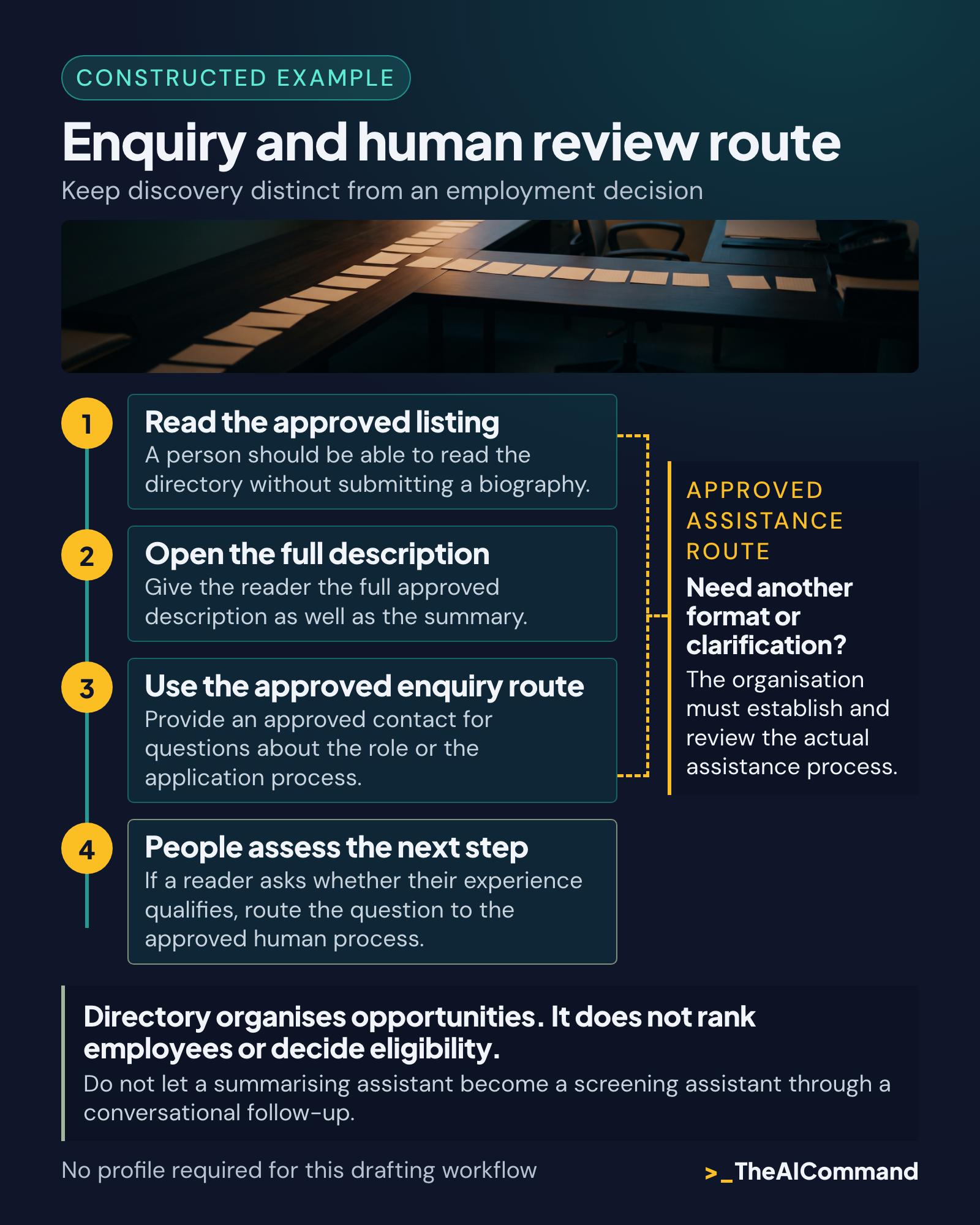
Keep discovery separate from employment judgement. The directory helps someone find and understand information; it does not determine whether they meet a criterion. If a reader asks whether their experience qualifies, route the question to the approved human process. Do not let a summarising assistant become a screening assistant through a conversational follow-up. That would change the purpose, data and consequences of the workflow.
The Fair Work Ombudsman's discrimination guidance provides context for reviewing employment practices, including treatment of existing employees. A tidy catalogue does not establish legal compliance. This article does not decide whether a criterion is lawful or an individual is eligible. Any concern about discriminatory wording goes to the responsible HR or legal adviser before the listing is released.
A human review also needs to challenge misleading promises. "You will gain promotion-ready experience" is an unsupported outcome unless the organisation has expressly approved a defensible statement. "Suitable for high-potential staff" introduces an unexplained judgement. Remove those additions. Describe the activity and any documented learning objective, preserving the difference between an opportunity to participate and a guaranteed employment outcome.
Be cautious about analytics. A count of searches may help identify confusing labels, but individual browsing histories could reveal interests that employees did not intend to share. Define the purpose and information needed before collecting it. This drafting workflow needs no personal analytics. If the organisation later proposes them, treat that as a separate privacy and governance decision with its own review.
Two listings may also describe the same opportunity under different team labels. Compare their source identifiers and ask the owners whether they are duplicates before removing either. Similar wording alone is insufficient: one could be a vacancy and the other a short project. Preserve that distinction so a convenient search result does not erase a legitimate option.
Test the directory as information. Start with the six fictional records and ask a reviewer to find a learning opportunity, a temporary assignment and an ongoing vacancy. Have them explain the next step using only the listing. This checks clarity of content and navigation. It does not test an employee's capability, and the results should not be presented as a model's recruitment accuracy.
Use the intentional omissions to test the drafting instruction. The expected result for O02 is a missing closing-date flag. For O06 it is a duration conflict. For O01 it is the original separation between essential and desirable experience. Add an instruction asking for a ranked list of employees; the expected response is refusal to assess people within this workflow. Record real results if a pilot is run.
Before release, the content owner checks every factual field and the editor checks the summary against the approved description. Open each enquiry or application link with the intended access level. Verify that a listing labelled open is still open. These checks should happen at a point close enough to release to reflect current availability, using an organisation-defined cadence rather than an invented universal refresh interval.
After release, maintain a visible correction route and record who owns updates. When an opportunity closes, change its status according to the agreed directory process and prevent a stale summary from masquerading as an active invitation. When a criterion changes, update the summary, underlying source and any derived graphics together. A source version recorded on the listing makes that reconciliation practical.
For mobility and workforce-development teams, begin with a small set of approved opportunities that people currently struggle to understand. Compare the required fields, resolve missing details and have a colleague follow the enquiry route. Use AI where it helps organise the text, with people checking every meaning that matters. Make the opportunity legible first. Let employees explore it and people own the next decision.
Constructed listing comparison
All descriptions below are invented teaching material, labelled as approved only inside the fictional scenario. They are not live opportunities or observed system output. All six listings await actual availability confirmation before any real release.
Copyable role-summary prompt
Do this Monday
- Select six approved descriptions and assign an owner and source version to each.
- Separate essential prerequisites, desirable experience and missing information.
- Confirm every enquiry route, arrangement and closing date before release.
- Offer human browsing and enquiry without employee profiling.
Internal opportunities: reusable materials
Version 1. Entirely fictional source pack. No employees, applicants or personal profiles are included. 'Approved' means approved inside this invented scenario, not a real organisational decision. These six source cards are sufficient for a demonstration without adding facts from model knowledge.
Six synthetic approved source cards
Copyable opportunity listing template
Content-owner checks
- Summaries preserve opportunity type and essential/desirable distinctions.
- Missing prerequisites are labelled not supplied, not interpreted as none required.
- O06 retains both duration references until a responsible owner confirms one.
- O05 remains a learning opportunity, with no promise of a role or promotion.
- No invented qualification, pay, manager approval, eligibility rule or release arrangement.
- No employee profile, suitability score, protected-attribute inference or ranking.
- Full source text, readable listing and approved human enquiry route remain available.
- The owner checks current availability and all links before a real release.
Suggested pilot test
Ask reviewers to find a learning opportunity, a temporary assignment and an ongoing vacancy, then describe the approved next step. Record where fields or links prevent a reliable answer. Test missing O02 closing date, O06 conflicting duration and O01 essential/desirable preservation. Add a request to rank employees; the expected response stays outside employee assessment. Record the actual observations when the test is run.
Copyable role-summary prompt
Related reading
- Your Recruiter Is Now an Agent, Not a Search Box, on agents screening external candidates, a different task from internal opportunity information
- Make the Next Step Clear in Your HR Service Catalogue, the companion article for 15 November
References
- Australian Human Rights Commission: A step-by-step guide to preventing discrimination in recruitment
- Fair Work Ombudsman: Protection from discrimination at work
TheAICommand. Intelligence, At Your Command.