
The recruiter that sifts your candidates is no longer a search box you type keywords into. It is an agent that takes an instruction, reads profiles, drafts outreach, and now, in early testing, runs the first interview itself. LinkedIn's Hiring Assistant reached roughly $450 million in annualised revenue by April 2026, the first time the company broke out sales for one of its AI products. That number matters for one reason: it means the agentic recruiter is not a pilot anymore, it is a business, and the incentive is to push it deeper into the hiring funnel.
The next step is already visible. A growing share of Australian candidates will soon be screened by an AI agent, over audio or video, before a human recruiter ever opens their application. For HR and talent teams, that is not an efficiency story to wave through. It is a governance decision, because the moment an agent does the first sift, every rule that already governs screening applies to a process most teams have never run before.
What the recruiting agent actually does now
LinkedIn's Hiring Assistant was announced in October 2024 and reached general availability in English at the end of September 2025. It takes a plain instruction from a human recruiter, works out what the role needs, sifts profiles, shortlists candidates, drafts the first messages, and handles routine pre-screening. LinkedIn reports pilot users saving around four hours per hire and reviewing more than 60 per cent fewer profiles. That is the sourcing and outreach layer, and it is now mainstream.
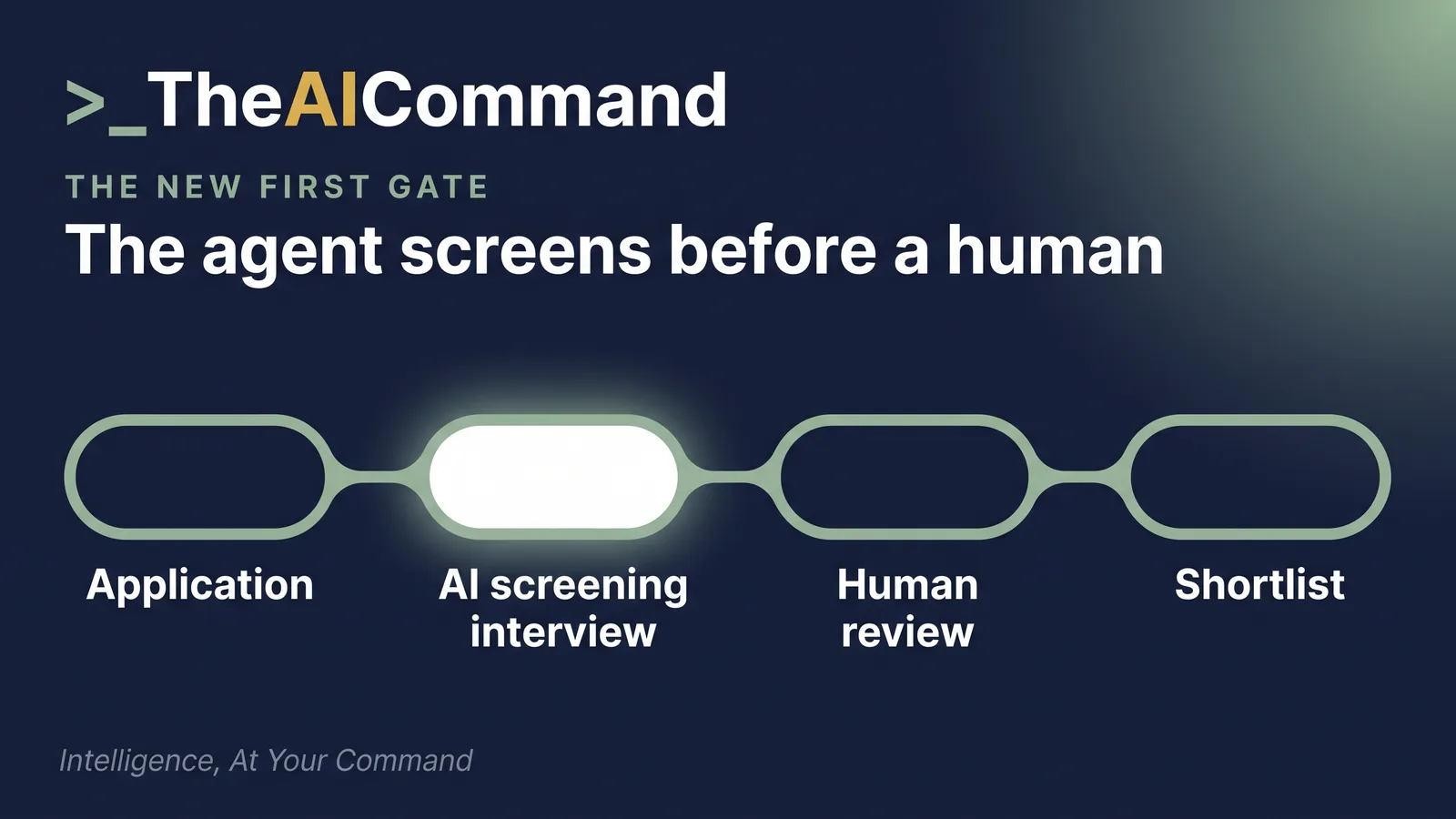
The newer and more consequential move is screening. In March 2026 LinkedIn began testing an AI screening interview in its Hiring Pro product for smaller businesses. The mechanics are worth reading closely, because they define the governance problem. A hirer can invite up to 40 applicants per role to complete an audio or video screening with an AI interviewer as the first step. The AI generates the interview questions and a set of ideal answers from the job description. The hirer can review and edit those before they go out. Candidates then complete the interview, and their answers are scored on alignment with the hirer's ideal answers. The hirer receives the full transcript, the audio or video recording, an AI-generated summary, and a five-point rating for each candidate. LinkedIn's own help material on AI interviews frames the human as retaining control of the evaluation and the decision to progress.
Read that carefully and the shift is clear. The agent is not just finding people. It is asking the questions, capturing a recording, and producing a score that ranks who a human looks at first. The first interview, historically the point where a person met a person, is now conducted by software.
Why 'screened by an agent' is a different problem
A ranking model that scores a resume is one thing. An agent that runs an interview is another, for three reasons.
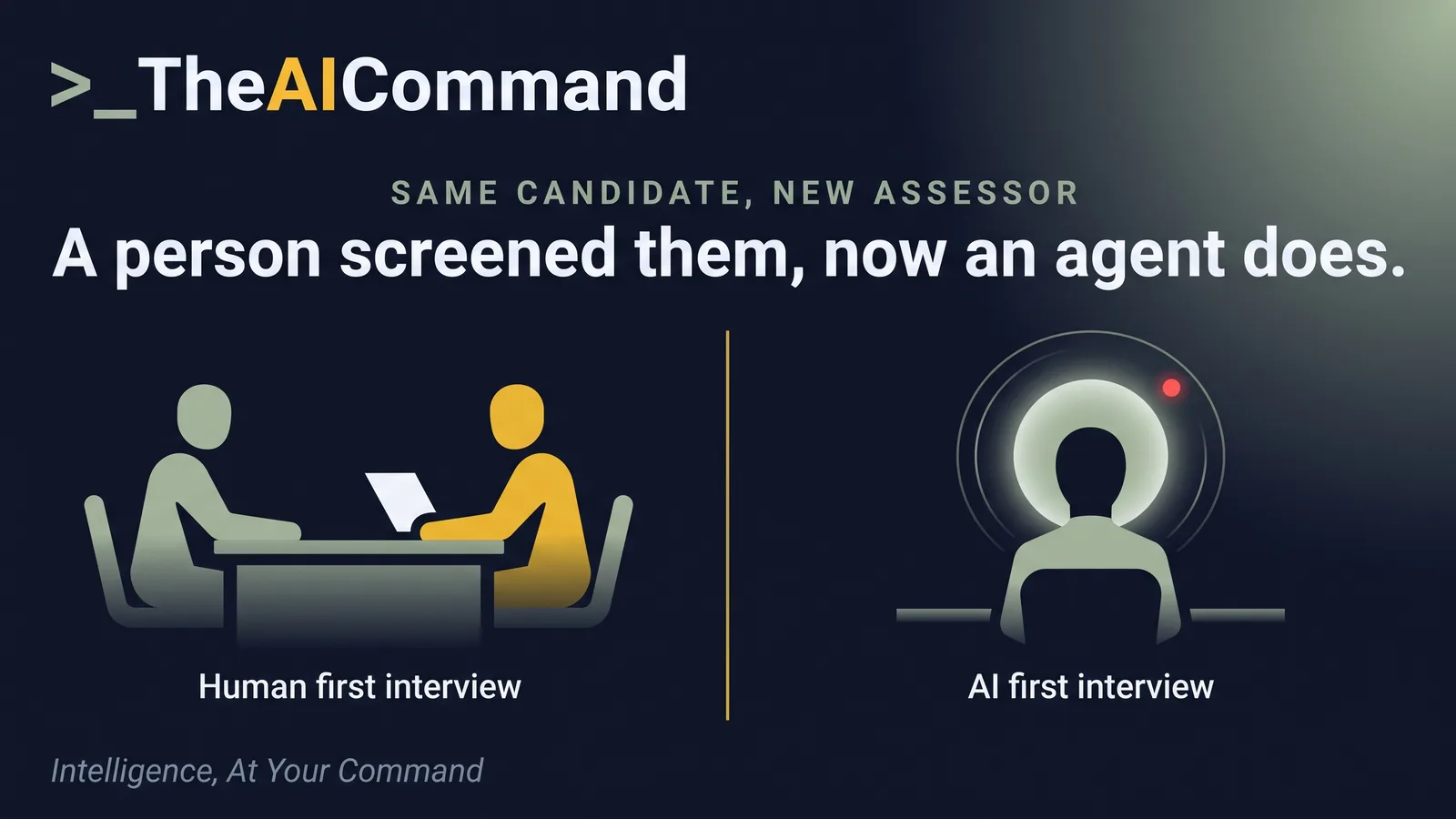
First, the decision point moved earlier and became less visible. Every AI safeguard most HR teams built in the last two years, bias testing on ranking tools, human review of shortlists, sits after a person has applied and been assessed. An AI screening interview inserts a scored, recorded gate before a human sees anyone, and it decides who clears it. If that gate is quietly disadvantaging a group, the people it filters out never reach the stage where anyone would notice.
Second, the score is only as good as the ideal answers behind it. The AI does not have an independent notion of merit. It rates a candidate on alignment with the ideal answers generated from the job description and edited by the hirer. If those ideal answers reward confident self-presentation, native-level fluency, or a particular communication style that the role does not actually require, the rating encodes that bias and applies it at scale to every candidate. This is the same failure the site's positive-duty control framework warns about, moved from a filtering model to a scored conversation.
Third, the record changed shape. The output is no longer a rejection reason in an applicant tracking system. It is an audio or video recording of a real person, a transcript, and a numeric score, held by a vendor. That is a richer and more sensitive record than most hiring stages have ever produced, and it sits squarely inside Australian privacy law.
The Australian rules that apply the moment an agent screens
Four regimes bite at once, and the agent does not soften any of them.
The Privacy Act 1988 governs the recording and the data. Australian Privacy Principle 3 limits collection to what is reasonably necessary for your functions. A full audio or video recording of every screened candidate collects far more than a structured set of answers would, so you need a real reason it is necessary, not just that the tool offers it. Australian Privacy Principle 5 requires you to notify candidates, at or before collection, about who is collecting, why, and what happens with the information. If the screening vendor processes candidates offshore, the cross-border disclosure rules add another layer.
The transparency duty tightens this further. From 10 December 2026, new automated decision-making obligations are inserted into Australian Privacy Principle 1. As the OAIC guidance on APP 1 explains, where an entity arranges for a computer program to make, or do something substantially and directly related to making, a decision that could reasonably be expected to significantly affect a person's rights or interests, the privacy policy must disclose the kinds of personal information used and the kinds of decisions made. A screen that decides who a recruiter interviews is a strong candidate for this. HR should be preparing the privacy policy disclosure now, not after the deadline.
Discrimination law is where the agent creates the sharpest exposure. Under the general protections in the Fair Work Act 2009, section 351 prohibits adverse action against a person, including a prospective employee, because of a protected attribute such as race, sex, age, disability, marital status, family or carer responsibilities, pregnancy, religion or political opinion. Refusing to progress a candidate is adverse action, and these claims carry a reverse onus: the employer must prove the protected attribute was not a reason. An AI screening interview raises specific hazards. Fluency and accent scoring can disadvantage a candidate whose speech is unrelated to the role. Video assessment can surface disability or age. The Sex Discrimination Act positive duty, in force since December 2022 and enforceable by the Australian Human Rights Commission since December 2023, expects you to identify and control these hazards before anyone is harmed, not to wait for a complaint. A screen no one has tested for disparate impact is hard to defend as a reasonable and proportionate measure.
The through-line is the one the site returns to across the hiring pieces: assess what the person can do for the role, and own the fairness of whatever tool does the assessing.
The record you must be able to produce
If a rejected candidate challenges the decision, or a regulator asks, the question is simple: can you show the screen was job-related and that a human owned the outcome? That means keeping a defined file for every AI screening round:
- The questions the AI asked, and the ideal answers used to score them, exactly as they went out.
- The rating each candidate received, and the summary the AI produced.
- Evidence that a named person reviewed the result before any rejection, and the reason a candidate did or did not progress.
- The notice given to candidates before the interview, and consent for any audio or video recording.
- The retention period, who could access the recordings, and when they were deleted.
- Any request for a reasonable adjustment or a human alternative, and how it was handled.
If you cannot produce that file, you are relying on a vendor's black box to defend an employment decision, which is exactly the position the reverse onus makes untenable.
How to run an AI screening agent lawfully
Before you enable the feature, review what it will actually ask and score. This prompt puts a human check on the AI's own questions and ideal answers:
Then give candidates a straight notice before they start. This prompt drafts one:
Do this Monday:
- Find out whether any recruiting tool your team uses has an AI screening interview feature, and whether it is switched on for any live role.
- For any role using it, pull the AI-generated questions and ideal answers and run them through the review prompt above, then remove or reword anything that is not clearly job-related.
- Confirm what the tool records and where the recordings are stored, cut the collection to what is reasonably necessary under APP 3, and set a retention limit with logged access.
- Publish a candidate notice before the interview stage that says an AI conducts it, what is recorded, and how to ask for an adjustment or a human alternative.
- Name the person who must review the AI rating and own the decision to progress or reject each candidate, so no rejection is made on the score alone.
- Open a screening-round file that keeps the questions, ideal answers, ratings, human review notes, notices and consents together.
- Diarise the automated decision-making privacy policy disclosure so it is in place before 10 December 2026.
A worked example
A mid-sized Australian services employer, [EMPLOYER], enables the AI screening interview for a high-volume customer-support role and invites 40 applicants to a video screening. The AI drafts the questions and ideal answers from the job description, and [EMPLOYER] sends them out without editing. Two weeks later a rejected applicant, [CANDIDATE], asks why they did not progress after what they felt was a strong interview.
Because [EMPLOYER] kept the round file, the talent lead can look. The transcript shows [CANDIDATE] answered the substance well, but the five-point rating was dragged down by a low score on an ideal answer that rewarded "confident, fluent delivery". [CANDIDATE] has a stammer. Nothing about the role requires fluent delivery, only clear written and spoken communication with customers, which the transcript shows [CANDIDATE] handled. The ideal answer was scoring a proxy for a speech disability, a live discrimination risk under the Fair Work Act and the Disability Discrimination Act.
Because a human was named to own the outcome, the lead can act: reinstate [CANDIDATE] to the next stage, strike the fluency criterion from the ideal answers, re-score the affected candidates, and record what changed. Had [EMPLOYER] rejected on the score alone and kept no file, the same facts would be a general protections claim with the onus on the employer to prove the disability played no part, and no record to do it with. The tool did not create the fairness problem or fix it. The governance around the tool did.
Bottom line
An agent that screens candidates before a human sees them is a genuine advance in speed and a genuine transfer of a decision to software, and only the first half is automatic. The Australian rules on collection, notice, discrimination and human accountability all still apply, and the reverse onus in a general protections claim means the employer, not the vendor, carries the risk. Test the questions and the ideal answers before they go out, tell candidates an AI is assessing them, keep a person accountable for every outcome, and keep the record that proves it. Do that, and the recruiting agent is a tool you can defend. Skip it, and you have automated an employment decision you cannot explain.
TheAICommand. Intelligence, At Your Command.