
When generative AI can make any job application read as competent and tailored, the written application stops distinguishing candidates, and the fix is to assess demonstrated capability directly rather than to hunt for the AI. The polished application just stopped meaning anything.
For as long as anyone has recruited, the written application carried signal. A tailored cover letter suggested genuine interest. A clean, well-structured CV suggested someone who could organise a thought. Clear, confident prose suggested communication skill. None of it was proof, but all of it was correlation, and recruiters leaned on it to sort a pile of applicants into a shortlist. Generative AI has quietly severed every one of those correlations. A candidate who has never tailored anything in their life can now produce a perfectly tailored, flawlessly written, keyword-aligned application in the time it takes to paste in a job ad. The signal is gone, and it is not coming back.
This is not a distant problem. It is in the inbox now, and Australian hiring managers can feel it.
Why has AI made hiring harder?
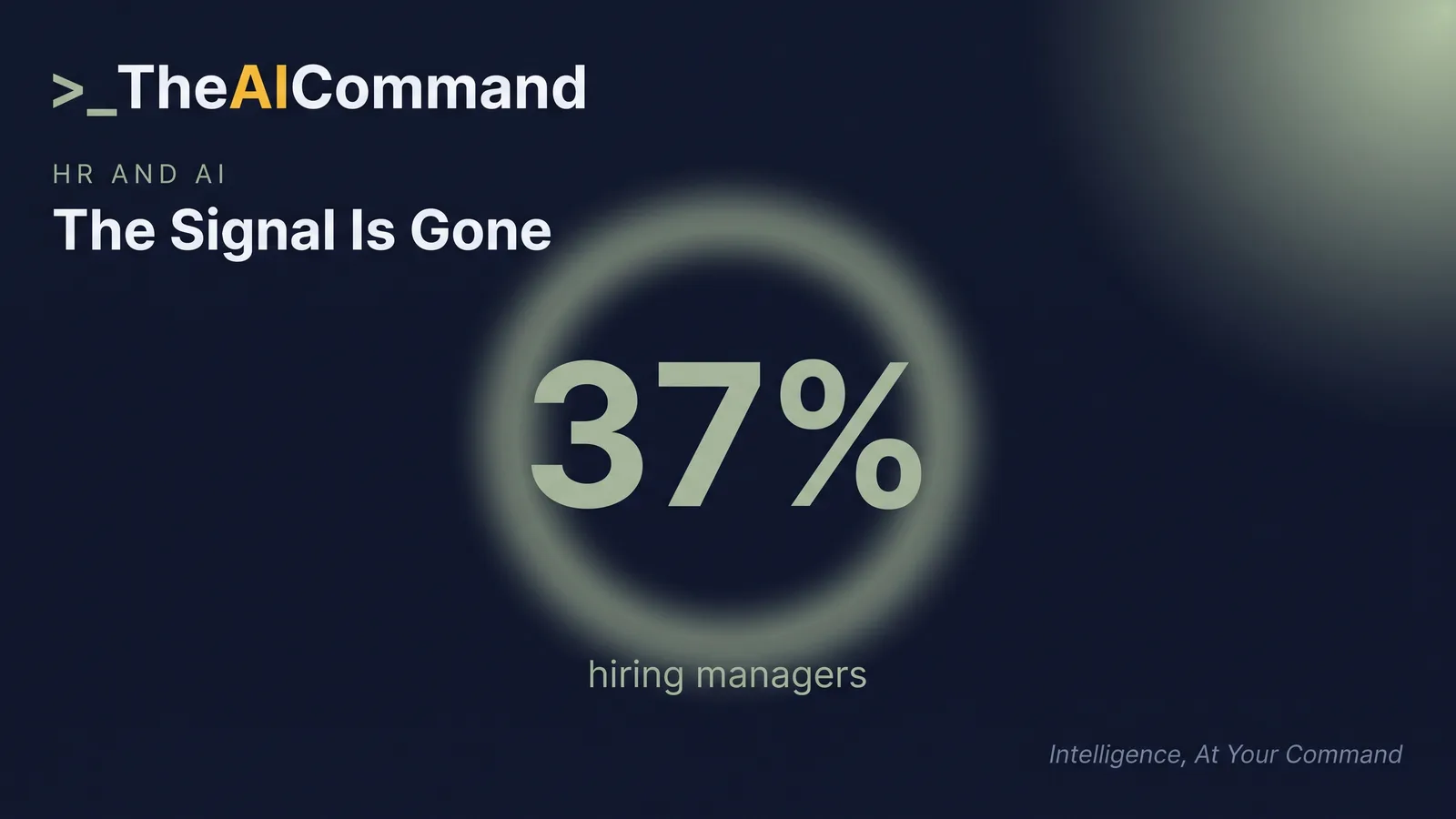
Robert Half's April 2026 Australian research puts numbers on the shift. It found that 97 per cent of Australian hiring managers now require new hires to have AI and automation proficiency, and that 88 per cent say it is challenging to find talent with those skills. The striking figure sits in the middle of that squeeze: 37 per cent of hiring managers say assessing AI-generated CVs makes it difficult to accurately judge candidate quality. As Robert Half puts it, uniform formatting and templated language "often blur the differences between applicants," making genuine skill harder to see, and it becomes "harder to distinguish between overly polished applications and genuine capability."
The mechanism is simple. When a tool lifts everyone's written output to the same competent baseline, the written output stops discriminating between them. A model does not just fix a weak applicant's spelling. It gives a weak applicant the vocabulary, the structure and the confident tone of a strong one. The candidate who genuinely has the skills and the candidate who can describe having them now look identical on paper.
The instinct in a lot of HR functions is to fight fire with fire: buy an AI-detection tool, flag the suspicious applications, screen them out. That instinct, reaching for another tool before a human review step, is wrong on two counts. It does not work, because AI-detection tools are unreliable and generate false positives that catch strong writers and people using assistive technology. And it solves the wrong problem. Using AI to write a job application is not misconduct. It is what applicants do now, the same way they once used a word processor and a template. Trying to police it is a losing arms race that also punishes the wrong people. The task is not to detect the AI. It is to stop relying on the artefact the AI has compromised.
The volume problem sitting underneath
There is a second effect compounding the first. The same tools that polish applications also multiply them. When applying takes minutes instead of an afternoon, people apply for more roles, including ones they are a loose fit for, and the pile grows. Robert Half's Australian data captures this pincer directly: alongside assessing AI-generated CVs, hiring managers named high application volume and a lack of tailored, role-specific skills as their biggest obstacles to spotting standout candidates. So recruiters face more applications, each individually more convincing and collectively less distinguishable. The old triage, skim for the well-written ones, fails at both ends: there are too many to skim, and being well-written no longer narrows anything.
That is why the answer cannot be "read harder". No amount of careful reading recovers a signal that the technology has erased, and throwing more recruiter hours at a larger, flatter pile just spreads the same guesswork thinner. The only durable response is to change what you are reading for, and to move the decisive evidence off the page and into something a candidate has to actually do.
How do you assess candidates when every application looks strong?
If the application no longer signals ability, move the assessment weight onto things that do. The good news is that the fix is not exotic. It is the skills-based, structured hiring that selection research has favoured for years, made newly urgent because the old shortcut has broken. Here is a workflow you can put in place for your next role.
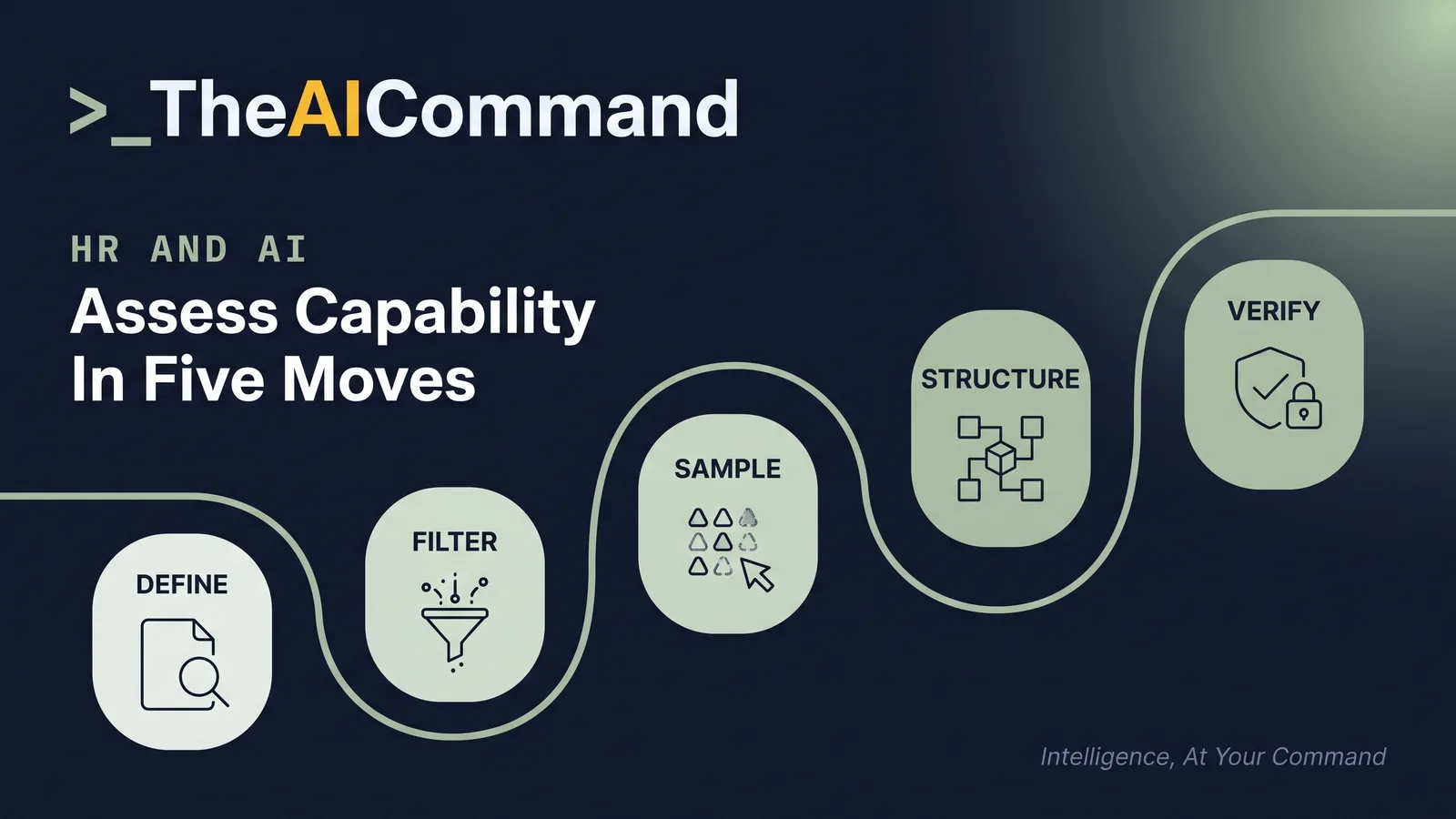
- Define the real capabilities first. Before you write the ad, list the three or four things the person must actually be able to do in the role, in observable terms. Not "strong communicator" but "can explain a technical decision to a non-technical stakeholder in writing." This list becomes what you assess, and it stops you defaulting back to reading the CV for a feeling.
- Use the application as a filter, not a decision. The written application still tells you whether someone meets the basic requirements: right to work, relevant experience, essential qualifications. Use it for that pass or fail screen, and stop asking it to rank people on quality it can no longer show.
- Add a short, role-relevant skills task. Give shortlisted candidates a small, realistic piece of the actual job to do. Keep it short enough to respect their time, close enough to the role that it tests the real capability, and consistent so every candidate does the same one. This is where genuine ability separates from confident description, because doing the task is harder to fake than writing about it.
- Structure the interview and score it the same way every time. Ask every candidate the same behavioural questions tied to your capability list, and score against a defined rubric rather than a gut read. A structured interview is one of the most reliable predictors of performance, and it is far more resistant to a polished front than an unstructured chat. It also gives you a defensible, consistent record.
- Verify with a supervised work sample where the stakes justify it. For senior or high-consequence roles, a short live exercise, a paid trial task, or a work sample done in front of you shows how the person actually thinks and works, including how they use AI to do it. That last point matters, because for most roles you now want to see a candidate use AI well, not pretend they do not.
A worked example
[HIRING_MANAGER] is recruiting a [ROLE] for [TEAM] and receives 200 applications, most of them articulate and tailored in a way that would have marked a strong candidate two years ago and now marks nothing. Under the old process, the manager would spend a day ranking cover letters and shortlisting the best-written ones.
Under the redesigned process, the written applications are run only against the essential requirements, which cuts the field to 60 who genuinely qualify. Those 60 receive the same 30-minute skills task built from the actual role. The task, not the prose, produces the shortlist, and it surfaces two candidates whose applications were unremarkable but whose work was clearly strongest. Those candidates go to a structured interview where every person is asked the same questions and scored on the same rubric, and the strongest is offered the role after a short paid exercise. The polished applications did not decide anything. What the people could do decided everything.
The part worth dwelling on is the two candidates the old process would have missed. Their applications did not stand out precisely because they had not dressed themselves up, and against a field of AI-polished submissions, an honest, plain application now reads as weaker than a manufactured one. That is the inversion the shift creates: the written artefact no longer rewards ability, it rewards willingness to use the tool, and those are not the same thing. A selection process that still leans on the artefact does not just fail to find the best candidate. It actively tilts toward the most polished, which in an AI-saturated pile is often the least revealing signal you have.
What are the legal limits on AI in hiring?
Redesigning selection around AI does not suspend the rules that already govern hiring. Two Australian obligations sit directly on this.
The first is fairness under the Fair Work Act. The general protections make it unlawful to take adverse action against a prospective employee because of a protected attribute such as race, sex, age, disability or family responsibilities. That bites hardest if you deploy AI screening of your own to cope with the volume. A model that filters applicants can quietly encode bias, and a job applicant is protected even before they are an employee, so an AI screen that disadvantages a protected group is a legal exposure, not just an ethical one. If you use AI to sift, you own the fairness of what it does, and a human must be able to explain and stand behind the outcome.
The second is privacy. Under the Privacy Act, you can only collect personal information that is reasonably necessary for the role, and sensitive information needs consent. The temptation to counter AI-polished applications by scraping a candidate's digital footprint or running them through a profiling tool runs straight into that limit, and offshore screening tools raise cross-border disclosure obligations on top. The line is clean: assess what the person can do for the role, not who they are outside it.
Underneath both is the human-decision boundary that runs through all of this. AI can help you build the skills task, structure the interview questions and organise your notes. It cannot decide who to hire. The hiring decision carries real consequences for a real person and has to sit with an accountable human who can justify it.
What never to automate
- Never let AI make the hire or the reject. It can organise and structure your assessment. The decision, and the accountability for it, stays with a person.
- Never screen candidates out on suspected AI use. Detection is unreliable, penalising it is unfair, and using AI to apply is now normal behaviour, not a red flag.
- Never let an AI screen run unmonitored. If a model filters applicants, a human owns its fairness and can explain any adverse outcome, or it should not be deciding anything.
- Never collect more than the role needs. Countering polished applications by profiling a candidate's private life breaches the collection limits in the Privacy Act and is the wrong instinct entirely.
The uncomfortable truth is that AI did not make hiring harder by cheating. It made it harder by removing a crutch. The written application was always a proxy, and a weak one, for the thing you actually care about, which is whether the person can do the job. Now that the proxy has broken, the work is to measure the real thing directly. Do that, and you end up with a fairer, sharper process than the one AI disrupted, because you are finally hiring on capability instead of on who wrote the best paragraph.
Bottom line
Generative AI has erased the signal the written application used to carry, so polish and tailoring no longer tell you who can do the job. Hunting for AI use is a losing game that punishes the wrong people. Move the decisive evidence off the page and onto demonstrated capability, and keep the process fair under the Fair Work Act and the Privacy Act.
Do this Monday:
- List the three or four observable capabilities the role actually needs before you write the ad.
- Use the application only as a pass or fail filter for basic requirements, not to rank quality.
- Give every shortlisted candidate the same short, role-relevant skills task.
- Run a structured interview with the same questions and a scoring rubric for everyone.
- Keep the hire or reject decision with an accountable human, and never screen anyone out on suspected AI use.
TheAICommand. Intelligence, At Your Command.