AI can draft a performance warning or improvement plan in seconds, but it cannot supply the facts or the fairness a dismissal has to rest on. The paper trail is now easy to write and easy to get wrong.
Every manager who has ever put off documenting an underperformance conversation knows the friction the blank page creates. AI has removed it. Feed a model a few rough notes and it returns a clean, structured, neutral-sounding warning or improvement plan in seconds. That is a real gift to a task most managers avoid, and it is also where a new risk enters, because the thing AI is best at is producing text that reads true whether or not it is.
The Fair Work Commission is watching that risk arrive from the other side of the bench. Its caseload has surged, and the President has been blunt about why.
What is going wrong with AI-drafted performance documents?
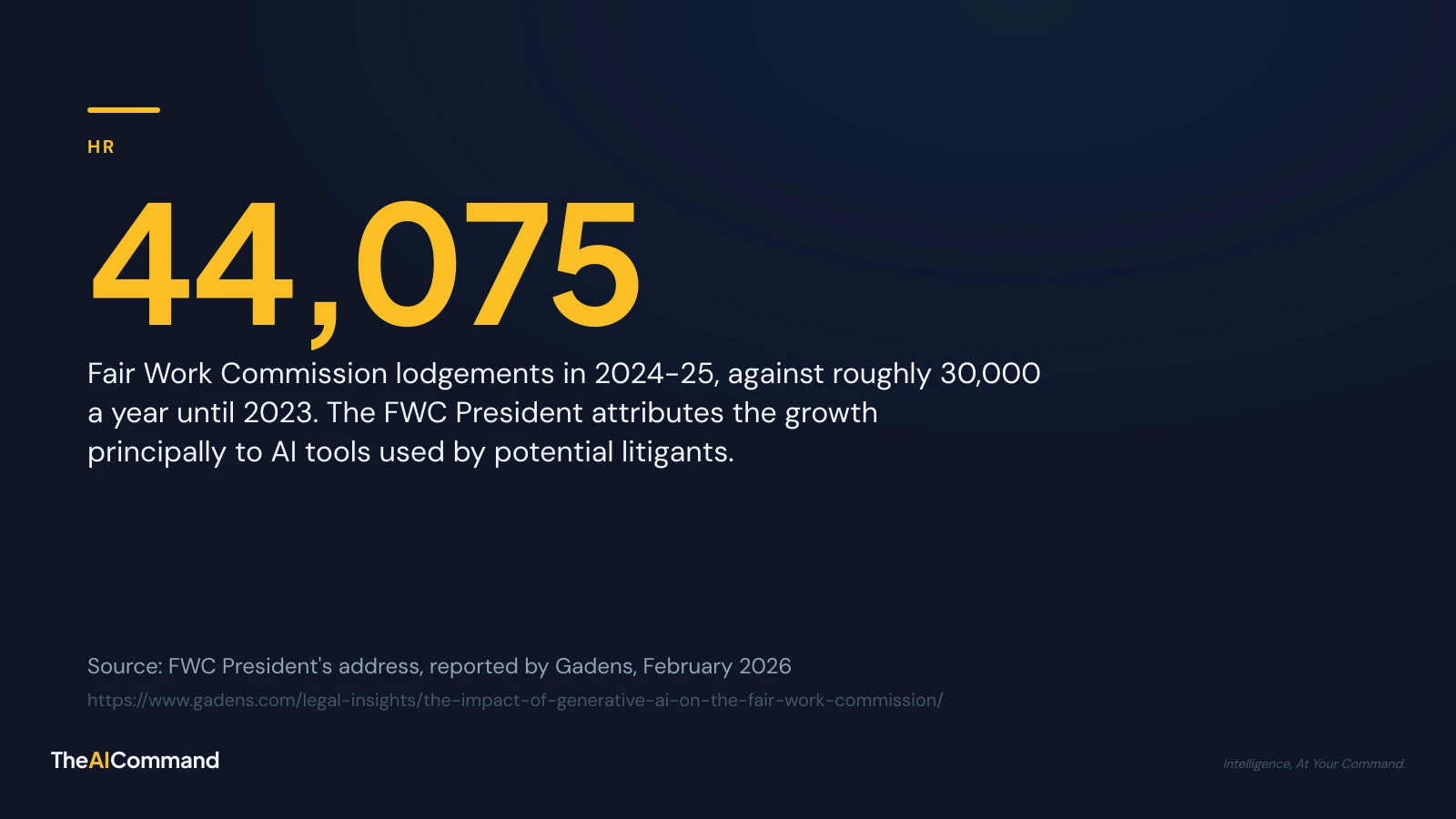
The numbers are striking. As Gadens reports the Fair Work Commission President Justice Adam Hatcher's late-February 2026 address to the Victorian Bar Association, the Commission received 44,075 lodgements across the 2024/25 financial year, against a normal of "just above 30,000 lodgements a year" until 2023, with 2025-26 projected between 50,000 and 55,000. The Commission's own view is that "the growth is principally due to the increasing use of AI tools by potential litigants."
More telling than the volume is what the AI is producing. Gadens notes documents where AI tools "generate made-up cases or hallucinate legislation," "invent facts or evidence," and "interpret the law incorrectly." In one matter, Reece Hoverd v M & J D Pty Ltd, the applicant "consistently relied upon provisions of his contract and the Waste Management Award 2020 which did not exist." The award was invented. The contract clauses were invented. The document read like a real case and was built on things that were never there.
The Commission has responded with an exposure draft Guidance Note on the use of Generative AI in its cases, published on 24 March 2026. Its core demand is simple and it applies far beyond the tribunal: a document produced with AI "must be checked and amended by the author so that all details are correct," and a witness statement must be "based on their own knowledge." Check it, correct it, own it.
Now turn that lens around. The same tools producing invented awards for self-represented litigants are the tools your managers are using to draft warnings and improvement plans. If a fabricated award can slip into a Commission filing, a misremembered incident or a wrong date can slip into a performance document just as easily. And that document is the one that ends up as evidence when the dismissal is challenged.
Not the note-taker problem, and not the investigation
It is worth being precise about what this is and is not, because HR now has several AI questions running at once. It is not the note-taker question, which is about consent and whether a meeting should be recorded and transcribed at all. It is not the workplace investigation question, which is about weighing evidence and reaching a finding on alleged misconduct. This is narrower and far more common: the everyday performance record, the warning, the improvement plan, the file note of a coaching conversation. Those documents are drafted constantly, by line managers who are not lawyers, often under time pressure, and increasingly with a model open in the next tab. That is exactly the setting where an invented detail slips in unnoticed, and it is exactly the document that gets read most closely if the relationship ends badly.
Why is an inaccurate AI record worse than no record?
An unfair-dismissal claim does not turn on whether the manager was frustrated or whether the employee was difficult. It turns on two things the Fair Work Act puts at the centre. Was there a valid reason for the dismissal, related to the person's capacity or conduct. And was the process fair, which includes whether the person was notified of the reason and given a genuine opportunity to respond. The performance documentation is where a firm proves both, or fails to.
That is why an inaccurate AI-drafted record is worse than no record at all. A thin file is a weakness. A file that says a coaching session happened on a date it did not, or quotes a policy that does not read the way it is quoted, or describes an incident with details the employee can show are wrong, actively damages the case. It hands the other side a document that is demonstrably unreliable, and it invites the question of what else in the file was never checked.
The failure mode is specific to generative AI. Older templates were generic but true to what you typed. A model fills gaps with invention. Ask it to write up a performance conversation from three bullet points and it will helpfully supply the connective detail, a plausible quote, a reasonable-sounding date, a policy reference that sounds right. Every one of those inventions is a fact you did not verify, sitting in a document that may be read as evidence.
There is a subtler failure than invention. A model produces smooth, generic prose, and a performance document that reads as generic can undercut the very thing it is meant to show. Procedural fairness is partly about whether the person was genuinely engaged with as an individual. A warning that could have been written about anyone, full of templated phrasing and none of the specifics of what this person actually did, reads as a process run on autopilot. The fix is the same as for invention. The document has to carry the real, specific facts of this case, in enough detail that no one could mistake it for a form letter. AI can format that. It cannot supply it.
The practitioner play: draft with AI, verify like a lawyer
The workflow that keeps AI useful and safe has one non-negotiable step in the middle. Verification is not a nicety. It is the control.
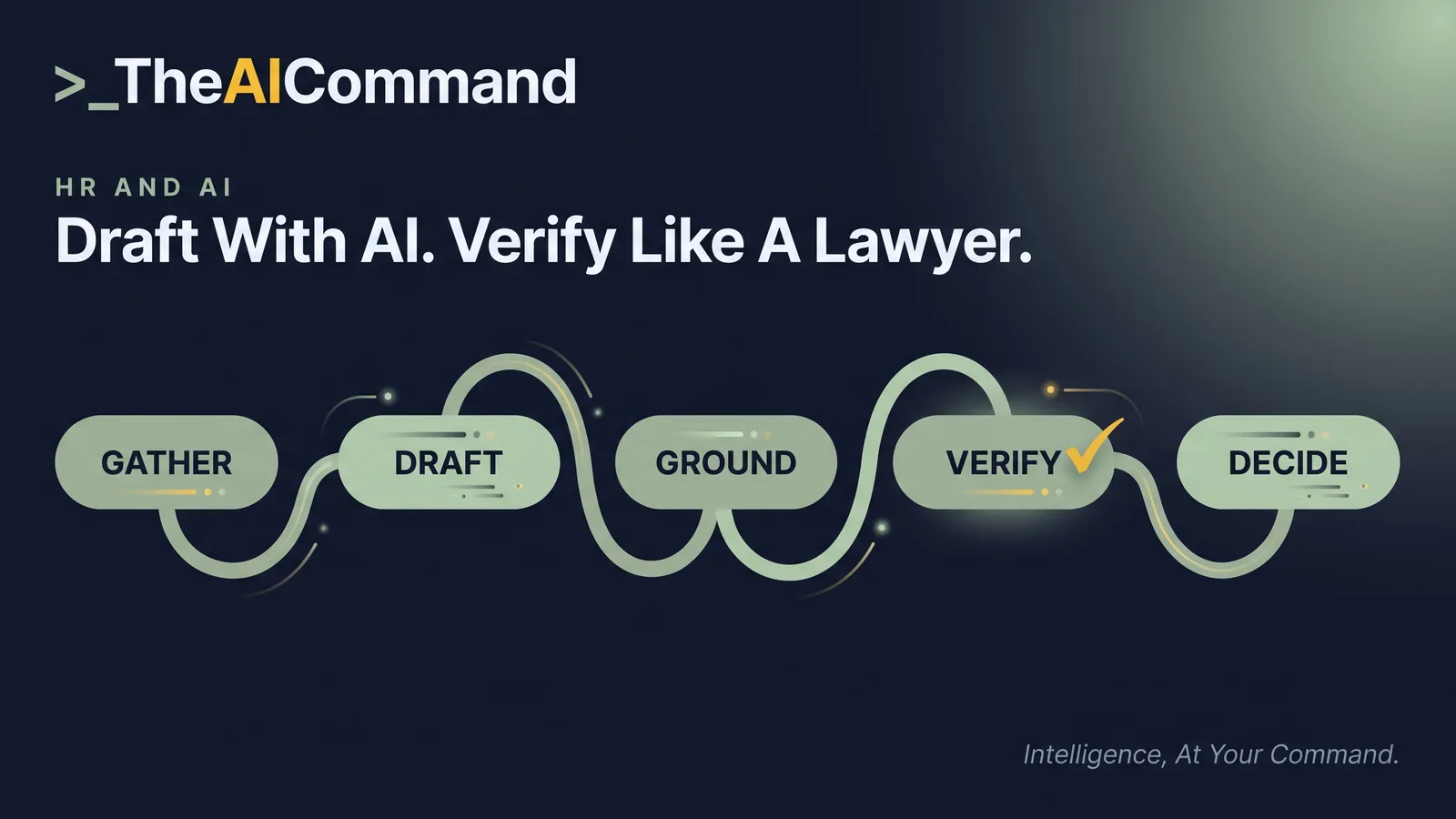
- Gather the real facts first. Before you open a model, assemble what actually happened: your contemporaneous notes, the dates, the specific incidents, the policy or standard that was not met, and what was said in each conversation. AI works from what you give it, so give it truth, not a prompt to imagine.
- Ask AI to structure and draft, not to supply content. Use ChatGPT or Claude to turn your verified facts into a clear, neutral, well-organised document. A safe instruction is explicit about the boundary: draft only from the facts provided, do not add incidents, dates, quotations or policy references that are not in the source material, and mark anything that needs a fact I have not given you.
- Ground every reference. For any policy, standard, award or contract term the document cites, open the actual instrument and confirm the wording. This is the Reece Hoverd lesson applied to your own file. A model's version of your code of conduct is not your code of conduct.
- Verify every fact against the record. Read the draft line by line against your notes. Every incident, date, figure and quotation has to trace to something real. Delete or correct anything that does not. If the model invented a detail to smooth the prose, that detail comes out.
- You decide, and you own the words. The document is now yours, not the model's. You decide whether to issue it, how to run the conversation, and whether the reason is valid. AI drafted the paragraph. Your judgement stands behind every sentence.
Across the whole document, the split between what the model touches and what the manager owns looks like this.
A worked example
[MANAGER_NAME] manages [EMPLOYEE_NAME] in [TEAM] and needs to document a first formal warning after repeated missed deadlines. The manager has notes from two conversations, the relevant deadlines, and the standard from the position description.
The manager pastes the verified facts into Claude with an instruction to draft a neutral first-warning letter using only those facts, flagging anything it cannot support. The draft comes back clean, except it has helpfully added a sentence saying the employee "acknowledged the concerns and committed to improve." That is not in the notes. It may even be true, but the manager did not record it, so it cannot go in. The manager deletes it. The draft also paraphrases the position description in a way that overstates the standard, so the manager replaces the paraphrase with the exact wording. The letter that issues is accurate, fair and defensible, and it took twenty minutes instead of two hours.
The AI did the writing. The manager did the one thing a model cannot: confirm that every word is true.
What should you never hand to an AI model?
- Never let AI generate the facts. It drafts from facts you supply and verify. It does not establish what happened.
- Never let AI decide the outcome. Whether to warn, to move to a plan, or to dismiss is a human decision with real consequences for a real person. A model does not carry that.
- Never let AI weigh the employee's response. Procedural fairness includes genuinely considering what the employee says. A person does that considering, not a summariser.
- Never paste sensitive personal or health information into a public AI tool. Performance conversations touch medical, personal and sometimes disability-related information. That does not belong in a consumer chatbot, and it is a privacy exposure separate from the fairness one.
- Never present an AI draft as a contemporaneous record. A record written today from memory, with AI help, is not the same as a note made at the time, and it should not be dressed up as one.
The governance line
The through-line, the same one that runs through AI in performance reviews, is that AI changes who writes the document but not who is accountable for it. The Fair Work framework asks for a valid reason and a fair process, and both are human standards that a model cannot meet on your behalf. Used well, AI removes the friction that makes managers avoid documentation, which is a genuine benefit, because the file that protects everyone is the one that actually gets written. Used carelessly, it fills that file with fluent invention. The Commission's own guidance points to the discipline that keeps you on the right side of the line: check it, correct it, and make sure it is based on your own knowledge. Do that, and AI is the best writing assistant a busy manager has ever had. Skip it, and the paper trail becomes the problem it was meant to solve.
One thing is worth saying plainly to managers. The point of all this is not to make performance documentation harder. It is to keep AI on the manager's side rather than against them. A verified, specific, fair record written with AI help is a better document than the one that never got written because the blank page was too daunting, and the file that protects everyone is the one that actually exists. The discipline is not a tax on using the tool. It is what turns the tool from a liability into the thing that finally gets the record done, and done properly.
Bottom line
AI changes who writes a performance document, not who is accountable for it. Under the Fair Work Act, a dismissal still needs a valid reason grounded in real evidence and a fair process, and a model supplies neither. Let AI carry the writing, then verify every fact against the record and make the decision yourself.
Do this Monday:
- Gather the real facts, dates and notes before you open a model.
- Instruct the model to draft only from the facts you supply, adding no incidents, dates, quotations or policy references of its own.
- Open the actual policy, award or contract and confirm every reference the draft cites.
- Read the draft line by line against your notes and delete anything you cannot verify.
- Keep sensitive personal or health information out of public AI tools.
TheAICommand. Intelligence, At Your Command.