
AI can build the redundancy. It cannot decide it.
Australian employers are restructuring, and AI is in the room. Through early 2026, several large employers announced redundancies framed around becoming AI-first operations. As reported, WiseTech and Atlassian were among the Australian names, with Block, the US-headquartered parent of Afterpay, making similar cuts across a workforce with a large Australian footprint. Inside HR teams, AI is being used a step earlier than the announcement: to model headcount scenarios, to score employees against a selection matrix, and to draft the consultation pack. Some of that is genuinely useful. Some of it walks straight into the part of redundancy the law has just made harder to shortcut.
Because while AI was getting better at the preparation, the High Court was tightening the rules on the substance. The result is a clean division of labour. AI can do the pack. People have to do the decision, the selection and the consultation. This guide gives you the legal line, two prompts you can reuse, a worked example, and the Monday setup that keeps an AI-assisted restructure defensible.
What is AI actually doing inside restructures?
The restructures making headlines are framed around AI, but the AI inside HR is doing something more specific. Three capabilities have matured to the point where teams reach for them by default. Generative models will draft a full consultation pack from a few bullet points. They will model headcount and cost scenarios from a spreadsheet of roles. And workforce tools increasingly offer to score and rank employees against criteria.
Each of those touches a different stage of a restructure, and each is now good enough to be tempting. The one that should give HR pause is the third. A model that ranks named people against a matrix feels like efficiency. It is also the one capability that crosses from preparing a decision into making one, and it does so in a way that is hard to unwind later when someone asks why this person and not that one.
What does the law now require for a genuine redundancy?
Under the Fair Work Act, a dismissal is only a genuine redundancy if two things are true. In substance, section 389 provides that the person's job is no longer required to be performed by anyone because of changes in the operational requirements of the employer's enterprise, and that the employer complied with any obligation to consult about the redundancy in an applicable modern award or enterprise agreement. A further test sits alongside it: a dismissal is not a genuine redundancy if it would have been reasonable in all the circumstances to redeploy the person within the employer's enterprise or an associated entity.
That redeployment test just got wider. In Helensburgh Coal Pty Ltd v Bartley [2025] HCA 29, decided on 6 August 2025, the High Court confirmed that the Fair Work Commission is not limited to asking whether a vacant position existed. As Ashurst summarised the decision, the analysis extends to whether the employer could have reorganised its workforce to make a position available, including by reducing its reliance on contractors or labour hire and bringing that work back in-house. In other words, "there were no vacancies" is no longer the end of the redeployment question. An employer may now have to show it considered whether it could have created a role by changing how it uses its workforce.
Consultation is the other place restructures fail. The obligation is not a notification. As the Fair Work Commission's consultation guidance puts it, quoting the case law, consultation is "not perfunctory advice on what is about to happen" but "a bona fide opportunity to influence the decision maker". It has to come after the employer has formed a proposal but before the decision is locked, so the affected people can actually shape it. The same guidance is blunt about the consequence: where an employer was obliged to consult and failed to do so, there cannot be a genuine redundancy at all.
Hold those three things in mind, because they are exactly where AI is most tempting and most dangerous. The decision, the redeployment analysis, and the consultation.
The practitioner play
Here is how to use AI on a restructure without letting it touch the parts the law reserves for people. Any capable assistant will do the preparation work, ChatGPT, Claude or equivalent, provided it is a version your organisation has approved for workplace data.
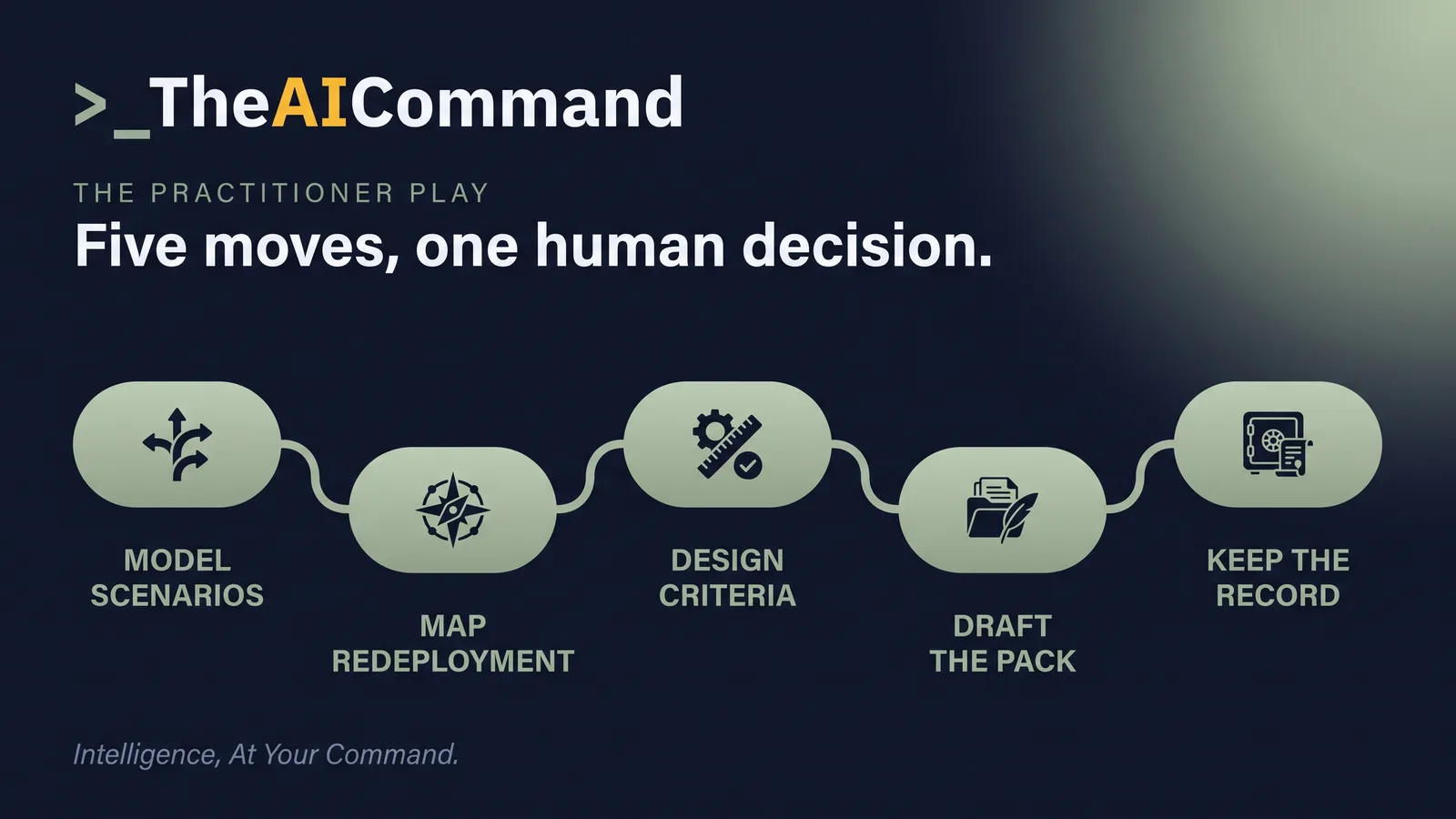
- Model the scenarios, do not pick one. AI is good at laying out options. If the team reshapes this way, here are the role implications, the cost, the skills you keep and lose. Use it to widen your thinking and to stress-test a proposed structure. The choice of structure is a business decision a person makes and owns.
- Build the redeployment map the High Court now expects. Have AI help you assemble a complete picture of where affected people could land: open roles, roles that could be reshaped, work currently done by contractors or labour hire that could be insourced, and adjacent teams. After Helensburgh Coal, a one-line note that no vacancies existed will not carry the weight it once did. Showing you genuinely examined reshaping roles and insourcing work, with AI helping you assemble that picture quickly, is now part of the evidence that the redundancy was genuine. A person then assesses what is reasonable. This prompt does the assembly without touching a name:
- Structure the selection matrix, do not let it score the people. AI can help you design fair, role-related selection criteria and lay them out clearly. What it must not do is rank named employees and hand you the answer. A model scoring people against a matrix can quietly encode bias, the same discrimination risk that runs through AI hiring and performance tools, and a number that came out of a model is not a defensible reason for choosing one person over another. Consider how easily a tenure or recent-leave variable becomes a proxy for age or carer's responsibilities. The model is not trying to discriminate. It does not need to. It only has to find a pattern, and protected attributes leave patterns.
- Draft the consultation pack. This is where AI earns its place. The notification letter, the explanation of the proposal, the questions and answers, the meeting agenda, the support information. Draft them with AI, then read every word, because these documents have to be accurate, humane and consistent with your obligations. And if an AI note-taker will sit in on the consultation meetings themselves, settle consent before the transcript. This prompt keeps everything explicitly provisional:
- Organise the file. Keep the trail: what was proposed, when consultation happened, what feedback came back, how it was considered, what changed. AI can help you keep that record clean, the same way it can organise an investigation file without touching the finding. A defensible redundancy is a documented one.
A worked example, end to end
[TEAM] is a nine-person operations team, and the proposal on the table would see one of three similar coordinator roles go. Here is how the HR lead ran it.
The setup. The HR lead built a de-identified dataset: the three coordinator role descriptions, a capability summary for each role rather than each person, the current vacancy list, and a list of functions performed by contractors. Names, employee IDs and anything that could identify an individual stayed out.
The prompts. Into the organisation's approved AI tool went the redeployment-map prompt above with the dataset attached. The model came back with a map that included two contractor-held functions flagged as potentially insourceable, plus a reshaped hybrid role in an adjacent team, each with a skills-gap note. The consultation pack prompt then produced a draft letter, a question and answer sheet and a meeting agenda, all framed as a proposal.
The verification. The HR lead checked the two insourcing options with the operations manager. One contractor function was locked under a fixed-term agreement into 2027, so it was ruled out, with the reason recorded. The other was genuine and went into the pack as a live redeployment option. In the drafted letter, the model had implied a timeline that read as final, so the HR lead rewrote it as proposed. The question and answer sheet had invented a support service the organisation did not offer, so it was cut.
The human calls. The HR lead and the manager chose the structure, ran two consultation meetings where feedback changed the transition timing, applied the selection criteria to the individuals themselves after consultation closed, and the manager had the conversation with [EMPLOYEE_NAME] in person. AI built the scaffolding. People made every call that affected a person, and the file shows both.
Set it up on Monday
- Confirm your tool. Open the AI tool your organisation has approved for workplace data, ChatGPT, Claude or equivalent on an enterprise plan, and confirm with IT or privacy that prompts are not used for model training. No approved tool means de-identified data only, and nothing sensitive.
- Pull the consultation clause. Find the applicable modern award or enterprise agreement, copy its consultation clause into your working file, and bookmark the Fair Work Commission's consultation obligations page alongside it.
- Build the de-identified dataset. Role titles, role-level capability summaries, the current vacancy list and contractor-held functions. Strip names, IDs and anything traceable before it goes near the model.
- Run the redeployment map. Paste the first prompt with your dataset, then walk the output with your operations lead and verify every option against reality, recording why each was ruled in or out.
- Draft the pack. Run the second prompt, then read every word. Check every entitlement and process statement against the award, the agreement and your policies, not against the model's confidence.
- Set up the file. Create the consultation file using the checklist below before the first meeting, not after the last one.
- Protect the order. Put the consultation meetings in the diary before any decision meeting exists, and keep every document labelled as proposed until consultation has genuinely closed.
The consultation file, as a checklist
If a matter ever reaches the Fair Work Commission, this file is your evidence that the redundancy was genuine. Build it as you go:
- The business case for the proposed change, dated and marked as a proposal
- The scenario models considered, and the structure a named decision-maker chose, with reasons
- The redeployment map, including the insourcing and reshaping options examined and why each was ruled in or out
- The selection criteria, who designed them, and who applied them to individuals (a person, not a tool)
- The written information given to affected employees under the consultation clause
- Records of each consultation meeting: date, attendees, questions raised, feedback received
- What changed because of consultation, or why suggestions were not adopted
- The decision record: who decided, when, and that it followed the close of consultation
- A note of which AI tools were used, for which preparation tasks, and who reviewed each output
Where must a human stay, and why?
Three boundaries are not negotiable, and each maps to a different part of Australian law.
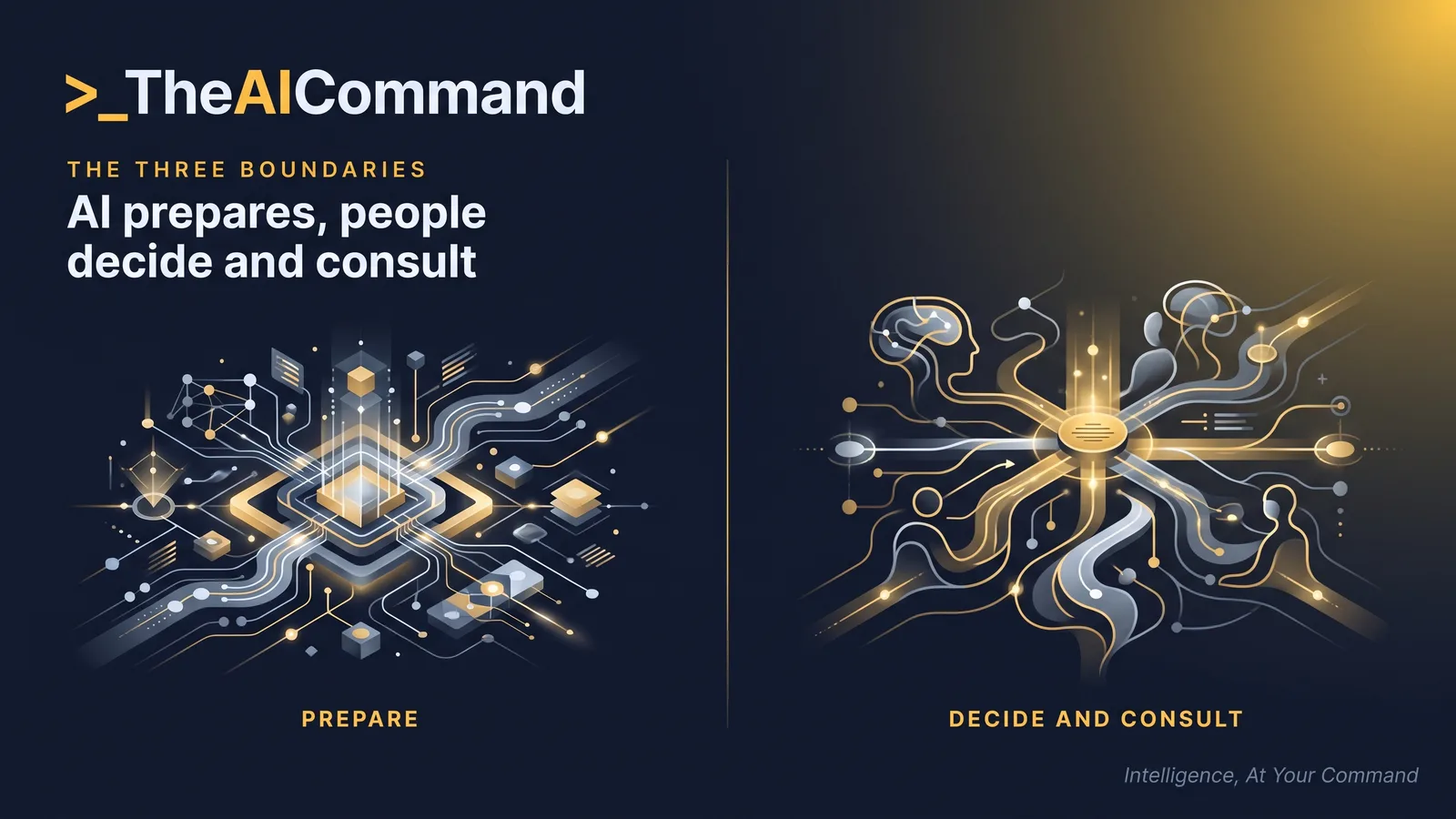
Consultation has to be real, and it has to come first. The fastest way to turn an AI-assisted restructure into an unfair dismissal is to let the model produce a polished, complete decision pack, circulate it, and call the meeting that follows. By then the decision looks made, because it is, and the law treats a consultation that cannot change anything as no consultation at all. AI makes it easy to produce something that looks final. Resisting that polish, keeping the pack explicitly provisional until people have been heard, is part of doing this lawfully.
Selection cannot rest on a protected attribute, and AI can smuggle one in. The Fair Work Act's general protections prohibit selecting someone for redundancy because of a protected attribute such as age, disability, pregnancy, or family and carer's responsibilities, all of which appear on the Fair Work Ombudsman's list of protected attributes. As employment lawyers Lander & Rogers put it in their analysis of AI employment tools, discrimination laws apply regardless of whether decisions are made by humans or machines. An AI selection score that correlates with tenure, hours or leave patterns can act as a proxy for age, disability or carer status without anyone intending it. If you cannot explain why a person was selected in terms a person chose and can defend, the AI has become a liability, not a tool.
Sensitive employee data does not belong in a public AI tool. A selection pack is full of sensitive information: performance, conduct, sometimes health. The Privacy Act's employee records exemption gives employers some latitude in handling their own employee records, but it does not stretch to tipping that data into a public or unapproved AI tool, and collecting sensitive information generally needs consent, the same privacy discipline that governs AI worker monitoring in Australia. Use an approved, contained tool, or de-identify, and never paste a named selection list into a consumer chatbot.
This is general guidance, not legal advice. Redundancy is fact-specific, and the consequences of getting it wrong are real, so take advice on your particular restructure.
What never to automate
Keep four things in human hands, always. The decision to make a role redundant. The assessment of who is selected. The genuine consultation. And the conversation with the person losing their job. AI can prepare you for all four. It cannot do any of them. The redundancy conversation in particular is the moment the whole process is judged, by the person in front of you and by everyone watching how you treat them. That is not a drafting task. It is a leadership one, and it is yours. No model has sat across from someone and watched the news land. You have, and that is exactly why it cannot be delegated.
Used well, AI takes the administrative weight off a restructure so the people running it can spend their attention where it belongs. On getting the decision right, consulting honestly, and treating people with care on the worst day of their working year. Used badly, it automates exactly the judgements the law, and decency, require a person to make. The line is not subtle. Let the tool build the pack. Keep the decision, the selection and the consultation human.
Bottom line
AI can carry the administrative load of a restructure: the scenario models, the redeployment map the High Court now expects, the selection criteria design, the consultation pack and the file. Under the Fair Work Act and Helensburgh Coal [2025] HCA 29, the decision, the scoring of named individuals, the genuine consultation and the conversation with the person losing their job stay with people. Get that division wrong and the redundancy risks not being genuine.
Do this Monday:
- Confirm an AI tool your organisation has approved for workplace data, and use de-identified data only where none exists.
- Run the redeployment map, including contractor and labour-hire work that could be insourced, then have a person judge what is reasonable.
- Design the selection criteria with AI, but never let it score or rank named employees.
- Draft the consultation pack as an explicit proposal, and put the consultation meetings in the diary before any decision meeting exists.
- Build the consultation file as you go, noting which AI tools were used and who reviewed each output.
TheAICommand. Intelligence, At Your Command.