
AI can help you read a modern award, but it cannot set the pay, and the law holds a person accountable for the figure. Every payroll in the country is about to change, and the tools your team uses to check pay changed first. From the first full pay period starting on or after 1 July 2026, minimum award wages rise 4.75 per cent and the National Minimum Wage moves to $26.44 an hour, or $1,004.90 a week (Fair Work Ombudsman). That is days away. In the same window, almost everyone in your organisation can paste an award clause into ChatGPT or Claude and get a confident, plain-English answer in seconds.
That combination is genuinely useful and genuinely risky, because a language model sounds most authoritative about exactly the things it gets wrong: penalty rates, classification levels, overtime thresholds and allowance amounts. This piece is about where AI belongs in award and pay work, and where it must never decide. The short version is the headline. AI can help you read the award. It cannot set the pay.
What changed, and why do the stakes matter now?
Two things shifted at once.
First, the cost of getting pay wrong went up. Since 1 January 2025, intentionally underpaying an employee's wages or entitlements can be a criminal offence under the Fair Work Act. The Fair Work Ombudsman is clear that this does not include honest mistakes (Fair Work Ombudsman). But the penalties for conduct that crosses the line are severe. For a company, the maximum fine is the higher of three times the underpayment or $8.25 million. For an individual, a court can impose up to 10 years in prison, or a fine of the higher of three times the underpayment or $1.65 million, or both (Fair Work Ombudsman). Even where intent is not made out, any underpayment still carries back-pay, civil exposure and reputational cost. Pay accuracy is no longer an administrative nicety.
Second, the asymmetry around award knowledge collapsed. For years, only payroll and industrial-relations specialists could navigate a modern award. There are more than 120 industry and occupational modern awards in Australia, each with its own classifications, penalty rates, overtime rules and allowances (Fair Work Ombudsman). Now any manager can paste a clause into a general AI tool and get a readable summary, and employees can do the same to check their own pay. That is not a threat to manage. It is a reason to get your own reading right, because the person on the other side of the conversation may have read the same clause the same way.
The trap is that the model is most confident on the numbers it is least reliable about. Ask it for the Sunday penalty rate under a named award and it will give you a figure, stated as fact, with no signal that it might be wrong. Australia's own workplace tribunal has put this in writing. In its March 2026 draft guidance on the use of generative AI in Commission cases, the Fair Work Commission warns that GenAI material may be inaccurate, incomplete, out of date or just made up, and that you cannot check whether something is correct by asking the AI. As the draft puts it, you must do this by looking at sources of information known to be correct (Fair Work Commission). That rule, written for a tribunal, is the right rule for payroll.
Most underpayments are not exotic. The Fair Work Ombudsman describes the conduct simply as not paying the correct hourly rate, or other entitlements such as penalty rates, overtime and allowances. In practice that usually means applying the wrong award, classifying someone below the level their duties warrant, missing a weekend or public-holiday penalty, not paying overtime when a part-time employee works beyond their agreed hours, or skipping an allowance. Every one of those is a place a confident but wrong AI answer can do real damage, because each turns on a detail in the instrument that the model has no reliable way to know.
The principle: the award is the source of truth
A modern award is a legal document that sets the minimum pay rates and conditions for an industry or occupation. The award instrument, and the Fair Work Ombudsman Pay and Conditions Tool, the official pay calculator, are the authoritative sources for what someone must be paid. A model's recollection of an award is not a source. It is a paraphrase of training data that may be months out of date.
It is also a layered instrument. A modern award sets minimum terms on top of the National Employment Standards, and an enterprise agreement, where one applies, can change the picture again. A model asked a flat question about pay will rarely tell you which of those layers it is reasoning from, or whether it has the current version of any of them. The instrument does.
The 1 July increase is the clearest illustration of why that matters. A model trained before the decision does not know that award minimums went up 4.75 per cent, and it has no way to tell you its answer is now stale. It will give you last year's rate with the same confidence it gives you this year's. So the boundary is clean. AI helps you understand and navigate the award. It never determines an employee's correct classification or pay. Determination is a human act, made against the instrument, and it is the act the law holds someone accountable for.
What is a safe loop for using AI on award questions?
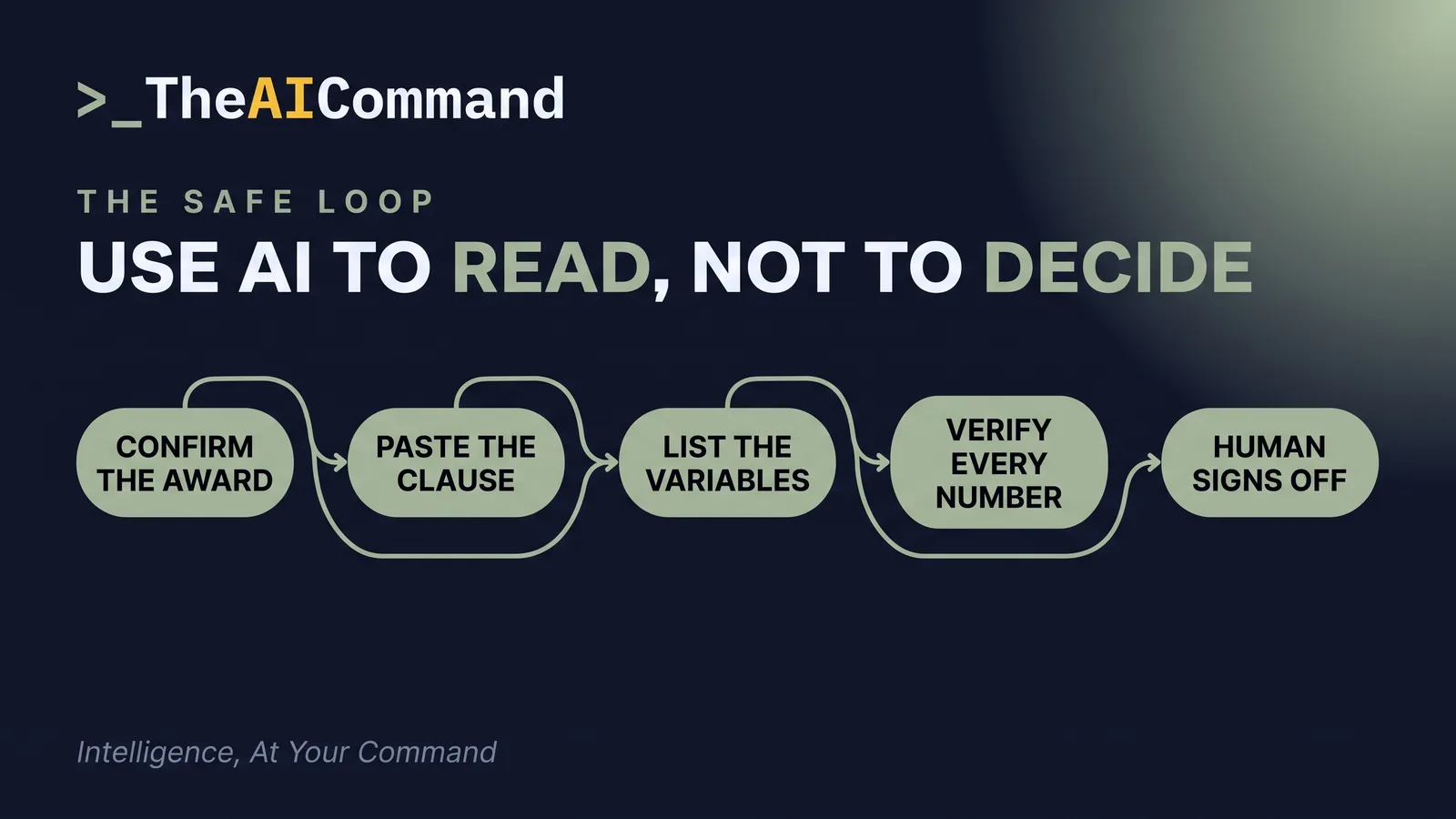
Here is a pattern any HR or payroll team can run today. It uses AI for what it is good at, reading and structuring, and keeps every number on the instrument.
- Confirm the award first, not with the model. Use the Fair Work Ombudsman Pay and Conditions Tool, or the list of awards, to confirm which award covers the role. Do not ask the model which award covers a [TEAM] role. Coverage is a legal question you settle against the official tool.
- Ground the model in the real clause. Open the current award on the Fair Work Commission or Fair Work Ombudsman site, copy the actual clause text, and paste it in. Never let the model work from its own memory of the award.
- Ask for the reading and the variables, not the rate. Prompt it to explain the clause in plain English and to list every variable that changes the answer: classification level, full-time, part-time or casual status, ordinary hours, day of week, public holidays, the span of hours, and which allowances might be triggered. You are using the model to build a checklist of what to confirm.
- Verify every number against the instrument. Take the plain-English reading as a draft understanding only. Check each rate, percentage and threshold against the award text and the Pay and Conditions Tool. No model-stated figure reaches a payslip unchecked.
- Record the decision and the human sign-off. Note the award, the classification, the clauses relied on, the resulting rate, and who verified it. That record is your evidence that a person, not a model, made the call.
Used this way, AI earns its place. It is genuinely good at turning a dense clause into plain English, at surfacing the variables you might otherwise miss, at drafting the file note that records your decision, and at drafting a clear explanation you can give an employee once you have confirmed the numbers. None of those outputs is a pay determination, and that is the point. The reading is the model's job. The figure is yours.
That split is the whole discipline. The table below sorts the same work into what the model may do and what a person must own.
A worked example. [EMPLOYEE_NAME] is a part-time team member in [TEAM] who worked a Sunday and then a public holiday, and their manager asks what the correct rates are. Run the loop. Confirm the award through the Pay and Conditions Tool, paste the relevant penalty-rate and overtime clauses, and ask Claude or ChatGPT to explain them and list what changes the answer. A good response surfaces the questions that matter: what is [EMPLOYEE_NAME]'s classification, were the Sunday hours within their agreed part-time hours or beyond them, which can make those hours overtime rather than ordinary penalty hours, and which public-holiday provisions apply. The model's value is that checklist. The percentages it offers are not the answer. They are prompts to go and confirm the real figures against the award before payroll runs them.
The governance line
The instrument and the human stay in charge, and the law expects it.
Verify against sources known to be correct, not against the model. That is the Fair Work Commission's own rule for AI output, and it is the load-bearing control here. The award and the Pay and Conditions Tool are those sources, and a verification step that ends by asking the AI again is not a verification step.
Document that you verified. The Fair Work Commission's draft guidance does not just say check the AI's output; for documents lodged in a case it says you must state that you have done so. Borrow the habit for payroll. A short note that records which award and clauses you relied on, that you confirmed the figures against the Pay and Conditions Tool, and who signed off, turns verification into evidence you can stand behind later.
Treat pay errors as high-consequence. The criminal underpayment regime means an AI-introduced mistake is not a small thing. The Fair Work Ombudsman Voluntary Small Business Wage Compliance Code gives small-business employers a path to avoid criminal referral where they have taken reasonable steps to pay correctly. The AI told me the rate is not reasonable steps. Documented verification against the award is.
Protect pay data. Classification, pay and the personal circumstances behind a roster are sensitive information. Before pasting anything identifiable into a general AI tool, check how that tool handles your data, including whether inputs are used for training, how long they are retained, and who can access them. Prefer de-identified inputs. Paste the clause and the scenario, not the named employee's record, and use placeholders such as [EMPLOYEE_NAME] and [TEAM] rather than real records.
Keep accountability and records human. The model does not sign the payslip and it cannot hold the obligation to keep accurate pay records. A person does both, against the instrument.
What should you never automate in award and pay work?
Some lines do not move.
Never automate the determination of an employee's correct classification and pay. That is a legal and accountability act tied to the award, and it belongs to a person.
Never trust a model's recall of award detail. Every rate, threshold and allowance a model offers is unverified until you check it against the award and the Pay and Conditions Tool.
Never feed identifiable employee or payroll data into an ungoverned tool.
And never act on an AI pay audit without human verification. If a tool flags a possible underpayment, that is the start of a check, not the end of one. A payroll or industrial-relations professional confirms it against the award before you rectify or report anything.
None of this means keeping AI out of payroll. It means using it where it helps and drawing a hard line where it does not. With rates changing on 1 July, the next few weeks are a good moment to set the discipline: the teams that get this right will be faster at understanding the award and slower to be wrong about the pay.
The ready-to-paste prompt
Here is a prompt you can drop into a ChatGPT or Claude project so the guardrails apply to every award question your team runs.
How to run it. Create a Project in ChatGPT or Claude and paste the prompt as the project instructions so the guardrails apply to every chat inside it, keeping nothing identifiable in the instructions. Run it one clause or one case at a time, then add a self-refine pass by asking the model to critique its own answer and rewrite any stated rate, percentage or threshold as a Verify this item. Take the cleaned checklist to the award and the Pay and Conditions Tool, confirm each figure, and record the decision and the sign-off so payroll runs the verified numbers, not the model's.
Bottom line
AI is genuinely good at reading a dense award clause into plain English and surfacing the variables you might miss, but it is most confident about exactly the figures it gets wrong, and pay accuracy is no longer an administrative nicety. Keep the reading with the model, and keep every number, and the sign-off, on the instrument and with a person.
Do this Monday:
- Confirm which award covers the role through the Fair Work Ombudsman Pay and Conditions Tool, not by asking the model.
- Paste the real clause text into ChatGPT or Claude and ask for the reading and the variables, never the rate.
- Verify every rate, penalty, threshold and allowance against the award and the Pay and Conditions Tool before it reaches a payslip.
- De-identify inputs, using placeholders such as [EMPLOYEE_NAME] and [TEAM] rather than real records.
- Record the award, classification, clauses relied on, resulting rate and who signed off.
References
- Fair Work Ombudsman, Criminalising wage underpayments and other issues (commenced 1 January 2025). https://www.fairwork.gov.au/about-us/workplace-laws/legislation-changes/closing-loopholes/criminalising-wage-underpayments-and-other-issues
- Fair Work Ombudsman, Criminal prosecution (fines and prison time for intentional underpayment). https://www.fairwork.gov.au/about-us/compliance-and-enforcement/criminal-prosecution
- Fair Work Ombudsman, Minimum wages increase from 1 July 2026 (Annual Wage Review 2026; 4.75 per cent award increase; National Minimum Wage $26.44 per hour or $1,004.90 per week). https://www.fairwork.gov.au/about-us/workplace-laws/annual-wage-review/annual-wage-review-2026
- Fair Work Ombudsman, Awards (modern awards are legal documents setting minimum pay and conditions; more than 120 awards). https://www.fairwork.gov.au/employment-conditions/awards
- Fair Work Ombudsman, Pay and Conditions Tool (official pay calculator). https://www.fairwork.gov.au/pay-and-wages/pay-calculator
- Fair Work Commission, President's statement and draft guidance for use of generative AI published (exposure draft Guidance Note, 24 March 2026). https://www.fwc.gov.au/about-us/news-and-media/news/presidents-statement-and-draft-guidance-use-generative-ai-published
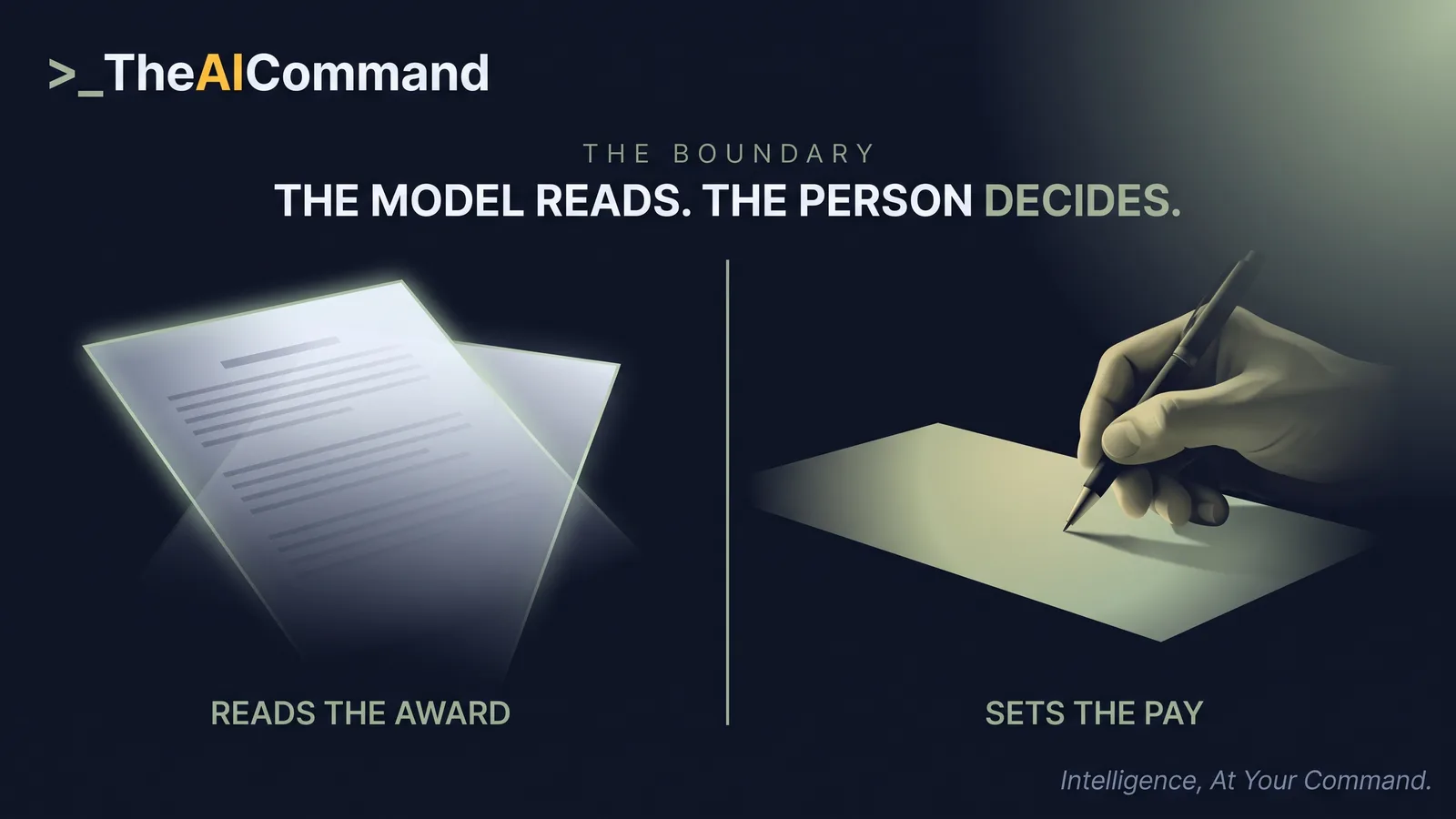
AI has made the award readable to everyone, which is a real gain for understanding. It changes nothing about who is responsible for the pay. The model reads. The person decides, against the instrument, and signs their name to it.
TheAICommand. Intelligence, At Your Command.