
Service-navigation workflow
"People support", "HR advice" and "employee services" appear as three links on the intranet. A manager trying to correct a payroll record opens each one. Two lead to forms asking for different information. The third describes the HR team's responsibilities without explaining how to request help. The catalogue lists teams, but it does not guide the task.
The first repair is to define what the manager is trying to do in everyday language. "Ask about a pay-record discrepancy" is an intelligible request. It can point to the approved payroll-query service without deciding whether money is owed. This separation keeps the directory useful while preserving the judgement that belongs to the service team handling the matter.
The example here is a fictional Australian private-sector organisation with eight HR services. All service names, source documents and uncertainties are constructed. They are not recommendations to restructure an actual HR function. The method also applies to public-sector service navigation, but the catalogue must preserve the organisation's own arrangements and applicable rules rather than borrowing a private-sector process.
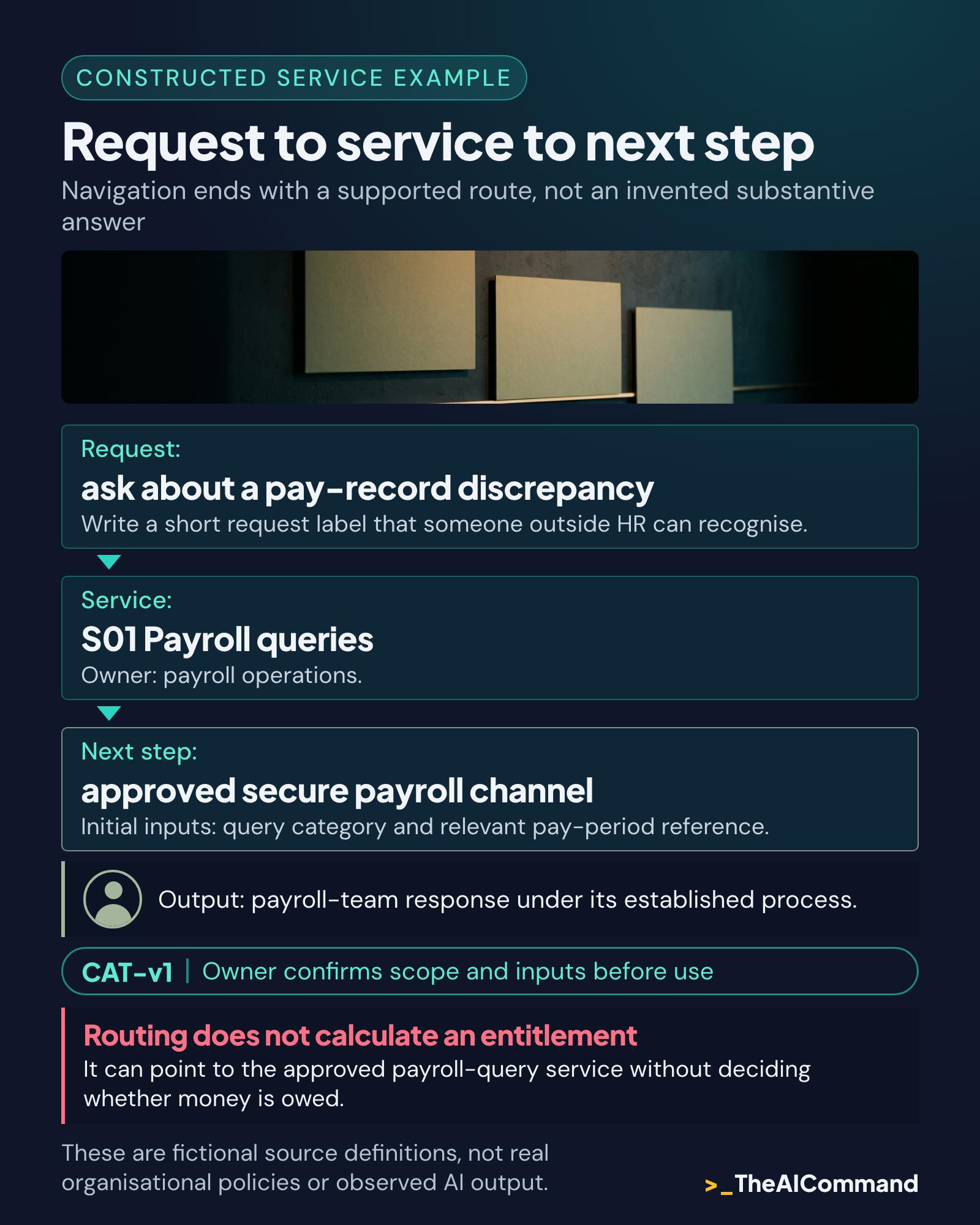
Start with requests, then identify the service. Ask each service owner for the approved description of what the service receives and what it produces. A payroll-query service might investigate a reported discrepancy through its established channel. A role-information service might explain where to find an approved position description. Neither description needs to promise an outcome that depends on facts the catalogue cannot see.
Write a short request label that someone outside HR can recognise. Add examples only where the owner confirms they fall within scope. Retain the formal service name and identifier for maintenance. The reader sees an accessible label; the support team can still reconcile it to the underlying service. Renaming the display text must not quietly expand the service's responsibilities.
For each entry, specify the next action and the approved intake route. State the information needed to start, using the minimum authorised fields. Distinguish a required field from information that may be requested later through a secure process. If the source does not define required inputs, record the gap for the owner. A model must not make up a form because complete rows look better.
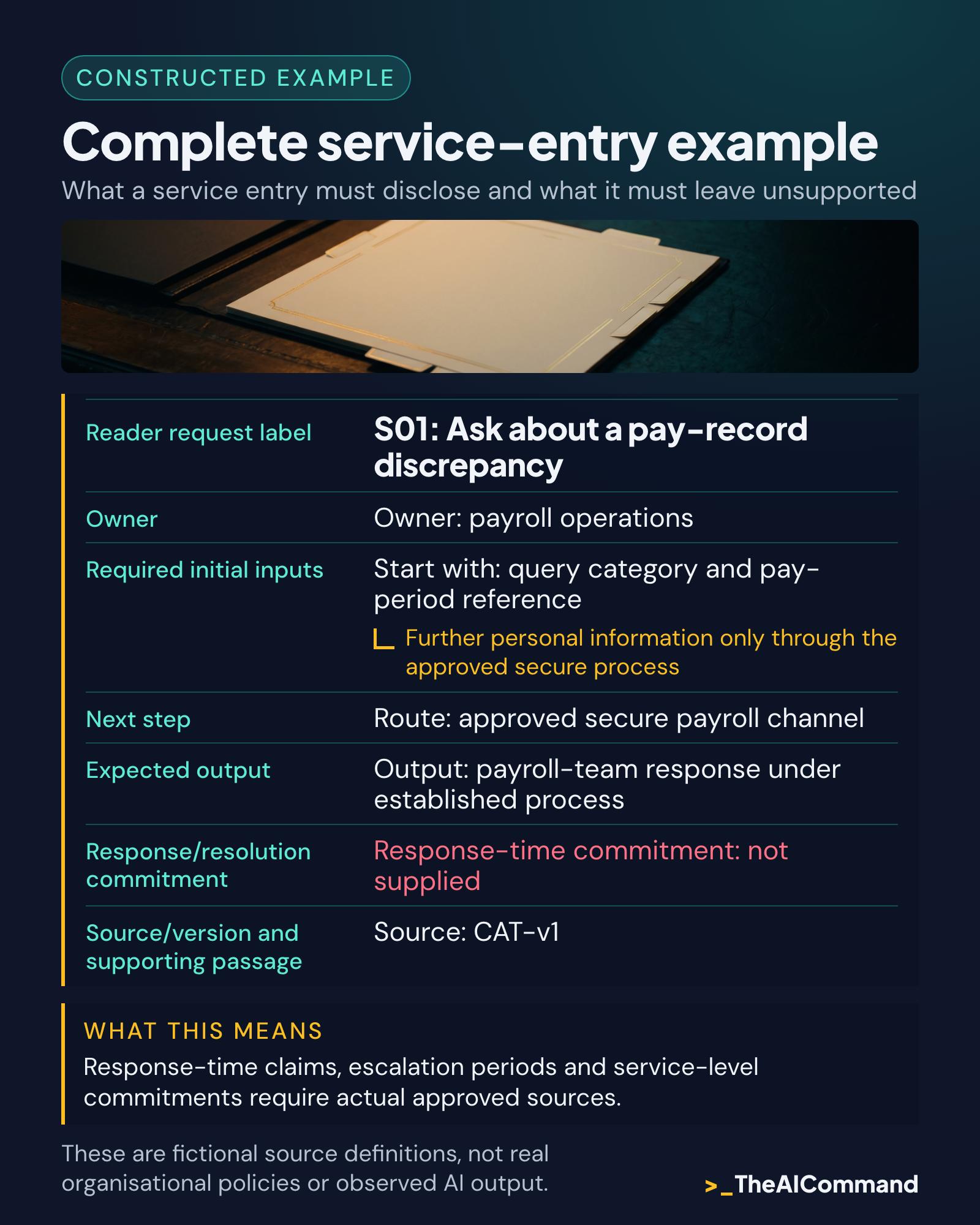
The output description also needs boundaries. "HR will assess your request under the applicable arrangements" may be appropriate if approved. "Your request will be approved" is an outcome promise. Response-time claims, escalation periods and service-level commitments require actual approved sources. Do not substitute customary practice, an aspiration or a model's generic customer-service advice for a real commitment.
Use a service-source pack, not a case archive. Assemble approved service descriptions, current intake instructions and published ownership information. Include a version date or other source identifier for each document. Preserve the distinction between a document's last edit and the owner's confirmation that it remains current. A recent file date does not prove that the service still operates in the described way.
Exclude completed case forms, named employee requests, health details, complaint narratives, payroll exports and correspondence. The task is to improve navigation, so it can operate on service definitions and invented examples. Do not scrape historical tickets to infer service ownership without a separately authorised purpose and data review. Those records may contain information far beyond what a directory editor needs.
The OAIC's commercial AI guidance calls for product due diligence and attention to input and output information. Apply that discipline before using an AI tool with organisational material. Start with fictional descriptions if approval is unclear. Removing names from a real ticket is not proof that its remaining details cannot identify someone.
The OAIC's employee-records guidance also describes limits to the private-sector exemption. It is not a blanket permission to share HR information with a provider. The organisation's privacy owner should resolve applicable obligations. The workflow in this article avoids that dependency by using a constructed catalogue and no real case records.
Eight services with deliberately messy labels. The fictional catalogue begins with S01 Payroll queries and S02 Pay support. Their descriptions overlap, but only S01 identifies payroll operations as its owner. S02 gives no owner and no distinct intake route. The model's job is to flag a possible duplicate. It cannot decide that S02 is redundant or delete a service without owner confirmation.
S03 is Leave process navigation. Its approved description explains where to submit a process question; it does not decide eligibility or approve leave. S04 is Recruitment administration, with a stated intake route for approved recruitment requests. S05 is Learning coordination, whose source lists course-enquiry information but omits ownership. These differences must remain visible rather than being flattened into a generic HR helpdesk entry.
S06 is Workplace adjustment enquiries. The approved description provides a confidential contact route but does not specify what personal evidence may be requested. S07 is Departure coordination, which covers coordinating the approved checklist. S08 is Employment relations advice, with restricted intake instructions for managers. These are eight source entries, not eight fully approved publishing entries: duplication and missing ownership still need human resolution.
The initial AI task is a consistency pass. It returns a row for every service, preserves source identifiers and identifies overlapping labels, missing owners, conflicting routes and unsupported promises. It can propose clearer request labels in a separate column. The expected result for S01 and S02 is "possible duplicate; owner confirmation required", not an automatically merged entry with an invented common mailbox.
For S05, the expected result is "owner not supplied". For S06, it preserves the approved confidential route and does not add a requirement to upload a medical report. For S07, it describes the coordination request without promising a final-pay outcome. For S08, it retains the restricted route rather than exposing its intake instructions in an unrestricted catalogue view.
In the constructed human review, payroll operations confirms that S02 is an old label for S01. The editor records that decision and maps the old wording to the current entry, subject to approval of the actual navigation change. The source register still shows both original entries. No claim is made that a live system has been altered or that all other entries are ready.
A complete entry answers the next-step question. Consider the revised S01 example. Its display label is "Ask about a pay-record discrepancy". Its scope is to receive a query through the approved payroll channel. The owner is payroll operations. Its initial inputs are the query category and relevant pay-period reference, only because those fields are supplied in the fictional approved intake description.
The example instructs the manager to follow the approved secure route for any further personal information. It does not ask for bank details in a general form. The expected output is a payroll-team response under its established process, with no invented resolution date. Questions about entitlement remain with the payroll or HR professional who can examine the applicable facts and instruments.
This boundary matters because apparently simple requests can contain legal questions. The Fair Work Ombudsman's final-pay guidance explains that relevant timing rules may come from different instruments. A service catalogue cannot replace that assessment. It can direct a departure-related payment query to the authorised team without calculating an amount or asserting a universal payment deadline.
The same distinction applies to records. The Fair Work Ombudsman's record-keeping guidance describes employment-record responsibilities. The catalogue's role is to identify an approved request route, not authorise someone to inspect or alter any record they mention. Record access and corrections must follow the applicable organisational process and legal requirements, assessed by the responsible people.
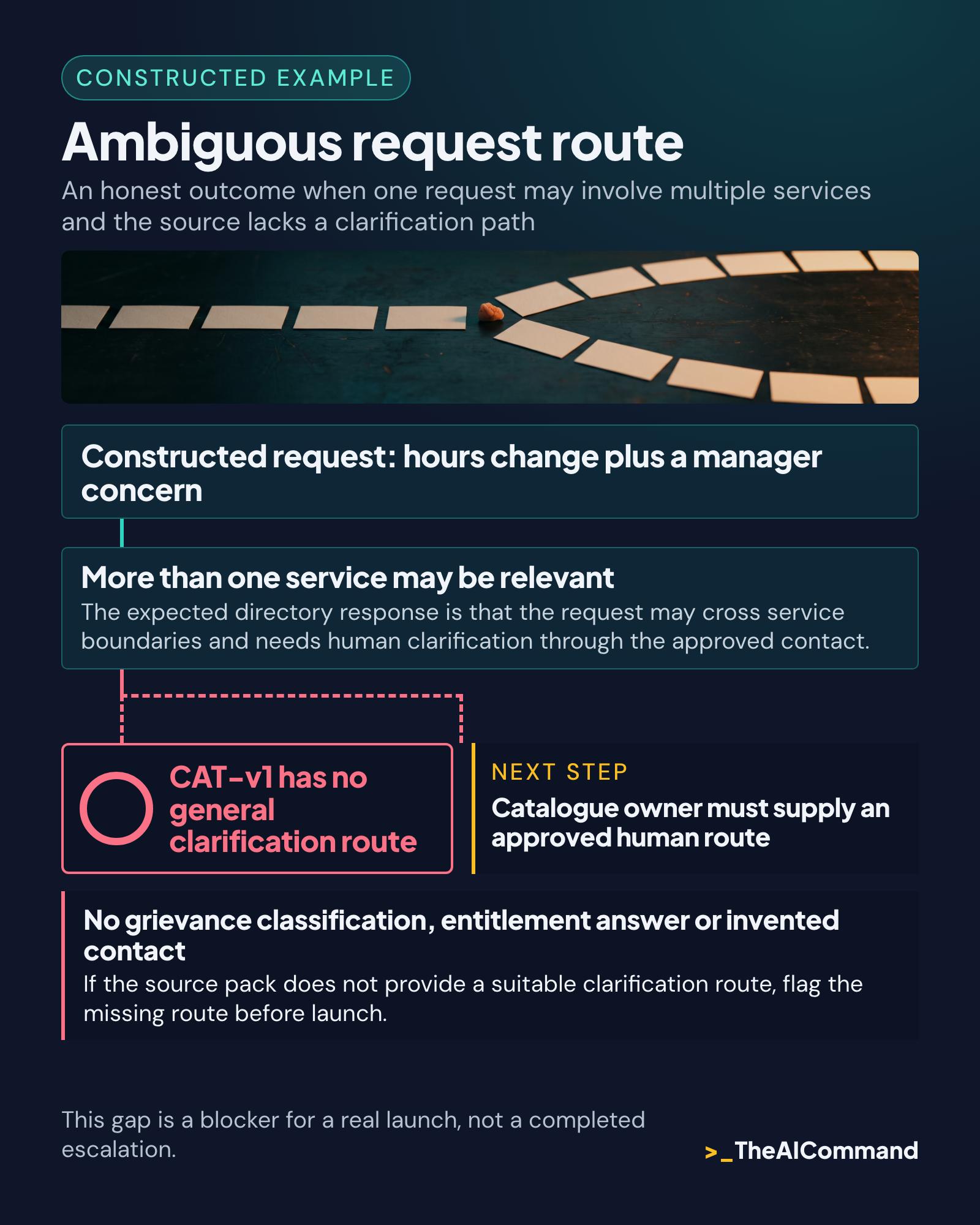
Give ambiguity a route of its own. A manager writes, "A team member wants to change their hours and has raised a concern about their manager." The catalogue should not demand that the person compress this into one routine request category. It needs an approved human clarification route that can recognise overlapping services and handle sensitive matters through the appropriate process.
Use that sentence only as a constructed routing example, with no additional personal details. The expected directory response is that the request may cross service boundaries and needs human clarification through the approved contact. It does not classify a grievance, decide a flexible-work entitlement or assess the manager. If the source pack does not provide a suitable clarification route, flag the missing route before launch.
An urgent or safety-related request must also follow the organisation's actual instructions. Do not invent an emergency channel, operating hours or response commitment. The catalogue owner should check whether the service entries point readers to the approved urgent pathways where relevant. If the approved material is missing, the correct result is a publishing blocker for that route, with an accountable owner to resolve it.
A directory does not need a conversational assistant to be useful. Clear text and working links may solve the task. If a search or chat interface is later added, keep it confined to the approved catalogue. It should cite the matching service entry and say when no supported route is available. A friendly answer assembled from general HR knowledge would undermine the boundary the catalogue was designed to preserve.
Keep a contact route separate from a service commitment. A staffed channel may acknowledge receipt without promising resolution, and different requests may need different review. Copy only the distinctions the approved material actually makes. Where it is silent, the catalogue should remain silent about timing and direct the question to its owner.
Test with requests that can fail. Use synthetic questions that exercise distinct paths: a payroll-record query, a course enquiry, an unclear departure request and a request spanning two services. Ask a reviewer to identify the next step using the draft. Record where they hesitate or reach an inappropriate form. This is usability evidence about the catalogue, not evidence about a model's ability to advise on employment matters.
Also test the intentional gaps. S05 must remain unresolved until an owner is supplied. S06 must not gain an invented evidence requirement. S01 and S02 must remain a proposed duplicate until a person confirms their relationship. A request for guaranteed turnaround must return the supplied commitment or state that none is supplied. Do not claim these tests passed until they have actually been run.
The service owner checks scope, inputs and route; the editor checks wording against source; the relevant privacy or security reviewer checks the handling boundary. Have someone using the intended access level open the final links. A link that works for an HR administrator may fail for a manager. Record the audience used in the check, without reproducing credentials or personal account details.
Maintain the catalogue through changes that users will notice. A new intake form, renamed team or changed service boundary can invalidate an otherwise accurate entry. Name the responsible content owner and use the organisation's chosen review process. When an old label is retained as a search alias, ensure it leads to current approved information instead of preserving a second, conflicting description.
Keep feedback about navigation separate from substantive cases. A reader reporting "this link does not open" need not paste the employee matter they were trying to raise. Offer a correction route that asks for the service ID and the problem with the page. If sensitive information arrives anyway, handle it under approved arrangements rather than feeding it back into a drafting prompt.
For an HR service team, the practical starting point is eight current service descriptions and a small set of fictional requests. Resolve duplicates and missing owners, then check whether a manager can reach the right human process without guessing. AI can help expose inconsistency, but accountable service owners make the catalogue trustworthy. Make the next step clear. Keep the underlying employment decision with the authorised person.
Constructed source catalogue and expected review
These are fictional source definitions, not real organisational policies or observed AI output.
Copyable catalogue-consistency prompt
Do this Monday
- Gather eight approved service descriptions and their intake instructions.
- Identify the owner, permitted initial inputs and next step for each.
- Resolve duplicates and missing routes with the responsible people.
- Test the draft with fictional requests and intended-reader access.
HR service catalogue: reusable materials
Version 1. This source pack and its approvals are entirely constructed. It is not an actual HR policy, contact directory, service commitment or employee case. Real use requires approved source definitions and secure handling arrangements.
Synthetic source pack
Copyable service-entry template
Consistency and routing checks
- S01 and S02 are a proposed duplicate until payroll operations confirms their relationship.
- Retain S05's missing owner and CAT-v1's missing clarification pathway.
- Preserve restricted S08 intake and confidential S06 routing.
- Do not invent policy advice, medical evidence requirements, response times or addresses.
- Keep each source ID visible, even where a human later approves an alias mapping.
- Verify real links using intended-reader access; record the role, not account identifiers.
- Confirm real urgent pathways with authorised owners; none is invented here.
Suggested tests
Copyable catalogue-consistency prompt
Related reading
- An HR Skill File That Answers From Your Policies, Not the Internet, on answering policy questions, where this article routes service requests
- Help People Find the Next Role Inside the Organisation, the companion article for 15 November
References
- Office of the Australian Information Commissioner: Guidance on privacy and the use of commercially available AI products
- Office of the Australian Information Commissioner: Employee records exemption
- Fair Work Ombudsman: Final pay
- Fair Work Ombudsman: Record-keeping
TheAICommand. Intelligence, At Your Command.