
The bot runs once each weekday, but the invoice contains more activity than the calendar suggests. A failed retrieval triggered a retry, a draft was regenerated, and a rendering service charged separately. The owner can explain the subscription price but cannot yet explain the cost of delivering one usable result.
A monthly estimate becomes more useful when it starts with the events that generated work and charges. The aim is a traceable calculation: a planned business task, its attempts, the services used, the accepted outcome and the human time needed to review it. That record supports a range rather than an unexplained single number.
This article uses a constructed business-bot example rather than records from a real pilot. All run counts, rates and outcomes in the example are invented teaching inputs. They demonstrate the method and arithmetic, not measured performance, provider quotes or evidence that a particular bot is economical.
Decide what one run means
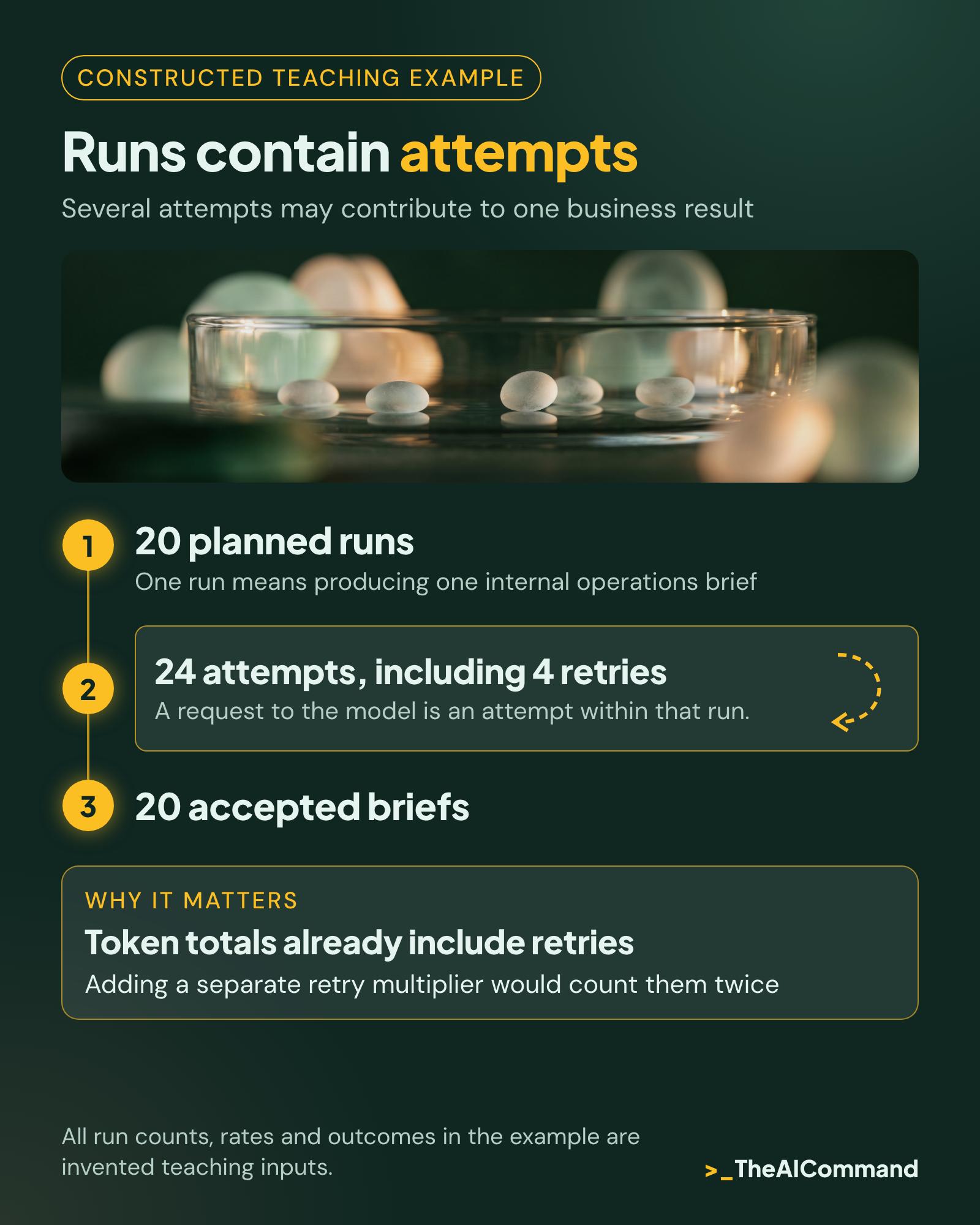
Define the business unit before counting tokens. In this example, one run means producing one internal operations brief from approved source material, ready for a human reviewer. A request to the model is an attempt within that run. A successful API response is not automatically an accepted business result.
Give each run a stable local identifier and each attempt its own reference. Record why an attempt occurred, whether it produced an output, and what happened next. A retry may belong to the original run rather than a new business task. Keeping that relationship prevents a retry from inflating the apparent volume of completed work.
Record accepted, rejected and abandoned results separately. If a brief cannot be used because the source is unavailable, the work may still have consumed paid services and review time. Excluding it from the cost numerator while counting only successful outputs makes the workflow look cheaper than the evidence supports.
Choose the reporting boundary as well. The estimate might cover incremental cash spend, allocated existing subscriptions, staff time or all three. Keep those views separate and name them. A paid seat already held by the business may create no additional invoice this month, yet its allocation still matters when comparing alternatives or planning growth.
Capture events without collecting the business's secrets
The ledger needs enough information to reconcile charges, not a copy of every confidential prompt. Keep run and attempt identifiers, timestamps, service, model or configuration reference, billable units, rate source, result status and review minutes. Store any sensitive source material in its approved system rather than embedding it in the cost worksheet.
For token-based calls, record the actual usage fields exposed by the endpoint. OpenAI's help guidance distinguishes individual response usage from dashboard reporting and notes that token field names depend on the endpoint. It also explains that an interrupted streamed Chat Completions request may not return its final usage chunk. That missing observation does not establish that a request used no tokens. OpenAI usage guidance.
Retain unknown values as unknown. A blank tool-charge field might mean that billing has not arrived, that a free allowance applied or that the integration failed to log the event. Those are different explanations. Use a status column so the person reviewing the estimate can see which costs are observed, calculated, allocated or unknown.
Capture non-token activity alongside model usage. Depending on the workflow, that can include search calls, retrieval storage, hosted execution, image or video rendering, hosting, message delivery and monitoring. The relevant list comes from the actual services used. Do not add a fashionable category that the bot never touches, or omit a small charge because it seems negligible in one run.
Use price documentation as a rate reference
A rate table answers how a measured unit is priced. It does not tell you how many units the workflow consumed. Keep the service, product or model, unit, currency, rate date and applicable conditions beside the rate. Preserve the evidence used to establish it, especially when discounts, free allowances or contract terms apply.
OpenAI's pricing page separately identifies model token charges and categories such as storage, tool calls and containers. Anthropic's pricing documentation distinguishes input, output and cache operations. Those structures explain why a single headline token price may not cover a complete workflow. The calculation still requires the prices and usage categories for the services actually selected. OpenAI pricing, Anthropic pricing.
Do not transfer a pricing rule from one vendor to another. Nor should an estimate assume that a consumer subscription includes the API usage of a separate bot. Check the actual billing route and contract. The worksheet can show where a rate is missing without guessing an entitlement or inventing a vendor comparison.
For the teaching calculation below, the rates are explicitly constructed. Input tokens cost USD 2 per million and output tokens USD 10 per million in this scenario. These numbers are not attributed to any model, although some current vendor list prices happen to use the same figures. Their purpose is to make the arithmetic inspectable while avoiding a product recommendation built on untested assumptions.
Reconcile a small pilot before scaling it
The constructed pilot contains 20 planned business runs and 24 model attempts. Four attempts are retries within those runs. Total input usage across all attempts is 480,000 tokens and total output usage is 96,000 tokens. The token totals already include the retries, so adding a separate retry multiplier would count them twice.
At the scenario rates, input costs USD 0.96 and output costs USD 0.96, giving USD 1.92 for model usage. The pilot also contains 60 tool calls at a constructed USD 0.01 each, four renders at USD 0.25 each, and USD 0.80 of attributable storage. Those components total USD 4.32 in variable cash cost.
The constructed review record assigns six minutes to each of the 20 runs, including the work required to inspect and correct drafts. That is 120 minutes, or two hours. At an assumed labour valuation of USD 30 an hour, the pilot's review effort is USD 60. This is a planning valuation, not a statement about a particular person's pay or an additional provider invoice.
For illustration, all 20 business runs eventually produce accepted briefs. Variable cash cost per accepted brief is therefore USD 4.32 divided by 20, or USD 0.216. Review effort contributes USD 3 per accepted brief. If only 16 briefs had been accepted, those same total costs would be spread over 16 outcomes instead.
Keep the evidence classification visible. In a genuine pilot, token usage might be observed while the rate-based charge remains calculated until billing is reconciled. Review minutes might be measured while the labour rate is an approved planning assumption. In this example, both the activity and prices are constructed, and no field is labelled observed.
Turn the pilot into scenarios
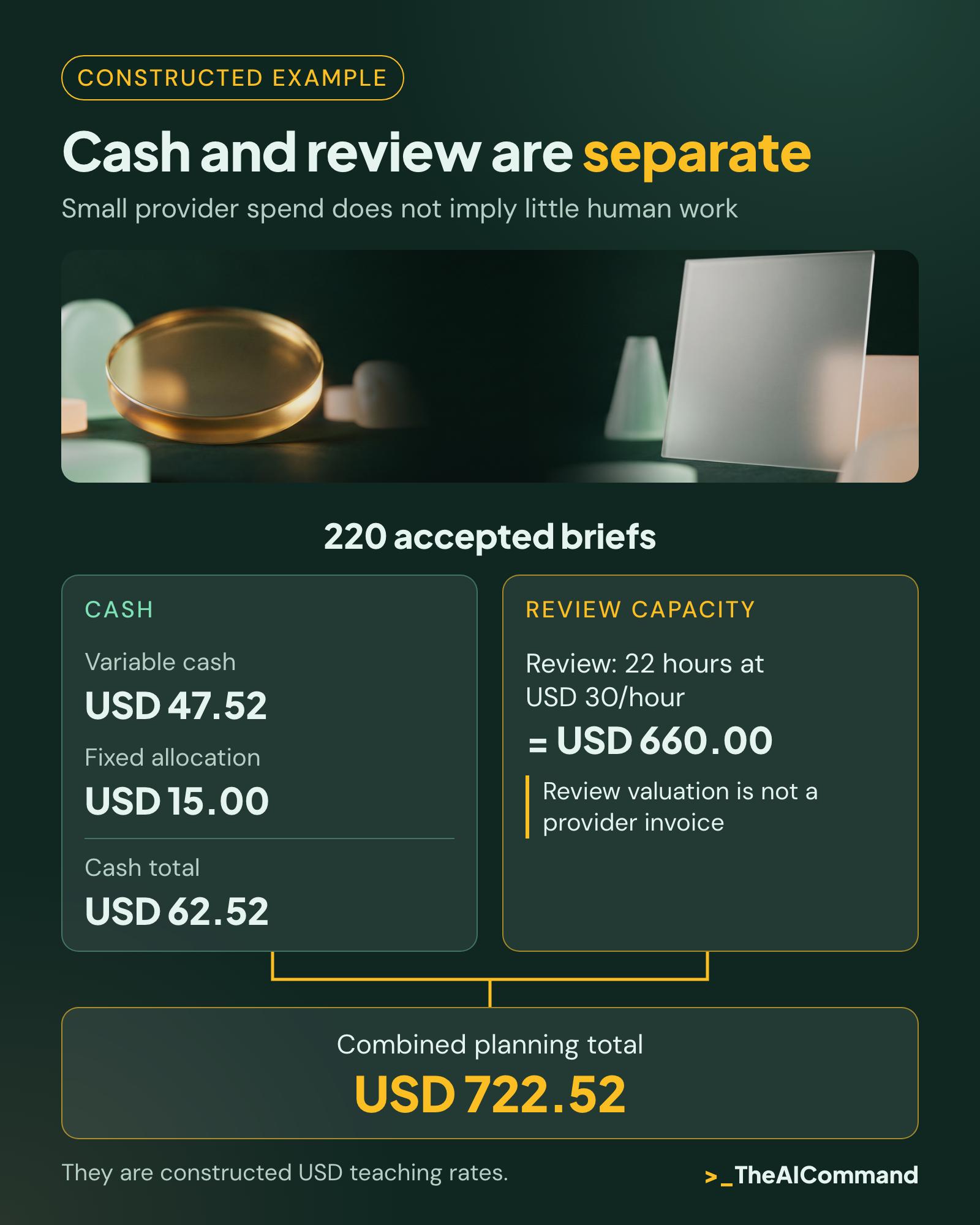
The base month assumes 220 accepted briefs with the same average variable usage and six review minutes per brief. Multiplying USD 0.216 by 220 gives USD 47.52. Add an assumed USD 15 monthly fixed hosting allocation to obtain USD 62.52 cash cost. Keep that fixed amount outside the per-run variable calculation.
Review effort is 1,320 minutes, or 22 hours. At the assumed USD 30 hourly valuation, that adds USD 660. The combined base planning total is USD 722.52. This distinction matters because the cash invoice and the capacity the business must provide are different questions. A low API bill does not mean the workflow requires little attention.
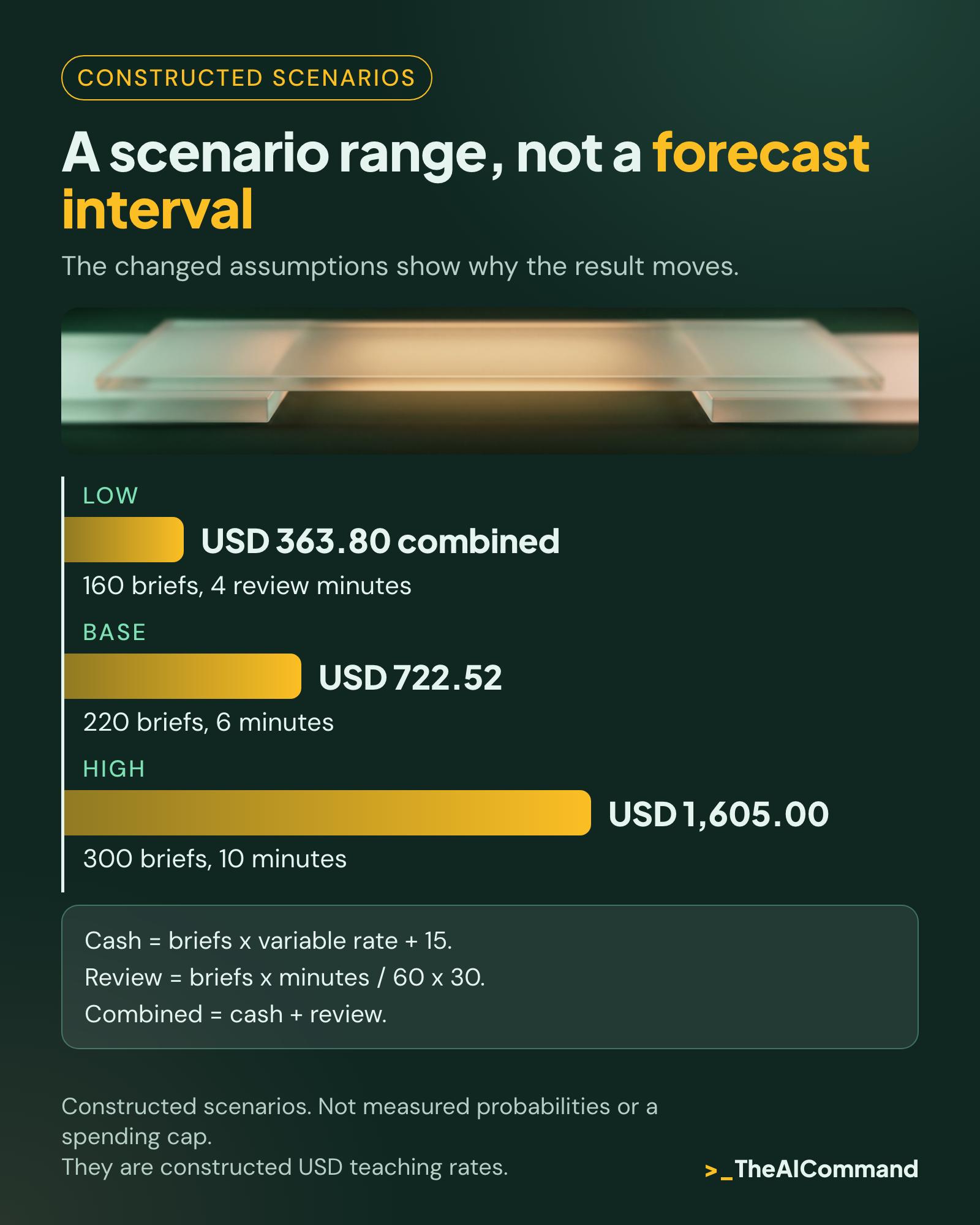
The low scenario uses 160 accepted briefs, USD 0.18 variable cash cost each, four review minutes each and the same USD 15 fixed amount. It produces USD 43.80 cash cost and USD 320 of review effort, or USD 363.80 combined. The scenario assumes both lower volume and an easier task mix; it is not a measured confidence bound.
The high scenario uses 300 accepted briefs, USD 0.30 variable cash cost each, ten review minutes each and USD 15 fixed cost. Cash cost is USD 105, review effort is USD 1,500 and the combined total is USD 1,605. The changed assumptions show why the result moves. They do not establish how likely that month is.
For an Australian planning view, the worksheet illustrates a conversion at an assumed AUD 1.50 per USD. This is a constructed round number, not a market rate: the Reserve Bank of Australia's indicative rate on 22 October 2026 was A$1 = USD 0.7018, or about AUD 1.42 per USD. The base cash amount becomes AUD 93.78 and the combined amount AUD 1,083.78. Taxes such as GST, payment charges and foreign-currency fees are not modelled and need to be resolved for the actual billing arrangement. Replace the assumption with the organisation's approved dated rate for an actual budget.
Check whether the pilot represents the work
Twenty tidy runs are not automatically a representative month. Ask which sources, document lengths, languages, exception types and reviewer workloads appeared in the pilot. If the pilot excluded failed retrievals or unusually long documents, the estimate must disclose that gap rather than treating the average as universal.
Compare groups of runs where the work differs meaningfully. A short weekly summary and a complex investigation brief may use the same model but require different source retrieval and review. Keeping separate averages can be more informative than applying one blended figure to every future task.
Inspect the expensive or difficult cases rather than treating them as noise. A single run may reveal a retry loop, repeated rendering or an instruction that generates unnecessarily long outputs. The ledger helps identify the event behind the cost, while a reviewer decides whether changing it would preserve the required quality.
Also check the denominator. Cost per attempted run, accepted brief and completed business process answer different questions. If a human later rejects an apparently accepted draft, update the outcome record through a visible correction. Do not preserve a favourable cost-per-accepted-result calculation after its acceptance assumption has changed.
There may be costs that do not scale linearly. A storage allowance can be exhausted, a new service tier may be needed, or review coverage may require another person. Put these thresholds in the assumption register with a trigger for recalculation. A straight multiplication is useful only while its operating conditions remain plausible.
Reconcile against billing without hiding differences
Compare the ledger with provider reporting for the same account scope and time interval. Time zones can shift events across a day or month boundary. OpenAI's usage guidance states that its dashboard uses UTC, which needs attention when application logs use Australia/Sydney. Keep both the original timestamp and a clearly labelled reporting period.
An invoice and a calculated run ledger may differ because of billing categories, rounding, delayed reporting, credits, shared resources or attribution choices. Do not force a match by altering usage observations. Record the difference, identify a plausible cause to investigate and preserve the original evidence until the discrepancy is resolved.
Shared charges need an allocation rule that someone can explain. For example, a fixed hosting amount may be assigned entirely to this bot or divided across several services. Choose one rule, label it and avoid counting the same amount in every bot's business case. An allocation is a management choice, not a provider measurement.
Treat credits carefully. A temporary credit can reduce cash paid while leaving the underlying consumption unchanged. Show the gross usage cost and the credit effect separately if both matter to the decision. That makes a future month without the credit easier to understand and avoids presenting promotional funding as a permanent operating advantage.
Make the next decision from the evidence
A useful estimate identifies what to measure next. If review effort dominates, test whether clearer source inputs improve the draft without weakening review. If retries dominate, inspect the failure pattern. If the largest cost is still unknown, resolve that uncertainty before presenting a precise monthly commitment.
Give the worksheet an owner and a refresh trigger. Recalculate after a model change, material prompt change, new tool, different task mix or changed rate. Keep earlier versions so a later reviewer can separate a genuine usage change from a different assumption. The purpose is a maintainable estimate, not a number that remains frozen after its evidence changes.
Start with one bounded workflow and a small ledger that captures all attempts. Reconcile what can be reconciled, mark the rest, and show cash and review capacity separately. The strongest monthly estimate is the one another person can reproduce and challenge using the recorded runs, rates and assumptions.
Reusable worksheet
The run-cost ledger, scenario table and assumption-check prompt below reproduce the calculation. All numbers are constructed teaching inputs, with no private billing records or real pilot claims. The worksheet is not a purchasing recommendation.
Reusable materials: run-cost ledger and worksheet
Version 1.0. All quantities, outcomes, rates and exchange assumptions below are constructed. None is a measured pilot result or a vendor quote, although the example token rates happen to match some current list prices.
Blank run ledger
No prompts, personal identifiers, credentials, private billing account identifiers or confidential document contents belong in this public worksheet.
Constructed pilot arithmetic
20 planned runs, 24 attempts, four retries already included in token/tool totals, 20 accepted briefs. No extra retry multiplier. Review valuation USD 30/hour; fixed monthly hosting assumption USD 15.
Cash = briefs x variable rate + 15. Review = briefs x minutes / 60 x 30. Combined = cash + review. These are scenarios, not confidence intervals or caps.
Constructed conversion assumption: AUD 1.50/USD (a round teaching number; the RBA indicative rate on 22 October 2026 was A$1 = USD 0.7018, about AUD 1.42/USD). Base cash AUD 93.78; base combined AUD 1083.78. Not a market observation. Replace with an approved dated rate for actual budgeting; taxes and payment charges are not modelled here and must be resolved for the real billing context.
Assumption-check prompt
Budget-owner checks
Confirm scope, accepted-result definition, period/time zone, service units, billing route, prices/conditions, shared-cost allocation, credits, exchange rate, tax/payment fees, review valuation and volume assumptions. Preserve unresolved fields as unknown. Record who accepts the assumptions and when they must be refreshed.
Related reading
Token Budgets for a Team: Set a Cap That Actually Stops. The related article covers budget controls. This worksheet adds run-level reconciliation and a transparent estimate.
For subscription and API prices side by side, with dated Australian dollar estimates, see the AI Tool Comparison.
Also see Keep Tender Scoring Tied to the Published Criteria, the companion article for 25 November.
References
- OpenAI Help: Reviewing API usage and costs
- OpenAI: API pricing
- Anthropic: Claude API pricing
- Reserve Bank of Australia: F11.1 Exchange rates, daily indicative rates
General information only. Not legal, compliance, financial, or professional advice.
TheAICommand. Intelligence, At Your Command.