
A persuasive comment still needs a criterion
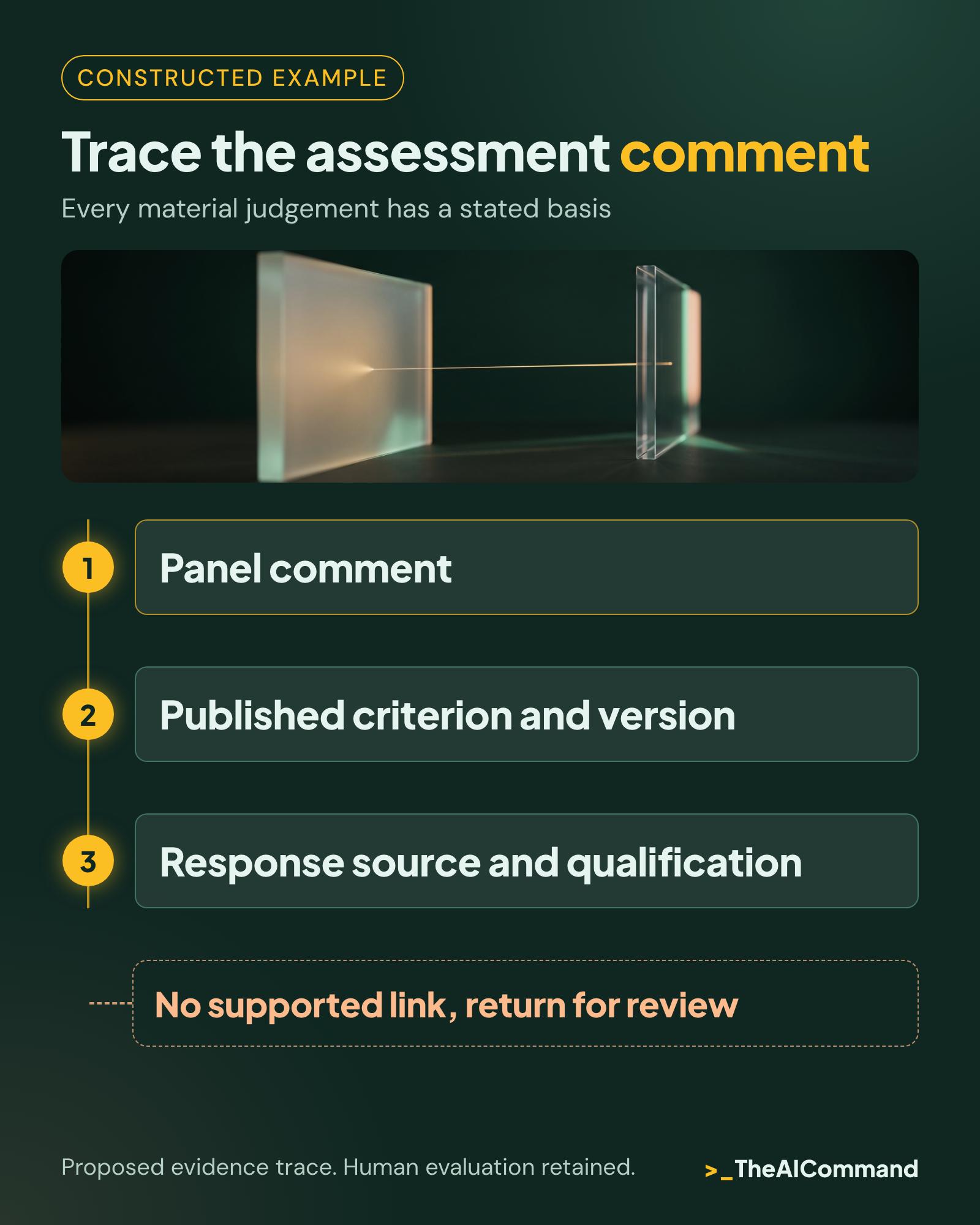
An evaluation comment says a bidder feels like a better cultural fit. Another praises a polished presentation. A third assumes the incumbent can begin immediately. These observations may influence a discussion without answering the question the market was asked. Before any score is accepted, the panel needs to identify the relevant published criterion and the evidence that supports the assessment. If that connection cannot be shown, better wording will not repair it.
AI can help prepare a criterion-to-evidence trace for a human evaluation team. It can organise supplied extracts, locate unsupported statements and identify where a proposed comment goes beyond the response. The task is bounded by the actual request documentation and approved evaluation method. It does not ask the model to decide which bidder deserves the contract. It also does not permit the team to quietly invent a new test after reading the responses.
This article uses a constructed Commonwealth procurement example. The fictional entity is assumed to be subject to the Commonwealth Procurement Rules, with an approved process established before responses arrive. No real tender information has been used and no procurement has been evaluated. The example concerns evidence organisation only. Conditions for participation, applicable policies, thresholds and the entity's instructions still need to be determined by its authorised procurement team for any actual process.
Fix the source of authority before the source of evidence
The Commonwealth Procurement Rules, issued by the Finance Minister, require documentation commensurate with the scale, scope and risk of each procurement. They also say documentation should record relevant decisions and the basis of those decisions, and that relevant evaluation criteria should be included in request documentation. Those provisions support a traceable record, but do not endorse a particular AI method. Use the applicable rules and entity instructions to establish the evaluation process before choosing a tool. Commonwealth Procurement Rules 17 November 2025, paragraphs 7.2, 7.3 and 7.12.
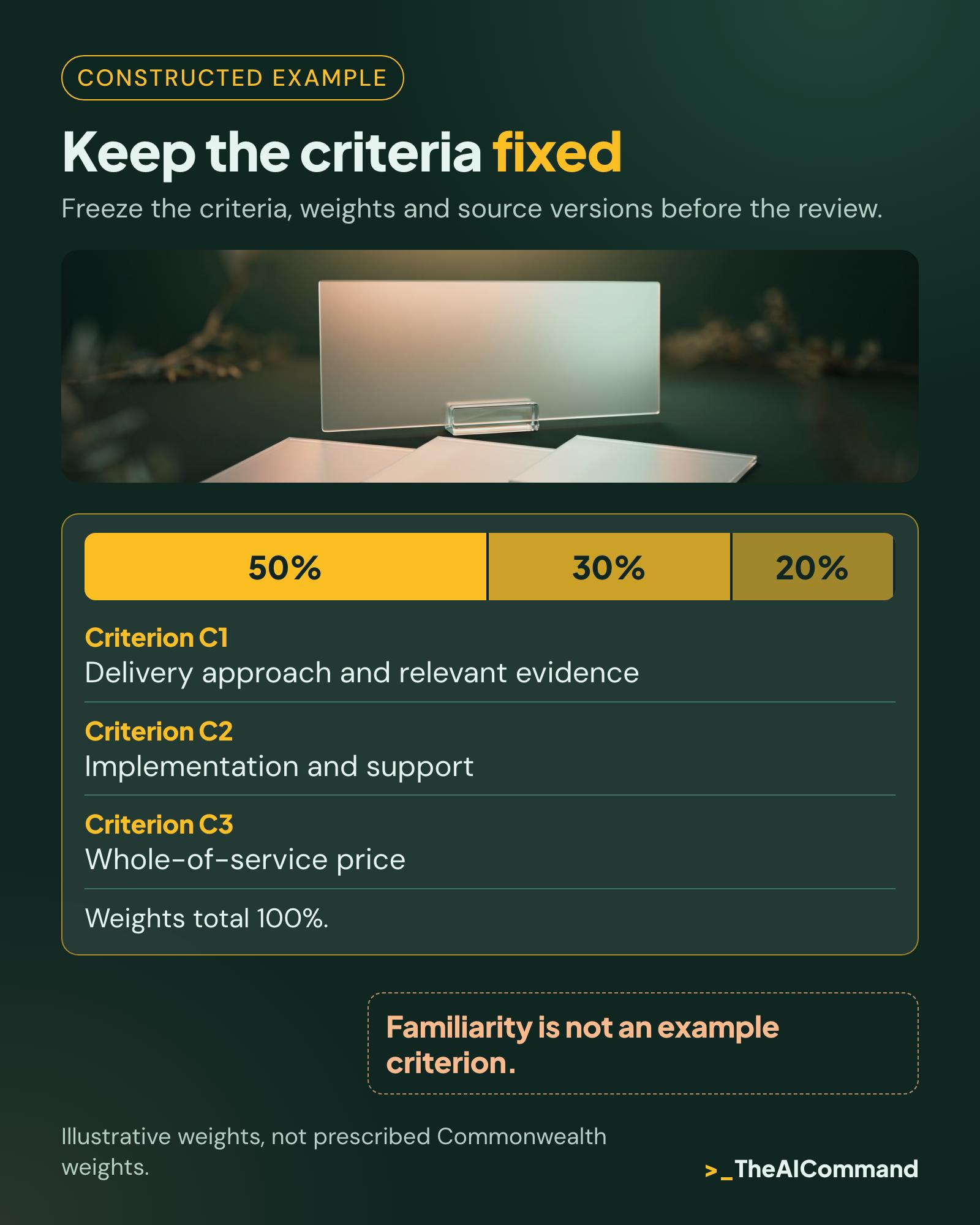
Prepare an authoritative criteria sheet from the request documents and approved amendments. Include the exact wording, identifiers, weights where used, evaluation method and the document version. Keep conditions for participation separate from comparative evaluation criteria. A model must not turn a desirable feature into a mandatory condition or treat an eligibility check as another weighted score. Those are differences in the process, not cosmetic differences in a spreadsheet.
Check that the internal evaluation plan and the material issued to tenderers tell a consistent story. If they conflict, pause the affected evaluation question and take it to the authorised procurement or probity adviser. Do not ask the model to choose the more convenient version. Finance's probity guidance cautions against changing advised criteria during evaluation outside a formal amendment process. A discovered inconsistency needs a documented response, not a quiet edit to the working table. Finance probity guidance, Tips 2 and 3.
Limit what enters the model
Tender responses can contain confidential commercial information, intellectual property and personal details. Use only an environment and input set approved for the procurement. A public chat service is not made suitable simply by replacing bidder names with letters. Distinctive pricing, technical designs or client examples may still reveal a supplier. The procurement owner needs to decide what may be processed and who may access the result before the evidence is copied anywhere.
For a practice run, use synthetic extracts written for the exercise. For authorised work, preserve the original response and provide stable references to the selected material. Record exclusions so a reviewer understands the limits of the pack. An absent attachment can change what the model appears to find. A statement that evidence was not present in the supplied extracts must not become a statement that the bidder failed to provide it anywhere.
Keep external searching out of this task. A model that supplements a response with a supplier's website, a remembered reputation or a later press release changes the evidence base. If the procurement process allows due diligence or clarification, authorised people determine the scope and handling. Record any resulting material as a new source. The evidence matrix can then be updated with its origin visible rather than quietly mixing it into the original tender.
Three fictional responses against one fixed sheet
The fictional procurement concerns a short records-training service. Its approved example sheet contains three weighted criteria: C1, delivery approach and relevant evidence, at 50 percent; C2, implementation and support, at 30 percent; and C3, whole-of-service price, at 20 percent. These values are constructed for this article. They are not prescribed Commonwealth weights, and the three extracts are not a complete procurement or a basis for awarding a contract.
Bidder A's extract A1 describes a four-session delivery approach and identifies two relevant example projects. A2 provides an eight-week mobilisation plan but does not identify the person responsible for escalation. A3 states a total price and expressly excludes travel. Bidder B's B1 describes four sessions and an assessment activity, without the requested evidence of comparable delivery. B2 names a support role and a six-week mobilisation period. B3 includes travel within the stated total.
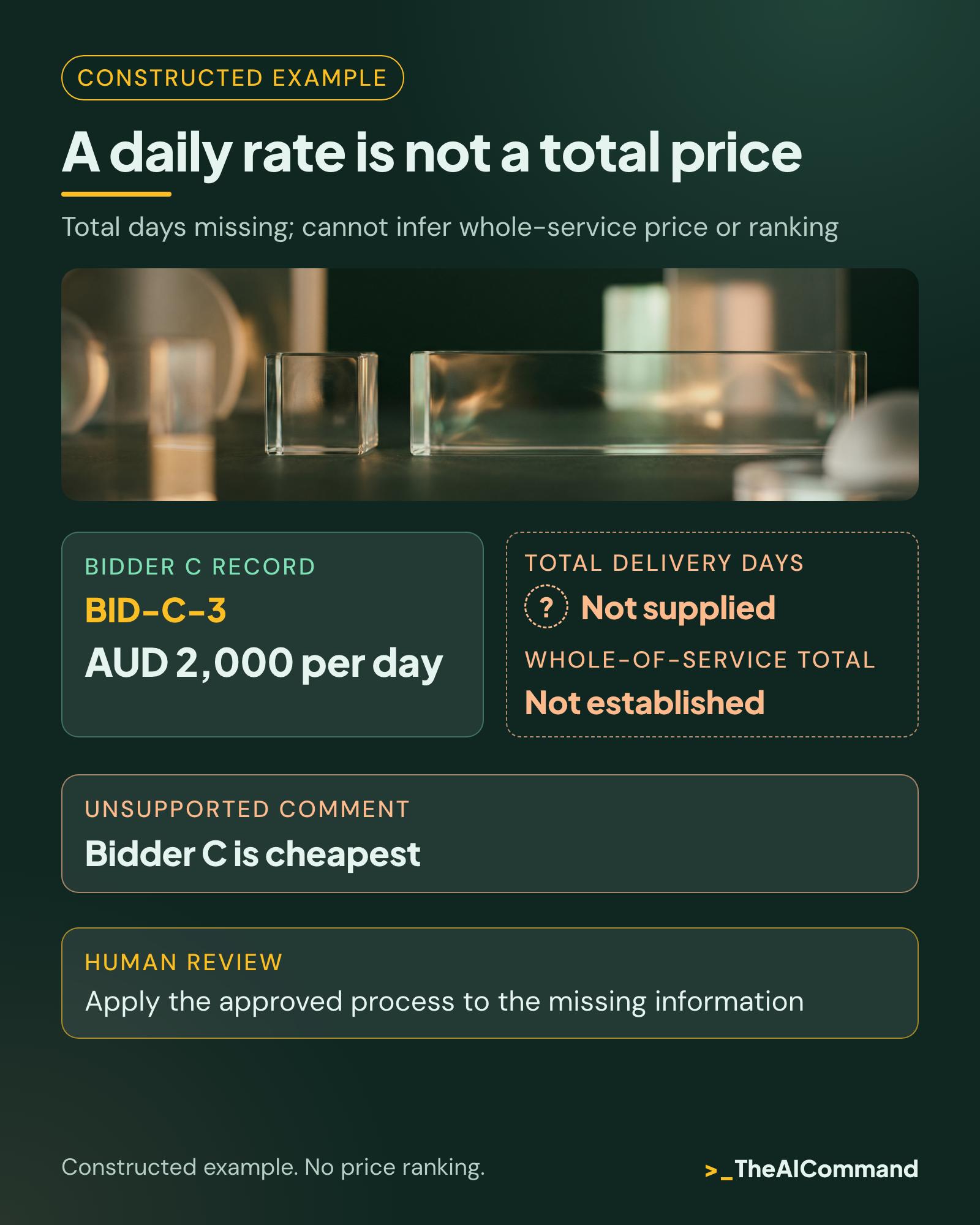
Bidder C's C1 describes a two-session approach without explaining how it covers the requested content. C2 says implementation timing will be agreed after award. C3 gives a daily rate but no estimate of total delivery days. The extract labels are evidence references, while the criteria also use C1 to C3. To avoid confusion in the working pack, label the third bidder's records BID-C-1, BID-C-2 and BID-C-3. Identifier design is a small preparation step with a direct effect on traceability.
Now add three fictional panel comments for the model to review. The first says Bidder A is the safest choice because the panel knows its people. The second says Bidder B has proven relevant experience. The third says Bidder C is cheapest. None can be accepted on the extracts alone. Familiarity is not one of the example criteria, B1 lacks comparable-delivery evidence, and a daily rate without a total number of days does not establish the lowest whole-of-service price.
The useful model output does not replace those comments with confident scores. It identifies the unsupported part, names the relevant criterion where one exists and points to the source gap. For Bidder B, the row can say that the extract describes a delivery approach but does not contain the requested comparable-project evidence. For Bidder C, it can identify the missing total-price basis. The panel still decides what those gaps mean under the approved methodology.
Separate extraction from evaluation
Ask first for an evidence matrix, not a ranking. A row contains the bidder label, criterion identifier, source reference, concise supported observation, limitation and reviewer question. Include every criterion for every bidder, even when the supplied extract offers no relevant evidence. That makes omissions visible and prevents the table from favouring a bidder simply because its response uses headings that are easier for the model to recognise.
Run a second, distinct review of proposed panel comments. Ask whether each comment is supported by the cited material and whether it introduces a consideration outside the approved criteria. The output can flag a problem and suggest neutral wording. It cannot settle the score. This separation helps the panel see when it is discussing evidence and when it is exercising judgement about that evidence under the evaluation method.
Treat an AI-suggested sentence as a proposed edit with a reason. For example, replace the unsupported claim about Bidder B's proven experience with a description of what B1 actually supplies and what is missing from the extract. Do not imply that the absence of one item automatically disqualifies the bidder. The governing process determines whether a gap affects comparative evaluation, triggers an authorised clarification or has another consequence. A writing assistant cannot decide that consequence.
Keep uncertainty symmetrical
Use the same evidence rules across bidders. If a missing support contact is flagged for one response, look for the corresponding information in the others. If an evaluator accepts a qualification in one price, check whether comparable qualifications exist elsewhere. This is a review discipline, not a demand that all tenders be identical. Different proposals may legitimately require different questions, but the reason for the difference should be explainable through the criteria and process.
Avoid interpreting confident language as stronger evidence. A response may use a modest description and provide a precise example; another may promise an outstanding outcome without support. The matrix should preserve the substance and limitations rather than imitate the bidder's tone. Likewise, a short extract is not necessarily a weak complete response. Before drawing a conclusion about a missing item, the human reviewer checks the full authorised material and the scope of the extraction.
Record ambiguity rather than resolving it by preference. In the fictional price comparison, A3 excludes travel while B3 includes it. The model can identify that difference. It cannot invent a travel assumption and quietly add it to A's price. The procurement team needs to apply the approved method and any authorised clarification process. The same restraint applies to proposed delivery times, staffing availability and unsubstantiated statements about previous performance.
Clarification is a controlled step
An evidence gap does not authorise the model to contact a bidder. Produce a draft question only where the procurement owner asks for one within the approved process. Keep its purpose clear and remove any information about another tenderer's response. The human contact officer determines whether and how the question may be asked, how fairness is maintained and how the answer will be considered. The model has no external-send authority.
Finance's procurement lifecycle describes clarification and due diligence as possible activities before evaluation is finalised. It also treats the evaluation report and the delegate's approval to commit funds as distinct activities within step 9. That separation matters in the working record: a drafted clarification is not an issued question, a response is not an accepted finding, and an evaluation recommendation is not approval to commit funds. Finance procurement lifecycle, steps 7 to 9.
If an authorised clarification arrives, give it a distinct identifier and date. Retain the earlier extract, the issued question and the answer together. Update only the affected matrix rows and explain the change. A later reviewer should be able to reconstruct what the panel knew when it made each judgement. Replacing the original row without a history can make the final assessment look better supported than it was at the relevant time.
Make the panel's judgement visible
The panel owns the assessment narrative and the final application of the approved method. If it uses numerical scores, record the reasons alongside them and check arithmetic separately. A model-generated decimal does not make a subjective judgement objective. The illustrative weights remain fixed throughout this exercise; none is adjusted after the responses are seen. A real methodology defect is escalated through the authorised process rather than repaired to favour a preferred result.
Before finalising the report, follow one material conclusion back through the record. It should lead from the panel's judgement to a criterion, a source and any relevant clarification. Then inspect a rejected or qualified conclusion to confirm that uncertainty has not vanished. This reverse trace is a practical document check. It does not replace the panel's full review, legal advice where needed or the delegate's responsibilities.
The assurance role is also distinct. A reviewer can examine whether the evidence trail supports the reported process without becoming the original evaluator. Do not cite internal audit standards as if they authorise this AI workflow or substitute for procurement rules. If internal audit performs an engagement, it applies its own applicable professional requirements and independence arrangements. The example matrix is an aid to record quality, not a certification of probity.
Start with the comment that is hardest to defend
Take one proposed assessment comment and ask the panel to identify its criterion and source. If it cannot, record the problem before improving the prose. Then use the bounded prompt to organise the relevant extracts and expose missing information. This makes a manageable first use of AI: a focused evidence check that can be reviewed completely, without moving decision authority into the tool.
Retain the source pack, criteria version, proposed output and human corrections with the evaluation record according to the entity's requirements. Recheck current rules and guidance before use, particularly where Finance marks material as undergoing updates. The practical result is an assessment that another authorised person can follow. Every material judgement has a stated basis, every unresolved gap remains visible, and the published criteria continue to govern the discussion.
Reusable material
The criterion-to-evidence matrix and consistency prompt below contain the complete synthetic sheet, response extracts and supported example rows. No scores or award recommendation are generated.
Criterion-to-evidence matrix and consistency prompt
Version 1.0. Constructed Commonwealth procurement example only. Not a complete tender, evaluation plan or procurement instrument. All criteria, weights, prices and responses below are fictional. The workflow produces no score or award recommendation.
Fixed example criteria sheet
Example sheet EVAL-01 v1.0, assumed approved and issued before the fictional responses. No amendments are included.
Weights total 100%. These are illustrative choices, not prescribed Commonwealth weights. Conditions for participation and complete process rules are outside this simplified extract and must be established in any actual procurement.
Fictional tender extracts
Comments to review
Authored example output
A3 and B3 use different travel bases. No assumed travel cost is added. No final score, automatic exclusion or award decision follows from these rows.
Blank evidence matrix
Copyable prompt
Human checks
- Confirm the governing procurement framework and current approved documents.
- Verify weights are unchanged and total 100% in this example.
- Trace every observation to the actual extract and retain qualifications.
- Keep bidder C record IDs distinct from criterion IDs.
- Reject P1's hidden familiarity criterion and unsupported claims in P2/P3.
- Do not equate missing extract content with automatic non-compliance.
- Route clarifications through the approved process; preserve questions and answers.
- Record human assessment reasons and check any scoring arithmetic separately.
Related reading
For the separate information-security due-diligence task, read CPS 234 and AI Vendors: A Due Diligence Framework. That APRA context does not supply the Commonwealth procurement criteria used here.
Also see Use Run Logs to Estimate a Business Bot's Monthly Cost, the companion article for 25 November.
References
- Department of Finance: Commonwealth Procurement Rules 17 November 2025, paragraphs 7.2, 7.3 and 7.12
- Department of Finance: Ethics and probity in procurement, Tips 2 and 3
- Department of Finance: Procurement lifecycle, steps 7 to 9
- Federal Register of Legislation: Commonwealth Procurement Rules 17 November 2025 (F2025L01263)
TheAICommand. Intelligence, At Your Command.