
CPS 234 already covers the information assets that AI vendors touch, so AI vendor due diligence is an extension of your existing information security work, not a new discipline. The gap is that the standard third-party security questionnaire was not written for AI. It needs to be.
Context for general readers: CPS 234 is the rule APRA uses to make sure regulated entities (banks, insurers, super funds) maintain strong information security. It covers the entity's own systems and the systems of its third-party suppliers. The standard is principles-based: it says what good information security looks like and requires the entity to maintain capability commensurate with its risks, rather than prescribing specific controls. AI vendors create a particular challenge because the information assets they touch (training data, prompts, model weights, inference logs) do not always fit cleanly into the categories that traditional information security frameworks were built around.
This article provides a practical due diligence framework for assessing AI vendors against CPS 234 expectations. It is structured as a working framework that risk and information security teams can apply directly. It assumes familiarity with CPS 234 and CPG 234.
What changes when you use an AI vendor?
A traditional SaaS vendor relationship has reasonably well-understood information security boundaries. The vendor processes data the entity provides, applies the documented controls, and returns outputs or maintains a hosted service. Information asset categories are clear: customer data, transaction data, employee data, configuration data.
AI vendors stretch this picture in five ways.
First, prompt data. When a regulated entity uses an AI tool, the prompts (often containing customer information, internal policy detail, or strategic context) become a new information asset category. Standard data protection language often does not address whether prompts are retained, where they are stored, and who can access them.
Second, fine-tuning data. Where the entity is using a fine-tuned model, the training data it provides creates a long-lived information asset embedded in the model itself. The data leaves the entity's direct control and becomes a feature of the model.
Third, model weights and embeddings. Some AI vendor architectures involve creating embeddings or model variants that are specific to the entity. These are derived information assets that may carry sensitivity from the source data.
Fourth, inference logs. The vendor may retain logs of inferences (input, output, metadata) for service improvement, debugging, or abuse monitoring. These logs can contain customer data and may be subject to access by vendor personnel that the entity has not approved.
Fifth, the upstream provider chain. Many AI vendors are themselves built on top of foundation model providers. The contracting layer (the AI vendor) may not be the layer where the most sensitive information processing actually happens, which is why it helps to treat the foundation model provider as a vendor risk in its own right.
CPS 234 treats all of this as in-scope. The information assets relevant to AI vendor relationships need to be identified, classified, and protected commensurate with their sensitivity.
What does a CPS 234 AI vendor due diligence framework cover?
A practical CPS 234-aligned framework for AI vendor due diligence covers eight areas.
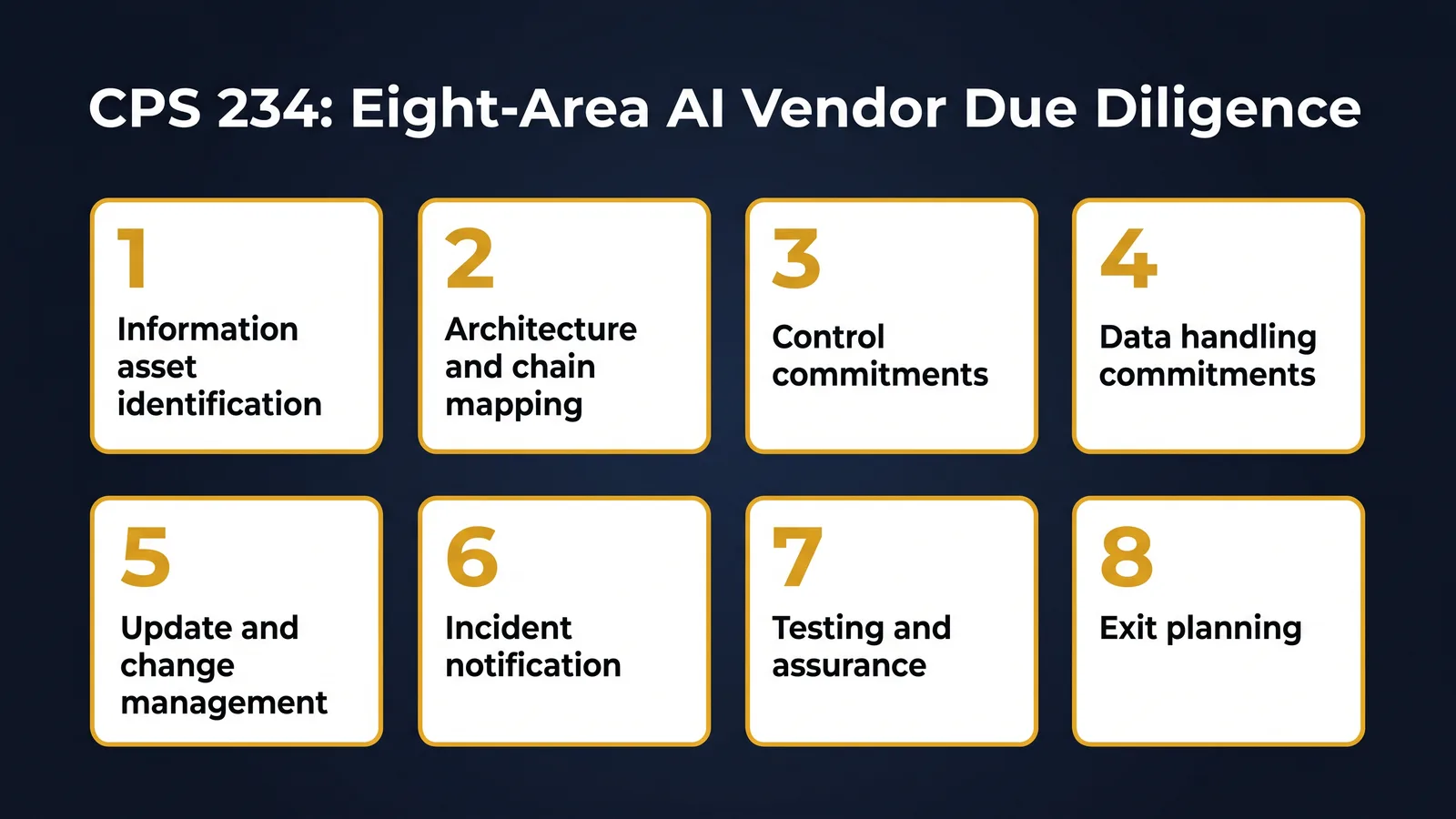
1. Information asset identification and classification
Document, for the proposed AI vendor relationship, every information asset category that will be exposed: prompts, fine-tuning data, embeddings, inference logs, configuration. For each, identify the originating data source, the sensitivity classification under the entity's information classification scheme, and the regulatory regimes that apply (Privacy Act, banking secrecy, AML/CTF Rules).
The deliverable is an information asset inventory specific to the vendor relationship. This becomes a control point: any change to what data flows to the vendor requires a review against this inventory.
2. Vendor architecture and chain mapping
Document, for the proposed AI vendor, the architecture of the service. Identify the foundation model provider, the inference infrastructure provider, the data residency for each component, and any sub-processors. CPS 234 paragraph 16 requires the entity to assess the information security capability of a related party or third party that manages its information assets, commensurate with the potential consequences of an information security incident affecting those assets. The entity needs to know what the chain looks like before it can make that assessment. APRA's letter to industry on AI, dated 30 April 2026, reinforces the point: it expects entities to map and maintain visibility over the full AI supply chain, including material third-party and fourth-party dependencies.
The deliverable is an architecture diagram and chain map that the entity holds independently of the vendor's marketing material.
3. Control commitments
Identify the information security controls the vendor commits to operate, and the evidence available for those commitments. Standard evidence sources include SOC 2 Type II reports, ISO 27001 certifications, and security questionnaire responses. AI-specific evidence sources are emerging but not yet standardised.
The CPS 234 expectation is specific here: paragraph 22 requires the entity to evaluate the design of a third party's information security controls that protect the entity's information assets. Where the vendor's control evidence is thin in AI-specific areas (training data isolation, inference log access controls, model update governance), the entity needs a documented compensating control or an accepted residual risk.
4. Data handling commitments
Document, contractually and operationally, what the vendor will do with prompts and inference data. Specifically:
- Will prompts be used for model training? If yes, are there opt-outs and how are they evidenced?
- How long are prompts and inference data retained?
- Who at the vendor (or its sub-processors) can access prompts and inference data?
- Are prompts and inference data ever co-mingled with other customers' data, including for service-improvement purposes?
These questions should be answered in writing before vendor selection. The vendor's standard terms often do not address them clearly.
5. Update and change management
AI vendors update their underlying models. The behaviour of the service the entity is using may change without a new contract being signed. CPS 234 paragraph 27 requires the entity to test the effectiveness of its information security controls through a systematic testing program, with a nature and frequency commensurate with, among other factors, the materiality and frequency of change to information assets. Where the underlying model can change without notice, the testing cadence needs to match.
Document the vendor's change management approach for model updates: notice given, testing the entity can perform, ability to roll back to a previous model version, and any substitute behaviour during a model deprecation. This is now an explicit supervisory concern. In its 30 April 2026 AI letter, APRA reported that "contractual arrangements often lagged practice, with limited evidence of specific provisions addressing audit rights, model updates and deviations, incident notification or changes to data handling".
6. Incident notification and response
CPS 234 paragraph 35 requires the entity to notify APRA no later than 72 hours after becoming aware of a material information security incident, and paragraph 36 requires notification no later than 10 business days after becoming aware of a material information security control weakness. As at 15 August 2026, both notifications are lodged through APRA Connect, which took over breach and incident reporting from 21 May 2026. For AI vendor relationships, these clocks require the entity to know when an incident has occurred at the vendor: a vendor breach starts your own notification clocks, not just the vendor's. The standard contractual approach (vendor notifies entity within X hours of becoming aware) may not be sufficient where the incident category is novel (for example, prompt injection leading to inadvertent disclosure of one customer's data to another).
Document the vendor's incident notification commitments, including coverage of AI-specific incident categories. Where the categorisation is unclear, the entity should request specific clarification.
7. Testing and assurance
CPS 234 requires control testing through a systematic testing program (paragraph 27), and paragraph 28 extends this to third parties: where information assets are managed by a related party or third party and the entity relies on that party's control testing, the entity must assess whether the nature and frequency of that testing is commensurate with the factors in paragraphs 27(a) to 27(e). For AI vendor relationships, this should include both standard control testing (penetration testing, configuration review) and AI-specific testing (prompt injection, data leakage, output quality drift).
Where the entity cannot directly test the vendor's controls, the testing capability of the vendor itself becomes part of the assurance picture. SOC 2 Type II reports and equivalent are useful but not sufficient for the AI-specific layer. APRA's 30 April 2026 AI letter flagged the deeper problem: point-in-time, sample-based assurance methods are poorly suited to probabilistic models that learn, adapt and degrade over time.
8. Exit planning
CPS 234 expects the entity to maintain information security capability through transitions. For AI vendors, exit planning has additional dimensions: what happens to fine-tuned models, embeddings, and historical inference data when the relationship ends? Are there irreducible information leakage paths (for example, model weights derived from the entity's data that cannot be reversed)?
Document the exit pathway, including data deletion commitments, attestation processes, and any residual information assets that will continue to exist post-exit.
Specific AI failure modes the framework should address
Beyond the eight framework areas, due diligence work should explicitly consider three AI-specific failure modes that traditional information security questionnaires often do not cover.
The first is prompt injection. A malicious or careless input causes the AI tool to behave in unintended ways, potentially exposing data or executing actions outside the design intent. The vendor's protections against prompt injection (input filtering, output review, system prompt protection) should be evaluated.
The second is data leakage between customers. Where the vendor operates a multi-tenant inference infrastructure, mistakes in tenant isolation can expose one customer's data to another. The vendor's tenant isolation architecture, including cache and embedding-store isolation, should be examined explicitly.
The third is training data contamination. Where the vendor uses customer data for any training purpose (even with consent), the data becomes part of the model's behaviour and may surface in responses to other customers. The vendor's commitments and operational controls on training data use should be specific and verifiable.
These failure modes are AI-specific. They do not feature in standard information security questionnaires because the underlying technology was not in scope when the questionnaires were designed. Adding them is straightforward but requires deliberate attention.
Working with the major AI providers
Vendor practice varies considerably across the major enterprise AI providers, particularly on data residency, audit rights, and the form in which compliance documentation is made available. Each vendor's published trust centre or compliance portal is the appropriate primary reference; due diligence work should review those sources directly at the time of assessment rather than rely on generic comparisons that age quickly. Our platform configuration library records fetch-verified data-handling positions for several major platforms, each dated to the day it was checked, which is a useful starting point for the review.
The practical implication for due diligence: the assessment framework should be applied to each vendor on its own terms, rather than expecting uniformity across providers. A vendor that cannot provide a particular control evidence type may still be acceptable if the entity has documented compensating controls and accepted residual risk explicitly.
The supervisory expectation is not that every AI vendor relationship is perfect. It is that the entity has assessed each relationship deliberately, documented the assessment, and managed the residual risk consciously.
Practical AI leverage under CPS 234
CPS 234 was written before enterprise AI vendors were common. Its principles still apply; the supervisory question is whether the entity has identified the AI-specific information assets and protected them commensurate with their sensitivity. The workflow below is the simplest path to a defensible vendor file for any material AI deployment.
Step 1: Run the eight-area framework on every material AI vendor relationship
Information asset identification, architecture and chain mapping, control commitments, data handling commitments, update and change management, incident notification, testing and assurance, exit planning. Each area produces a documented artefact that becomes part of the vendor file.
Step 2: Build an AI-specific addendum to the standard third-party security questionnaire
Standard SaaS questionnaires don't ask about prompt retention, training data use, multi-tenant inference isolation, or model-version notice. Add these explicitly. Vendor responses should be in writing, dated, and signed.
Step 3: Map the architecture chain you actually depend on
Foundation model provider, inference infrastructure provider, data residency for each, sub-processors. The contracting layer is rarely the layer where the most sensitive processing happens. The map should be your understanding, held independently of the vendor's marketing material.
Step 4: Match the testing cadence to the change cadence
Where the underlying model can change without notice, annual control testing is insufficient. Quarterly assurance with continuous output monitoring is a reasonable starting point for material vendors. Document the cadence and the trigger conditions for ad hoc reassessment.
Step 5: Make incident notification cover AI-specific failure modes
Standard breach notification doesn't cover prompt injection, multi-tenant data leakage, or training data contamination. Negotiate (or document) explicit coverage. Where the vendor will not commit, the entity has an accepted residual risk that a Board paper should record.
Step 6: Address AI vendor concentration risk
Where multiple critical workflows depend on a single foundation model provider, the entity has a CPS 230 operational resilience question alongside the CPS 234 information security question. See our CPS 230 and AI operational resilience playbook for the resilience overlay.
What to never do
Do not: Accept a vendor's standard SaaS contract for an AI deployment that touches customer data without the AI-specific addendum. Rely solely on the vendor's logs for the audit trail you'll need under APRA notification. Treat AI vendor due diligence as a separate discipline from existing CPS 234 work; it's an extension, not a parallel. Allow the vendor's inference infrastructure to host customer data without a documented residency and access posture.
Governance checklist
- Every material AI vendor relationship has all eight framework areas documented
- An AI-specific addendum to the third-party security questionnaire is in use
- Architecture and chain map exists for every material AI vendor, held by the entity (not the vendor)
- Testing cadence matches change cadence; rationale is documented
- Incident notification commitments explicitly cover AI-specific failure modes
- Exit planning addresses fine-tuned models, embeddings, and irreducible information assets
- AI vendor concentration risk is reviewed at Board / Risk Committee level on an annual cycle
How often should you test AI vendor controls?
CPS 234 paragraphs 27 and 28 expect the effectiveness of information security controls to be tested through a systematic testing program, with a nature and frequency commensurate with the materiality and frequency of change to the information assets, including where those assets are managed by a third party. Internal audit must separately review the design and operating effectiveness of information security controls, including those maintained by related parties and third parties (paragraph 32). For AI vendors, these requirements intersect with the change cadence problem covered in our CPS 230 piece: the vendor's underlying model can change without notice, and the testing cadence needs to match.
The practical pattern for material AI vendor relationships: a continuous or near-continuous monitoring approach focused on output quality, with periodic deeper assurance on the underlying control framework. Quarterly assurance with continuous output monitoring is a reasonable starting point for material vendors. Annual-only assurance is unlikely to be sufficient.
Practical implications this quarter
For information security and third-party risk teams:
- Build an AI-specific addendum to the standard third-party security questionnaire. The eight areas above translate directly into questionnaire sections.
- Reassess the highest-impact AI vendor relationships against the framework. Where the original due diligence pre-dated AI-specific governance attention, gaps are likely.
- Build the architecture and chain map for each material AI vendor. This is the artefact most often missing in current third-party files.
- Coordinate with procurement on standard AI-specific contractual terms. Standard SaaS contract language often does not adequately address the AI-specific information asset categories; the CPS 230 AI vendor contract work is a useful starting template.
Direction of travel
CPS 234 has been operationally embedded for several years, and APRA has already tested compliance at scale: by the end of 2023, more than 300 banks, insurers and superannuation trustees had taken part in independent tripartite assessments of CPS 234 compliance, and APRA's first-tranche findings, published in July 2023, listed limited assessment of third-party information security capability among the most common control gaps. The application to AI vendors is now explicit supervisory territory. APRA's letter to industry on AI, dated 30 April 2026 and following a targeted engagement with selected large banks, insurers and superannuation trustees in late 2025, found that contractual arrangements with AI suppliers often lagged practice and that few entities had demonstrated robust contingency planning or tested exit and substitution strategies for critical AI providers. Practitioners who treat AI vendor due diligence as a structured extension of the existing CPS 234 framework, rather than a new and separate discipline, will find the implementation cleaner and the supervisory conversation easier. For a structured walk through the standard itself, our CPS 234 learning module covers the full paragraph structure with a self-assessment.
The pace of underlying technology change means the framework itself will need refreshing periodically. The eight areas above are unlikely to change quickly, but the specific control evidence that vendors can provide, the standard contractual terms available, and the supervisory expectations on each will continue to evolve. Building in an annual framework refresh, with quarterly review of material vendor relationships, is a sensible operational rhythm for the next two to three years.
Bottom line
CPS 234 already reaches the information assets AI vendors touch, so the task is to identify them and protect them commensurate with their sensitivity, not to invent a parallel discipline. Run the eight-area framework plus the three AI-specific failure modes on every material AI vendor, match the testing cadence to the change cadence, and document any residual risk consciously.
Do this Monday:
- Build an AI-specific addendum to the standard third-party security questionnaire covering prompt retention, training data use, multi-tenant inference isolation, and model-version notice.
- Map the architecture and provider chain for each material AI vendor, held by the entity rather than the vendor.
- Run the eight-area framework on your highest-impact AI vendor relationships, especially where the original due diligence pre-dated AI-specific attention.
- Set testing at quarterly assurance with continuous output monitoring for material vendors, and document the trigger conditions for ad hoc reassessment.
- Record any accepted residual risk, such as uncovered incident categories, in a Board or Risk Committee paper.
Content disclaimer: This article is for general educational and informational purposes only. It does not constitute legal advice, regulatory guidance, or a substitute for professional compliance judgement. Regulatory obligations vary by entity type, licence, and circumstance. Always refer to primary source guidance from APRA, ASIC, or the relevant regulatory authority.
TheAICommand. Intelligence, At Your Command.