
Use AI to summarise treating practitioner reports, not to weigh them. It compresses the reading task, but weighing the evidence and applying the section 16 reasonableness test stay with the case manager.
Summarise. Do not interpret.
The pain point
A working file in workers compensation often contains many medical reports. Treating practitioner reports, IME reports, treating specialist correspondence, hospital discharge summaries, allied health updates. Reading the full set, with the level of attention each deserves, is a real time burden on case managers carrying loaded caseloads.
This is exactly the kind of task where AI tools look attractive. Compress, structure, summarise. Save twenty minutes per claim. Multiply across the caseload.
The attraction is real. The risk is also real. Medical evidence is the substance of section 16 reasonable treatment determinations. The substance cannot be delegated to a tool.
Where does AI help with treating practitioner reports?
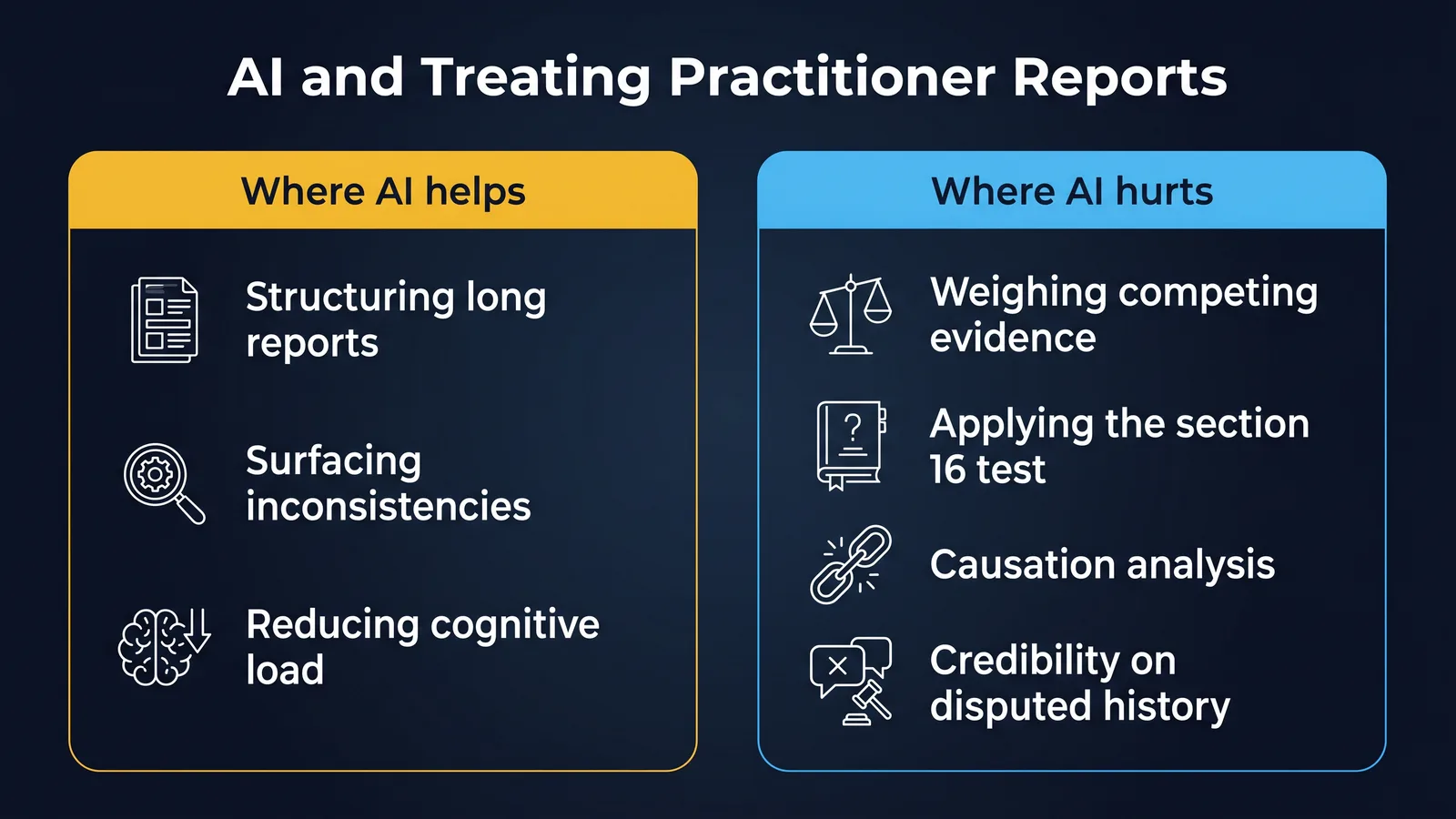
Three things AI tools do well with treating practitioner reports.
Structuring long reports. A 14-page report can be compressed into a structured summary that lists the diagnosis, the relevant history, the proposed treatment, the prognosis, and any specific recommendations. A case manager can read the summary in two minutes and use it to navigate the full report more efficiently.
Surfacing inconsistencies. Where multiple reports exist on the same claim, AI tools can highlight where the reports agree and where they differ. The case manager still has to weigh the inconsistencies. The AI just makes them easier to see.
Reducing the cognitive load on entry tasks. First reading of a new report, classification of report type, extraction of key dates and treatment recommendations. These are entry-level tasks that AI handles competently and that take the friction out of the first hour with a new report.
Where does AI hurt with treating practitioner reports?
Four things AI tools do poorly with treating practitioner reports, where the consequences of getting it wrong are material.
Weighing competing medical evidence. When a treating practitioner's view differs from an IME's view, the case manager must weigh the two. This involves judgement about the basis of each opinion, the qualifications of each provider, and the overall coherence of each view with the file evidence. AI cannot weigh these factors with the rigour the SRC Act expects.
Applying the section 16 reasonableness test. Reasonable medical treatment under section 16 is a legal test. AI can summarise the proposed treatment. AI cannot apply the legal test. Any AI output that drifts from describing treatment to evaluating reasonableness is out of scope.
Causation analysis under section 5A and section 5B. Whether an injury arose out of or in the course of employment is a section 5A question, and whether employment contributed to a disease to a significant degree is a section 5B question. Both are legal questions informed by medical evidence. AI summaries help the case manager read the medical evidence. They cannot perform the causation analysis.
Credibility on disputed history. Where the claimant's account of injury history differs from what is on file, the case manager often relies on the treating practitioner's framing of history to support their assessment. The nuance in this kind of evidence does not survive AI summarisation reliably.
De-identification callout. Treating practitioner reports contain identifiers in many places. Letterheads, signature blocks, practice details, file references. The five-category de-identification toolkit applies in full. Use [TREATING_PRACTITIONER], [PRACTICE], [CLAIMANT_NAME], [CLAIM_NUMBER], [INJURY_DATE], [CONDITION] consistently. Do not paste reports into any tool that has not been approved by your scheme operator. This is consistent with the OAIC's guidance on privacy and the use of commercially available AI products, which recommends as best practice that organisations do not enter personal or sensitive information into publicly available generative AI tools (guidance current as at 20 September 2026).
What is a safe workflow for using AI with a treating practitioner report?
The workflow below uses AI for the parts of the task it does well and keeps the case manager in charge of the substantive work. It sits inside the broader SRC Act framework for AI-assisted determinations.
Step one. Triage with the full report. First read of a new report happens with the full document, not a summary. The case manager is checking that the report addresses what was asked, identifies any flags, and matches the claimant's stated condition.
Step two. Generate a structured summary. Once the case manager has read the report once, the AI summary is useful as a navigation aid for later reference. The prompt asks for a structured summary covering diagnosis, history, treatment, prognosis, and recommendations.
Step three. Cross-check the summary. The case manager reads the AI summary against the original report and confirms the key points are accurately represented. Any drift is corrected.
Step four. Use the summary as an aid, not a replacement. When making decisions under section 16 or section 14, the case manager refers back to the original report for the substantive points. The summary is a wayfinding tool.
Step five. Capture the medical opinion in the practitioner's words. Where the determination needs to record the treating practitioner's opinion, the case manager pulls direct quotes from the original report, not paraphrases from the AI summary. AI paraphrasing of medical opinion is a known source of subtle distortion.
A worked example
A case manager has received a 12-page report from [TREATING_PRACTITIONER] in respect of [CLAIMANT_NAME], claim [CLAIM_NUMBER], [CONDITION]. The case manager:
- Reads the report end to end.
- De-identifies the report into a working copy.
- Asks the AI tool to produce a structured summary covering diagnosis, history, treatment, prognosis, recommendations.
- Reads the summary against the report and confirms accuracy.
- Uses the summary to navigate the report when preparing a section 16 determination.
- Quotes the treating practitioner's opinion directly from the report, not from the summary, when the determination references the medical evidence.
The case manager's reading is end to end. The AI's summary is a wayfinding aid.
Risks and guardrails
Three concrete risks come up in practice.
Summary drift. The risk is that the AI summary subtly distorts the practitioner's view in a way that affects the determination. The control is the cross-check in step three and the rule that medical opinion language stays in the practitioner's words.
Treating AI summary as the report. The risk is that, over time, case managers begin to read the summary instead of the report. The control is the rule that the first read is end to end, every time.
Privacy creep through medical metadata. The risk is that practice letterhead, signature blocks, or file metadata contain identifiers that survive a quick redaction pass. The control is the visual scan in the de-identification routine.
For practitioners
- Use AI to compress reports into structured summaries, not to weigh them
- Always cross-check AI summary points against the original report
- Keep medical opinion language in the practitioner's words, not paraphrased
- Flag any inconsistency between the AI summary and your file knowledge
- Treat AI as a reading aid, not a clinical interpreter
For governance leads
- Establish boundaries on what AI can and cannot do with medical evidence
- Audit summaries against source reports as part of your QA cycle
- Confirm de-identification covers practitioner names and practice details
- Brief delegates on the legal weight of AI summaries vs full reports
- Treat any AI output that opines on causation as out of scope
A note on report types
The workflow above applies cleanly to standard treating practitioner reports. Three other report types deserve specific consideration.
IME reports. Independent medical examination reports are typically commissioned under a section 57 examination referral for a specific purpose under the determination process. They tend to be longer, more structured, and more legally framed than treating practitioner reports. AI summarisation works on IME reports, but the case manager should be especially careful that the legal framing in the report is preserved accurately in the summary. Distortion of the legal framing is the most common failure mode here.
Specialist reports. Specialist reports often contain technical clinical language that AI summarisation can flatten. Where the determination relies on the specialist's specific clinical reasoning, the case manager should pull direct quotes from the original report rather than relying on the summary.
Allied health updates. Physiotherapy, occupational therapy, and psychology updates tend to be shorter and more progress-focused. AI summarisation here is lower risk because the substantive evidentiary weight is usually carried by the treating practitioner and IME reports. The summarisation can be more aggressive without much downside.
How this fits with section 16
Section 16 of the SRC Act (current compilation No. 82, C2026C00285, in force from 1 July 2026, as at 20 September 2026) governs the case manager's liability for medical treatment. The reasonableness test applies. AI summarisation supports the reading task; it does not support the legal test.
Where a section 16 determination depends on the case manager's view of the proposed treatment, the determination text needs to reflect the treating practitioner's clinical view fairly. AI summarisation that compresses the clinical view too aggressively, or that subtly shifts emphasis, can produce determinations that are accurate at the high level but unfair at the granular level. The cross-check in step three of the workflow is the control. The companion guide on how AI can build the section 16 picture, not make the call covers the same boundary.
The role of the IME
Where the case manager is weighing a treating practitioner's view against an IME view, AI tools can summarise both, the same pattern covered in mapping conflicting medical opinions. The summaries help. The weighing does not happen in the AI. Where the IME report itself was prepared for the Administrative Review Tribunal, it may carry its own AI disclosure obligations that the case manager should be aware of when reading it.
The pattern most case managers find useful is to summarise both reports separately, read both summaries side by side, and then make the weighing decision in writing in the file note. The summaries support the reading. The case manager's analysis carries the weighing.
Three failure modes to watch
Three failure modes recur in audits of teams using AI to summarise medical evidence.
Failure mode one. Confirmation summarisation. The case manager has formed a view of the claim and the AI summary, intentionally or not, reinforces that view. Where this happens, the case manager is using the summary as confirmation rather than information. The control is the cross-check in step three of the workflow, with explicit attention to whether the summary surfaces evidence that runs against the case manager's preliminary view.
Failure mode two. Compression of disagreement. Where treating practitioner and IME views differ, the AI summary often flattens the difference, presenting the views as broadly consistent when they are not. The control is to summarise the two reports separately and to read the summaries side by side rather than asking the AI to reconcile them.
Failure mode three. Loss of clinical specificity. The AI summary uses general terms where the original report used precise clinical language. The general terms are easier to read but less defensible at review. The control is to pull direct quotes from the original report when the determination references medical opinion.
These failure modes are not exotic. They are the pattern this work falls into when the discipline slips. Naming them helps teams see them.
The discipline of going back to the source
The single most important habit in this workflow is going back to the source. Whenever a determination references a medical opinion, the case manager pulls the language from the source report, not the summary. The summary is a navigation aid. The source is the evidence.
Case managers who keep this discipline generally find that AI summarisation accelerates their reading without compromising the substance of their determinations. Case managers who let the summary become the evidence find that, over time, the determinations they issue drift from the source material in ways that show up at review.
The bottom line
Treating practitioner reports are the substantive evidence in many of the determinations case managers make. AI is a useful tool for compressing the reading task. AI is a poor tool for weighing the evidence, applying the legal tests, or making the determinations.
Use AI to read faster. Use your judgement to decide.
---
Content disclaimer: This article is for general educational purposes only and does not constitute legal advice, liability determination guidance, or a substitute for professional judgement. Workers compensation decisions must be made by appropriately qualified and authorised persons under the Safety, Rehabilitation and Compensation Act 1988. All AI outputs described in this article require human review before use in any claims management context.
Do this Monday
- Pick one open claim and read the treating practitioner report end to end before any tool touches it.
- De-identify the working copy first, sweeping letterheads, signature blocks, practice details and file references, and apply your placeholders consistently.
- Ask the tool for a structured summary covering diagnosis, history, treatment, prognosis and recommendations, and nothing beyond that.
- Cross-check the summary against the original report and correct any drift, paying particular attention to evidence that runs against your preliminary view.
- Quote the practitioner's opinion directly from the source report wherever a determination records medical opinion, never from the summary.
- Where a treating view and an IME view conflict, summarise each report separately and read the summaries side by side rather than asking the tool to reconcile them.
- Keep the reasonableness test, the causation analysis and the weighing in your own file note, and treat any AI output that opines on them as out of scope.
- Add the summary against source check to your QA cycle, so drift is caught in audit rather than at review.
TheAICommand. Intelligence, At Your Command.