
Some determinations nobody ever asks you to make.
Section 30 of the Safety, Rehabilitation and Compensation Act 1988 is the only compensation provision that obliges the authority to make a determination the employee never has to request. Where weekly incapacity payments sit at or below the indexed redemption ceiling and the authority is satisfied the degree of incapacity is unlikely to change, it shall make a determination converting the remaining liability into a lump sum. No application. No form. No statutory clock.
That is an awkward fit for a claims operation built around inbound work. Almost every other determination arrives attached to a claim, a request, an invoice or a certificate. Section 30 arrives attached to nothing. It sits inside the open incapacity population, and the only thing that surfaces it is somebody looking.
So an AI screen earns its place here, and has to be fenced hard. It finds the cohort and assembles the stability picture. The satisfaction under paragraph 30(1)(c), the lump sum figure and the determination stay with the delegate.
What does section 30 actually require?
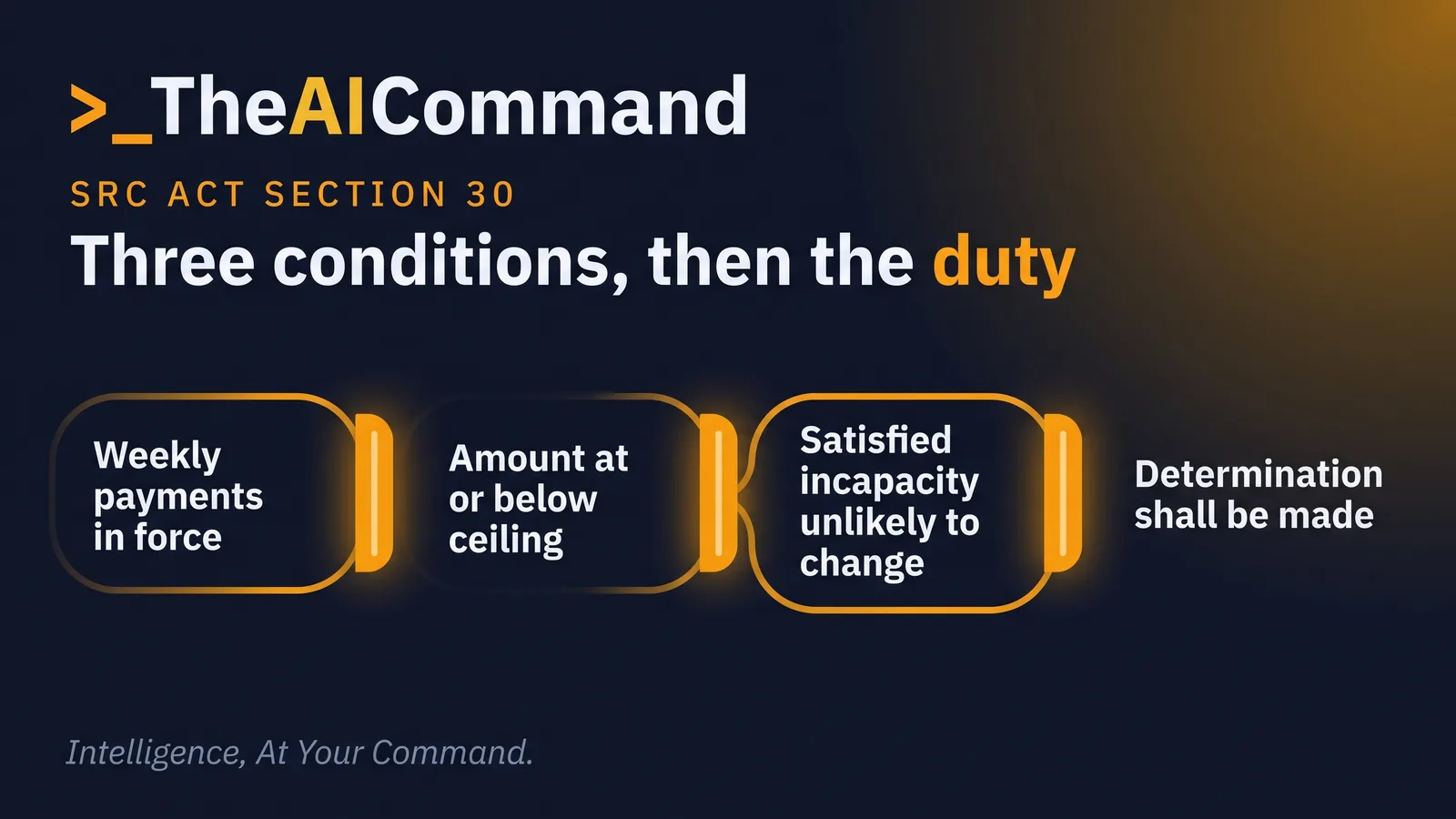
Three cumulative conditions. The authority is liable to make weekly payments under section 19, 20, 21 or 21A in respect of an injury resulting in an incapacity. The amount of those payments is at or below the redemption ceiling. And the authority is satisfied that the degree of the employee's incapacity is unlikely to change.
Once all three are met the Act uses "shall". The determination redeems the liability to make further payments under that section by a lump sum, worked out under subsection 30(2) as the present value of an annuity: 52 times the weekly amount, discounted across the remaining period by a specified number the Minister sets by instrument.
Two inputs in that formula get missed. The specified number is 0.03, set by section 5 of the Specified Number for Redemption of Compensation Instrument 2019 (F2019L00289), and subsection 30(4) lets the Minister change it. The period runs to pension age, which subsection 4(1) defines by reference to subsections 23(5A) to (5D) of the Social Security Act 1991. That is date-of-birth dependent. It is not 65 and it is not 67. Where the employee was injured on or after reaching the age two years before pension age, paragraph 30(3)(b) points instead at the day the entitlement would otherwise cease.
Why can a licensee not read section 30 literally?
Section 30 speaks only of Comcare. It does not use the term relevant authority, which subsection 4(1) defines to include a licensee. Section 137, the request-based redemption for former employees, does. Section 30 does not.
For a licensee the obligation runs through Part VIII instead. Paragraph 108A(1)(c) makes an authorised licensee liable to pay compensation under the Act, subsection 108C(1) requires it to determine any claim within the scope of its licence, and paragraph 108E(b) requires those claims to be determined accurately and quickly.
That routing point matters more than it looks. A licensee running a redemption screen is not applying a section that names it. It is discharging a Part VIII obligation under an Act whose section 30 duty is expressed against Comcare. Write the procedure that way and the delegation, licence scope and audit record all line up.
Section 137 does not merge with section 30.
Both borrow the same discount input, because subsection 137(5) adopts the number specified for subsection 30(2).
The ceiling moved. The section did not.
As at Comcare's statutory rates effective 1 July 2026, the subsection 30(1) redemption eligibility ceiling is $152.50 per week (Comcare, Statutory rates for compensation). The $50 on the face of the section is the 1988 base amount. Section 13 lists subsection 30(1) among the relevant amounts indexed to the Consumer Price Index each 1 July, so the printed figure stopped being the test a long time ago.
Two cautions follow. First, coverage: a rule written against $50 finds almost nobody, and one written against the current figure finds roughly three times as many files. If a screen already exists, check which number it holds.
Second, naming. Comcare's Table 1 for 1 July 2026 shows $152.50 against three rows: subsection 19(8) incapacity for a prescribed person, subsection 30(1) redemption eligibility, and subsection 137(1) redemption eligibility. Three unrelated entitlements carrying the same figure this year. Do not let a rule cite the wrong one, or a model infer that they move together.
Comcare's income support page adds an operational reading: gross weekly payments meet or fall below the ceiling, incapacity is unlikely to change based on medical evidence, and redemption payments are treated as income so tax is payable. Those are Comcare's published positions, not section 30. The Act draws no gross or net distinction, sets no evidentiary standard, and says nothing about tax. Label them accordingly.
Commentary sometimes asserts redemption is available only after the first 45 weeks. No such rule appears in section 30. Comcare's published adjustment percentages do reduce weekly amounts after week 45, so the cohort tends to appear later, but that is where the files sit, not a precondition.
Why the one-way door raises the evidentiary bar
Subsection 23(3) is why this determination cannot be treated as housekeeping. Once it is made, compensation is not payable under section 19, 20, 21 or 21A for any period of incapacity resulting from that injury occurring after the day of the determination. Subject to section 31, the weekly stream for that injury closes.
Section 31 is the only way back, and it is narrower than plain-English summaries suggest. It is not "if capacity changes". It requires that the injury results in the employee being incapacitated for work to the extent that they are not able to engage in suitable employment, and that the incapacity is likely to continue indefinitely. Even then it pays only the difference between what would have been payable and the amount redeemed. Section 32 disregards a redemption determination for subsections 23(3) and 31(2) where it is revoked or set aside, unless a tribunal or court substitutes its own redemption determination. A narrow correction, not a general reopening.
The review path is ordinary. Section 60 includes section 30 in the definition of determination, so section 61 requires written notice of the terms, the reasons and the reconsideration statement, reconsideration under section 62 is available, and the section 62 decision is the reviewable decision that can go to the Tribunal. What is absent is any deadline: the prescribed decision period in subsection 61(1A) is confined to a claim under section 14, so nothing chases the file. That is why the screen has to be a standing routine.
The standing redemption screen
The screen is a population routine, not a file task. It runs monthly across every open claim with a live weekly incapacity entitlement and produces a candidate list plus a stability evidence bundle for each candidate. No conclusion. The step-by-step version is a companion artefact: how to run a section 30 redemption screen.
- Define the population by rule. Every open claim currently attracting weekly payments under section 19, 20, 21 or 21A. Not the long-tail files, not a manager's recollection. A rule you can re-run.
- Supply the three volatile inputs. The indexed ceiling, the specified number in force, and the individual's pension age date. All three change, and a model asked to recall any of them returns a plausible wrong answer. Pass them as parameters every run.
- Test the amount actually payable. The condition is the weekly amount payable under the relevant section, not normal weekly earnings and not an annualised average. Apply the same discipline as an incapacity cross-check. A file that has only just dropped under the ceiling on a retrospective adjustment belongs in a hold column until the ledgers reconcile, because paragraph 30(1)(b) has nothing stable to run against.
- Assemble the stability picture, do not conclude it. Certificate history and stated restrictions, treatment frequency, rehabilitation status, actual earnings in suitable employment, any pending reassessment. Each item cited to a source. No conclusion about whether incapacity is likely to change.
- Route to the delegate with the question open. The delegate reads the bundle, forms or declines to form the satisfaction, and records why.
- Log the run, including the nils. A month with no candidates is evidence the obligation was tested, and an unlogged screen is indistinguishable from no screen.
TheAICommand works to the Verified Draft Method: de-identify the inputs, ground the model in your own source material, keep a person at the decision point, verify against the primary source, and log what happened. Here the first step does most of the work, because the input is the whole open cohort. Apply the de-identification toolkit at extract time and keep the re-identification key in the claim system.
A worked screening output
Take a de-identified candidate row: claim [CLAIM_NUMBER], injury date [INJURY_DATE], accepted [CONDITION], paid under section 19 below the supplied ceiling for 31 consecutive weeks. The bundle returns five lines. Certificates from [TREATING_PRACTITIONER] across 14 months carry identical restrictions with no review date. Treatment is monthly maintenance physiotherapy. The rehabilitation program closed nine months ago, goal marked achieved. Actual earnings in suitable employment sit in a narrow band across 22 pay cycles. Pending items: "not stated".
That is a screening output, not a finding. The gap is doing real work, because no pending reassessment recorded is not the same as no reassessment warranted. Under paragraph 30(1)(c) the delegate is satisfied on that evidence or is not, and the reasons record which.
What the model never does
It does not form the satisfaction. Paragraph 30(1)(c) is the reserved judgement here, and a model that writes "incapacity appears stable and unlikely to change" has crossed the line even when every underlying fact is right, because that phrase is the statutory test wearing a summary's clothes.
It does not recommend that the satisfaction be formed. A ranked list headed "recommended for redemption" is the same crossing with an extra step. Rank by how complete the bundle is, never by how likely the determination looks.
It does not model the employee's interests. Whether a lump sum suits this person is not the statutory question. The line that governs AI-assisted determinations governs here, and subsection 23(3) makes blurring it close to permanent.
Redemption is not a cost saving or a closure tactic. Failing to screen leaves a statutory obligation unmet. Screening carelessly finalises an entitlement on a satisfaction never properly formed. Both land on the delegate.
Bottom line
Section 30 is the rare provision where the compliance risk is an absent decision rather than a wrong one. A standing AI screen turns an invisible obligation into a monthly, reproducible, logged routine that finds the cohort and assembles the evidence. Under paragraph 30(1)(c) the delegate is satisfied, or is not, and signs the determination.
Do this Monday:
- Confirm the current subsection 30(1) ceiling from Comcare's statutory rates page, with the date beside it.
- Run one population query for every open claim attracting weekly payments under section 19, 20, 21 or 21A.
- Check whether any existing rule still holds the $50 base amount, or cites subsection 19(8) or 137(1) by mistake.
- Build the stability bundle for the first candidate, and stop at the evidence.
- Name the delegate who forms the paragraph 30(1)(c) satisfaction, and log the run either way.
References
- SRC Act 1988, Compilation No. 82 (C2026C00285), 1 July 2026. https://www.legislation.gov.au/C2004A03668/latest/text
- Comcare, Statutory rates for compensation, Table 1, from 1 July 2026. https://www.comcare.gov.au/claims/statutory-rates
- Comcare, Income support. https://www.comcare.gov.au/claims/supports-benefits/income-support
- Specified Number for Redemption of Compensation Instrument 2019 (F2019L00289). https://www.legislation.gov.au/F2019L00289/asmade/text
This article is general information and education only. It is not legal advice, and it is not advice about any individual claim. Decisions under the Safety, Rehabilitation and Compensation Act 1988 are made by human decision-makers on the individual merits of each claim, and claimants have reconsideration and review rights in respect of determinations. Seek advice specific to your scheme and circumstances.
TheAICommand. Intelligence, At Your Command.