
The paperwork just became the point.
For years, a decision to send an injured employee for an independent medical examination sat in the routine middle of claims work. That has changed. Two amendments to the Comcare scheme have turned the section 57 examination decision into one of the more scrutinised steps a case manager takes, and the change lands squarely on how the referral is prepared and recorded.
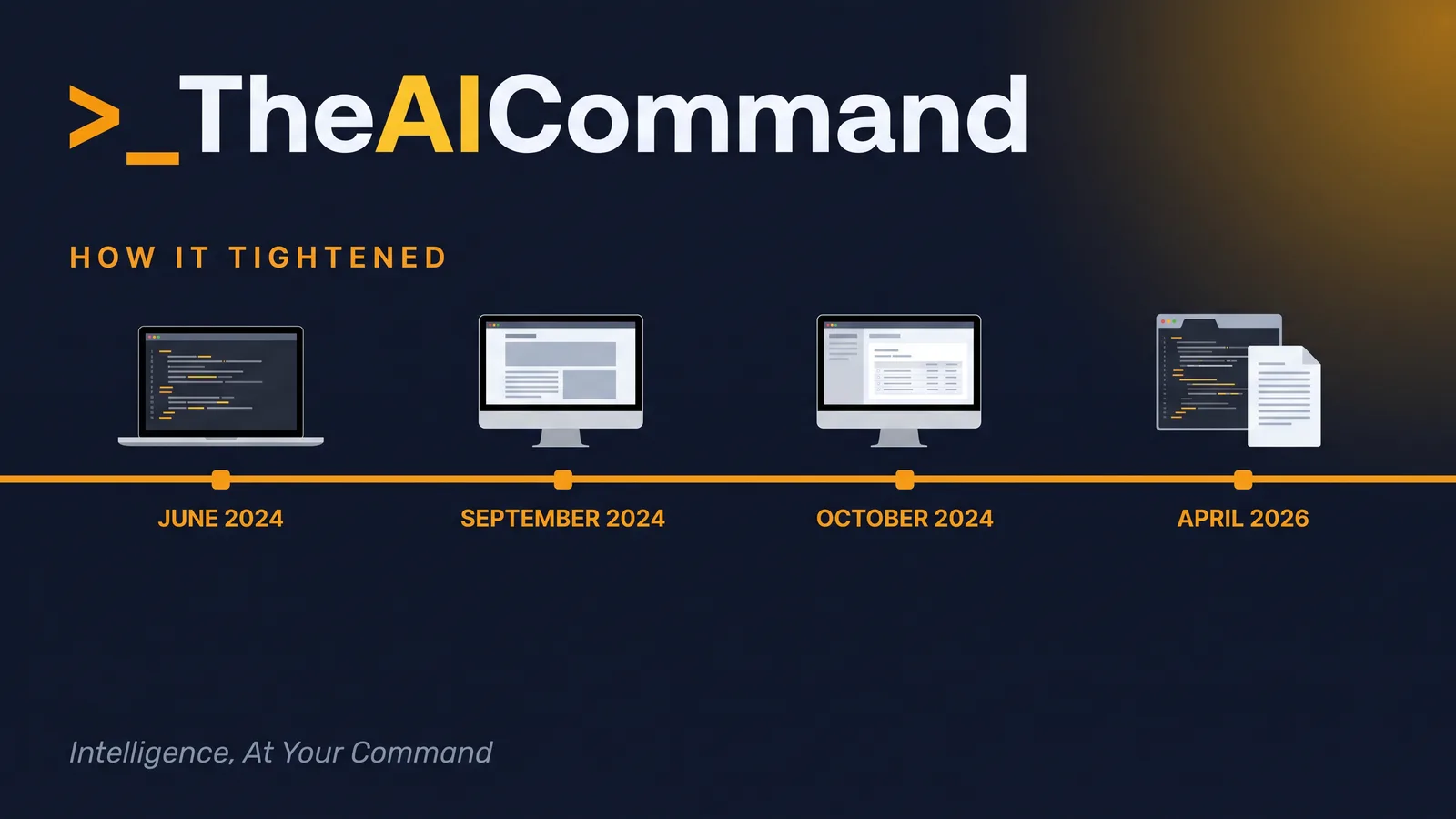
Since 14 June 2024, a request to undergo a medical examination under section 57 of the SRC Act is a reviewable determination. Comcare's guidance is explicit that these requests are determinations that are reviewable and can be subject to review by the Administrative Review Tribunal. Because it is a determination for the purposes of section 60, notice of it must be given in writing under section 61, setting out the terms of the determination and the reasons for it. And since 30 October 2024, the decision must comply with a mandatory Guide made under section 57A, whose object is to support ethical, transparent and accountable decision making, including appropriate consideration of the employee's personal circumstances.
Put together, that means a section 57 referral now has to be defensible, documented and Guide-aligned, and a person may later ask a tribunal to look at how it was made. This is exactly the kind of high-volume, structured, reasoning-heavy task where AI can take real load off a case manager, and exactly the kind where a case manager cannot let AI take the decision.

The workflow problem
A good section 57 referral is not a form. It is a small piece of reasoning. The decision-maker has to be satisfied the information already held is insufficient without an examination, has to consider the employee's circumstances, should rely as much as possible on the treating practitioner's information, and should seek and take into account the employee's views on who conducts the examination. The examination questions then have to be relevant and neutral, and the whole decision has to be written up with reasons.
The Guide sharpens each of those expectations. Comcare's material on it makes clear that relevant authorities must consider an employee's circumstances, rely as much as possible on relevant information from the injured employee's treating practitioner, and seek and take into account the employee's views about who conducts the assessment or examination. A referral that reaches for an external examination without first exhausting the treating practitioner's information, or that never records the employee's view on the examiner, is not just poor practice now. It is a departure from a mandatory instrument on a reviewable decision.
Done well, that takes time and consistency across a caseload, and it is easy for the record to lag behind the reasoning. Done poorly, it produces the thin, boilerplate referral that a review body, or the Commonwealth Ombudsman, can pick apart. The Ombudsman's April 2026 report on improving Comcare's decision-making framework for medical examinations and complaint handling is a reminder that this exact decision has been under external scrutiny. The pressure is on the quality and transparency of the referral, and that is a documentation and structure problem before it is anything else.
That is the shape of problem AI is genuinely good at: de-identify, assemble, structure, draft, and lay a decision out against a required framework, at speed and consistently, for a human to check and own.
The step-by-step AI workflow
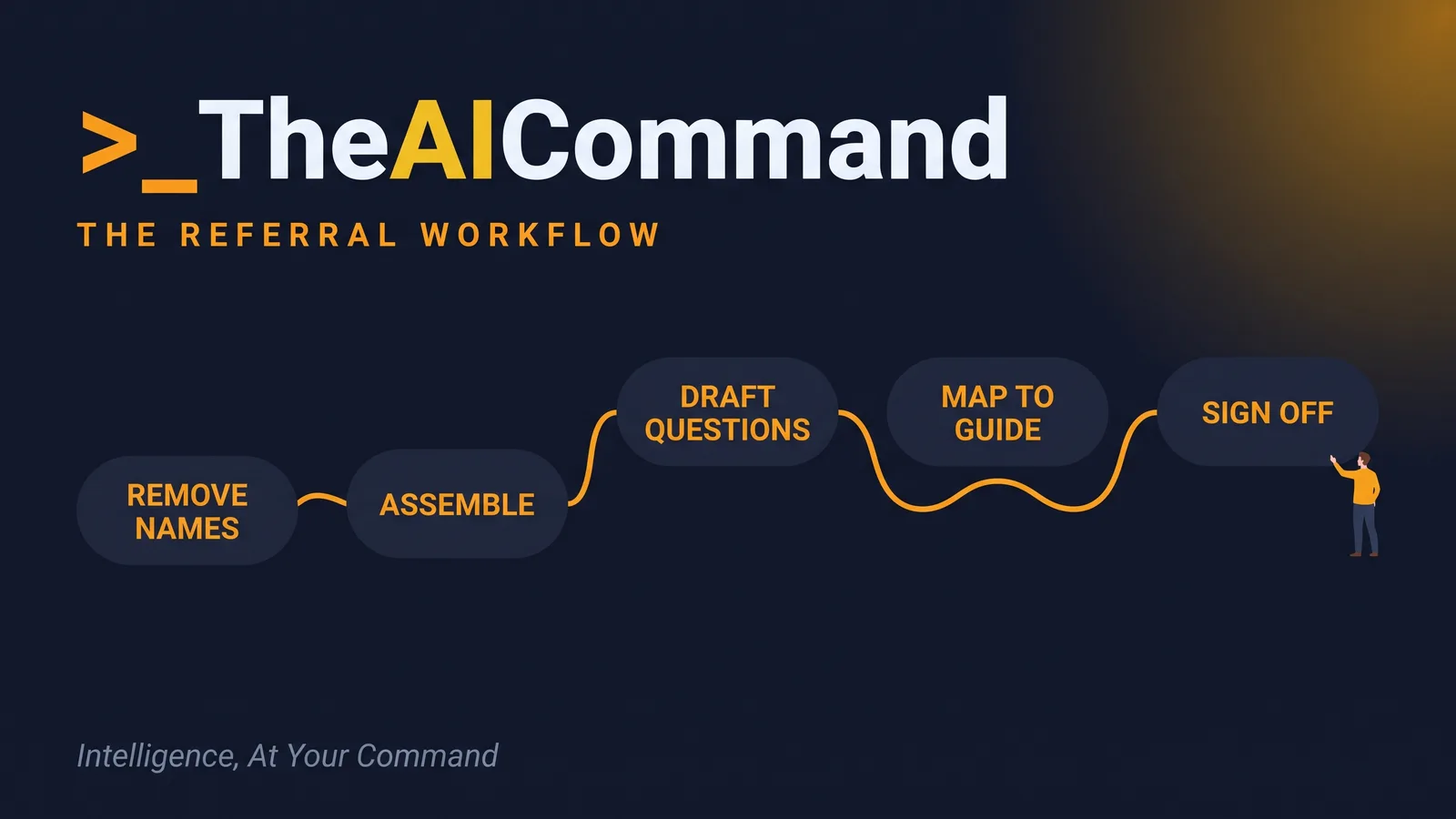
- De-identify the file first. Before any material goes near an AI tool, strip the identifiers. Replace names, claim numbers and dates of birth with placeholders such as [CLAIMANT_NAME], [CLAIM_NUMBER] and [DATE_OF_INJURY]. De-identification is not a nice-to-have step here, it is the condition on which everything downstream is allowed to happen.
- Assemble the referral brief. Ask the tool to pull the de-identified file into a structured brief: the accepted condition, the treatment and rehabilitation history, the current clinical question, and the specific reason an examination is being considered now. The output is a first draft that saves the case manager assembling it from scratch, not a decision that one is warranted.
- Draft the examination question set. Have the tool draft the questions for the examiner from the clinical issue, keeping them relevant, specific and neutral. Then the case manager checks every question. Leading questions, questions that stray beyond the accepted condition, and questions that invite an opinion on liability rather than a clinical matter all get cut. The model drafts, the delegate curates.
- Produce a Guide-aligned decision record. This is the step the amendments make matter most. Ask the tool to lay the draft decision out against the Guide's considerations: why the information already held is insufficient without an examination, what treating-practitioner information was relied on, what the employee's circumstances are, and how the employee's views on the choice of examiner were sought and taken into account. The record is structured to the Guide so a reviewer can follow the reasoning.
- Human sign-off is the decision. The case manager reads the assembled brief, completes and corrects the decision record, forms the judgement on whether to require the examination, chooses the examiner, and signs. The determination, notified in writing with reasons under section 61, is a human act. The AI never made it.
Where AI helps, and where judgement is non-negotiable
AI helps with volume, structure and consistency. It assembles a brief faster than a person can, drafts a first question set, and produces a decision record laid out to the Guide so nothing is quietly left out. Across a caseload, that lifts the floor on quality and makes the good referral repeatable.
What AI cannot do is exercise the judgement the section 57 decision requires. It cannot decide that an examination is warranted in a particular case, because that is a determination the relevant authority must make. It cannot weigh a specific employee's personal circumstances, which the Guide requires and which are, by definition, about a real person the model does not know. It cannot choose the examiner while genuinely taking the employee's views into account. And it must not be allowed to shape a decision that carries a suspension consequence, since section 57 provides that an employee who refuses or fails without reasonable excuse to undergo the examination has their compensation rights suspended until it takes place.
The reasonableness of any excuse, and whether an examination should be required at all, are human calls with a legal edge. The scheme even bounds the mechanics: under the Guide an employee generally cannot be required to undergo examinations more frequently than at six-month intervals, except in specified circumstances, so timing and necessity are judgements a delegate has to make, not settings a model optimises. A decision with that weight, and a right of review attached, belongs to a person who can explain it. Every AI output in this workflow is a draft a human checks before it is used, and the determination itself is never automated. This is the human-in-the-loop line, and on a section 57 referral it is not a courtesy to the reader, it is where the lawful authority to decide actually sits.
A worked example
Take a de-identified matter. [CLAIMANT_NAME] has an accepted claim for [CONDITION] with a date of injury of [DATE_OF_INJURY], claim number [CLAIM_NUMBER]. Treatment has plateaued and the treating practitioner's most recent report leaves an open question about current capacity. The case manager is considering a section 57 examination.
Working on the de-identified file, the tool assembles a brief that pulls together the accepted condition, the treatment history and the specific clinical question, and drafts a question set for a suitably qualified examiner. It then produces a decision record structured to the Guide, with prompts for why the information already held is insufficient without an examination, the treating-practitioner information relied on, the employee's circumstances, and how the employee's views on the examiner were sought.
The case manager does the part that is theirs. They read the treating practitioner's report themselves rather than relying on the summary, decide whether an examination is genuinely necessary or whether the treating information will do, strike two questions that strayed toward liability, record the employee's stated preference on the examiner, and complete the reasons. Then they sign the determination.
If that decision is later reconsidered or reviewed by the Administrative Review Tribunal, the record shows a delegate who considered the treating evidence, turned their mind to necessity and to the employee's circumstances, and gave reasons. That is what a Guide-aligned record is for. The AI made the referral faster to prepare and harder to under-document. It did not decide that [CLAIMANT_NAME] should be examined. That is the whole design.
Do this Monday
- Write the de-identification step into the workflow. If your team uses any AI tool on claims material, confirm the file is de-identified before it goes in, with placeholders standing in for every identifier. If that step is not written down, write it down today.
- Turn the Guide into your decision-record template. Build the section 57 decision record around the Guide's considerations so the reasoning is captured by design, not remembered after the fact.
- Audit one recent referral for questions. Pull a recent examination question set and check it for leading or liability-flavoured questions. That is the review body's first line of attack, and the easiest thing to fix.
- Name who signs. Confirm the determination is made and signed by a delegate who can explain the reasons, and that the AI's role is preparation only, on the record.
The amendments did not make AI riskier in claims work. They made the referral matter more, and a well-structured, Guide-aligned, de-identified preparation step is precisely where AI earns its place. It builds the referral. A person still makes the call, and on a section 57 decision that is not a nicety, it is the law.
Bottom line
Requiring an injured employee to attend a medical examination is no longer routine middle-of-the-file work. It is a reviewable determination, it has to be notified in writing with the terms and the reasons, and it has to comply with a mandatory Guide built around ethical, transparent and accountable decision making. That turns the referral paperwork into the substance rather than the admin around it. AI suits the preparation exactly: work on a de-identified file, assemble the brief, draft a neutral and relevant question set, and lay the draft decision out against the Guide's considerations so nothing is quietly left out. What it cannot do is judge whether the examination is necessary once the treating information has been exhausted, weigh a specific employee's personal circumstances, or genuinely take that employee's views on the examiner into account. Those judgements are about a real person, they carry a suspension consequence and a right of review, and they belong to the delegate who signs and can explain them.
Content disclaimer: This article is for general educational purposes only and does not constitute legal advice, liability determination guidance, or a substitute for professional judgement. Workers compensation decisions must be made by appropriately qualified and authorised persons under the Safety, Rehabilitation and Compensation Act 1988. All AI outputs described in this article require human review before use in any claims management context.
Primary sources
- Safety, Rehabilitation and Compensation Act 1988 (Cth), s 57 (power to require medical examination), s 57A (Guide for Arranging Rehabilitation Assessments and Requiring Examinations), s 36 (assessment of capability of undertaking rehabilitation program), s 60 (definition of determination) and s 61 (determinations to be notified in writing). Compilation No. 82, C2026C00285. https://www.legislation.gov.au/C2004A03668
- Comcare, Amendments to the SRC Act and SRC Regulations (section 57 examination requests reviewable from 14 June 2024). https://www.comcare.gov.au/scheme-legislation/src-act/amendments
- Comcare, New Guide for Arranging Rehabilitation Assessments and Requiring Examinations (commences 18 September 2024, applies to section 36 and section 57 determinations made on or after 30 October 2024). https://www.comcare.gov.au/about/news-events/news/guide-assessments-examinations
- Commonwealth Ombudsman, Actions Speak Volume 12, Improving Comcare's decision-making framework for medical examinations and complaint handling, April 2026. https://www.ombudsman.gov.au
TheAICommand. Intelligence, At Your Command.