Review of an SRC Act determination runs through three tiers: internal reconsideration, then the Administrative Review Tribunal, then a Federal Court appeal on a question of law. The review pathway changed in October 2024. The map matters more than ever.
Context for general readers: When a determination is made under the Safety, Rehabilitation and Compensation Act 1988 (SRC Act) - about whether an injury is compensable, how much compensation is payable, what rehabilitation is appropriate - the affected party (claimant or employer) can challenge that determination through a structured review process. On 14 October 2024 the Administrative Appeals Tribunal (AAT) was replaced by the Administrative Review Tribunal (ART) under the Administrative Review Tribunal Act 2024. The substantive review rights under the SRC Act did not change, but the forum, the procedural framework, and some of the supporting practice directions did. This article is a practitioner's map of the three review tiers as they operate now, with an explicit section on how AI-influenced determinations are being treated in evidence.
This piece is written for case managers, claims and compliance officers, and practitioners advising claimants or employers. It assumes familiarity with the SRC Act and Comcare scheme operations.
What are the three review tiers under the SRC Act?
Workers compensation review under the SRC Act sits in three tiers. Each tier serves a different purpose. The order matters.
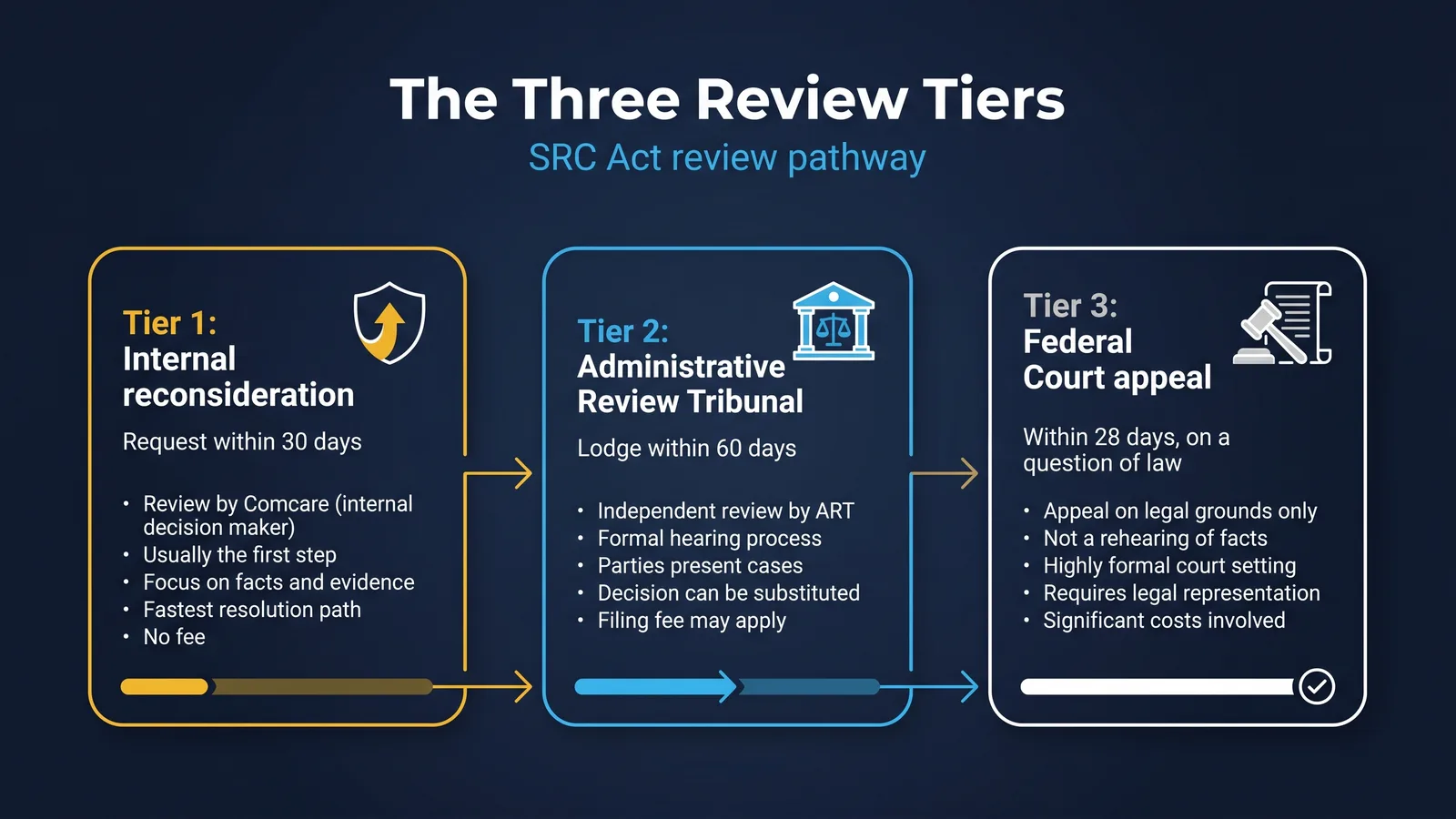
Tier 1: Internal reconsideration (s 62 SRC Act)
The first review of any primary determination is internal. A claimant or employer who disagrees with a determination can request that the determining authority reconsider it. The Comcare reconsideration guidance sets out the process.
Key features:
- Who reconsiders. Section 62 requires the reconsideration to be carried out by a reconsideration officer who was not involved in making the primary determination. This is a procedural fairness requirement, not a courtesy.
- Timeframes. A request for reconsideration of a primary determination should generally be made within 30 days of the determination being notified (section 62(3), as at 20 September 2026). The determining authority can extend this period in certain circumstances. Reconsideration of an own-motion reconsideration is also possible in narrow circumstances.
- What the reconsideration officer can do. The reconsideration officer can affirm, vary, or revoke the primary determination. The reconsideration produces a "reviewable decision" - the artefact that triggers the next review tier.
- What the reconsideration officer must do. The reconsideration must be on the merits, not just a check on procedure. The Comcare best-practice decision making guidance sets out the standard.
Reconsideration is the gateway for the great majority of determinations. ART review of a primary determination requires a reconsideration first, and going straight from a primary determination to the ART is procedurally not available. There is one narrow statutory exception: where a rehabilitation determination under section 36 or 37 is made by a rehabilitation authority that is not the "relevant authority" (typically the employing agency, rather than Comcare or a self-insured licensee), the review pathway runs through Comcare under section 38, not reconsideration under section 62. Comcare's decision on that section 38 review is itself a "reviewable decision" and proceeds directly to the ART. A reconsideration request works best as an issue map tied to each disputed element, not a prediction of the outcome, and a service complaint is not the same thing as a reconsideration request even where AI is used to route the correspondence.
Tier 2: Administrative Review Tribunal (s 64 SRC Act)
A reviewable decision (the output of reconsideration) can be reviewed by the Administrative Review Tribunal. The ART replaced the AAT on 14 October 2024 under the Administrative Review Tribunal Act 2024. The substantive merits review function is preserved; the procedural framework is updated.
Key features:
- Who decides. The ART conducts an independent merits review. The decision-maker is the Tribunal, exercising the powers under section 54 of the ART Act 2024 (per the Comcare scheme guidance) to review the reviewable decision.
- Timeframes. An application to the ART for review of a reviewable decision under the SRC Act must generally be made within 60 days of the reviewable decision being received (this SRC-specific period is set by section 65(4), which modifies the ART Act's general timing rule; as at 20 September 2026). Like the reconsideration timeframe, extensions are possible in narrow circumstances but should not be assumed. AI can hold the clock and the freeze calculations; the determination itself still sits with the delegate.
- What the ART can do. Affirm the reviewable decision, vary it, set it aside and substitute the Tribunal's decision, or set it aside and remit the matter to the determining authority for reconsideration in accordance with the Tribunal's directions. There are some limits on substitution (notably for certain rehabilitation decisions).
- Procedure. The ART operates under updated practice directions. Hearings can be conducted on the papers in straightforward matters, with oral hearings available. Pre-hearing case management is more structured than under the AAT. The ART workers compensation page sets out the practical steps.
Tier 3: Federal Court appeal (s 172 ART Act 2024)
A decision of the ART can be appealed to the Federal Court of Australia. The appeal is on a question of law - not a fresh merits review.
Key features:
- What can be appealed. A "question of law" arising from the ART's decision, under section 172 of the ART Act. This is narrower than it sounds. Errors in the application of legal tests, misconstructions of statutory provisions, denials of natural justice, and failures to provide adequate reasons can all ground a question of law. Disagreements about the weight given to evidence generally cannot.
- Timeframes. An appeal must generally be lodged within 28 days of the party being given the ART's statement of reasons for the decision, under section 174 (subject to extension by the Federal Court in narrow circumstances; as at 20 September 2026).
- Outcome. The Federal Court can dismiss the appeal, set aside the ART decision, or remit the matter to the ART. The Federal Court does not generally substitute its own decision on the merits.
For most workers compensation matters, the practical review pathway ends at the ART. Federal Court appeals are uncommon and reserved for matters where the ART has arguably erred on a question of law.
A worked scenario
[CLAIMANT_NAME] was determined to have ceased to be incapacitated for work as at [DATE], with weekly payments suspended from that date. The case manager relied on a [REPORT_TYPE] from a treating practitioner and a workplace functional capacity report. Internal AI-assisted document review summarised the medical evidence and flagged the inconsistency between the treating practitioner's view and the functional capacity report. The case manager made the determination on the evidence, acknowledged the AI-assisted summary in the file note, and recorded the reasoning that resolved the inconsistency.
[CLAIMANT_NAME] requests reconsideration. A different officer reviews the file. The reconsideration officer reaches the same conclusion on different reasoning, taking specific account of the AI-assisted summary's role in the original determination. The reviewable decision is notified.
[CLAIMANT_NAME] applies to the ART. At the case management hearing, the scheme is asked to file an evidence pack that includes the AI-assisted summary, the file notes, and the reconsideration reasons. The ART reviews the matter on the merits and affirms the reviewable decision, noting in its reasons that the AI's role was appropriately documented and that the determination was made by the case manager on the evidence, not by the AI.
The pattern in this scenario - AI in the analysis, human in the decision, documented in the reasoning trail - is the pattern that survives external review. A companion case note on reading the reasoning trail of an AI-drafted determination works through the same dynamic. Schemes that cannot produce this evidence trail are exposed.
What role is AI playing in your evidence base?
A separate but increasingly relevant question: what role is AI playing in the evidence and reasoning that the ART sees? Three considerations practitioners should be tracking.
1. AI-assisted analysis in the determination
Where the original determination relied on AI-assisted summary, draft, or pattern analysis, the file note should record the role the AI played, the same accountability approach set out in the practitioner framework for AI-assisted SRC Act determinations. The reconsideration reasons should engage with that role, not pretend the AI was not involved. The ART's evidence pack should include the AI-assisted artefacts that fed into the determination, and where those artefacts include expert or medical evidence, the disclosure obligation is now explicit.
The risk position: a determination that was AI-influenced but presented to the ART as if it was not, where the AI's contribution surfaces in cross-examination or document discovery, creates a credibility problem. The pattern is to disclose, document, and defend the AI's role honestly.
2. AI in the claimant's evidence
Claimants and their representatives are using AI tools too - to review files, draft submissions, and identify relevant precedent. This is appropriate use of AI. As at 20 September 2026, the position has moved: on 20 August 2026 the ART President made the Administrative Review Tribunal (Use of Generative AI) Practice Direction 2026, made under section 36(1) of the ART Act. It applies to all persons involved in a proceeding, including parties, their representatives, and witnesses, and it sets out when a person must disclose that generative AI was used, be able to explain how it was used and how the output was checked, and independently verify AI-assisted material before relying on it. It specifically warns that generative AI can produce fictitious citations, quotes, and legal sources, and that presenting false or inaccurate material to the Tribunal is unacceptable regardless of whether AI was involved in producing it.
The risk position: AI-drafted submissions can contain hallucinated case citations or misstated precedent. Schemes responding to claimant submissions should verify cited authorities against the primary source, and should expect the Tribunal to require disclosure, explanation, or certification of AI use where it considers it appropriate. This is increasingly a routine part of submission review.
3. AI tools used by the ART itself
The ART has not, at the time of writing, published guidance on its own use of AI in decision-making or registry functions. This gap is confirmed rather than closed by the new Generative AI Practice Direction: that Practice Direction expressly states it "does not apply to the use of Generative AI in the internal administration of the Tribunal" (as at 20 September 2026). Practitioners should monitor for any guidance that issues on internal Tribunal use, particularly around AI-assisted summarisation of evidence packs. Where AI is used in the registry, that fact may itself be relevant to procedural fairness analysis.
When should you seek review of a determination?
For practitioners advising on whether to seek review of a determination, a simple workflow.
Step 1: Read the determination and the reasoning behind it
Often the strongest signal about whether review is worthwhile sits in the reasoning. A clearly reasoned determination on contested evidence is harder to displace than a poorly reasoned determination on similar facts.
Step 2: Identify the specific element of the determination in dispute
Liability under section 14, calculation of NWE under section 8, arranging rehabilitation assessments/examinations under section 36, rehabilitation pathway. The review tier and the available outcomes depend on the element.
Step 3: Assess the evidence base
What evidence sat behind the determination, what evidence has changed, what evidence was missed. A reconsideration request that brings new material evidence to the table is materially stronger than a request that re-argues the same evidence.
Step 4: Consider the AI-evidence dimension
Where AI was part of the original determination, was the AI's role documented? Was the human accountability clear? If yes, the AI evidence is unlikely to be the path to a different outcome. If no, that is potentially a procedural fairness issue worth raising.
Step 5: Mind the clock
30 days for reconsideration. 60 days for lodgement of ART review. 28 days for Federal Court appeal. Extensions are available in limited circumstances and should not be relied upon.
What to never do
Do not: Skip the reconsideration step in an attempt to go straight to the ART (procedurally not available for review of primary determinations). Lodge an ART application without an evidence pack that addresses the original determination's reasoning. Allow the ART hearing to be the first time the AI's role in the determination is mentioned. Misstate the timeframes - the statutory timeframes are firm, and being a few days late is fatal in the absence of extension.
Governance checklist
- Reconsideration officers have been trained on AI-evidence considerations
- An evidence pack template exists for matters heading to the ART that includes the AI's role where relevant
- Scheme submissions to the ART explicitly address the explainability of AI-influenced determinations where the issue arises
- ART outcomes are tracked against initial determinations to surface systematic issues
- Practice direction updates from the ART are reviewed quarterly for any AI-relevant changes
Direction of travel
The AAT-to-ART transition was procedural rather than substantive in workers compensation matters. The merits review function continues. The procedural framework is being settled through ART practice directions, and a body of post-AAT case law is forming that will tell practitioners how the ART approaches familiar issues differently from the AAT.
For AI specifically, the ART has not yet been the forum for any body of jurisprudence on AI-assisted determinations. That body is forming. Schemes that have been documenting the AI's role from the start will be in a much stronger position when the first matters with material AI evidence reach the Tribunal. Schemes that have not been documenting will be reconstructing under deadline.
The work this quarter is the evidence trail. Reconsideration officers and case managers should be capturing the AI's role in determinations now, in the file notes, the reasons, and the supporting evidence. The cost is small. The value, when the matter reaches the ART, is substantial.
Bottom line
Review of an SRC Act determination runs through three tiers, and reconsideration is the mandatory gateway before the ART. The timeframes are firm, and the evidence trail, including any AI role in the determination, is what survives external review. Schemes that document the AI's role from the start are in a stronger position when a matter reaches the Tribunal.
Do this Monday:
- Confirm which review tier applies and what outcomes it can deliver before advising on a determination.
- Diarise the timeframes: 30 days for reconsideration, 60 days for lodgement of an ART review, 28 days for a Federal Court appeal.
- Check that the reconsideration officer was not involved in the primary determination.
- For any matter that could reach the ART, build an evidence pack that records the AI's role where relevant.
- Verify any authorities cited in claimant submissions against the primary source.
Content disclaimer: This article is for general educational and informational purposes only. It does not constitute legal, compliance, or professional advice. The SRC Act 1988 and the ART Act 2024 should always be consulted directly. Practitioners should refer to current Comcare scheme guidance and ART practice directions, and seek legal advice where required. Nothing in this article constitutes a formal determination, interpretation of law, or substitute for advice on a specific matter.
TheAICommand. Intelligence, At Your Command.